Author: Math Expert

  • X to the Power of Huh? Or, How Math Anxiety Almost Ruined My Life

    X to the Power of Huh? Or, How Math Anxiety Almost Ruined My Life

    I’m betting that many of you dear readers will identify with today’s guest post from Lisa Tabachnick Hotta. Math anxiety may still dog some of us, but it doesn’t have to ruin our lives. Read my guest post on her blog here.

    “Miss Tabachnick,” exclaimed my grade 8 math teacher.  “Please come up to the board and demonstrate how you obtained the answer to that equation; I’m sure the entire class will benefit from your explanation.”

    Sweat trickled its way from my brow to my toes. Show the class? Now? At the chalk board? Somehow I must’ve squeaked out the answer because I did graduate – from grade 8, then from high school and ultimately obtained two university degrees. (My majors, of course, had absolutely nothing to do with math!)

    Anxiety in all its sweaty glory – shaky hands, racing pulse, nausea – is pretty much the story of my life when it comes to math. Of course I’m rarely at a chalk (or smart) board deciphering mathematical problems these days as a writer, community volunteer and parent. But, you will often find me deep in “grownup” math conundrums.  Here are but a few examples:

    • Recently I was out for dinner with the girls and we were splitting the check. “Anne, you’re the accountant, you can figure out what we all owe,” I half-joked to one member of our group. She wasn’t amused. (Maybe it’s like the doctor who’s always getting asked for health tips at parties?) Her reluctance to assist me meant having to figure out not only what my drink, dinner and dessert cost but also my portion of the tax and tip – not at all easy for someone who’s math challenged!
    • My son who is (miraculously) gifted in math, asked me fairly simple questions in the car as a kind of numbers game: What’s 2 + 2, What’s 4 + 4, What’s 8 + 8, What’s 16 + 16, etc. Now, the first few questions? No problemo. But, as the numbers and queries got larger, I had to think harder to come up with the answers and, yes, that in turn increased my anxiety level.
    • Just today my kids and I were at a medical appointment. The administrator explained that receiving a response from the government to our query could take up to 30 weeks. I laughed along with the other adults who joked about government inefficiencies but, somewhere in my mind, I was still trying to figure out how many months equalled 30 weeks.

    All joking aside, being mathematically challenged has caused me enormous stress. From hiring tutors throughout middle and high school, to being told (by that same grade 8 math teacher) that I’d never amount to anything because my math skills were so poor, to ensuring that I am charging clients appropriate rates on invoices – I’ll be forever haunted by issues around math.

    So, how do I cope as a math-phobic adult? Luckily, I’ve learned to lean on my strengths – writing, communications and art. I also lean on calculators! Have you heard the expression, “fake it ‘til you make it”? I’ve also employed that strategy more than once. And, I’ve found that humor works well – I’ll just admit outright that math isn’t my forte and, while I’d be happy to volunteer as project manager or group leader, appointing me treasurer really isn’t the best idea.

    Lisa Tabachnick Hotta is a professional writer, editor, social media expert and researcher who lives just north of Toronto, Ontario. Lisa specializes on topics related to health, mental health, family, the arts and society. Check out her blog: KidsAndMentalHealth.com.

    What are your childhood memories of math anxiety? How does math anxiety influence your life now? How have you learned to get around it?


  • September: Back to School

    September: Back to School

    Got your sharpened No. 2 pencils? Graph paper? Protractors? It is definitely back-to-school time. Whether your little genius attends public or private school or learns at home with you, as a parent you can look forward to afternoons at the kitchen table talking about multiplication tables, coordinate geometry and trigonometry.

    Maybe this thought scares you a little. Maybe you are worried that you won’t be able to help your kid when she’s confused. Maybe you hate the way she’s taught math. Those are all great reasons to focus on math education this month. Throughout September, I’ll bring you posts that help boost your confidence and even understand the math your kid is doing. I’ll have guest posts about math anxiety— a huge problem for lots of kids (and adults) — and I’ll continue bringing you Math at Work Mondayinterviews, from people with cool jobs that your kids want to have.

    Have questions that you want to see addressed this month? Ask them in the comments section or send us an email. I’ll track down the answers, so that you can feel good about the math your kid is learning and your role in that process.

    To start off, let’s revisit some of the most popular Math for Grownups posts of all time. In this short series, I asked teachers, parents and kids what they wanted from each other when it comes to math education. And boy howdy, did they tell me! See if you recognize yourself in any of these lists.

    Five Things Math Teachers Wish Parents Knew

    Ten Things Students Wish Math Teachers Knew

    Ten Things Parents Wish Math Teachers Knew

    So what are you waiting for? Ask your questions in the comments section. Let’s get back to school!

  • Math at Work Monday: Labor Day 2012 Edition

    Math at Work Monday: Labor Day 2012 Edition

    It’s been a rough year for the U.S. economy and workforce. No matter what your political stripe, there’s no sugar coating the numbers: unemployment is still high and people around the country are struggling. In honor of Labor Day, we’ll look at the numbers behind this news.

    Once a month, the Bureau of Labor and Statistics releases its employment data, and here are some interesting numbers from July 2012. (August 2012 data will be released on September 7, 2012.) Remember, this is just raw data. The numbers are important, but they can’t really tell the story behind the country’s (or a portion of the population’s) economic and employment situation. People will interpret this information differently, based on their ideologies and personal philosophies. (Politicians will interpret this data based on who they want to attract to the voting booth.)

    155.013 million: The number of people in the workforce (16 years and older).

    47.8: Percent of women in private workforce

    82.6: Percent of women in total production and non-supervisory positions.

    34.5: Average weekly hours worked for all employees.

    33.7: Average weekly hours worked for all production and non-supervisory positions.

    $23.52: The average hourly earnings for all employees.

    $19.77: The average hourly earnings for all employees in production and non-supervisory positions.

    11.472 million: Number of people in the workforce with less than a high school diploma or equivalent.

    37.047 million: Number of people in the workforce with a high school diploma or equivalent.

    37.398 million: Number of people in the workforce with some college or an associates degree.

    47.697 million: Number of people in the workforce with a bachelor’s degree or higher.

    9.616 million: Number of self-employed workers (including agriculture workers).

    8.246 million: Number of people who are working part time (one to 34 hours a week), for economic reasons.

    6.9: Unemployment rate* for all veterans.

    8.9: Unemployment rate for all Gulf War II-era veterans.

    12.4: Unemployment rate for all Gulf War II-Era veterans in the previous month (June 2012).

    8.3: Unemployment rate for all non-veterans (18 years and older).

    18.866 million: Number of people who are working part time (one to 34 hours a week), for other reasons (including childcare problems, school, training or family or personal reasons).

    2.711: Number of people who have been unemployed for less than 5 weeks.

    3.092 million: Number of people who have been unemployed for 5 to 14 weeks.

    6.945 million: Number of people who have been unemployed for more than 15 weeks.

    38.8: Average duration of unemployment in weeks.

    *The unemployment rate is the percentage of the workforce that is unemployed at any given date.

    Based on these numbers, what do you think about the current economy? What kinds of questions do these numbers raise? Are there other numbers that you would like to see? How does this data inform you as a voter? (Don’t worry, we won’t get into big political discussions here. I promise.)

  • Four Sneaky (And Fun) Math Resources

    Four Sneaky (And Fun) Math Resources

    For most of us, summer has wound down and school is either in session or just around the corner. The time for preventing summer brain drain is over. But you can continue to reinforce math skills with your kids (and even yourself!) no matter what time of year it is. Here are some really neat games, puzzles and books that help:

    Rush Hour

    As the video below shows, this game looks like it’s for little kids — but it’s not! I became obsessed with Rush Hour a few years ago, and I periodically bring it out to give myself a challenge. Additional cards can be purchased in expansion packages. Kids (and parents) can play alone or challenge one another to see who can get out of the traffic jam quickest! (Ages 8 years old and up, $19.99, ThinkFun)

    https://www.youtube.com/watch?v=-0RpbCZANto

    Sudoku

    If you’ve ever done one of these puzzles, you know that Sudoku doesn’t have much to do with everyday math. But they do reinforce pattern-identification skills, which is critical for basic math skills. These puzzles aren’t limited to numbers, either. For little kids (Kindergarten through first grade), try picture-based Sudoku. Or use a number Sudoku to help your child remember or learn his numbers.

    Connect the Dots

    For really little kids, this perennial favorite is a great way to reinforce counting numbers. But these puzzles aren’t just for tiny brains. Look for options that count by 2s or 10s or even consecutive prime numbers. Check out Monkeying Around for much more challenging designs.

    Set Game

    This is an oldie, but a goodie. The idea is to identify a “set” of three cards (from an array of 12 cards), based on four characteristics: color, shape, shading and number. It takes a while to get hang of this, but once players see the similarities and differences in the cards, the game can get really fast. Check out other games made by SET Enterprises. (Ages 8 years old and up, $12.99, SET Enterprises)

    https://www.youtube.com/watch?v=bMhJmrJVP4Q

    Books by Greg Tang  (Bonus suggestion, which wasn’t a bonus until a kind commenter pointed out that I didn’t count accurately. Oy.)

    Featuring an intuitive approach to learning and understanding math, Greg Tang‘s books aren’t contrived stories that have a math lesson. Each page is chock full of problem-solving skills that encourage kids to discover new connections in math. New York Times Bestseller, Grapes of Math centers around a series of math riddles that delve deep into kids understandings of grouping and creative addition processes. His website was just amped up with cool online games, too.

    Do you have a favorite game or book that sneaks in some math? Share it in the comments section!

  • Math at Work Monday: Tiffany the math teacher

    Today is the first day of school here, so I decided to repost this Math at Work Monday interview with Tiffany Choice, a middle school math teacher in Fairfax, Virginia. You might be a little surprised by how she uses math in her work!

    I know what you’re thinking. “It’s so obvious how a 6th grade teacher would use math! She’s teaching fractions and division and percents!”

    There’s always a lot more to teaching than the rest of us may think. And that’s why I asked Tiffany Choice to answer today’s Math at Work Monday questions.  Ms. Choice was my daughter’s 4th grade teacher, and she’s the best elementary math teacher I’ve ever met.  She truly made the math fun, and she really got into her lessons.  I know this for sure, because I had the pleasure of subbing for Ms. Choice while she was on maternity leave.  Let me tell you, those kids loved her — and so do I!

    Last year, Ms. Choice moved to Fairfax County, Virginia.  She’s getting ready to start teaching 6th grade there.  In honor of what was supposed to be our first day of school — until Hurricane Irene changed our plans! — here’s how she uses math in her classroom.

    Can you explain what you do for a living? I teach state-mandated curriculum to students. My job also includes communicating to parents progress and/or concerns, appropriately assessing my students, and analyzing data to drive my instruction and lessons.

    When do you use basic math in your job?  I use math all the time — mostly basic addition, subtraction, multiplication and division. When I plan lessons, I need to appropriately plan for activities that will last a certain length of time. Then, when I am teaching the lessons, I am watching the clock and using timers to keep my lessons moving or calculating elapsed time.

    I also use math to grade assignments and calculate grades. I break a student’s grade into 4 categories; participation, homework, classwork, test/projects. Each category has a different weight. Participation and homework are each 10 percent, while classwork and test/projects are each 40 percent. Then for each grading period, I average grades and take the appropriate percentage to get the overall grade.

    I also use math to analyze data and drive my instruction. After quarter assessments or chapter tests are given, I look for trends. Which questions did the majority of students get incorrect? If I notice out of 60 students only 30% of them got a certain question correct this says to me that most of them (42 to be exact) got the question wrong. I need to figure out why and go back.

    I will also use math to group my students for games and activities. When I originally plan for them I always assume all students will be present. However, with absences and such I have to use last-minute division to regroup them.  I move desks around into different groups periodically during the year, and that requires division as well.[pullquote]It’s completely normal to feel anxious or nervous about math. But a great teacher at any level (primary to college) will help you “get it.”  Just don’t give up.[/pullquote]

    When I plan for field trips, I have to calculate the total cost for each student depending on the fees involved. Then, I have to count large amounts money that has been collected to account for the correct amounts.

    Do you use any technology (like calculators or computers) to help with this math?  At my first teaching job, I had a computer program that calculated grades for me, but when I left and went to a new district I didn’t have that software, so I did grades all by hand using a calculator.

    How do you think math helps you do your job better? The whole point of my job is to get students to learn and become great thinkers. I wouldn’t be able to find or focus on areas of weakness if I wasn’t able to properly analyze data and comprehend what it really means to me.

    What kind of math did you take in high school?  Did you like it or feel like you were good at it? I only took algebra and geometry in high school. I was terrible at math in high school and didn’t enjoy it or “get it” until college. I started in a community college and I had to take two developmental math classes before I could take what was required. It was during those developmental courses I finally “got it” and began to actually enjoy it. Everything finally made sense.

    It’s completely normal to feel anxious or nervous about math. But a great teacher at any level (primary to college) will help you “get it.”  Just don’t give up.

    Did you have to learn new skills in order to do this math? The math I use to do my job is math that is taught up to the middle school level. I didn’t have to learn anything special.

    Thanks so much, Ms. Choice!  (I don’t think I can ever call her Tiffany!)  If you have questions for Ms. Choice, just ask them in the comments section.  She has agreed to come back to Math for Grownups to talk a bit about how parents can work with their kids’ math teachers, so stay tuned for more advice from her.  

  • Common Core Common Sense: Myths About the Standards, Part 4

    Common Core Common Sense: Myths About the Standards, Part 4

    In recent months, there’s been a tremendous amount of buzz regarding an educational change called Common Core. And a ton of that buzz perpetuates down-right false information. There’s so much to say about this that I’ve developed a five-part series debunking these myths — or outright lies, if you’re being cynical. This is the fourth in that series (read Myth 1Myth 2 and Myth 3), which will continue on Wednesdays throughout August and into September. Of course, I’ll be writing from a math perspective. Photo Credit: Watt_Dabney via Compfight cc

    Myth #4: The Standards Require More Testing

    Perhaps the most controversial aspect of the U.S. education system is standardized testing. And for good reason. There are a myriad of problems with these tests–from their links to private companies to their use as teacher evaluation tools.

    While I’ve said from the start that it’s not fair to judge the Common Core Standards based on their implementation in individual states, it’s also not fair to pretend that the standards and testing don’t go hand in hand. States aren’t abandoning standardized testing any time soon, so don’t hold your breath.

    But what we do know for certain that the adoption of Common Core Standards does not mean more testing–in the long run. In fact, there is no testing requirement inherent in the adoption of Common Core. None!

    However, as states move from previous standards to Common Core, there will be some changes in testing. First, student may take two sets of standardized tests–at first. In these situations, one test is the one aligned with the state’s previous standards. And students may take practice tests, based on the Common Core Standards. Usually this translates to more testing during one school year, with only one test score used for student placement or teacher and school evaluations.

    Because the Common Core Standards focus on critical thinking, Common Core-aligned tests will probably look a little different than the all-multiple choice tests that we’re all used to. Students are required to show their work and may even be asked to explain how they came to their answers. Here’s a two-part example, which corresponds with the third grade math standards:

    A. Fill in the blanks below to make a number sentence that represents the drawing:
    ________ x ________ = ________
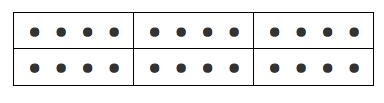
    B. Put the dots below into five equally sized groups and write an equation that represents the drawing.

    •  •  •  •  •  •  •  •  •  •  •  •  •  •  •  •  •  •  

    Answers:
    A. 4 x 6 = 24 or 6 x 4 = 24 or 8 x 3 = 24 or 3 x 8 = 24, etc.
    B.   •  •  •      •  •  •      •  •  •      •  •  •      •  •  •      •  •  • 
    3 x 5 = 15 or 5 x 3 = 15 or 15 ÷ 3 = 5 or 15 ÷ 5 = 3

    There’s something going in the above problems that’s difficult (or impossible) to measure with multiple choice questions. First, students are asked to draw as a way of problem solving. Second, there are multiple correct answers.

    (Psst. Want to test your third grade or fifth grade math skills? Take one of the Math for Grownups math quizzes. No one has to know your score. Promise!)

    So while Common Core does not eliminate testing or prevent test results from being used inappropriately, if the tests are well constructed–and dang, that’s a big if–students have a much better opportunity to demonstrate critical thinking and the open-ended nature of mathematics. That’s not more testing, that’s better testing.

    Got a question about the Common Core Standards for Mathematics? Please ask! Disagree with my assessment above? Share it! And if you missed Myth #1, Myth #2 or Myth #3, you can find the herehere and here.

  • Math at Work Monday: Samantha the Freelance Designer

    Math at Work Monday: Samantha the Freelance Designer

    I had the pleasure of speaking with Samantha Volz who has the pleasure of working from her very own home every day. That is one of the benefits of being a freelance designer. In addition to graphic design, this artist also does photography. It seems she is creatively blessed with talent.  I was curious about how she uses math in her work. Let’s take a look at what she had to say:

    Can you explain what you do for a living?

    I’ve been working as a freelance designer since 2001.  I design marketing/advertising material for companies. In addition, I also design websites and other support files for social media applications. I am a photographer, painter, and artist as well.

    When do you use basic math in your job?

    I have to use specifications to set up design files. Set up bleed, trim and safe zones so that when the file gets to the printer, it is set up correctly and prints correctly. For instance, if I have a print sheet that is 8.5 by 11 inches for a trifold brochure, I need to divide the paper by three and adjust 1/8th of the 3 panel. Depending on how the trifold folds, I will need to adjust the panels 1/16th of an inch if a panel folds in. Then, on the layout in the software I have to consider set up for a printing press or digital printing if my graphics bleed to the edge I have to add at least 1/8th to 1/4th of an inch of graphics that extends past the actual final layout for being trimmed down to allow for machine error. So my final file that is handed over to the print vendor is 8.5 x11 with bleed 1/8th bleed on all sides. Total graphic coverage is 8.75 x 11.25 trimmed down to 8.5 x 11 and scored for folds indicated on the set up with 3 panels roughly 3.66 ” wide, again depends on the fold design chosen for that tri-fold brochure how it will read, flow and open up to reveal the information being provided.

    Do you use any technology (like calculators or computers) to help with this math? Why or why not?

    Yes, I use a calculator a lot.

    How do you think math helps you do your job better?

    I could not do my job without it. It is how everything flows from the client to me, the designer, and then to the printer until it is produced as an end product.

    How comfortable with math do you feel? Does this math feel different to you?

    I am comfortable with normal addition, subtraction, division, multiplication, and fractions. Nothing too complicated.

    What kind of math did you take in high school? Did you like it/feel like you were good at it?

    I took honors math classes.

    Did you have to learn new skills in order to do the math you use in your job? Or was it something that you could pick up using the skills you learned in school?

    Yes, what I use now I learned in high school.

    Who knew that the creative type still need to know their basic calculations and fractions?  Seems like everywhere you go, even in your home, math is sure to follow. I hope you enjoyed learning a little more about Samantha. Let me know if you have any further questions for her. 

    Photo Credit: 55Laney69 via Compfight cc

  • The Arithmetic of Allowance

    The Arithmetic of Allowance

    I wrote the following post for Simply Budgeted last August. Given our topic this month, I thought I’d share it as a great example of how parents can extend learning outside the classroom. Enjoy!

    You probably find it pretty darned easy to encourage literacy.  In fact, there are countless magazine articles and books and workshops out there on this very subject.  And so all good parents read to their kids every night, play word games with them, give them magnetic letters for the fridge.

    But what about math?  If you’re like most parents, the idea of working math into the day probably seems down right daunting.  Scary even.

    It’s not as hard as you think, especially if you’re willing to give into your children’s demands for a regular allowance.  Money is an instant math lesson—and can motivate even the most reluctant student (adult or child).

    Here’s how:

    The Even Split: If you want to use allowance to encourage savings and charitable giving, you’re at least half way there.  One way to do this is to require kids to split their allowance into three equal accounts: spending, saving and giving.  If your five year old gets $3 per week, $1 goes in each pot.  But what about the kid who gets $6 a week?  Or worse, $10 a week?  Pose these questions, and let your child figure it out.

    The lesson: Factoring and division

    Percent, Per Week: For a more complex math problem, consider uneven distributions, say 20% spending, 20% giving and 60% saving.  Or encourage your child to put aside a certain percent of savings for a particular goal, like a new iPod.  Or enforce a different distribution around the holidays, when she buys gifts for her friends.  If she can’t do the math, she doesn’t get paid!

    The lesson: Percents

    Accounting for Savings: If you have a little investor on your hands—and some of us do—show him how to create a simple register for recording his savings and spending.  He’ll get a first-hand look at how his stash can grow (or shrink).

    The lesson: Addition and subtraction

    Project Savings: Your child will inevitably want something she can’t afford.  In that situation, help her figure out when she’ll have enough money in savings.  Can she wait that long?  If not, consider giving her a loan, with interest and a regular payment plan.  Show her how the interest is calculated and even help her figure out the total interest on the loan.

    The lesson: Using formulas and problem solving

    Math may be hard for you, but with a little bit of creativity allowance can help your kids practice their skills—and become a little more savvy with their own money.  Now all you have to do is remember your kids’ payday.

    How have you used allowance as an impromptu (or regular) math lesson? Share your stories in the comments section.Save

  • Math at Work Monday: Leah the firefighter

    Math at Work Monday: Leah the firefighter

    Leah Davis is tough as nails. She’s been a firefighter in North Carolina for 17 years. These days, she is a Captain EMT — intermediate. I had never really thought about the math required to fight fires, but reading through Leah’s responses, it all makes perfect sense. If your little guy or gal is interested in firefighting as a career, this interview is a must-read!

    Can you explain what you do for a living?

    I am a Captain on a fire engine. This means that I respond to and mitigate emergencies ranging from motor vehicle accidents, fires (all sorts), medical emergencies and rescues. In addition to providing emergency response, I complete preplans of existing businesses; the preplans are walk-through inspections that provide information about a building’s layout and any hazards that might be associated with the business. As a member of the fire service, I am responsible for participating and providing training in all aspects of the job.

    When do you use basic math in your job?

    Within the fire service, there are many opportunities to use math. The first one that comes to mind is calculating pump pressure to determine the PSI (pounds per square inch) on the end of a nozzle.  Basic math skills, like addition, subtraction, multiplication, and division, are necessary. A basic understanding of hydraulics and a good understanding of formula usage is vital.

    In order to calculate the amount of nozzle pressure is necessary, the engineer must find the friction loss of hose distance, along with appliances and elevation. Only then can the pump be set up properly. Engine pressure is the sum of the nozzle pressure plus the friction loss plus any elevation or devices. Based on the engine pressure formula EP = NP + FL, if we need a nozzle pressure of 100 psi to flow 100 GPM then the engine pressure needs to be greater then 100 psi.

    When determining how much water will be required for any given structure that is 100 percent involved in a fire, the fire engineer must calculate the area and divide by 3. This gives the gallons per minute required to extinguishing the fire.

    Math is also used when providing medical care. The division is used in calculating the correct dosage of medications to administer. Many medications are calculated milligrams per kilograms or mg/kg.

    Do you use any technology to help with this math?

    I use a calculator when finding the fire flow or GPM needed on the preplans.

    Technology is not usually used on the fire ground when calculating the engine pressure. The engineer needs to be well trained and able to calculate the engine pressure in their heads.

    How do you think math helps you do your job better?

    Having a math competency provides me with additional problem-solving skills. The fire service is about problem-solving.

    [laurabooks]

    How comfortable with math do you feel?

    Although I am not a math whiz by any means, I do feel relatively comfortable with math most of the time. The math that is used within the fire service–like the area of a structure, GPM needed, nozzle pressure, medication dosage–helps ensure the safety of firefighters and others.

    What kind of math did you take in high school?

    I did not take much math in high school because I did not like it and did not feel successful. However, in college, I was required to take remedial math courses and then was able to move on to taking more advanced classes, including calculus. I graduated from college with a good understanding of math and problem-solving. I also found that I enjoyed the problem-solving aspect of math.  Too bad I didn’t pay more attention when I was in high school.

    Did you have to learn new skills in order to do the math you use in your job?

    I was comfortable with my math skills when I entered the fire service.

    Do you, or your child, have math questions like the ones in this firefighting story? If so, buy the book that will help you with the math here. As for summer-slide activities, why not take your child to a fire station for a tour? While you’re there, ask about the math required on the job.

  • Math Mnemonics: How I Memorized My Daughter’s Cell Phone Number

    Math Mnemonics: How I Memorized My Daughter’s Cell Phone Number

    Until Wednesday, I didn’t know my daughter’s cell phone number. Yes, she’s had this number for a year. Yes, I’m lazy, choosing to depend on my own cell phone directory. And yes, memorization is not my best friend.

    But I should know my daughter’s cell phone, right? If I needed to reach her using someone else’s phone, I’d be up a creek.

    So I memorized it. And it was easy, and even a little fun. That’s because she and I both noticed a relationship between the last four digits in her cell phone number. Here, see if you notice it, too.

    1628

    See anything interesting in there? We did. First off, I noticed that 6 + 2 = 8. I crowed about that for a little bit, until my daughter asked how I was going to remember the 1. Suddenly, it hit me like a train. Duh.

    16 = 2 • 8

    Cool, huh? And you might even notice more interesting connections. (Share them in the comments section if you do.)

    My point is this: Simple math can help you remember important details, like your phone number or license plate or even Social Security Number. Whenever you need to memorize a number, look at the math.

    Here are a couple of additional examples. Do you notice any patterns?

    491-625

    1587

    These connections can also be geometric — for the more visual of us. Consider this house number: 2684. Ring any bells? If not, picture the touch pad of a telephone? Now do you get it? (When you press the numbers in order, you create a diamond.)

    Believe it or not, these little tricks are great ways to keep your budding Einstein’s math brain humming over the summer months. You can even play road-trip games just by noticing patterns.

    So share your mathematical mnemonic tricks in the comments section. How has simple arithmetic or geometry helped you remember a number? I’ll bet every one of you has a story to tell.

    What patterns do you notice in 491-625 and 1587? Share in the comments section.

  • Let the Boys of Summer Review Math with Your Kid

    Let the Boys of Summer Review Math with Your Kid

    The first professional baseball game I attended was at Tiger Park. I don’t remember who Detroit was playing that night, but I do remember the score card and tiny golf pencil I was given. I wasn’t (and still am not) a baseball fan, but I did love keeping track of the runs and outs on my score card.

    That was also my introduction to the role that math plays in baseball. On Monday, Charlie Vascellaroexplained this in his Math at Work Monday interview. Between a player’s batting average and games back, this math helps fans (and team managers and sports writers) understand how well players and teams are performing.

    If your kid is a baseball nut, this could be just the thing that can help keep skills sharp over the summer months. Instead of simply reading about these stats, how about teaching your kids to actually calculate them? Here’s how:

    Batting Average

    First up, ask your kid to tell you what he thinks a batting average is. What kind of math does he think will be involved?

    Yep, he ought to notice the word “average.” Kids learn to find an average — or mean — in elementary school. A child in fourth grade or older should be able to tell you that the process involves three things: counting, adding and dividing.

    A batting average is easy to find:

    number of hits ÷ number of official at-bats

    In other words, you’ll divide the total number of hits by the total number of times the player has (officially) been at bat. The answer is rounded to the nearest thousandth (or three places to the right of the decimal point. Easy peasy, right? Try it out.

    In the last seven days, Mike Trout of the Los Angeles Angels had 23 at bats and 6 hits. What’s his batting average?

    6 ÷ 23 = .261

    Follow up questions: What does the batting average mean? If someone has a low batting average, what can you say about his skills as a hitter? What does a high batting average mean? What happens to a player’s batting average, if over the season he gets more hits in each game? Could a player’s batting average be zero? Why or why not? Could a player have a batting average if he didn’t have any at-bats? Why or why not?

    Skills reviewed: division, decimals, rounding

    Earned Runs Average (ERA)

    In case you didn’t know — and I didn’t — an earned run is when a pitcher allows a batter to score. The earned runs average is the average number of times a pitcher allows runs in a game. Here’s the formula:

    (number of earned runs • 9) ÷ number of innings pitched

    Again, we’re dealing with an average, so it’s important to know that division is going to be involved. And if you look at that formula, you might notice another important concept: the order of operations. We’ve had quite a lively discussion about the order of operations or PEMDAS on the Math for Grownups facebook page.* In September, I’m going to demonstrate another way to remember what order is necessary for these operations. But for now, let’s just stick with Please Excuse My Dear Aunt Sally or Parentheses, Exponents, Multiplication, Division, Addition and Subtraction.

    Since the multiplication is in parentheses, do that operation first. Then divide. (Okay, so really you don’t need the parentheses at all, but it’s easier to write these problem online using them.)

    Here’s an example:

    In the last seven days, Jordan Zimmermann of the Washington Nationals has had 2 earned runs and pitched 11.7 innings. What is his ERA?

    (2 • 9) ÷ 11.7 = 1.54

    Follow up questions: What does a big ERA indicate? What about a small ERA? Can you explain why? If you did the division before the multiplication, would you get the same answer? Why or why not? Could the average ever be zero? Can a pitcher have an average if he didn’t pitch a single inning? Why or why not?

    Skills required: order of operations, multiplication, division

    There are many other baseball stats that require math, like baserunning average, fielding percentage, slugging percentage and games back.  In addition, you can take a look at a player’s stats over time and see how they’ve improved or declined. And of course, it’s interesting to compare the stats between players. If you’re unsure of the math, just google the terms!

    What are some other ways to use sports for math review? Share your experiences in the comments section.

    *Have you liked Math for Grownups on facebook yet? If not, what’s stopping you?

  • Math at Work Monday: Charlie the baseball writer

    Math at Work Monday: Charlie the baseball writer

    Anyone who knows anything about baseball knows that math plays a pretty big role. From how the pitcher releases the ball to the many stats that help rank the best players, the game depends on numbers. No one knows this better than Charlie Vascellaro. He’s been a freelance baseball (and travel) writer for 20 years. Here’s how he uses math in his work.

    Can you explain what you do for a living?

    I write baseball and travel feature stories for magazines, newspapers and web sites. A lot of my baseball writings are historical retrospective pieces that include statistical analysis and comparisons. In a recent story on this year’s National Baseball Hall of Fame inductee, Barry Larkin, I compared his batting statistics to those of other shortstops enshrined in the Hall of Fame. I also write spring training preview stories on major league baseball teams that rely heavily on statistical information used to explain each teams relative strengths and weaknesses and how they compare to other teams. I use this information to measure each teams’ relative prospects for the upcoming seasons. Last spring I wrote a feature story on current players chances of being elected to the Hall of Fame based on statistics produced so far and projections for the future (see excerpts below).

    Jered Weaver, 29, had what could be described as a breakout season in 2011, reaching a career best with 18 victories and a 2.41 ERA. In six seasons, Weaver has compiled an 82-47 record, for a very Hall-of-Fame-like .632 winning percentage with a 3.31 ERA.  The 300-victory-pitcher is fast becoming an endangered species, and consequently, not a necessary prerequisite for the Hall, but Weaver would still have to maintain his current pace, and actually improve upon it a bit, to merit consideration for Cooperstown; a 20-win season or two would certainly improve his chances. 

                Of the current White Sox players, slugging first baseman/DH Paul Konerko compares favorably with Hall of Famer Orlando Cepeda in similarity of scores posted on Baseball-Reference.com, and although he has not quite reached 400 home runs, (he’s currently at 396) he probably will this year. Konerko’s numbers are also similar to what Reggie Jackson’s were at the same age, and his .282 batting average is 20 points higher than Jackson’s .262 career mark. Jackson hit 39 home runs at age 36 and 99 home runs in his last 5 years on the field. Konerko hit 31 last year at age 35, and will probably end up pretty close to Jackson’s 563. In today’s age of inflated offense, Konerko’s eventual career statistics might be on the cusp of Hall-of-Fame-worthiness, but I like his chances. 

    When do you use basic math in your job?

    Oftentimes while I am writing a baseball story I will consult the www.baseballreference.com website to research statistical material. Sometimes I might have to tally up home-run and runs-batted-in totals and divide them by the number of years to decipher the average numbers per year.  I do a lot of multiplication and division to figure percentages. For example, a player’s batting average can be figured by dividing the number of hits by the number of at bats. Three hits out of 10 at-bats is 3 ÷ 10 or .300.

    Earned run average (ERA) is a measure of a pitcher’s relative effectiveness and is often referenced when writing about pitchers. Earned run average is the number of earned runs scored against a pitcher, divided by the number of innings pitched multiplied by nine (the number of innings in a regulation game). Earned runs are scored without the assistance of a fielding errors. ERA is represented with a number followed by a decimal and two percentage points explaining how many runs a pitcher gives up in an average nine-inning game. Here’s an example: In 1985, Dwight Gooden of the New York Mets gave up 47 earned runs in 276 and 2/3 innings pitched for a National League leading ERA of 1.53, a number which has not been reached by any starting pitcher since Gooden accomplished the feat. Prior to Gooden’s stellar season, no pitcher had recorded an ERA as low as Gooden’s 1985 figure since Bob Gibson of the St. Louis Cardinals in 1968. (His ERA was 1.12.)

    Do you use any technology (like calculators or computers) to help with this math?

    I use the calculator on my computer, which I can move around on top of the statistical information, so that both are visible to me at the same time.

    How do you think math helps you do your job better?

    Math and baseball are inseparable. Mathematical measurements are employed to explain batters’ and pitchers’ relative success and failure. Individual and team statistics are used by writers to explain what has transpired during the course of a baseball game, a baseball season and a baseball career.

    How comfortable with math do you feel?

    I was not very proficient at math in high school or college. In fact I struggled with high school algebra which is as far as I have advanced in mathematical skills and could probably not solve an algebraic equation today. I would like to strengthen my math skills.

    Did you have to learn new skills in order to do the math you use in your job?

    Thankfully, I have been figuring batting averages and earned run averages since I first became a baseball fan. Fortunately I can still get by in my baseball writing with the rudimentary math skills that I have. However, statistical analysis in baseball has become much more complicated and there are certain statistical formulas that I do not understand.

    Read a few of Charlie’s stories:

    The Real Indians of Baseball

    The Living Spirits of Sports Legends

    The King and I: Remembering and Writing about Dave Kingman

    Do you have questions for Charlie? Ask them in the comments section, and I’ll let him know they’re here. Do you remember learning math through baseball when you were a kid? Share your stories below.