Author: Math Expert

  • Math at Work Monday: Mina the Speech-Language Pathologist

    Math at Work Monday: Mina the Speech-Language Pathologist

    Today’s interview is with Mina Greenfield.  She has been a speech-language pathologist for sixteen years.  I enjoyed hearing not only about the math involved in her job but also about her work with children on the autism spectrum.  People like Mina are becoming needed more and more as autism is on the rise. I’m so thankful that she has dedicated herself to this important job.

    Can you explain what you do for a living?

    I am a clinician in a private school for students on the autism spectrum. I work on interdisciplinary teams that include classroom teachers, teaching assistants, occupational therapists, and social workers. When most people think of a “speech therapist”, they think of kids that can’t say their R’s or S’s. However, my work takes a broader look at communication. Can they understand what they hear or read? Can they express their ideas? And can they use language to communicate effectively with others?

    When do you use basic math in your job?

    I use basic math in my job to calculate my billable hours (each 15 minute segment counts as a unit) and to compare my “scheduled vs. actual” therapy time for the week (i.e. I was scheduled to do 23.5 hours of therapy time, but a kid was absent so my actual time was 22.5). I also use math when scoring standardized tests and interpreting test scores on incoming reports. When looking at standardized tests, usually the mean =100 and the standard deviation (SD) is 15. Therefore scores between 85 and 115 are considered to be within the average range. If I read a report on a new kiddo and I see language scores that are in the 60’s or 70’s (or lower), I will be keeping a close clinical eye on him. Percentile ranks also make frequent appearances in assessments.

    Do you use any technology (like calculators or computers) to help with this math? Why or why not?

    I use a widget calculator on my desktop for daily and weekly billable hours. I’ve always been good at mental math so it makes that process much quicker. When scoring standardized tests, there’s a lot of basic addition to determine a raw score, but then you use the manual to look up corresponding scores which does not require math.

    How do you think math helps you do your job better?

    My ability to do mental math makes my job much quicker which I suppose makes me do my job more efficiently (better). I’ve been in the field long enough that I don’t have to “think” about standardized scores and what they mean. If I see a certain number, I know it indicates a certain strength or deficit.

    How comfortable with math do you feel? Does this math feel different to you?

    For my purposes, I feel comfortable with math all of the time. Again, I’m very thankful I’m good at mental math.

    What kind of math did you take in high school? Did you like it/feel like you were good at it?

    I took them all…Geometry, Trigonometry, Calculus, and AP Calculus. I also took statistics in college.

    Did you have to learn new skills in order to do the math you use in your job? Or was it something that you could pick up using the skills you learned in school?

    I picked up the math at my current job pretty quickly. I think compared to other professions, it’s “basic” math. (maybe?)

    Questions for Mina?  Let me know, and I’ll pass them on.

    Photo Credit: fotoroto via Compfight cc

  • Everyone Does Math, Every Day (Video)

    Think you don’t need math? Think again! Math is everywhere, and much of the time you might not even realize that you’re doing it.

    If you remember wondering when you’d ever use math as a grownup, click on my next Math Manifesto video above.

    And don’t miss out on other videos, including: Everyone Has a Math Gene.

    More videos are coming, so please subscribe to my YouTube channel: mathforgrownups.  Also, I hope you’ll share this video on Twitter, using #idomath and post it on your Facebook page. Share the Math for Grownups love!

    As always, I’d love to hear what you think. Ask your questions or share your feedback in the comments section. After watching the video, are you convinced — as I am — that you do math every day? Why or why not?

  • The Inner Critic: NaNoWriMo and Math

    The Inner Critic: NaNoWriMo and Math

    I’m going to reveal a big secret here today — with my tummy doing summersaults and my hands sweating. Here we go: I’m participating in this year’s National Novel Writing Month. There I said it. And god help me, I hope I didn’t jinx myself.

    What is this and why is it so scary? Basically, I’ve challenged myself to write 50,000 words of a book by November 30. Most folks write novels — hence the name — but I’m writing non-fiction, which makes me a rebel. We’re a fully accepted part of NaNoWriMo, and I like that.

    There’s plenty of math in NaNoWriMo, not the least of which is the word count. Each day, I write approximately 1,667 words or 50,000 words divided by 30 days. Because I’m writing in Scrivner (a great word-processing program for writers), I need to calculate my total word count per day. That means subtracting what I’d written previously from what I wrote today. And because in Scrivner, I can create chapters that are separate documents, if I pick up in the middle of a chapter and then start a new one during one writing session, I’ve got some more calculations to do.

    Honestly, that little bit of number crunching isn’t all that interesting to me. It’s the dreaded inner critic who has caught my attention.

    Near as I can tell, NaNoWriMo is not about producing the perfect book. It’s about getting out a first draft. Most of us fans of Anne Lamott‘s Bird by Bird use a more colorful phrase: Shitty First Draft or SFD. I hate these. With a passion. And so for years, I’ve completely avoided them.

    Sure my first drafts aren’t great, but I usually weave a great deal of editing into the initial writing process. I do this because my inner critic freaks me out. And so the writing process for me is generally stop-and-go. Hell, I can’t even go until I have a good paragraph or two formed in my head.

    This is not necessarily a bad way to write. But I’ve never liked the fact that I’m letting some bitch of an inner voice tell me what I can and cannot write at any given time. This is why NaNoWriMo has been a freeing experience so far. I don’t have time to ponder each and every word choice or search for the perfect metaphor or google to find when, exactly, Star Wars hit the big screen. The sheer speed of this process means I can’t give my inner critic any attention at all. I’m focused on getting out an SFD (or as I learned to call it, a “discovery draft”).

    Many of us have inner math critics, too.

    If you don’t feel like you can manage finding percentages, you might freeze up when the restaurant check comes and you need to find the tip. If you’re worried about what cubic measurements actually mean, you might buy way too much mulch.

    In other words, our inner critics might be saying, “You suck at math!”

    There are entire books written for writers with advice on how to ignore, kill or somehow disable the inner critic. This voice is sometimes considered a part of every writer’s process. We don’t think we’re stupid or crazy or inept because we have one. We learn to work with that critic or make her take a break in the corner.

    And that’s what we need to do with our math critics. Because just like with writing, these bossy voices prevent us from taking risks with math. They reinforce the feeling that we’re hopeless idiots, when in fact we all possess the math gene.

    So if you’re a writer who is actively avoiding statistics or reviewing studies or even accurately tabulating your NaNoWriMo daily word count, turn some of those terrific tactics for squelching your inner writing critic on that voice telling you that you cannot manage everyday math. 

    Meantime, I’ll keep on writing like a fiend, knowing that there’s plenty of time in the months to come to polish, rewrite, and kill my darlings.

    Are you a NaNoWriMo writer this year? I would love to hear about your book or project. And if you’ve got great ideas for telling any inner critic to take a hike, please share them in the comments section!

    This is also a great place to plug my book, Math for Writers. If you’re a writer who feels a little (or a lot) nervous about math this is your ticket to ease and confidence.

  • Math at Work Monday: Mary the Non-Profit Principal

    Math at Work Monday: Mary the Non-Profit Principal

    Today’s interview is with Mary Cahalane, Principal of the non-profit company Hands-On Fundraising, LLC.  Mary knows this business well as she has been working in nonprofits for 30 years, 26 of those years as a fundraiser.  She is especially proud of this newest venture which is only 4 months old.  When we talk funds, we’re talking numbers so it wasn’t a surprise to me that math is a part of what she does.

    Can you explain what you do for a living? (Be specific!)

    I help nonprofit organizations improve their fundraising programs. I focus particularly on annual giving, copywriting and donor communications and improving donor retention.

    When do you use basic math in your job? 

    Fundraising is a funny combination of art and science. I could write the best appeal in the world, but I couldn’t judge it as such until I saw the results. We need to track donations and donor behavior. There are some measurements used all the time: Total dollars, Average gift, Response rate, Retention rate, for instance. All of those things require some math. Setting up and working with donor databases is another area. Information has to be quantified and categorized in order to be useful. How much to weigh this kind of information against that kind? What’s the hierarchy?

    Do you use any technology (like calculators or computers) to help with this math?  Why or why not?

    Oh heavens, yes. I no longer trust my brain to do even simple calculations on the fly. That’s what Excel and calculators are for!

    But if you don’t understand what it is you’re looking for, all the machines in the world won’t really help. So I need to have a theoretical grasp before resorting to the calculator to do the arithmetic for me.

    How do you think math helps you do your job better? 

    Too often, fundraising can be grounded in instinct. That can work if you’ve got very good instincts. And for the people side of fundraising, good personal skills are critical. Can you connect with people? How are your relationship-building skills? That can be very subjective.

    But to measure success, it always comes down to the numbers. Did this appeal work? If your board chair loved it, but it raised very little money, then it did not work. Conversely, if it was so corny it made you cringe, but your donors responded well – it worked. It’s not subjective. It’s all about the numbers.

    How comfortable with math do you feel?  Does this math feel different to you?  

    I’m pretty comfortable with math at work. I’m in my element there. Outside work, I don’t feel quite as adept. I often grab the calculator to tally the checkbook.

    What kind of math did you take in high school?  Did you like it/feel like you were good at it?

    Math was definitely NOT my subject in high school. I believe our course schedule was Algebra I, Geometry, and Algebra II/Trig and then if you were a glutton for punishment, you could take Calculus senior year.

    I was not a glutton for punishment. Geometry wasn’t too bad. The logic was probably verbal enough for me. I still get hives at the thought of trigonometry, however.

    Did you have to learn new skills in order to do the math you use in your job? Or was it something that you could pick up using the skills you learned in school?

    It’s funny. My first job out of college was so dull. I worked in the import office of a huge retail organization. This English major spent her days hovering over boring import documents and adding long lines of figures. Doing that day in and day out vastly improved my ability to add and subtract in my head. I was also a whiz at using my left hand on the calculator and my right on the phone. Unfortunately, those haven’t been highly sought after skills.

    Anything else you want to mention?

    Just thank you for the interview. This was fun!

    It sounds like Mary sure knows the ropes when it comes to fundraising and math.  She may not have confidence in all areas of math, but she has sure honed the areas she needs to make a large impact in the non-profit world.  Have a question for Mary?  Let me know, and I’ll be glad to get in touch with her again.

    Photo Credit: Tracy O via Compfight cc

  • Stop Freaking Out About Ebola (Because: Math)

    Stop Freaking Out About Ebola (Because: Math)

    When I read Richard Preston’s The Hot Zone in the mid-1990s, I was terrified. This was the first I had heard of a scary new disease called ebola. I was working for an AIDS Service Organization at the time, so I understood — better than most — how blood-borne infectious diseases are contracted. Still, the images of how the victims of this virus die are still with me. Horrifying.

    But I’m not at all afraid of ebola today. Not one little bit. Why? Math.

    It’s difficult for ebola to spread. Really difficult. Like HIV, the ebola virus only lives in bodily fluids, including blood, saliva, mucus, vomit, semen, breast milk, sweat, tears, feces and urine. (HIV is only transmitted through four bodily fluids: semen, vaginal fluids, breast milk and blood.) Transmission can occur when infected bodily fluids come into contact with a person’s eyes, mouth or nose, or an open wound or abrasion.

    Compare this to measles, which is transmitted through the air. The measles virus lives in the mucus lining of the nose. A sneeze or cough can release virus-infected droplets into the air. Breathe in the air with little measles droplets, and unless you’ve been vaccinated, it’s very likely you’ll see a tell-tale rash in a few days.

    Since measles is highly contagious for four days before symptoms appear, a person can transmit the virus without even knowing he has it himself. According to the CDC, measles is so contagious that if one person has it, it will spread to 90 percent of the people who come in contact with that person (if they are not already immune, thanks to the vaccine).

    It’s All About the R0

    The way a virus is transmitted helps determine how contagious the disease is. And the big deal here is something called R0 or “reproduction number” (also called “r-naught”). R0 is the number of people that one infected person will likely infect during an outbreak.

    Those of us of a certain age might remember a shampoo commercial that illustrates this perfectly.

    Like Fabrerge Organics shampoo, ebola’s R0 is 2. When one person contracts ebola, it is likely that two others will become infected. Yes, those numbers add up — and they have in parts of Africa.

    Now take a look at measles, with an R0 of 18. When one person gets measles, it’s likely that 18 people around him do too. Then each of those 18 people spread the virus to 18 more people. In one generation of this infection, 18 x 18 (324) have contracted measles. That’s compared to only 2 x 2 (4) people who will likely contract ebola in one generation of the infection. In fact, measles is still one of the leading causes of death in children around the world. According to the WHO:

    Measles is still common in many developing countries – particularly in parts of Africa and Asia. More than 20 million people are affected by measles each year. The overwhelming majority (more than 95%) of measles deaths occur in countries with low per capita incomes and weak health infrastructures.

    But measles is not a major threat in the U.S., and we all know why — the measles vaccine. Ebola has no vaccine, but a relatively strong health care system in our country and its very low R0 makes ebola a low threat, compared to other viruses, like HIV and certain strains of influenza.

    The scary thing about ebola is not how quickly it spreads but how basic medical care can keep it from spreading. We have that basic care here in the U.S. Large swaths of Africa do not.

    And along with a low R0, the ebola virus has a relatively short infectious period — about a week. On the other hand, HIV is infectious for years and years — many of those years while the infected person has no symptoms or does not even test positive on an HIV test. The relationship between time and infection matters, too.

    You Should Worry About Other Things Instead

    For example, the National Institutes of Health (NIH) reports that each year, about 5,000 people under the age of 21 die in alcohol-related incidents, including car crashes, falls, burns, homicides, suicides and alcohol poisoning.

    According to the Federal ReserveAmericans held $229.4 billion in consumer credit (outstanding household debt, including credit cards and loans) in July 2014.

    The global sea level is rising at alarming rates, according to the National Oceanic and Atmospheric Administration (NOAA). Before 1900, these levels remained constant. Since 1900, the levels have risen 0.04 to 0.1 inches per year. But beginning in 1992, that rate climbed to 0.12 inches per year. This translates to much greater likelihood of flooding in coastal areas (including the neighborhood where I lived for 10 years).

    And we should be concerned about ebola in Africa, mainly because we can do something about the higher rates of ebola infection and deaths there.

    But ebola in the United States? Really, this shouldn’t be a worry for you. Let the math ease your mind.

    Photo Credit: CDC Global Health via Compfight cc

  • Math at Work Monday: Kelly the Virtual Assistant

    Math at Work Monday: Kelly the Virtual Assistant

    This world is spinning fast, and a lot of things are changing.  Today’s interview is with Kelly Case ofTime on Hand Services.  She is a virtual assistant or VA — in fact, she’s my VA!  Without Kelly, this blog would be empty most of the time. She also lays out my newsletter and does lots of research for me. 

    Can you explain what you do for a living?

    I have my own business that provides administrative services to other companies.  These companies vary in size and may be located anywhere in the world.  Thanks to the internet, there is less and less need for your assistant to be in the physical office with you.  My clients enjoy the freedom of having a virtual assistant. They don’t have to provide office space, computer equipment, or benefits.  They decide how many hours they want me to work for them each month and then assign tasks to me at their convenience.  These tasks vary widely.  I do bookkeeping, email management, calendar management, blog management, proofreading, data entry, travel planning, transcription, customer service, email marketing, website design, and more.

    When do you use basic math in your job?

    I use math just about every day, for my own virtual assistance business as well as for the businesses of my clients.  I use math when doing invoicing, payroll, travel planning, and bookkeeping.  For instance, when reconciling credit card or checking accounts, I must use math to make sure the credits and debits match the bank statement.  When invoicing, I use math to make sure I’m charging their clients or mine the right amounts or percentages.  A customer of my client may agree to make three monthly payments to the client for a certain product.  I split the payment into thirds and charge at the appropriate time.

    Do you use any technology (like calculators or computers) to help with this math? Why or why not?

    Yes, I use the calculator function on my computer whenever I need to calculate long lists of numbers to prevent human error.  I usually do it twice to be sure I come up with the same answer each time.  I also use Microsoft Excel to keep track of credits and expenses for my clients’ check registers. Quickbooks is used often for the bookkeeping aspect as well.

    How do you think math helps you do your job better?

    I’m not sure that it helps me do it better, but it enables me to do my job.  I wouldn’t be able to invoice, do payroll, or keep books without the use of math.  Numbers are an integral part of our daily lives and work places.  And, where there are numbers, there is math.

    How comfortable with math do you feel? Does this math feel different to you ?

    I am extremely comfortable with math.  The type of math I use in my job is very elementary and basic for me.

    What kind of math did you take in high school? Did you like it/feel like you were good at it?

    I enjoy math very much.  In high school, I got As in math and was asked by friends to do their homework assignments for them.  In fact, I enjoy it so much I took math as one of my college electives because I knew it would be an easy A for me.

    Did you have to learn new skills in order to do the math you use in your job? Or was it something that you could pickup using the skills you learned in school?

    No, I didn’t need to learn any new math skills per se.  I just had to learn the different programs that I use to do the math, like Quickbooks or an online payroll service.

    More and more writers, like me, are hiring virtual assistants. This allows us to focus on our writing, and for me, it means having a detail person on my team. Have a question for Kelly or interested in learning more about her services?  Check her out at www.timeonhandservices.com. Wondering how you can use a virtual assistant in your business? Ask in the comments section.

    Photo Credit: Philippe Put via Compfight cc

  • Is Math Creative?

    Is Math Creative?

    As a math major in college, I was required to take a computer programming class. In retrospect, the reasoning made perfect sense: successful programming follows a natural logic, very much the same way math does. But at the time, I was resentful, and a little scared.

    Sure enough, I was lost by week two. I enlisted in some tutoring from a dear friend in my section. And she demonstrated to me a completely different way of structuring the code. Her process made much more sense than the methods taught by our instructor, so I adopted it. Three days later, I sat in shock, as the prof announced that some of our assignments looked suspiciously similar.

    Let me be clear: I had not copied my friend’s coding. I had identified with her way of thinking and modeled my code after her approach. But it was such out-of-the-box thinking, I understood why the prof thought we were cheating. And sadly, instead of talking to him about it, I simply reverted back to his methods. Yeah, I didn’t get much out of that class.

    My friend demonstrated some amazing creativity in her approach to coding. She did this in all of her math classes as well — for which she was greatly rewarded. I learned from her that thinking creatively is critical for succeeding in math of any kind. And I mean any kind — from proving Fermat’s Last Theorem to finding out how many gallons of Symphony in Blue you need to paint your living room.

    Too often, math is described in black-and-white terms. There’s a right and a wrong answer. There’s a step-by-step process to follow. If you think of math this way, it’s no wonder. Most of us were taught that math is about a right answer.

    But those teachers were wrong. Sure, the right answer is important, but just like those inspirational posters say, it’s all about the journey. How you get to your answer is just as important as the right answer.

    And that’s where creativity comes in. Because we all access this information in different ways. Some of us are visual. Some of us need time to think. Some of us like to talk things out. Those of us with true numeracy use creative methods for solving ordinary problems. Take 23 x 6, for example.

    Most of the world would stack these numbers up, multiply 6 by 3 and then 6 by 2, add (remembering to align the numbers properly) and get 138. But there are many other ways. I like this one:

    23 x 6 = (20 + 3) x 6

                           = (20 x 6) + (3 x 6)

             = 120 + 18

     = 138

    With that method, I can do the problem in my head!

    But you don’t need to solve the problem that way. Come up with your own process. Be bold! Set off on your own! Be creative!

    So in answer to the question, Is math creative? YES! You’ve just got to access your own out of the box thinking.

    Photo Credit: Yuri Yu. Samoilov via Compfight cc

    Do you agree that math is creative? Why or why not? What examples of creativity (or lack thereof) can you share?

  • 3 Website Statistics Tools Reveal Your Visitors’ Secrets (in a good way)

    3 Website Statistics Tools Reveal Your Visitors’ Secrets (in a good way)

    We writers have all heard about platform, and so many of us have blogs — both to share what we’re thinking and to reach audiences that might also be interested in reading our books. But how can you tell if your website or blog is really working for you? Stats, of course. Since this can be overwhelming, I’ve asked Donna K. Fitch — an expert on WordPress and a fellow writer — to share her favorite tools for gathering and analyzing website stats. She’s broken it all down, making the process easier to understand and to follow. Plus, she’s offering you a free glossary of analytics terms. (I’m snatching that bad boy right up!)

    Who’s visiting your website? Is anyone reading your blog posts? Site statistics provide the keys to these questions. Many options exist for providing these statistics, depending on what site platform you use or how much depth of analysis you desire.

    Your hosting provider will often show you the rough numbers in your dashboard or cPanel, such as “x number of visitors this month,” but that’s not helpful. That number is the equivalent of the counters people were enamored of a few years back. Seeing “302,455 site visitors since 1997” is not that impressive if you think about it. Site visitors is a raw number that may include the site owner herself, and tells nothing about how many of those visited multiple times.

    I design and maintain WordPress sites, so I’ll be focusing on that platform, but you may find many of the same tools available on your site. If you’re not familiar with the terms used, I’ve provided a glossary of analytics terms as an exclusive free PDF download for you.

    Jetpack

    A suite of free features available on WordPress.com hosted sites, Jetpack offers website statistics. If you use self-hosted WordPress, you can link your account to a WordPress.com account and take advantage of Jetpack as well. At a glance, Jetpack shows you a graph of site visits, referrers, search engine terms, subscriptions, top posts and pages, and clicks. As you dig into the information, you will find an “About the math” section, where their logic is explained.

    When should you use Jetpack? When you’re mainly interested in how many site visits occurred when. This number is useful if you want to determine the optimum day to post on your blog. If more people read it on Friday than on Monday, you can adjust the day you post accordingly.

    Google Analytics

    Available for free to anyone with a Google email address, Google Analytics can be quite daunting, but the wealth of information provided is astounding. Hooking your site up to the analytics tracking requires signing up at http://google.com/analytics. You must use a Gmail account for the requested email address. Google provides you with an ID code which you then insert into either all the pages you wish to track, or your site template. After that, wait about 24 hours to see the results.

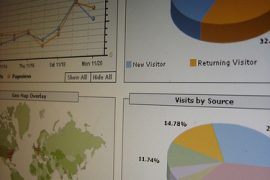
    When you log into the Google dashboard, you immediately see a graph of visits, with information on sessions, users, pageviews, pages per session, average session duration, bounce rate, and percentage of new sessions, plus a pie chart showing the percentage of new and returning visitors. Below that you see three sections: Demographics, including the language of the top ten visitors, their country or territory, and city from which they visited; System, showing what browser they used, what operating system (Windows, Macintosh, Android, iOS, Linux), and what service provider (Charter Communications, Time Warner, etc.); and Mobile, listing operating system, service provider and screen resolution.

    While you could spend hours on each section alone, skip down to the Behavior section to see interesting facts about how people interacted with your site. (The Acquisition section is primarily useful to those purchase ads on Google AdWords.) You can learn what pages were visited the most, how fast pages were accessed, and the flow of the user’s behavior through the site. You can even click on Real Time and see who is visiting your site at that very moment.

    When should you use Google Analytics? When you’re interested in knowing in detail who’s visiting your site, from where, how often. When you want to tweak your site’s content or architecture in answer to visitor patterns, to enhance the user experience. When you just love seeing all the numbers generated by your website.

    WP SlimStat

    This is a highly-rated free web analytics plugin for WordPress. I have only recently installed it, but am amazed at the range of information it provides, some of which isn’t provided by Google. A real-time log shows you who’s viewing your site at any given moment. The Audience section uses the term “daily human visits,” separating out people from visits by bot. Site analysis gives you at a glance how many content items your site has, as well as the number of comments. The Map overlay provides a fun way to see if you’re getting visits from around the world.

    When to use WP SlimStat? When you’re a WordPress self-hosted user who wants a rich, broad array of statistics in an easy to use format.

    I’d love to hear from you about your experiences with these tools. Please use the comments below to share!

    Donna K. Fitch, MLS (Master of Library Science), MCert (Master’s Certificate in Web Design and Development), is the founder and CEO of Maximum Author Impact, creating beautiful WordPress websites, training webinars and other resources for indie authors. She is the independent author of Second Death, The Source of Lightning, and The Color of Darkness and Other Stories, newsletter web editor and member of the Horror Writers Association, and a member of the Alexandria Publishing Group, aimed at raising the level of professionalism among indie authors. In her day job, she is the digital communication specialist in the office of marketing and communication at Samford University in Birmingham, Alabama, USA.

    Top photo credit: trekkyandy via Compfight cc.

    Bottom photo credit: Donna K. Fitch.

  • Everyone Has the Math Gene (Video)

    So where have I been this week? Makin’ video, y’all! I had lots to learn, but I’m tickled to share my first Math Manifesto video: Everyone has a math gene.

    If you’ve heard yourself saying, “I’m no good at math; I don’t have a math gene,” this video is for you. In it I talk about all of the current research and understanding of how our brains were born to do math. Take a look!

    You may have noticed that I changed this line of my manifesto. Originally I believed that there is no such thing as a math gene, but after doing some reading I’ve come to a different conclusion. We all have the math gene.

    More videos are coming, so please subscribe to my YouTube channel: mathforgrownups.  Also, I hope you’ll share this video on Twitter, using #mathgene and post it on your Facebook page. Share the Math for Grownups love!

    As always, I’d love to hear what you think. Ask your questions or share your feedback in the comments section. (Yes, I already know that I say “So…” and “But…” too often. *smile*) After watching the video, are you convinced — as I am — that you have the math gene? Why or why not?

  • The Brain Ordered: A review of The Organized Mind

    The Brain Ordered: A review of The Organized Mind

    These days I’m devouring just about any writing I can find that features the cross section between neurology, sociology and psychology. Daniel Pink’s Drive completely changed my mind and confirmed my suspicions about how motivation actually works. And now The Organized Mind by behavioral neurologist Daniel Levitin has helped me better understand how the brain helps us organize our time, thoughts and things — and how our brains can get in the way.

    It’s a big book. And parts of it are very dense, including sections that explain the anatomy of the brain and almost an entire chapter devoted to the probabilities of medical outcomes. But the rest of the book is quite narrative, with funny and relatable examples. This science and geek loved it all.

    For me, the takeaways were in productivity and learning. It’s not fair to boil it all down to two categories, but I will. At the same time, I’ll point out how all of this relates to math, with a few quotes from Levitin‘s book.

    What the Brain Does Well

    Categorization

    Turns out the brain is perfectly designed for identifying similarities and differences.

    In the last few years, we’ve learned that the formation and maintenance of categories have their roots in known biological processes in the brain. … Theoretically, you should be able to represent uniquely in your brain every known particle in the universe, and have excess capacity left over to organize those particles into finite categories. Your brain is just the tool for the information age.

    Where’s the math in that? Everywhere. It could be argued that math is the study of categories. Start with our number system. Positive numbers that are not fractions and decimals fall in the category of whole numbers. Add negative numbers to that group, and you’ve got integers. (And so on.) Or you can group numbers as prime and not prime or even and odd. Graphs of equations can be lines or curves — and some curves are parabolas, while others are circles. See where I’m going with this?

    This is all good news. Because the brain is so excellent at forming and maintaining categories, your brain was made for math.

    Discovery

    But how can we make sure we remember all of these categories?

    The last two decades of research on the science of learning have shown conclusively that we remember things better, and longer, if we discover them ourselves rather than being told them explicitly.

    This idea has huge implications for math education. For the most part, approaches to teaching math fall in one of two categories (see what I did there?): telling and discovering. Most of us who grew up in the 70s and 80s learned math through the “telling” method. The teacher gave a lecture, demonstrating how to perform a skill, and asking students to practice the steps shown in the lesson. Discovery turns this process on its head, giving students the opportunity to figure things out on their own, even finding new ways to solve problems. When they can discover ideas on their own, students have a much better shot at remembering what they’ve learned.

    Of course discovery is messy and difficult, which brings us to ways that our brain gets in the way.

    What the Brain Doesn’t Do Well

    Frustration

    This idea from Levitin blew my mind. Apparently it’s a proven fact that people don’t manage frustration well. It’s why we procrastinate, and that feeling of frustration is rooted in our brains.

    The low tolerance for frustration has neural underpinnings. Our limbic system and the parts of the brain that are seeking immediate rewards come into conflict with our prefrontal cortex, which all too well understand the consequences of falling behind. Both regions run on dopamine, but the dopamine has different actions in each. Dopamine in the prefrontal cortex causes us to focus and stay on task; dopamine in the limbic system, along with the brain’s own edogenous opiods, causes us to feel pleasure.

    Then we play into this automatic system with two “faulty beliefs: first, that life should be easy and second, that our self-worth is dependent on our success.” So, when the going gets tough, we quit — shoot for an easier option.

    Unfortunately, this is just something we need to fight against. And Levitin has some great strategies to offer. At the same time, I felt very validated in my instinct to choose low-hanging fruit, rather than reaching for loftier goals. That also goes for the math student who is immediately frustrated by assignments he can’t understand, and the grownup who always lets someone else split the restaurant tab.

    Probability

    For years I’ve struggled with my inability to internalize the concepts of probability, so I was really relieved to learn that my brain is wired this way.

    Cognitive science has taught us that relying on our gut or intuition often leads to bad decisions, particularly in cases where statistical information is available. Our guts and our brains didn’t evolve to deal with probabilistic thinking.

    No wonder I have to work so hard to understand the probability I’ll suffer from a medication’s side effects or even the chance I’ll win in Roulette. Unlike categorizing, my brain isn’t set up to have an intuition about probability. (This isn’t to say that others can’t find calculate probabilities quickly, of course.)

    Of course much depends on our understanding of probability, including life-and-death situations, like choosing the right medical treatment. It’s important to think about these things in a clear and focused way. That’s one reason Levitin spends so many pages on something called FourFold tables. (More on those in a later post.)

    I encourage you to pick up a copy of The Organized Mind. (No, you can’t borrow mine; I’ve been referring to it over and over since I finished reading!) It’s a great look at how we can maximize the things our brains do well and work against the tricks our brains play on us — to be better organized and productive, while learning and using math.

    Photo Credit: dierk schaefer via Compfight cc

    Have you read Daniel Levitin’s book? If so, what did you think? Share your comments and questions.

  • Tough Equations: Aging parents and housing

    Tough Equations: Aging parents and housing

    I’ve hit the age when many of my friends and colleagues are managing the realities of having aging parents. Luckily, I’m not there yet — my mom is still very active, both physically and mentally. But many of us in our 40s or 50s are probably at least thinking about how we might manage our parent(s) affairs if/when they are unable to handle things on their own.

    My friend and fellow writer, Beth, faced this problem last year, when she, her husband and her mother moved to another state. Beth’s mother needed a little more supervision, and so Beth and her husband arranged for her to live with them. That brought up some emotional and practical questions, which Beth shared in an online writing’s group that we both belong to. She gave me permission to share them here:

    Mom lived independently until we combined households. She wants to pay us a monthly fee that covers “room and board.” The question is: How to figure a fair and reasonable amount.

    It’s been a long time since [my husband] and I had a roommate. In those days, we simply divided the big stuff by three (rent, utilities, cable), and each person was responsible for his/her own food. That doesn’t seem fair in the current situation for a variety of reasons (not the least of which we’re talking about my MOM, not some friend).

    I feel I’m making this unnecessarily complicated. Can anyone help me sort this out? I bring it up because Mom talks about it constantly. She seems to feel the amount she’s paying is too low, and I keep putting the brakes on changing the dollar figure until we have better data about our expenses.

    Naturally, I think math can help us find some simple solutions to emotional problems. So I offered this:

    I have a really easy and non-biased way to look at this. Calculate your total household costs — mortgage, utilities, food, etc. Then divide this by three. Each of these is a share.

    Next, you can decide how many shares each person should have. For example, your mom may have only a half-share, based on what you think she can afford or how much she eats, etc. Take half of a share, and that’s her monthly rent.

    Naturally, I like taking a mathematical approach, because it can help reduce the emotions. And if any of the variables go up or down — utilities, for example — you can adjust the rent really easily.

    And that seemed to do the trick for Beth. In fact, she took things even farther, considering fair market value, as suggested by another group member:

    Here’s how we solved the problem in the end:

    1. I drew up Mom’s current monthly budget.

    2. I drew up a list of household expenses that apply to her (including the mortgage payment). I didn’t include things like pet expenses or [my husband’s] fuel for commuting, obviously, because those are our sole expenses.

    3. I used Laura’s methodology to divvy up the total household expenses into three full shares. Then I calculated partial shares: 3/4, 2/3, and 1/2.

    4. I used [another member’s] data about the fair market value of a studio apartment in [my county] for comparison purposes.

    5. Then I sat down with Mom and first explained her current budget. Next, I went over the household expenses.

    6. I told her about the fair market value of a studio apartment and explained how that related to our attempt to determine what was a fair amount for her to pay us each month.

    7. I showed her the share information.

    8. I showed her how each share amount would affect her net income. Even at a “full share,” she still retains about 45% of her net income for “mad money,” and that’s without touching any investments. (I didn’t point that out to her, in terms of trying to steer her. I think what I wrote kind of reads that way. I just used a calculator to show her what each share amount would leave her, in terms of disposable income.)

    9. I had written all these figures down on paper, so I stepped away to giver her time to peruse the numbers for awhile and consider what SHE wanted to do.

    10. After a few minutes, she called me back and said she’d decided to pay a full share. She’s the type of person who likes to “pay her own way,” and she’ll still have plenty of mad money left over. She also was very happy she wouldn’t need to dip into any investments.

    It’s important to note that this cut-and-dry approach didn’t erase all of the feelings in Beth’s situation. She was very nervous talking to her mother, and her mother felt responsible for paying a full share. See? Feelings.

    Another interesting aspect is how flexible this process can be. With some simple parameters — the value of a full share vs. a half-share, for example — Beth’s family can alter the process depending on where everyone is financially. And if her mother needs more resources or Medicare helps to pay for things, the entire formula can be changed.

    Just a bit of math helped Beth gain some perspective and offer her mother tremendous autonomy. The process also set them up to avoid conflict later on. Nice work, math!

    Photo Credit: VinothChandar via Compfight cc

    I’m currently reading The Organized Mind, by Daniel Levitin, and I can’t wait to share a review with you when I finish. He offers some really terrific math to help when medical decisions are tough. Four-square decision tables anyone?

    What do you think of the process Beth worked out? (I also offer this approach as a way to divvy up the cost of a beach house among several family members.) Have you used math to help you come to a difficult or emotional decision? Do you think this approach would work for a young adult who hasn’t flown the nest? Share your stories in the comment section.

  • Math at Work Monday: Becca the Trauma Nurse

    Math at Work Monday: Becca the Trauma Nurse

    When it comes to life and death situations, we want to have confidence in those that are taking care of us. How do they know when to give us medicine, or exactly how much we need? Rebecca Paisley has been a registered nurse for five years and describes her use of practical math in the workplace. 

    Can you explain what you do for a living?

    I work on an inpatient trauma unit. We take care of the patients once they are seen in the ER. The patients either go to the Intensive Care Unit, the Operating Room or come to our floor. We have a variety of patients – from car wrecks, falls, gun shot wounds, stab wounds, motorcycle wrecks, traumatic brain injuries and some very intense medical surgical patients with complex diagnosis. We care for these patients throughout their stay which can be from 1 day to months. We are constantly on the go, getting patients out of bed, doing procedures at the bedside (extensive dressing changes, chest tube insertions, general patient care), occassionally transfering patients to ICU, if they need a higher level of care. We also admit and discharge patients throughout the day. Needless to say, we are busy!

    When do you use basic math in your job?

    I use math every single day at work. It’s basic math (simple multiplication, division, addition, subtraction), but I have to use it to take care of my patients. Mainly it’s medication related. For example, you’ve got Tylenol 1000 mg ordered, but the patient needs to use a liquid form (650 mg in 20.3 mL) of the medication, you then have to figure out how many milliliters you need to give the correct dose. Once you do the math a couple of times, you remember the mLs that you need. It’s easy to do it that way with a rountine medication, but sometimes we are doing the math extremely fast in an emergent situation (like a chest tube insertion or code situation). We always double check the medication during these times with a second nurse. Another example is when we give pain medication. Say the patient has diluadid ordered our standard protocol is 0.3 mg to 0.9 mg per dose. Using our judgement, we decide on the dose amount. The medication is stock in 2 mg per 1 mL vial. By using basic division I know that the concentration is 0.2 mg per 0.1 mL. I also use it to figure out the drip rate for IV fluids and antibiotics. Ancef is ordered, it comes in a 50 mL bag, it needs to infuse in 20 minutes. Here is the math in my head: 60 minutes (1 hr) divided by 20 is 3. Multiply 3 by 50 (the mLs needed to infuse) and you get 150 ml/hr. Or if we need to bolus some IV fluids, but the doctor wants them over a certain amount of time. Say 500mL over 4 hours, (500 divided by 4 equals 125, so 125 ml/hr). I also use math to estimate my time spent with my patients in the morning (15-20 mins a patient, totaling 1 hour to 1 hour and 20 minutes ), so I can grab my morning cup of coffee! 🙂  However, this math is not always correct!

    Do you use any technology (like calculators or computers) to help with this math? Why or why not?

    We have certain medications that are continuous drips, like heparin or insulin. The pharmacy has calculators for these high risk medications for us to use. We just have to plug in the correct numbers, and we get the new dosing rate. The formulas for these calculations are available on our protocols, so if the calculators are unavailble (which rarely happens), we have the formula to use to get the new dosing rate. These calculators are used to reduce human error on these high risk medications. They are extremely important for safe patient care, ONLY as long as the nurse is plugging in the correct values! That’s why there is always a second nurse verification! Some of the medications (like the Tylenol example) will have the milliliters needed for the dose in the order information, but I like to challenge myself, and calculate the dose myself.

    How do you think math helps you do your job better?

    It makes my patient care more efficient. When I am able to do basic math in my head, I can administer medications faster, especially in an emergent situation where time is everything.

    How comfortable with math do you feel? Does this math feel different to you ?

    I feel pretty comfortable with math, but just basic math. The math I use at work has become “second nature,” so I’m able to use it and not really think about it. More complex calculations require good ‘ole paper and pencil!

    What kind of math did you take in high school? Did you like it/feel like you were good at it?

    I took geometry, and trigonometry, and I’m guessing Alegbra. I honestly hated math in school, but was fairly good at it. I never wanted to aspire to take calculus or advanced Algebra.

    Did you have to learn new skills in order to do the math you use in your job? Or was it something that you could pickup using the skills you learned in school?

    In nursing school, we had a pharmacology class, the whole first portion of it was math. We had to pass a math exam to even continue in the class. Everyone was so stressed out about it. We had to hand calculate drip rates, dosages, and do conversions. This math wasn’t foreign to me, as far as proportions and basic alegbra, but it was definitely stressful! Once we learned the “easy” ways to figure these calculations out, it was all good. I had to learn these new ways of solving these problems, it obviously did not come naturally!

    Do you have a question for Becca? Send me your question and I will forward it to her.