Category: Math at Work Monday

  • Math at Work Monday: Jennifer the book editor

    Photo courtesy of shutterhacks

    So you’ve got a brand new book on your nightstand or electronic reader. Or maybe you have a book idea that you’d love to get published. How on earth does an idea get translated to pages or bytes? A book editor could play a big role. Jennifer Lawler was my editor for Math for Grownups, and these days, she’s the imprint manager for Adams Media’s new direct-to-ebook romance imprint. Today, she answers the big question we have here on Mondays: How do you use math in your job?

    Can you explain what you do for a living?

    I’m an imprint manager for a book publishing company, which means I acquire books from writers based on what we think our readers will want to read. Then I shepherd the books through the entire editorial and production process, which includes everything from negotiating contracts to approving cover design to making sure the publicity department is doing its job. My job constantly switches from big-picture items like “How  does our imprint differentiate itself from other imprints like it?” to nitty-gritty items like “did that copy editor ever send over her invoice?”

    When do you use basic math in your job?

    I have a set budget for producing each title, but not all titles are alike, so they require different amounts of money. I have to make sure that each book gets what it needs without going over the budget as a whole, and also without being really out of whack for any one title. This is very similar to keeping a household budget and balancing a checkbook.

    For nonfiction print books, I have to calculate how to make them fit into the allotted page count we have for them. At my company, page count is determined at the time a book is signed, based on the type of book it is, what the cover price will be, and other factors. Since nonfiction books are sold on proposal, not finished product, the finished product can vary significantly from what we assumed it would be at the time of signing. So I have to figure out what we can do to make the book fit. Can we add pages to the index, or subtract pages from the index? Can we add or subtract front matter? Can we go up to 2-page chapter openers or down to 1-page part openers? We can’t go over or under more than 16 pages for any project. Usually it’s not a big problem but sometimes you should see my desperation!

    Do you use any technology to help with this math?

    We use a special calculator based on trim size to estimate how many words per page, taking design considerations into account (lots of sidebars or illustrations mean fewer words on each page). For the budget, I just use a spreadsheet. This just helps make sure simple errors in addition or subtraction don’t through the whole process off.

    How do you think math helps you do your job better?

    On a fundamental level, if I don’t do the math right, the company and everyone in it suffers. We miss our projections, we overrun our budgets, we even screw up our earnings. That’s a big deal. It also helps me be creative and to make better judgment calls. If I find myself saying, “Well, it doesn’t really matter if this one book doesn’t fit the page count, I can just get the publisher to change the page count,” I know I’m being lazy. Maybe that is what has to happen sometimes, but that type of change directly impacts our profit-and-loss statement for the title, so it has to be the last resort. Same with the budget. “Well, the publisher isn’t going to kill me if I go over by a little bit.” That’s true, but it’s a lazy way of thinking. Doing the math makes me think about what I need to do differently to hit the budget. In some instances, yes, the budget simply needs to be bigger. But it could mean I need to watch what I acquire so I’m not picking up things with potential but that require a ton of editing. It could mean I need to streamline a process somewhere or develop a template instead of doing some type of custom approach each time.

    Math adds a lot of clarity to my work—something I never thought a book editor would say!

    How comfortable with math do you feel?

    I am pretty comfortable with math except when I am put on the spot (like someone asking me point-blank to answer a math question). I find the math at work to be easy in the sense that I’m confident about not making mistakes with it. I do it in the privacy of my office, so if I have to check my calculations five different times to make sure I’ve got them right, I do it.

    What kind of math did you take in high school?

    I got as far as Algebra II and felt like a complete idiot by that point.

    Did you have to learn new skills in order to do the math you use in your job?

    I had to get over my fear of “oh my god I will screw up the math and they’ll kick me out and I love this job!” Other than that, though, the math is straightforward—definitely something a high-school kid could do. Probably a third-grader could do it

    Thanks for playing with us today, Jennifer!  If any of you dear readers are interested in writing and publishing a book, check out Jennifer’s great book proposal class.  (I can recommend it from personal experience!) Or feel free to ask her a question in the comments section.
  • Math at Work Monday: Sally the photographer

    Math at Work Monday: Sally the photographer

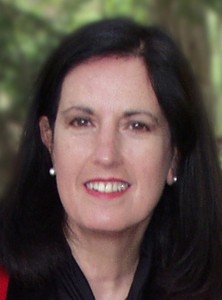
    Photography is one of those art forms that looks easy but is really challenging — at least challenging to get it done right!  Writer and photojournalist, Sally Wiener Grotta describes how math helps her compose the best photograph, including perfect lighting. 

    Can you explain what you do for a living?

    Essentially, I am a visual and verbal storyteller. This has developed into a multi-pronged career.

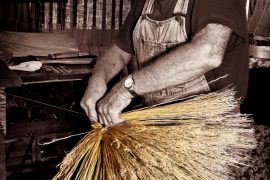
    As a photojournalist, I have traveled all over the globe, visiting all 7 continents (including Antarctica several times) and many islands (such as Papua New Guinea and Madagascar) on assignment for major magazines and other publications. My current and ongoing fine art project is American Hands (www.facebook.com/AmericanHands) for which I am creating narrative portraits of individuals who are keeping the old trades alive, such as a blacksmith, glassblower, bookbinder, spinner, weaver, etc.  I travel around the county, mounting American Hands exhibits and giving presentations about the people I photograph.

    In addition, I give lectures and teach master classes on photography and imaging. I recently launched a YouTube channel in which fellow photographer David Saffir and I discuss the essential elements that define a photograph and pull us into it, using the narrative power of shadow and light.

    As a non-fiction writer, I have written literally thousands of articles, columns, features and reviews for major magazines, newspapers and websites, as well as seven non-fiction books. In non-fiction, I am primarily known for my expertise in testing, analyzing and explaining technology related to photography, imaging, printing and epublishing.

    My first novel “Jo Joe” will be published this spring as both an eBook and printed book by Pixel Hall Press, followed later this year with other stories and books.

    When do you use basic math in your job?

    Math is integral to my work in many ways. An intuitive understanding of geometry is essential for good photographic composition. In addition, I use math to control exposure (the amount of light used to define a photograph) and to decide how to set up auxiliary lighting.

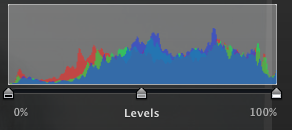
    A prime example of math in photography and imaging is the histogram tool. The histogram is a graph that provides information analyzing the exposure of a photograph. When a photographer or digital artist looks at a histogram, it helps us understand the “dynamic range” of the picture. In other words, what percentage of the photograph is made up of highlights, shadows and midtones. If the graph displays that there is too much image data in, say, the highlights, and I know that the image is of a scene that isn’t that bright, I can then decide to change my exposure so the photo better represents the scene.

    But basic math goes much deeper into my everyday career concerns. For instance, my American Hands project is a non-profit venture supported by grants and sponsors. When I apply for a grant, I must present an accurate, logical and meaningful balanced budget. Therefore, I have to calculate my costs over time and balance that against potential income. (If the budget isn’t balanced with income=costs, the grant application will be rejected.)

    Another example of everyday math has to do with laying out books and journals for publication, such as my American Hands Journal. At the very basic, a typical book is printed in “signatures” of a specific number of pages each, such as 4-pages each. So a book must be laid out so that its total pages are a multiple of 4 (or whatever the signature number is). Then, there are spatial concerns, such as keeping type and photographs within specific printable margins, that requires more intuitive understanding of geometry.

    Do you use any technology to help with this math?

    I do believe that it is important to understand math and be able to do it without calculators or computers. However, when I use it for accounting, grants applications and such, I must be sure that I haven’t introduced an error, through a mistake in arithmetic or simply a typo. So, I may use a calculator. More often, I will use Microsoft Excel on my computer to create a spreadsheet that does automatic calculations for me when I input figures. However, I am the one who creates the rules for those calculations. So, using a spreadsheet doesn’t preclude the need to understand the underlying math.

    How do you think math helps you do your job better?

    Math isn’t only necessary in my career as an artist and writer, but it is also a skill that sharpens your mind the more you use it. That kind of precision thinking is a great complement to the creative side of my business, balancing it. What’s more, a sharpened mind is one that is more open and creative.

    How comfortable with math do you feel?

    I was lucky to have some wonderful teachers – starting with my mother before I ever went to school. She created basic arithmetic puzzles to keep me busy, and I learned to think of numbers as a game, starting when I was about 4 years old. So, I have long been comfortable with numbers and their relationships to each other. Math and art are not opposites. In fact, in the Renaissance, the great mathematicians were artists and vice versa. And, today, the great math innovators have highly creative minds.

    What kind of math did you take in high school?

    I studied geometry, algebra and calculus in high school.  I enjoyed it, again, mostly because I had good teachers. It continued to be a game to me to understand how numbers fit and changed each other.

    Did you have to learn new skills in order to do the math you use in your job?

    The new skills I developed since leaving school has to do with defining intelligent, useful calculation rules in an Excel spreadsheet. But it was all based on math I already understood, so it was relatively easy… once I understood how the spreadsheet works.

    Do you have questions for Sally?  Ask them in the comments section!

  • Math at Work Monday: Shana, Ursula and Ann

    Math at Work Monday: Shana, Ursula and Ann

    y birthday is this week, and I’ve decided I don’t want to work so hard. So today, I’m bringing you three archived Math at Work Monday interviews–two artists and a museum curator.  Enjoy!

    Shana Kroiz: Jewelry artist

    Shana has been designing museum-quality jewelry for almost 20 years.  She also began the Maryland Institute College of Art (MICA) jewelry department, when she was fresh out of college.  Using a combination of resin molds, metals and gemstones, her pieces are distinctive and tell interesting stories.

    drawer #4 from Marcum’s “collections” series

    Ursula Marcum: Glass artist

    Ursula isn’t a glass blower, like Elizabeth Perkins.  Instead she works in kilnformed glass, creating layered pieces that truly unique. She uses various formulas to create her pieces, allowing different kinds of glass to fire at different temperatures and for different lengths of time.

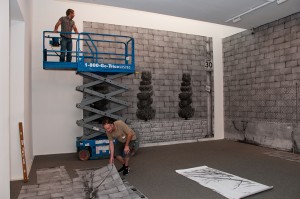
    An installation at the BMA.

    Ann Shafer: Museum curator

    Ann is the associate curator of the prints, drawings and photographs department at the Baltimore Museum of Art.  Part of her job is acquisitions, so she helps manage a budget — making sure that the museum has a balanced collection and spends its donations wisely.

    Enjoy the interviews. See you on Wednesday!

  • Math at Work Monday: Samantha the painter

    Math at Work Monday: Samantha the painter

    Samantha Hand, plein air painting

    Sam doesn’t remember this, but when she and I were in middle school, I used to ride home with her on the bus after school, when we’d watch Godzilla on television and eat her mother’s homemade potato bread.  At that time, she said she wanted to be a veterinarian (like her dad).  Instead she earned a BA in art and then her MFA. Since 2010, she’s discovered her talent in oil painting.  

    Samantha Hand has some mad skills when it comes to oils and canvas. And even I was surprised by the math that she uses.  Unlike most of the other folks I’ve interviewed for Math at Work Monday features, Sam really counts on being able to visualize the math she needs.  Read on…

    Can you explain what you do for a living?  For the last two years, I have completely immersed myself in oil painting and have tackled landscape, plein air, still life and portraiture. Currently I am painting compositions that intrigue me in hopes of selling them, while accepting commissions on a variety of subjects. Recent projects include still life and figurative painting.

    When do you use basic math in your job?  I use the most math at the beginning stages of a painting. When I am sketching thumbnail ideas, I use the rule of thirds to compose a more interesting picture. I use a variety of angles to draw the eye toward the focus of the picture and to lead the eye around the composition. I also use angles in drawing perspective when I am attempting to create depth in a two-dimensional space. (For example, the angle of a building is wider in the foreground and will go toward a vanishing point as the building retreats into the distance)

    If the composition is complex, as in a triple portraitI am currently working on, I use a grid to enlarge smaller reference images to the larger size of the canvas. This helps to keep the proportions of the sketch on the canvas accurate. Proportions are also important in balancing the values and subject matter in a composition. I check to see if the proportion of dark values is greater or lesser than the proportion of light values to add interest.  I may balance the visual weight of the subject with a greater space of sky to create visual tension or to draw the eye toward the subject.

    Mr. Allison’s Hat

    When I am sketching the figure I am constantly checking my proportions by comparing the size of body parts. For example, in most faces the space between the eyes is the width of one of the eyes in the face. Also, in general, people are approximately 6 and a half heads tall. I use a paint brush or pencil to measure and compare. I also use this measuring and comparing in all other subject compositions to check my spacing and proportions.

    Once I begin painting, I use ratios in the mixing of colors. If I am looking for a purple I may mix an equal amount of red and blue. But if I want a warmer purple with a reddish tint I’ll use less blue in the mixture. Throwing in the amount of yellow equal to the red will turn it toward a brown. Equal measures of red, blue, yellow becomes a neutral gray. There are infinite numbers of colors to be mixed which is one of the most exciting things about painting.

    Do you use any technology to help with this math?  I do not use a calculator or computer because the math I use is simple and not very exact. It is more about the feeling of balance or rightness. If something doesn’t feel right with the composition I begin to check using more exact measurements and angles.

    How do you think math helps you do your job better? Math is the building block of my compositions. I use angles and proportions to try and create intriguing compositions with believable subject matter.

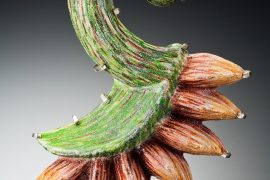
    No. 5 tiara

    How comfortable with math do you feel?  I am very comfortable with the math I use in my artwork but less so with the everyday math of a household. Somehow I feel as if I can visual the math I use in compositions and it makes sense to me. When I apply it to household tasks I have to really focus on the task at hand.

    What kind of math did you take in high school?  I only vaguely remember my classes in high school but did take math analysis, geometry and the other algebra courses offered. I really enjoyed my math classes and felt confident in my ability, though less so with geometry. I continued with a calculus course in the first year of college and enjoyed that also. Unfortunately, I think I’ve only retained very simple math skills.

    Did you have to learn new skills in order to do the math you use in your job?  I haven’t had to learn any new skills yet but I have learned to use the math I know in tangible situations.

    Did you have any idea about the math that goes into planning a painting? If you have a question for Samantha, ask it in the comments section.

    This month, Math for Grownups has gone arty, taking a close look at how math shows up in the visual arts.  Last week, glass blowing took center stage.

  • Math at Work Monday: Elizabeth the glass artist

    Elizabeth Perkins with “The Miller’s Lie/I Love America”

    I’ve known Elizabeth Perkins since she was about 16 years old, I think.  In fact, I’ve always called her Beth.  

    I was Beth’s geometry teacher way back when.  And I was so excited to find out that she’s now a very successful glass artist.  After graduating from Atlanta College of Art in 1997 with a degree in sculpture, she embarked upon an amazing journey as an artist and teacher.  She earned her MFA from Virginia Commonwealth University in 2004. 

    Like me, Beth grew up in a rural, southern town and has a very strong connection to her family, so I’m really moved by her work, which incorporates glass, found objects and heirlooms.  But you know what I’m going to say next: The fact that Beth uses math in her art is both surprising and expected.  Read on to learn more.

    Can you explain what you do for a living?  I work as a production glass blower for a company called Glassybaby and in addition serve as a contractual glass blowing and artist assistant to other professional artist here in Seattle.  I also continue to make my own sculpture primarily in glass and am able to teach workshops in my specific area of expertise at Pratt Fine Arts Center.

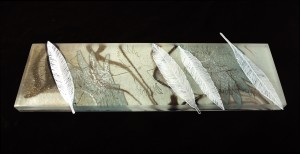
    “Glass Lace Mural” (100% cast glass: pate de verre)

    When do you use basic math in your job?  I use math all the time in my job.  One of the primary areas  is in creating and writing annealing programs.  This is the process where glass is cooled slowly so that it can cool evenly from the outside to the inside.  This differs depending on a glass’ annealing temperature, the thickness of the glass, size, and the thickness of the mold material (if you are casting glass).  The annealing programs are structured on the Fibonacci sequence, an integer sequence.

    Do you use any technology to help with this math?  I usually do the math by hand, because I really have the need to visualize everything that I do.  The math result (which is usually in diminishing time increments per hour) is then called the annealing program for your glass project, which for me as an artist changes with most every piece — because I rarely repeat any image.  The annealing program is then put in to a controller.  The controller works on a relay to turn on and turn off the electricity in the heating elements inside an annealer or kiln.  Some controllers are set up to combine the time per hour cumulatively and some are not.  So I sometimes adjust the type of program based on the controller I am using.  All of my mold materials, as well as glass, are measured when creating castings, so that the ratios are correct. This insures that the “investment” (mold body) is as strong as it can be, to hold up to temperatures up to 1600 degrees.  Measuring the glass is also important so that the mold is completely filled but not overfilled. (If a mold overflows, that can ruin the kiln.)

    How do you think math helps you do your job better?  Without math, I would be very wasteful with time and resources.  Math helps to create little science experiments in my daily artistic practice, as well as a strong control for testing firings and materials to get the best outcome in my work.  When I am working on a project, I keep detailed notes of all of my recipes for investment bodies and glass and the temperature that each glass moves.  Because all glasses and all colors of glass have a different material composition and they move at different rates and temperatures.  The firing and annealing schedules also are included variables in these experiments.  These are all the things I deal with on a daily bases that have everything and nothing to do with the image I am trying to convey in glass.  Every sculpture includes created and solved math problems.

    How comfortable with math do you feel?  I have always, well, just not been very strong in math.  I use it everyday though.  I am one of those people that feels comfortable with patterns and shapes.  So perhaps I am more comfortable managing things like the Fibonacci sequence as well as geometry in my art practice problems.  I find now that my measuring has come so routine that I can feel the investment body when it is wet and know if the ratios are right and kind of fudge it with smaller sculptures.  With larger sculptures I can’t take those shortcuts.   I often use the old woodworker’s rule of measuring twice and cutting once.  I always check and re-check my math.

    “Invisible Threshold” (kiln cast glass, heirloom, wood)

    What kind of math did you take in high school?  I took the required math but no advanced math courses.  I liked geometry, but I never felt like I was ever good at math or liked it.  But I think for this reason I have a deep satisfaction when I am able to figure out these strange solutions to artistic problems.  I once became obsessed with figuring out the physics involved in the weight differential of glass on the end of a glass pipe.  (Glass pipes have a standard length but the material amount varies depending on what you are making, and it is constantly changing form while you are making it.)

    Did you have to learn new skills in order to do the math you use in your job? Yes. I had to build on very basic math skill sets, only because I was unable to comprehend much of math.  I do think because math is necessary for what i do I am even more motivated and eager to find solutions.

    I am a skilled, talented, and a creative artist, I feel very good about that and very proud.  I feel very honored that the math teachers I had in high school somehow managed to create “a current between the wires.” But I guess even a pickle can carry current. I use lots of math on a daily basis, and without their lessons I would not be able to make my work at all. While math is not my lover, it’s certainly a confidant. It’s always got my back.

    And without Beth, I may not have felt like a great teacher.  Have questions for Beth?  Feel free to ask them in the comments section. 
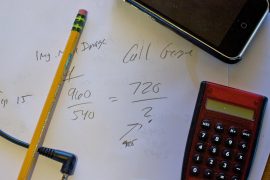
    All month, we’ll be talking about art and talking to artists.  So stay tuned — and fall in love with the math of art.

  • Math at Work Monday: Kiki the career coach

    Photo courtesy of danielmoyle

    So this is the year — you’re ready to launch out into a new career, start a business, get back into the workplace after taking time off to raise the kids.  Rebecca “Kiki” Weingarten, M.Sc.Ed, MFA knows all about these big decisions.  As an executive, corporate and career coach, she’s worked with lots of folks who want to make successful career changes with no regrets.  As the cofounder of Atypical Coaching, Kiki works with corporations and individuals.  She says she once hated math, but today she uses math to help her clients make solid decisions that ease their way into uncharted professional territory.

    Can you explain what you do for a living?

    Short answer? I work with corporations and individuals  in the US and internationally to set and reach their goals, maximize their potential and fend off anything that gets in the way of their achieving that. Or as my tag line says: Motivating & Guiding Clients to Achieve Success, Focus, Productivity, Stress Management, Balance & Transitions.

    Long answer? As an executive, corporate and career coach I’ve worked with people and corporations/institutions in just about every industry on the planet from education, government, finance, business, technology, science, health care, psychology/mental health to numerous industries in the entertainment and creative arts fields including theater, film and writing.

    When do you use basic math in your job?  

    I’m a firm believer that math is part of just about everything we do. That means that I use math in my job all the time. If I’m working with clients on an business, start-up, corporation or entertainment or creative project we work with budgets, time, financial parameters of a project.

    If I’m working with clients on making a career transition we work on the mathematics of finances. How much more or less money will I be making? What kinds of financial sacrifices or changes will I make? If I’m going to be making more money, how will I manage that? Will I need a financial planner?

    The math is pretty important when I’m working with clients on life-work balance. How many hours are in your day? How many hours do you need to work? How many leisure hours are there?

    Do you use any technology to help with this math?

    I use it if necessary. When working with corporations or projects, I’ll work with the people who do the math and they use whatever tools they normally use. If it’s an individual the math part usually comes in the form of coaching tasks that I assign them to do and then we discuss the results and strategize next steps during our sessions.

    How do you think math helps you do your job better?

    I’m aware that math is part of everything, and I embrace it as much as possible. Math is the language of time, budgets, finances and financial decisions.

    How comfortable with math do you feel?

    I have an interesting relationship with math. In high school I was a whiz at English and history, but I didn’t apply myself when it came to math. The year I took geometry I totally bombed one semester and decided there was no way I was going to take the Regents exam twice.  So I sat down with the class math whiz and then alone for three days and studied. I totally aced the exam. That let me know that I could do it if I just applied myself.  But I really didn’t love math best, so it still wasn’t my favorite subject.

    An amazing thing happened in college when I was studying for my Bachelor’s of Science in Education. I had to take a course on teaching early childhood math and my professor (whose name escapes me now – sadly, because she was wonderful!) LOVED her subject and was such an amazing teacher. I came to understand math in a new way. Turns out I loved teaching it. I wish I’d loved it as much in elementary and high school.

    Did you have to learn new skills in order to do the math you use in your job?

    I learn a new math language with all the different industries I’ve been in and coach. For example for multi-billion dollar and over one-million person target-group government projects that I’ve directed, I use one kind of math. Venture capital and business plan math is another kind. Entertainment budgeting is another kind of math, and when I’m coaching individuals on negotiating salary and compensation, that’s yet another kind of math.

    Talking about money is an entirely different language, and I wish women were more comfortable speaking it. When working with women I find it’s a language they’re not as comfortable with as the men I work with. Even women in the corner offices, C-level, business owners, leaders in the corporate and other industries just aren’t as comfortable as they should be doing the math of the worth of their work and contributions. I work with them to do the math of who they are, what value they bring to their work (whatever it is), how to measure that in dollars and how to assert their value in order to get the financial rewards that they should get. Whether it’s during a job interview or asking for a raise.

    One’s knowledge of math should be an evolving knowledge. School provides the basics and you keep your ears, mind and abilities ready and willing to learn new knowledge and incorporate new skills.

    I often kid around that I learned a lot about coaching  by being an early childhood teacher which was my very first job. Math is no exception. I learned that math is part of every single day and most activities — shopping and spending, time, money, baking and cooking. If you pay attention to how much math is part of your daily life you’ll be amazed.

    I love that Kiki talks about the language of math, because that’s what most folks are afraid of — and very good at.  You’re probably an expert in your own field, whether that’s being a mom or a speech therapist or a corporate executive.  That’s half the battle in using math to further (or launch) your career.

    If you have questions for Kiki, ask them in the comments section.  I’ll make sure she knows they’re here!
  • Math at Work Monday: Janine the professional organizer

    Math at Work Monday: Janine the professional organizer

    Either A&E Television is super smart or I’m easily manipulated.  On January 1, the cable channel ran a marathon of Hoarders, the documentary-style television program that shows extreme hoarders getting help to deal with their illness and their (often disgustingly) cluttered and dirty homes.

    I watched several episodes.

    Let’s get one thing straight: I am not a hoarder.  But like most folks, I do have a clutter problem.  Hoarders makes me feel better about my own issues, while learning a bit about how to let go of material things.  And besides, professional organizing has always been a fascinating career.  The process of helping someone get organized — their spaces, their collections, their time! — is akin to waving a magic wand.

    Getting organized is one of the most common New Years resolutions, so I’ve invited professional organizer Janine Adams, who owns Peace of Mind Organizing in St. Louis, Missouri.  Not surprisingly, she uses math in her work.  Here’s how.

    What do you do for a living? 

    I help people create order in their homes and their lives. I specialize in working with folks who are overwhelmed by clutter and for whom getting organized is a lifelong challenge. Though no two clients are alike, I typically help in the area of decluttering, then creating systems to help people function smoothly in their homes. My special skill is in gently guiding people who have a special relationship with their things so that they can let go of stuff and feel okay about it.

    When do you use basic math in your job?

    When someone has too much stuff to fit into their space, we sometimes have to figure out what percentage of their things they might need to part with in order to be able to store everything. So the client might agree that he or she needs to part with three of a particular type of item for every one kept, for example. When creating storage systems, I typically try to subdivide spaces using bins, so I use simple math to figure out how many bins will fit on a shelf, for example. When working with clients on creating habits and routines and time management, we break down the day into small increments and try to figure how long things will take and what can actually get done in a given amount of time.

    Some organizers do a lot more space planning than I do (I’m spatially challenged, so I don’t do space planning). I imagine they use more complicated math!

    professional organizer

    On the financial side of my business, I use math all the time, calculating my fees (I typically charge by the hour) as well as in calculating what I owe my subcontractors. I pay sales tax on any items I buy wholesale, but sometimes I round up or down to a whole number when I’m charging the client. Then, for bookkeeping purposes, I have to calculate the base price and the sales tax on it so that they equal the whole number.

    Do you use any technology to help with this math?

    I use the calculator on my iPod to check my math when I’m calculating what I’m owed (or owe subcontractors). I want to make sure I get it right. I also use a calculator when I’m figuring out sales tax. I use Quickbooks to help me with my bookkeeping and appreciate its math functionality.

    How do you think math helps you do your job better?

    If I didn’t know how to do basic math, I wouldn’t be able to run a business. I think it’s that simple. I feel like I’m constantly calculating fees, expenses, time available. Math is essential!

    How comfortable with math do you feel?

    This is very basic math. I’m comfortable with it!

    What kind of math did you take in high school?

    I was in an accelerated math program, but stopped at second year algebra, in 10th grade, because I didn’t enjoy it very much, to be honest. But I felt pretty good at it. I also took accounting classes, which have helped me in my two businesses (writing and organizing) and with home finances. What’s interesting to me is that I’m much better at basic math (the kind I use in every day life) than my husband is and he majored in applied mathematics in college.

    Do you have questions for Janine?  Ask them in the comments section.  And be sure to come back on Wednesday and Friday.  I’ll show you exactly how you can use math to help yourself get organized.
  • Math at Work Monday: Best of 2011

    Math at Work Monday: Best of 2011

    Math for Grownups readers love Math at Work Monday.  And here are the top 10 interviews of the year.

    Mary Ellen the FBI Profiler

    In her book, Dangerous Instincts: How Fear Can Betray Us, Mary Ellen O’Toole, PhD, puts these experiences to work everyday life.  And in this interview, she reveals how she uses math in her work.

    Melissa the Speech Therapist

    Lots of people think of speech therapists in the school setting, working with kids.  But my sister, Melissa, works with adults, who are critically ill or recovering from an injury or illness in rehab.

    Katie the Costume Designer

    As a costume designer and technician, Katie Curry worked for the Berry College Theatre Company and the Atlanta Shakespeare Festival. She recently started her own venture called Nancy Raygun Costuming that caters to folks who are into cosplay and conventions or just want a fun costume.

    Jennifer the Retail Buyer

    Merchandise at your favorite store doesn’t magically appear on the store shelves.  In fact, there’s a lot of planning that goes into the number and types of candy bars that fill checkout-line racks. And that’s where Jennifer Cassara comes in.

    Graham the Fish Hatchery Technician

    Graham Laing is my brother, and I don’t think he’d be offended by my telling you that some of us in the family were a little worried that he might not amount to anything.  But that’s another story for another day.  Today, he’s afish hatchery technician, which basically means he raises trout — “from eggs to eating size,” he says.

    Tiffany the 6th Grade Teacher

    I know what you’re thinking. “It’s so obvious how a 6th grade teacher would use math! She’s teaching fractions and division and percents!” But there’s always a lot more to teaching than the rest of us may think.

    Brette the Cookbook Author

    When my friend and fellow writer, Brette Sember let me know that she has a cookbook coming out, I jumped at the chance to feature her here.  It should be no surprise that math is a critical ingredient of all recipes.  The Parchment Paper Cookbook is no exception.

    Shana the Jewelry Designer

    Art and math are diametrically opposite, right?  Wrong. Shana Kroiz is a Baltimore-based, acclaimed jewelry designer and artist, whose work has been shown in the some of the country’s most esteemed galleries and museums, including The Smithsonian and the Museum of Arts and Design in New York City.

    Kim the Copywriter

    If you’ve ever visited the website of a prescription medication or picked up a brochure from your doctor’s office, you’ve seen the kind of work that Kim Hooper does.  And she’s proof that math and writing are not mutually exclusive endeavors.

    Ron the Web Designer

    Ron S. Doyle is both a web designer and a freelance writer.  In fact, he’s found a particular niche in developing web sites for other freelance writers.  He’s also got a wicked sense of humor and uses math in his work.

    I’m planning for the New Year. Who would you like to see interviewed for Math at Work Monday?  Share in the comments, or shoot me an email.

  • Math at Work Monday: Kim the candle maker

    Math at Work Monday: Kim the candle maker

    Good grief the winter holidays include a lot of candles!  Earlier this month, Christians began lightingAdvent candles; Hanukkah begins tomorrow night at sunset; Thursday is the Winter Solstice; andKwanzaa starts on December 26.  

    That’s a lot of wax!

    Lately, I’ve been fascinated by how candles are made, and so I reached out to Kim Meade, owner ofAdirondack Chandler Candles.  In the interview below, she explains how math plays a role in candle making.  It’s a longer interview than usual, but Kim provided such great details, and I didn’t want to leave anything out!

    Can you explain what you do for a living?

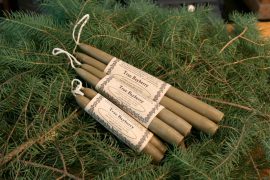
    I make candles the same way they have been done for centuries, dipping candles in a variety of waxes, including paraffin, True Bayberry, and beeswax.  I have a hand made carrousel that allows me to dip 120 pairs of taper candles per dip.  I also make votives, tea lights, potpourri tarts and other items with wax in them.  This is a full time job for me.  I sell my candles to more than 100 retail shops, as well as several consignment shops and on Etsy. I also have a retail website as well as a very small retail shop in my studio.

    When do you use basic math in your job?

    I use math every day.  I have recipes that I use to make my candles in a variety of scents and colors.  I have to weigh the wax and adjust dyes and formulas depending on how much new wax I add to my batch.  For example, a fresh, new batch of wax requires 75 lbs of wax.  When I finish each dip, I always have a minimum of 30 lbs left over since the dippng vat has to remain full.  At the end of the day, I save the leftover for the base for the next dip of this particular scent or color.  The next time I am going to do this particular scent or color, I have to determine how much more wax I have to add to the melter.  This is basic addition and subtraction.

    Then I have to calculate the percentage of dye and fragrance that I have to add.  For example, if I have added 45 new pounds of wax, I have to calculate the proportions — 45 lbs vs. 75 lbs.  If I add 24 ounces of fragrance for a 75 lb batch of a particular scent and 5 Tbs of dye, how much would I add for a batch with only 30 lbs of new wax?  (I always use a calculator for these calculations!)

    I also have to consider the strength of the dye.  Green dye is much more “potent” than, for example, yellow dye.  I have color ratios that I use.  If combining dyes for custom colors, I have to look at these ratios to determine how they will affect the end result  For example, I may use only 1/2 the green dye vs. a red dye for a particular result.

    With each dip, I determine how many of each size candle I have to make. I routinely make 6″, 9″ and 12″ candles.  I have to look at my sales projections and determine how many of each candle size I have to make.  I then measure the amount of wicking that I have to cut. As an example, for a 6″ candle, I need to cut a piece of wick that is 12″ long, since the wicking will hang over the holder to allow me to dip a pair of candles.  I also have to add 5″ extra to give room for the wick to hang over the holder.

    I have to ensure that the candles are at larger than the 7/8″ standard taper base, but not so large they look malformed.  Wax will shrink when it cools, and temperature and humidity can affect it, so I have to be aware of each of these factors.  Temperature plays an important role, specifically if it is warmer than 76 degrees.  Over 80 degrees in studio temperature will negatively affect candle integrity.  Although my candles will be fine above 80 degrees, they will not cool correctly and will have imperfections in them as they cool.  Candles cannot be in a draft, as it will cause them to curve, so I have to consider weather (specifically in the summer).  I cannot run an air conditioner during production.

    I have a melter that I use to melt the 75 lbs of wax required for each batch.  Each wax has a different melt point optimum pouring temperature, and flash point (point at which the wax will ignite).  If combining waxes, calculations are made to determine correct melt point and pouring temperature.   Fragrance also has a flash point.  Wicks have different coatings on them (i.e., standard melt point, high melt point, super high melt point).    I load this melter the night before, and have a timer that I use to start the wax melting at the appropriate time.  It takes approximately 5 hours for the wax to melt to the correct temperature. so my first math calculation is to determine when to have the timer set to come on, depending on when I plan to start the day.  Some days I try to get two dips done in one day (so I have to start very early).  The second melt takes less time since the melter is already hot, so I have to make an educated “guess” on how long it will take based on temperature and size of the batch.

    When making votives or tealights, I have to add other additives to the wax, such as stearic acid, vybar and other additivies depending on what is being made.  These are based on proportions compared to the weight of the wax.   I usually melt less wax, using a melting pot and a hot plate to melt this wax.  Usually I will melt 5- 10 lbs, so I have to calculate how long it will take to melt, and how much dye,fragrance, etc to add along with the additivies .  I base the dye on the original 75 lb recipe.

    Finally, I use math during the packaging and shipping.  I have to determine correct box size, weigh the candles and gather measurements from shipping boxes.

    Do you use any technology to help with this math?

    I always use a calculator or computer to do my math calculations.  Just a few percentage points off in the production of my candles can ruin an entire batch.  I made an entire batch one time with just 1/2 a teaspoon too much green dye and had to redo the dip and the candles I made, although beautiful, were the wrong color for the scent.

    How do you think math helps you do your job better?

    Just about everything I do requires math.  I have several sizes of wicking that  I use depending on the size and type of wax I am using.  Large pillar candles require a larger wicking than, for example a 4″ petite, 1/2″ bas candle.  Votive candles require larger wicks  than tea lights.  I also have all the proportions and ratios to consider.  Without math, my candles would not have the correct proportions and most likely would not be successful.

    How comfortable with math do you feel?

    I actually do not like doing math at all.  But, at my job it is second nature to me now.  Without it, my products would not be successful.  For example, I order 500 lbs of wax at a time, but each candle is only ounces in weight.  I add ounces of fragrance to the entire batch, but how much of that cost is in each single candle?  I purchase wicking by the yard, but the candle is measured in inches.  Dye are purchased by the pound, but measured into the recipe by teaspoon or tablespoon.  I have some complex spreadsheets that I have created in Excel that allow me to plug in the cost of my raw materials and it calculates the cost of my individual batch and candles.  But, even with this, the cost of my raw materials changes at different times, and some of the materials I use, such as dyes, will last for several years.

    What kind of math did you take in high school?

    In high school I took algebra, geometry, trigonometry and calculus.   I was very good at algebra, found geometry to be difficult, was pretty good at Trigonometry and found that I really enjoyed Calculus.

    I have actually continued to learn ways to do math throughout my varied careers.  There are always things to learn to help you do your job better.  Learning to use Excel was a big boost for my business.  It helps me to compare prices, past years sales, calculate my formulas, project raw material requirements, etc.  It is amazing, when I think about it, how much math I use daily.  I am used to doing it, but considering it for this interview, I realized that I use math in almost every aspect of my candlemaking, from ordering raw materials through to the finished product and sales.

    Do you have questions for Kim?  Ask them in the comments section!

  • Math at Work Monday: Nicole the candy maker

    Math at Work Monday: Nicole the candy maker

    Math is a chief ingredient in the kitchen, and those who make a living creating the sweets many of us crave during the holidays depend on calculations every day.

    Nicole Varrenti is the chief candy maker and owner of Nicole’s Treats. Like many artisans of all kinds, she makes small batches by hand and ships to buyers all over the world through her Etsy shop.  Here’s how she uses math in her job.

    Can you explain your job?

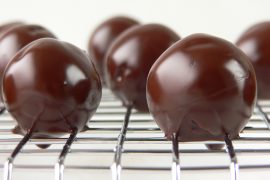
    I hand make Belgian chocolate candy and other edible treats like granola, spoon fudge, and caramel sauce. I opened my Etsy shop in August 2008, but I have been making candy for more than 20 years.

    When do you use basic math in your job?  

    I use math DAILY! I need to measure ingredients for my treat recipes and weigh my products to ensure my customers receive the amount of product they ordered. I measure and weigh boxes to prepare them for shipment. Also, I triple check all my orders to make sure all amounts, charges and weights are correct. From start to finish, on one order, I use math at least five times.

    Do you use any technology to help with this math? 

    Of course I use old-fashioned measuring cups to measure ingredients, and a scale to weigh ingredients and packages. I use a calculator to calculate the price of my products and a computer is very useful to store spreadsheets so I can keep track of all my sales, purchases, expenses, shipping costs, etc.

    Math helps to keep my business organized so I can see how I am doing on a daily basis. Without math I would be lost and would not know how my business is performing.

    How comfortable with math do you feel?  

    Math has never been my strong suit; in fact I had a math tutor for many years while I was in middle and high school, when I took algebra, calculus and geometry. However, since I use math on a daily basis I am comfortable with math and in my skills now.

    Did you have to learn new skills in order to do the math you use in your job? 

    All of the math I learned in school has played a role in my job at some point or another. Sometimes I have had to re-learn certain math skills or just refresh my memory by practicing a bit. The only new skill I would say I had to learn was some basic accounting since I never took an accounting class.

    Nicole’s blog has gorgeous, mouthwatering photos of sweets, plus free recipes.  Visit! But first, if you have questions for her, ask them in the comments section.
  • Math at Work Monday: Elana the personal shopper

    Math at Work Monday: Elana the personal shopper

    On the whole, I don’t like shopping.  But I do like shopping for Christmas gifts. Still, at around this time of year, I’m about ready to hand over my list to someone else — say a personal shopper?  And if she can help me find that perfect outfit for Saturday night’s holiday party?  Even better.

    Meet Elana Pruitt, a personal shopper in the L.A. area of California.  Elana isn’t just a shopper.  She helps her clients figure out what they need and how to find it. She also writes about fashion at her blog, Good Girl Gone Shopping. Here’s how she uses math in her job.

    Can you explain what you do for a living?  

    I am a personal shopper and wardrobe consultant. My day-to-day schedule is never the same because the services I carry out are based on the every individual’s needs. I am committed to helping men and women find quality fashion not just for affordable cost, but at their specific budget. My job entails a variety of duties for my clients: re-organizing closets, styling new outfits using the clothes they already own to prove the versatility of their wardrobe, shopping with (or without) the client at particular stores or online, styling new purchases with their existing wardrobe after a shopping trip, and conducting online research.

    Although my services are affordable, I realize that hiring a personal shopper and wardrobe consultant is a luxury. So the other half of my job entails writing about fashion. On my blog, Good Girl Gone Shopping, I provide helpful information about shopping and fashion, with references to our culture, entertainment, and the celebrity phenomenon.

    When do you use basic math in your job?  

    I’ve never been asked this question before – it’s a good one! In thinking about how I incorporate math into my job, I realize that I use it frequently. From counting items in a client’s closet to calculating my gas mileage for a shopping trip to scheduling appointments throughout the month. Everything I do involves the basics of math: addition, subtraction, multiplication, division, and percentages. Most of the time, I don’t consciously think about the fact that math is a natural, necessary, and unavoidable component of my business. The main time when I am aware that I am using math is when there is a transaction of sorts. I charge hourly rates and a commission percentage of purchases, which needs to be clearly defined to the client. In addition, I sell advertising space on my Good Girl Gone Shopping blog. This also needs to be clearly structured for the client to understand (ads can be sold on a 6-month basis or yearly). Those two specific situations are when I am so happy I paid attention in math class throughout college!

    Do you use any technology to help with this math?  

    I am usually old school – I use a good ol’ pencil and paper most of the time. Then to double check my work, I use the calculator either on my computer or from my phone.

    How do you think math helps you do your job better?

    For my job, it’s not that it makes it better – it’s just a part of it. Math is that essential to my work as a personal shopper, wardrobe consultant, and fashion blogger.

    How comfortable with math do you feel?  

    Basic math is second nature to me. Algebraic formulas take more effort. But fortunately, I’m doing something right, because I am able to successfully see my job through, from the consultation with the client to follow-up communication after my service with him or her is complete.  Overall, I feel comfortable with math…basic math.

    What kind of math did you take in high school?  

    I took Pre-Algebra, Algebra, and Geometry. I do recall struggling with Geometry. I have always respected those who excel in the study of math, because it requires such analytical thinking. I hate to say I wasn’t good at it, but let’s just say I would never choose to enter that field!

    Did you have to learn new skills in order to do the math you use in your job? 

    The skills I use now are pretty much standard. Students everywhere need to erase this thought from their brain, “I don’t know why I’m taking this class, I won’t need it in the real world when I grow up!” The journey throughout adulthood can be amazing if you are knowledgeable and skilled in a multitude of areas. Never say never!

    Have you ever wondered how personal shopping works? Now’s your chance to ask Elana.  Post your question in the comments section!

  • Math at Work Monday: John the coffee roaster

    Math at Work Monday: John the coffee roaster

    We’re rounding out our month of nesting today and Wednesday. What’s cozier than a cup of hot coffee?  If you’ve ever wondered where your morning cup of Joe comes from, meet John Curry, owner of Buona Caffe, an artisan coffee roaster.  

    Can you explain what you do for a living?

    I roast and sell specialty coffee.

    When do you use basic math in your job?

    I use math to figure out how much coffee I need to roast for our orders. When coffee is roasted, it loses about 18% of its weight. I have to take that into account in my calculations. On my blends, I have to calculate proportions of coffees, whether it’s for a 12-ounce retail bag or a 5-pound bag for a restaurant. We also use math for brewing coffee – different brewing methods require different amounts of grounds and ratios to water.

    We have to consider shipping weights when we order green coffee beans. And I use basic math for running the business – tracking sales and outstanding invoices, forecasting sales, that kind of thing.

    I use math is just about every aspect of roasting and selling coffee. Math is a very important part of running your own business. Money is all numbers!

    Do you use any technology to help with this math?

    Yes. I use a calculator to do proportions for blends. Accuracy is very important.

    How do you think math helps you do your job better?

    Without it, I couldn’t be sure of any of my measurements. Since we sell a food product, it’s very important that our product weighs what the label says it weighs and that our proportions are accurate. If we don’t do the right math every time, our coffee won’t taste as good as it should!

    Upperline

    How comfortable with math do you feel?

    I feel relatively comfortable with math all the time. I use it with hobbies as well, such  as woodworking. I also use math with spreadsheets.

    What kind of math did you take in high school?

    That was a long time ago! I know I took geometry. I didn’t take any higher level math. I did not like math, and I was not good at it. I was better at geometry than other kinds of math. I feel more comfortable with math now than I did then.

    Did you have to learn new skills to do this math?

    I didn’t have to learn new skills to do this math. I do a lot of percentages and ratios.

    So what are your big questions about roasting coffee?  Ask John!