Category: Math for Grownups

  • Last-Minute Gifts for Geeks and Not-So-Geeks

    Last-Minute Gifts for Geeks and Not-So-Geeks

    I don’t know about you, but I’m still pulling together some gifts — with less than a week before Christmas. Each year, I try to get done before December, but no dice. I must love the stress.

    So, if you’re still looking for a little giftie or two for the geek — or geek-lover or geek-wannabe? — in your life, here are some ideas.

    Mathletic Department Hoodie

    I am not an athlete. Not by any stretch of the imagination.  But even I would wear this hoodie. It’s the perfect mix of geek and cool. Well, at least I think so.

    From Cafe Press.

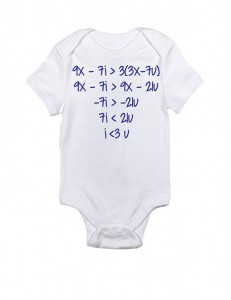
    Math Love Onesie

    It might take you a moment to see the beauty of this design. I’ll wait.

    Get it? Even if you can’t follow the solution to from start to finish, the last line is perfection. (Must speak internet.) And while you’re baby is sporting this fashionable accessory, you can review solving inequalities.

    Made by Skyhawk Press, Monterey, Cal. Available on Etsy.

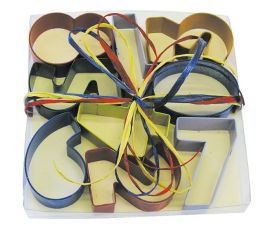
    Number Cookie Cutters

    Because how else can you make a π pie? I have a set like these, and while they’re terrific for really geeky cookies, they’re also great for making cute kid-party sweets — Like a bunch of 3s for a three-year old’s party. They’re also handy when you need number “stencils.”

    Available at Barnes and Noble (order online and pick up at the store).

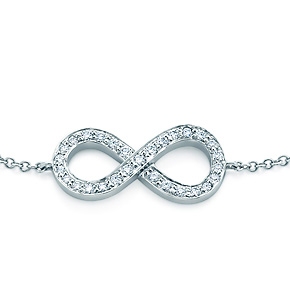
    Tiffany & Co. Infinity Bracelet

    Splurge for the platinum with diamonds or stuff her stocking with a more moderately priced bobble in sterling silver. Either way, you’re telling her that you mean forever in a delightfully geeky way.

    Available at Tiffany & Co.

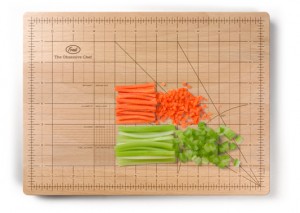
    Obsessive Chef Cutting Board

    We all have one in our families or among our friends: the home chef who cooks with the precision of a surgeon. And finally, here’s a cutting board they can truly appreciate. With guidelines for julienne, chop and mincing — and even including curves and bias marks — veggies have never been so perfectly prepared.

    Made by Fred & Friends.

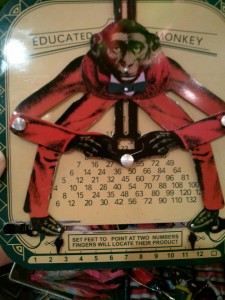
    Consul the Educated Monkey Calculator

    This has to be my very favorite find of the holiday season. A reproduction of a 1916 toy created by William Robertson, this little piece of tin can find the product of two numbers in the shake of a tail. Give it to a particularly precocious child and ask him or her to figure out why it works. (Hint: It’s all about the triangles.)

    Available at local gift shops and online.

    Need more ideas? Check out last year’s list, which offers ideas specifically for kids.

    And if you’re in the market for something funny and useful, check out my book, Math for Grownups, designed to ease the fears and pain of even the most resistent math-phobe. Promise. (Available online, at local independent bookstores and Barnes & Noble.)

    Do you have gift ideas to share? Please post about them in the comment section. (I still have a few things to pick up myself!)

  • Math at Work Monday: Sole the fashion designer

    Math at Work Monday: Sole the fashion designer

    I’ve been dying to have a fashion designer in this spot for a very long time. So when designer Sole Salvo‘s message arrived in my inbox on Friday morning, I was thrilled! As an avid sewer — who doesn’t like using patterns — I am fascinated with the process of fashion design. I know there is a lot of math involved. Some of it has to be a gut instinct — how will this angle work on a human body? And some of it is very calculated — what do I need to add in order to get a 5/8″ seam allowance?

    Sole has been working as a designer for nine years, currently working for a large clothing company in New York. Here’s how she uses math in her job.

    Can you explain what you do for a living? 

    I design women’s clothing. I sketch new styles then give the specs (measurements of the garment, like length, waist measurement, neck drop etc) to the tech designer or pattern maker to make a sample. I pick out fabrics, colors and trims, like buttons and thread, to complete the look of each garment. Once my seasonal collection is complete, I review it with my merchant team who decided what to buy for the store.

    When do you use basic math in your job?

    Math is important for design. We have to measure our sample garments to know where we need to add or subtract fabric to make the garment fit well. Additionally a strong understanding of geometry is important for understanding how the flat pattern shape will make up into a 3D garment as well as what part of the flat pattern to change to fix the fit.

    Do you use any technology (like calculators or computers) to help with this math?

    I usually don’t use technology for this myself because the calculations I have to do are usually simple, like adding 1/4″ here and 1/8″ there, but my cross functional partners on the tech team do use a computer program to digitally manipulate the flat garment pattern. I use Illustrator to draw my flat sketches — these are the detailed sketches that the factory pairs with the measurement specs to make up the sample. These drawings have to be very accurate and clear so the factory can see each detail of stitching and seaming, as well as the overall proportion and look of the garment.

    How do you think math helps you do your job better?

    Without math it would be impossible to keep sizes consistent, and it would be impossible to draft a garment pattern. In addition it would be impossible to create trim pages — the list of trims required to make a garment. We use numbers on those as well to tell the factory how many buttons to use on each shirt. The factory must multiply the number of buttons by the number of shirts they are making to order enough buttons. It becomes very important when ordering because if you make a little mistake on a style that has 100,000 pieces on order, all of a sudden you could wind up with 100,000 too many buttons!

    How comfortable with math do you feel?

    I feel very comfortable with math in what I do. I deal with whole numbers and simple fractions for the most part.  I also have a strong sense of geometry. I can visualize what a pattern piece would look like if it is draped on the body, and this helps me design and also helps me make comments in my fittings.

    What kind of math did you take in high school?

    I took algebra, geometry and calculus.  Algebra was manageable, geometry I could do with my eyes closed. I can essentially reander 3D models in my head, so anything that involves shapes and how to manipulate them comes naturally to me. Calculus was more of a challenge. When it came to doing more complicated problems, I struggled. I did ok in the end, but I had to really study in calculus.

    Did you have to learn new skills in order to do the math you use in your job?

    Knowing how to add fractions comes in handy every day.  Also area is important. If you are working on a garment, sometimes the size might be right, but the fabric is just distributed in the wrong place. To fix it, you might have to keep your total area the same, but just shift it around to make it lay flat or to drape just the right way.

    Thanks so much, Sole! If you have questions for her, ask them in the comments section. 

  • Tis the Season to Give Generously: Do the math first

    Tis the Season to Give Generously: Do the math first

    Yesterday afternoon, I dropped off the gifts I had purchased for a mother and son who are spending the holidays in a women’s shelter. He’s not even three years old, and he’s already had a much rougher life than I. But at least this year, he’ll have a Little People fire truck and new set of ABC and counting board books.

    I don’t share this story to toot my horn. Plenty of people do as much or more than that each year. And I’m guessing their motivation is the same is mine — it feels good to give.

    At the same time my math brain loves some guidelines. I grew up Lutheran, and I was expected to tithe 10% of my allowance. It was a great practice to get into, but now that I’m not a tithing church-goer, I miss having a formula. How much giving is “enough”? How can I know if I’m pushing myself enough?

    Last year, I came across Peter Singer, who developed a really wonderful set of formulas based on a variety of different incomes. I wrote about it last fall, and I thought I point you to it today — in case you didn’t see it or need a reminder.

    The Math of Generosity

    No matter what holiday you celebrate in December, the month has traditionally marked a time for charitable giving.  The weather is growing colder in some areas, making it much tougher on the homeless.  The end of the year is creeping up, and with it the deadline for tax exemptions for charitable giving.  And holiday cheer often means counting our blessings and remembering those who are less fortunate.

    Yes, December is the time for giving.  But how much is enough? And what is too much?  As we attempt to balance our own needs (especially in these difficult economic times), many of us struggle with our own sense of guilt and generosity. Read the rest of this post.

    Do you have a formula for developing your yearly contributions? Share it — or your thoughts about using math to make charitable giving decisions — in a comment.

  • 12-12-12: A once-in-a-lifetime date

    12-12-12: A once-in-a-lifetime date

    Today, the Museum of Mathematics (MoMath) in New York City has its opening ceremony. But that’s not what makes this date really special. Organizers of this tribute to numeracy chose 12-12-12 very carefully. Want to guess why?

    Geeks and superstitious folks around the world love dates like today’s. It’s exactly six years, six months and six days from the last time we saw such a repetitive day: June 6, 2006 (06-06-06). And there won’t be another one until 3001. I don’t know about you, but I won’t be around for that one.

    I imagine there were a few people up at 1:21:02 this morning, admiring an elegant numerical palindrome — when the time and date reads the same left-to-right as right-to-left.

    2012-12-12, 1:21:02 = 20:12:1, 21-21-2102

    What can I say? Some people like patterns. Brides and grooms are tying the knots in record numbers today. According to a report by David’s Bridal, about 7,500 couples will wed in the U.S. today. That’s a 1,446 percent increase over December 12, 2011.

    An anniversary date like that is easy to remember, right?

    But for us mathematically minded folks, it’s the number 12 that really stands out. That’s because it’s so flexible. Its factors are 2, 3, 4 and 6, which means it can be evenly divided by all of these numbers. This has a great number of applications — from a clock face to an egg carton. If you have to file your taxes quarterly — as I do — you know that this means every 3 months. That’s simply because:

    4 quarters • 3 months = 12 months

    As a result of this numerical flexibility, 12 is a pretty big deal in geometry as well. A cube as 12 sides, and there are 12 pentominoes, or shapes that can be created with five squares that share sides.

    Each of these wooden tiles is a pentomino. Photo courtesy of Jeffrey Bary.

    Pythagoras got so excited by the number 12, he taught that it has divine meaning.

    Perhaps this significance is why the number 12 is such a big deal in some religions and spiritual practices:

    • 12 Tribes of Israel
    • 12 disciples of Jesus
    • 12 feasts of Eastern Orthodoxy
    • 12 stations of life in Buddhism
    • 12 Jyotirlingas, Hindu Shaivism temples
    • 12 direct descendants of Muhammad in Shia Islam

    And in everyday, secular life, this special number also abounds:

    • 12 members of a jury (U.S.)
    • 12 inches in a foot
    • 12 steps in Alcoholics Anonymous (and its sister programs)
    • 12 zodiac signs
    • 12 basic hues on the color wheel
    • 12 pairs of ribs in the human body

    So whether you love the idea of a repetitive date, a numerical palindrome, or the inherent beauty of the number 12 — or perhaps you’re just really glad it’s hump-day — welcome to 12-12-12. Besides, any day is worth celebrating, right?

    Did you notice the special nature of today’s date? Have you planned a special event — like a wedding! — for today? Share your thoughts on today’s date in the comments section.

  • Math at Work Monday: Cecilia the grant writer

    Math at Work Monday: Cecilia the grant writer

    While we’re on the subject of museums, I thought I’d introduce you to Cecilia Meisner, who is the Director of Grants and Government Relations at the Baltimore Museum of Art (BMA). In short, she’s a fundraiser, specializing in writing grants (rather than asking folks like you and me for donations). These grants may come from foundations or government agencies or corporate funding divisions. 

    And with a newly renovated contemporary art wing, the BMA can use all of the funds it can get. Naturally, Cecilia uses quite a bit of math in her job. Here’s how.

    Can you explain what you do for a living?  I oversee fundraising from foundation, corporate, and government sources to support The Baltimore Museum of Art.  A lot of my work is writing (grant proposals, reports, letters of inquiry or acknowledgement), but I also do a lot of work with creating grant budgets, tracking grant-funded expenses, and reporting back to the funders.

    When do you use basic math in your job?  It can be as simple as applying a percentage to a salary to show the value of staff benefits in a grant proposals, and as complicated as tracking hours worked on a project for dozens of employees over the course of two years.

    Do you use any technology to help with this math?  I NEVER do math in my head: I always use an old-fashioned adding machine with a paper tape for quick calculations, and I loooove spreadsheet programs for creating budgets and tracking expenses.  The first one I ever used was Lotus 1-2-3 but now I use Excel.  I have been working in this job long enough that I used to use huge binders full of ledger paper to track expenses with pen on paper – hence the need to run a paper tape on everything: they didn’t add up automatically, unlike computerized spreadsheets!

    How do you think math helps you do your job better?  Funders don’t want to give money unless they feel secure that it is enough to get the job done, and that the recipient will manage the money carefully.  And since we are audited every year by an outside auditing firm, it is a lot easier to make sure everything is done right the first time, rather than having to go back and make a lot of end-of-year journal entries in the organization’s books.

    How comfortable with math do you feel?  I am very comfortable with the math I use in my work: basic functions plus percentages (which a surprising number of people do wrong, I find as I review draft grant budgets).  That being said, I am utterly incapable of helping my 10th grader with his Algebra II/Pre-Calc, Trig, Probability & Statistics, or Physics homework.

    What kind of math did you take in high school?  I didn’t take any math after 9th grade “pre-Geometry.”  I was very intimidated by math, and I took enough science courses (Chemistry, Physics, Geology) to fulfill my high school’s joint math/science requirement. Because I got a high enough grade on the ACT test math portion, I was able to exempt out of Freshman Mathematics in college. I didn’t need any additional math as a requirement for my major. I escaped math in high school and college, but it caught up with me in the work world, and it turns out that it isn’t so bad after all! I wish I had Math for Grownups when I was in high school and college – I might not have been so intimidated!

    Did you have to learn new skills in order to do the math you use in your job? I was totally set with the basic addition-mulitplication-subtraction-division-percentages skills, but I did need to learn how to use spreadsheet and double-entry accounting, and how to use the specific spreadsheet software programs.

    Do you have questions about grant writing and administration? If so, ask in the comments section, and I’ll let Cecilia know!

  • Hanukkah by the Numbers

    Hanukkah by the Numbers

    Tomorrow, at sundown, marks the beginning of the Festival of Lights or Hanukkah (or Chanukah, Chanukkah or Chanuka). By most standards, this is not a significant holiday for those who practice Judaism, but it is fun for the kids — oh and the latkes! (Until this morning, I did not know that it’s traditional to eat fried food during this holiday, to commemorate the miraculous oil that lasted eight days and eight nights. Learn something new every day.)

    [laurabooks]

    In honor of Hanukkah, I bring you some numbers that are important to this holiday. Enjoy!

    6.6 million: Estimated Jewish population in the U.S. in 2011

    2.1: Percent of the entire U.S. population in that year

    8: Days and nights of Hanukkah, and a number of days that a one-day supply of oil miraculously burned during the time of the rededication of the temple by the Maccabees.

    25: The day of the Jewish month of Kislev, on which Hanukkah is celebrated each year

    9: Including the shammus — or service — candle, number of candles in a menorah

    3: Number of blessings recited during the first night of Hanukkah

    2: Number of blessings recited during all other nights of Hanukkah

    30: Minimum number of minutes the Hanukkah candles should burn each night

    44: Total candles lit (including the shammus) overall eight days.

    4: Number of Hebrew letters inscribed on a dreidel

    92: Approximate number of years that American chocolatiers have been making chocolate gelt.

    4: Number of potatoes required for Debbie Koenig’s most delicious latke recipe. (My favorite one I’ve ever tried!)

    19: Number of celebrities mentioned in Adam Sandler’s Hanukkah Song.

    2: Number of those who are not Jewish

    What other numbers are important to Hanukkah? Share them in the comments section.

  • Time for Holiday Cookies — and Fractions

    Time for Holiday Cookies — and Fractions

    I haven’t started my holiday baking yet, but that time is just around the corner. Today, I bring you a post from last year, Cookie Exchange Math, in which I look at the fractions involved in tripling my cow cookie — yes, I said cow cookie — recipe. If you need to feed the masses, check out an easy way to manage those pesky and sometimes strange fractions that come from increasing a recipe.

    Ah, the cookie exchange!  What better way to multiply the variety of your holiday goodies.  (You can always give the date bars to your great aunt Marge.)

    The problem with this annual event is the math required to make five or six dozen cookies from a recipe that yields three dozen.  That’s what I call “cookie exchange math.”

    Never fear! You can handle this task without tossing your rolling pin through the kitchen window. Take a few deep breaths and think things through.

    To double or triple a recipe is pretty simple — just multiply each ingredient measurement by the amount you want to increase the recipe by.  But it’s also pretty darned easy to get confused, especially if there are fractions involved.  (And there are always fractions involved.)

    The trick is to look at each ingredient one at a time.  Don’t be a hero!  Use a pencil and paper if you need to.  (Better yet, if you alter a recipe often enough, jot down the changes in the margin of your cookbook.)  It’s also a good idea to collect all of your ingredients before you get started.  That’ll save you from having to borrow an egg from your neighbor after your oven is preheated.

    Read the rest here — and you’ll avoid fractions-related, messy kitchen mistakes.

    While you’re at it, check out this interview I did with fantastic candy-maker, Nicole Varrenti, owner of Nicole’s Treats. (I love her chocolate mustaches, personally.) It shouldn’t be any surprise that she uses math daily.

    Finally, if you have some holiday-related math questions, would you mind sharing them with me? What trips you up — mathematically — at this time of year? Comment below!

  • Math at Work Monday: Mary Helen the History Museum Curator

    Math at Work Monday: Mary Helen the History Museum Curator

    I’ve known Mary Helen Dellinger my whole life. That’s because she’s my cousin, born a whole two months before I was (a fact she never let me forget when we were kids). Growing up in Virginia as we both did, it was darned near impossible to avoid a history lesson at every turn. And while I never really caught the bug, Mary Helen got it bad.

    She’s been a history museum curator for 22 years now, the last year in a new position as curator for the City of Manassas Museum System, where she has overseen exhibits that include photographs of the Civil War and a collection that features a rare, surviving “John Brown Pike,” or spear, with which abolitionist Brown had intended to arm sympathizers in an aborted raid at Harper’s Ferry.

    Yeah, this is cool stuff. And much to Mary Helen’s chagrin, her job includes quite a bit of math. She’s not shy about expressing her disdain for the Queen of Sciences, but like most grownups, she has learned to get along just fine.

    Can you explain what you do for a living? 

    There are two major aspects to my with the Manassas Museum System. First, I am in charge of maintaining the Museum’s collection of objects. This includes meeting with prospective donors and accepting new donations for the collection, making sure the collection is properly stored and that a proper environment is maintained at all times (stable temperature and humidity at acceptable levels), and that adequate security is always in place. There is a lot of paperwork that goes along with this – Deed of Gift forms for donors, thank you letters, conservation reports, tax forms for those objects that are really valuable. Everything has to be photographed and entered into the Museum’s collection database. The entire collection numbers over 10,000 pieces – most of it in off site storage. Much of the work I described above is backlogged from the past eight years, so there is always something to keep me busy.

    The second aspect of my job is running the Museum’s exhibition program. Exhibit schedules are usually created 2-3 years out. So right now, I am scheduling shows for 2015. For exhibits that we do “in-house” I select objects from our collection and negotiate loans from private collectors and other museums. I also have to write labels, work with exhibit designers and (if necessary) conservators, and do things like select paint colors, make object mounts, etc. – basically come up with the look and feel of the gallery space. The final step in all of this is the installation process – which is the most fun of all.  It’s a very creative process and neat to see it all come together in the end. On occasion, I will rent a traveling exhibition that was put together by another museum. When I do that, it is just a matter of unpacking it and installing it.

    When do you use basic math in your job? (And what kind of math is it?) If you can offer a very specific situation when math is important, that would be great.

    Math is very important when creating any exhibition. First, I have to keep in mind what the square footage is in the gallery, and how much space the objects in the exhibits will take up. This includes spaces on the floor, inside cases, and on the walls. Large objects take up lots of floor space but also cover the wall space behind them. Cases have to hold the objects AND the labels. Framed pieces go on the walls. My design must include measurements of all the major components that include height, width and depth. This allows me to make sure everything will fit and yet allow space for visitors to move through the exhibit. During the design process we are constantly measuring, re-measuring and moving things around to get the most out of the space. For complicated exhibits we use floor plans and sketch in everything including measurements to help us understand the relationships between the pieces and if we are leaving enough space. You don’t want to get to installation and realize you don’t have enough room for a key piece of the exhibit. There is some geometry involved here (understanding angles and lines) but most of it is basic addition, subtraction, etc.

    Secondly, each exhibit has an individual budget that I am responsible for creating at the outset of the project. I have to include designer time, materials, the cost of creating graphics, prepping the gallery space, etc. Each budget has a contingency built in for those unexpected things that inevitably crop up. I have to carefully track expenses to make sure I don’t overrun my budget.

    In addition to the exhibitions, I am in charge of the annual budget for my part of the department. In fact, we are in the middle of creating the budget for FY 2014 right now. Using last years’ budget as a base, I have to project (using the aforementioned two-year exhibition schedule) how much money I am going to need in the next fiscal year. This requires me to know how much contractors charge per hour and how many hours I am going to need them, the cost of supplies, shipping schedules, etc. The math used here is addition/subtraction/multiplication/division – but it can be complicated because you are working with a lot of assumptions.

    Do you use any technology (like calculators or computers) to help with this math? Why or why not?

    I use calculators when doing the budget. For exhibit design, we use basic rulers and calculators. Nothing fancy.

    How do you think math helps you do your job better?

    Math enables me to design exhibits that are affordable, and work within the spaces that we have.

    How comfortable with math do you feel? Does this math feel different to you? (In other words, is it easier to do this math at work or do you feel relatively comfortable with math all the time?)

    I have NEVER been comfortable with math, not even today, 22 years into my career. Budgets, especially, make me nervous because if we don’t get it right, that will impact future expenditures and our ability to do other projects. So while the math I use in my job is familiar to me, because it is something I do every day, I don’t think I will ever be comfortable with it.

    What kind of math did you take in high school? Did you like it/feel like you were good at it?

    In high school I took Algebra I and II (barely passing both) and Geometry (did okay in this). I absolutely hated math, and only took it because I had to. Despite my best efforts, going to all the extra tutorials, studying every night, etc. I never could get it. The abstract concepts were not something I could ever wrap my mind around. Put me in a history class with definable dates, facts, and people to learn about and I was fine. I never had to “show my work” in history.

    Did you have to learn new skills in order to do the math you use in your job? Or was it something that you could pick up using the skills you learned in school?

    The math skills I learned in elementary/high school are enough for me to do my job. I have not had to learn anything new.


  • U-boats, Enigma and an Apple: The story of Alan Turing

    U-boats, Enigma and an Apple: The story of Alan Turing

    The British were deep in the throes of the Battle of the Atlantic. In six short months of 1940, German U-boats had sunk three million tons of Allied shipping. The U.S. Navy joined the quickly growing British forces in the region to help push back the German attack on convoys of Allied supplies and imported goods. The Germans had one goal: keep Britain isolated and vulnerable to attack.

    But the Germans were also too confident in their system of sending encrypted messages from land to its seamen in the Atlantic. See, they were depending on a remarkable, typewriter-like encryption machine, called Enigma. Messages could be scrambled using a collection of wheels that offered billions of combinations. The complexity — and simplicity — of the Enigma machine was its greatest success and failure.

    By 1939, the Poles had managed to get their hands on an Enigma machine, and just before the country was invaded, the Polish intelligence organization sent the machine to the British. A code-breaking headquarters was set up in Bletchley Park an estate in Buckinghamshire.

    And this is where math — and Alan Turing — comes into the story.

    Born in London in 1912, Turing showed great aptitude for mathematics at a young age — but like many of the great mathematicians before him, he was much more interested in following his own instincts and interests. As a result, his performance in school was checkered. In 1931, he enrolled in King’s College Cambridge to study mathematics, and after graduating in 1935, he became a fellow of the school.

    Turing was fascinated by a variety of mathematical concepts, including logic and probability theory. He independently discovered the Central Limit Theorem, which explains why many distributions are close to the normal distribution (or bell curve). (Trust me, this is a really big deal.) He also began experimenting with algorithms, designing the Turing machine. This led him to Princeton, where he studied with Alonzo Church, before returning to England in 1938.

    At first, Turning considered his “machine” to be an abstract concept — a computer was a person doing a computation. But over time, he began considering the possibility that an actual machine could be built that would follow algorithms to solve problems. Once back in England, he began developing this invention.

    But in 1939, war was declared. Turing was asked to be a part of the Bletchley Park team in England. Using the stolen Enigma machine provided by the Poles, he and mathematician Gordon Welchman developed the first “bombe” or WWII, British code-breaking machine, which collected top-secret information the team called ULTRA. By the end of the war, Turing and his colleagues had developed 49 such bombes, which were instrumental in decoding German Navy U-Boat messages during the long Battle of the Atlantic.

    While Turing’s inventions did not end World War II, historians estimate that his contributions shorted it by several years and helped save thousands of lives.

    This work propelled Turing into the burgeoning field of computer science. Employed by the National Physical Laboratory, he set his mind to developing the first digital computer, but his colleagues dismissed his ideas. In 1949, he joined Manchester University, where he laid the groundwork for the field of artificial intelligence.

    But something was simmering under the surface: Turing’s sexuality. He didn’t particularly hide his attraction to men, and in 1952, he was arrested and convicted for the crime of homosexuality. His choice was to go to prison or accept chemical castration, a process designed to reduce the libido and thus sexual activity. He chose the latter. Although he had continued to work in secret for the Government Communications Headquarters (GCHQ, the British intelligence agency), because he was an out, gay man, his security clearance was revoked. Still, Turing went back to work on his research in computers and applying mathematics to biology and medicine.

    In the summer of 1954, his house cleaner found Turing dead in his bedroom, a half eaten apple near his body. The coroner found that he had died of cyanide poisoning, and the subsequent inquest ruled his death a suicide. However, his mother asserted that his death was accidental, a result of cyanide residue on his fingers.

    In 2009, the British government issued a posthumous apology to Turing for his arrest, conviction and chemical castration. Prime Minister Brown called his treatment “appalling”:

    While Turing was dealt with under the law of the time and we can’t put the clock back, his treatment was of course utterly unfair and I am pleased to have the chance to say how deeply sorry I and we all are for what happened to him … So on behalf of the British government, and all those who live freely thanks to Alan’s work I am very proud to say: we’re sorry, you deserved so much better.

    This year, marking the 100-year anniversary of his birth, much of the math and science community around the world has celebrated Alan Turing Year, designed to elevate Turing’s contributions to the fields. (And in fact, Google introduced one of the most challenging of its Doodles on Turing’s 100th birthday. Check it out!)

    What did you already know about Alan Turing? And what could more could he have accomplished had his life not been so short? Share your reactions in the comments section.

    I have had a wonderful, wonderful time exploring these stories of math history this month. Let’s do it again sometime! If you’d like to learn something more about math history, drop me a line.

  • The Mother of All Scientific Computing

    The Mother of All Scientific Computing

    Ada Lovelace was probably bound for greatness. The product of the brief marriage between Lord Byron (yes, that Lord Byron) and Anne Isabella (“Annabella”) Milbanke, she was born in 1815. But in true Romantic tragedy, her parents separated soon after her birth , and she never knew her father. Her mother, whom Lord Byron called “the Princess of Parallelograms,” was pretty quick with the calculations, and so Lovelace got a good education in math and science. This approach also served to protect Lovelace from the fiery passions of poetry (according to her prudish mother).

    Seems Ada got the best of both parents. At age 13, she developed a design for a flying machine — quite a feat in 1828, a full 85 years before and an ocean away from the Wright Brothers at Kitty Hawk. But over time, her approach to mathematics was decidedly verbal. She called herself the poetic scientist, and her writings were imaginative and described in metaphors.

    When she was 17 years old, Lovelace met Mary Somerville, the self-taught mathematician and scientist. The two became fast friends, attending lectures, demonstrations and concerts together. And it was Somerville who introduced Lovelace to the man who would help cement her name in history.

    Charles Babbage was the inventor of the Difference Engine, a rudimentary calculator that wasn’t built until more than 100 years after his death. He and Lovelace met in 1834, when he was working out the design of his next invention, the Analytic Engine.

    Unlike his Difference Engine, this new design was programmable, an idea that completely enthralled Lovelace. She and Babbage became good friends and colleagues, and in 1843, Babbage asked Lovelace to translate into English a French summary of a presentation he gave describing the Analytic Engine. And by the way, could she also expand upon the ideas, since she was so familiar with the design?

    What Lovelace wrote was nothing less than prescient:

    The distinctive characteristic of the Analytical Engine, and that which has rendered it possible to endow mechanism with such extensive faculties as bid fair to make this engine the executive right-hand of abstract algebra, is the introduction into it of the principle which Jacquard devised for regulating, by means of punched cards, the most complicated patterns in the fabrication of brocaded stuffs. It is in this that the distinction between the two engines lies. Nothing of the sort exists in the Difference Engine. We may say most aptly that the Analytical Engine weaves algebraical patterns just as the Jacquard loom weaves flowers and leaves.

    (I said she wrote in metaphors!)

    Again Babbage’s machine was not built in his lifetime, but the design — featuring punch cards of the early mechanical computers — is still acknowledged as the precursor to the modern-day computer. And Lovelace is considered the first computer programmer because of what she suggested the machine could do: compute the Bernoulli numbers.

    What the heck are they? Well, first off, Bernoulli numbers are a pretty big deal in number theory and analysis. Basically, they’re a sequence (or list) of rational numbers (or decimals that either repeat or terminate). These numbers show up in a variety of places that won’t matter to you. The important thing here is that they are darned difficult to compute. In the 19th century, folks who needed them typically depended on tables that listed these numbers. But Lovelace developed a program that would generate them automatically.

    Thus, the first computer program program was born.

    Unfortunately for all of us, Lovelace would never see her invention realized. She died of cancer in 1852, before publishing anything more. Still, her contribution is so great that computer geeks around the world still revere her. In 1977, the Department of Defense named its high-level computer programming language Ada. Heck, the IT guy at my last regular job named his first daughter Ada.

    I wonder what Lord Byron would have written about his daughter, the poetic scientist?

    Had you heard of Ada Lovelace? What do you think Lord Byron would have thought of her contributions? Share your feedback below.

  • En Garde! The great calculus duel

    En Garde! The great calculus duel

    Before beginning this story, a little background. There are two really basic ways to think of calculus:

    1. The study of the infinite (extremely large) and the infinitesimal (extremely small).

    Or

    2. The study of limits. Imagine a gnat that is flying from the middle of a room to the doorway. The gnat first moves halfway to the door. Then he takes a little breather and moves half of the remaining distance. Another breather, another jaunt half of the remaining distance. And so on and so on. Will he ever get to the door?

    (Okay, most mathematicians might hate me for boiling things down to this very basic level, but for the average Joe or Jane, these explanations will do the trick. And due to space issues, I need for you to just trust me on why these things matter. Some day, I’ll write about the applications of calculus and other higher-level math.)

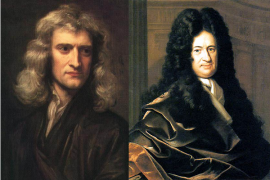
    If you think math history isn’t very exciting — in a Batman meets Joker or Clint Eastwood make-my-day kind of way — you’re pretty much right. There are a few life-and-death situations, like Galileo’s (okay, it was his soul in peril, not his physical body), but for the most part, mathematicians were either revered or went unnoticed. Except for Sir Isaac Newton and Gottfried Wilhelm Leibniz.

    I wish I could say that this was an actual duel, not because I love violence or wish ill on one of these fine mathematicians, but because it would make this story even more interesting — especially to high school students or grown ups who think math is BOR-ring. But in the end this story is still pretty fascinating, especially given the fact that these men never met or spoke on the phone or Skyped (because cell phones and the internet didn’t exist).

    It was 1666, around the time of the Apple Incident (you know, when a fallen apple prompted Newton to develop his theories of gravity) that The Sir thought up his ideas of fluxions. Don’t worry, you shouldn’t know what that word is, as it’s never used in modern mathematics. Instead we call his development differential calculus.

    Leibniz was just 20 years old at that time. Sure, he was a genius — he had already earned degrees in philosophy and law, and that year he published his first book, De Arte Combinatoria or On the Art of Combinations. While this expansion of his philosophy dissertation is obliquely related to mathematics, it was well before Leibniz began formally dabbling in the Queen of the Sciences.

    This timing is pretty darned important. Trust me.

    So Newton farts around with this idea of fluxions, finally getting around to publishing Method of Fluxions in 1736. But along he published a few manuscripts on the subject, sending early copies to some colleagues. Meanwhile, in Germany, Leibniz was jotting down his own discoveries in his journal. In 1675, he noodled around, finding the area under a the graph of y = f(x) using integral calculus.

    In other words, the two men were discovering calculus at the same time and in completely different parts of the world. (Okay, Germany and England weren’t too distant from one another, but in the 17th century, they may as well have been on different planets.)

    I’d bet that given Newton’s stereotypical absent-minded-professor approach to the world around him, he might never have even noticed Leibniz’s publications, which came in 1684 and 1686. Or at the very least, he might have simply acknowledged the great coincidence and moved on. (Apparently, the man could barely be trusted to keep a dinner date, much less worry about a rival in a different country.)

    In fact, it was neither Newton nor Leibniz who lit the fire of the great calculus war. In 1704, an anonymous review of Newton’s fluxions suggested that he borrowed [ie stole] the idea from Leibniz, which of course infuriated Newton. Letters flew back and forth between the two mathematicians and their surrogates. Newton was behind the publication of these letters, called Commercium Epistolicum Collinii & aliorum, De Analysi promota. (I am not kidding.) A summary of this publication was published anonymously in 1714 in the Philosophical Transactions of the Royal Society of London. But everyone knows that Newton wrote it.

    The Swiss mathematician Johann Bernoulli — who later made his own contributions to infinitesimal calculus — attempted to defend Leibniz, but Newton pretty much took him down. In the end Leibniz meekly defended himself, refusing to look through his “great heap of papers” to prove that he had independently discovered calculus at the same time as Newton. When he died in 1716, Leibniz had been pretty well beaten up by Newton and his buddies (metaphorically speaking, of course).

    It wasn’t until much later that everyone came around to the accepted and logical — though really coincidental — truth of the whole ordeal. Both Newton and Leibniz discovered calculus at the same time, using slightly different approaches. To many of us math folks, this is a truly wondrous event.

    But there’s more. Even though Newton enjoys (and did enjoy) a bit of celebrity for his genius, he largely wrote for himself, while Leibniz was a bit obsessive about notation, wanting to be sure that his discoveries could actually be used. This is one of the big reasons that today’s calculus is pretty much Leibniz’s discovery. Newton’s approach turns out to be a bit too clunky for everyday use.

    So whether or not you possess a general (or specific) understanding of calculus, you can certainly appreciate the 17th-century-style drama surrounding the discovery of this critical field of mathematics, right? At the very least, we can thank Newton and Leibniz for that.

    Did you know about the great calculus controversy? What questions does it bring up for you? Ask them in the comments section!

  • A Greek, a Bathtub and an Amazing Discovery

    A Greek, a Bathtub and an Amazing Discovery

    It seems to me that the Greek philosopher and scientist, Archimedes, was like the forgetful scientist. And a few tales of his life support this theory.

    Born in 287 B.C. on the island of Sicily, he had the good fortune — for him and us — to have a wealthy astronomer for a father. He enrolled in an Alexandrian school based on the principles of Euclid — the father of plane geometry. (You know: points, lines, planes, if the corresponding sides of two triangles are congruent then so are the triangles and vertical-angles-are-always-congruent.)

    He must have gotten a good education, because Archimedes went on to apply mathematics to building tools, like the Archimedes screw, which is used to efficiently pump water from one place to another. (Contraptions based on his design are still being used today.) He also explained how levers and pulleys work, developing new ways to move even heavier objects. (“Give me a lever long enough and a fulcrum on which to place it, and I shall move the world,” he said.)

    And speaking of heavy objects, my very favorite math story is about our dear, old, absent-minded Archimedes. Apparently his good buddy King Hiero hired a goldsmith to make him a crown of the shiny stuff. But the king was suspicious that the goldsmith was cheating him — giving him a crown made of a composite of gold and another (cheaper) metal.

    So Hiero took his crown to the smartest man he knew, Archimedes, who gave the problem some deep thought. But it wasn’t until he lowered himself into one of the city’s public baths that the solution hit him like a ton of bricks (or a crown of gold). He got so excited that he ran through the streets naked and shouting, “Eureka! Eureka!” or “I’ve got it! I’ve got it!”

    Nobody  knows for sure if this is a true story, but it sure got the attention of my high school math students back in the day. And Archimedes’ discovery has certainly stood the test of time. See, when he got into his bath, Archimedes noticed that his body caused some of the water to spill over the side. That got him thinking about the relationship between the volume of his body and the amount of water that was displaced. By replicating the experiment with gold and silver, he realized he had discovered the principle of displacement — if an object sinks in water, the amount of water that is displaced (or overflows) is equal to the volume of that object.

    P.S. Apparently the goldsmith was trying to pull one over on the king. The crown was made of iron and covered in gold.

    But when it came to mathematics, geometry was his thing. (Duh. It was ancient Greece, after all.) The man had an obsession with circles. In order to better estimate the value of π (or the ratio of the circumference of a circle to its diameter), he drew a 96-side regular polygon. (It was between 3 10/71 and 3 1/7.) He used the same “method of exhaustion” to find the area of a circle and the volume of a sphere.

    Archimedes’ death is a testament to his ability to focus on his studies with no regard to the world around him. Stories say that his last words were, “Do not disturb my circles.” These were said to the Roman soldier who killed him, as Archimedes studied.

    Did anything about Archimedes surprise you? Which of his discoveries have you counted on at home or work? Share your responses in the comments section.