Category: Math for Grownups

  • How Many Points Is That? (My weight loss journey)

    Photo courtesy of TheKarenD

    I am not one to talk about my personal weight loss (or gain, usually), especially since I’ve spent years bouncing between feeling good about my figure and avoiding mirrors at all costs.

    Fact is, I’ve tried lots and lots of diets — the South Beach DietBody for Life, calorie counting, Weight Watchers.  I’ve even tried hypnosis and extreme exercise.  But even though I have never felt completely successful in these attempts, I haven’t failed.  Each time, I’ve refined my goals and figured out things that I will and won’t do.

    With all this in mind, I decided in late December that I was going to give Weight Watchers another try. Two things have happened since I was last actively using the program: the PointsPlus program has been refined just a bit, and I wrote a math book.  I have to say that thinking about math so much over the last year has been a great benefit in figuring the PointsPlus values for everything I eat.

    (In case you have been living under a rock or don’t know who Jennifer Hudson is, the Weight Watchers program is based on a points system.  Each person is allotted a certain number of points per day, based on their weight and gender.  Everyone also has 49 extra points to eat throughout the week.  Foods have points values based on… well, read on, because that’s kind of what I’m getting to in this post.)

    My daily PointsPlus allotment is 26.  I use online tools to help me track the points of the foods that I’m eating (and the drinks that I’m drinking).  And of course, I have those extra 49 points to spread throughout the week.

    So first, my math brain figured out that if I use up all 49 points throughout the week (and believe me, I do!), that translates to 7 points per day.  If I only eat an extra 5 points one day, I have an extra 9 points on another day.  (The 49 points carry over, but if I don’t eat all 29 points in a day, poof! they’re gone.)

    Believe me, I’ve gotten damn good at these little calculations.  An extra 2 points is the difference between a light and a regular beer.

    But it’s the points values themselves that are so amazing, mathematically speaking.  Weight Watchers has done some pretty tricky math to make it easier for us to figure out what to eat.  Instead of counting just calories, we’re considering four components of our food:  protein, fiber, carbohydrates and fat.  These values are run through a formula that outputs a handy-dandy PointsPlus value.  (Online tools and special calculators find PointsPlus values for any foods, and common values are listed in a variety of Weight Watchers resources.)

    This formula is pretty complex.  I’ve seen versions of it online, and apparently it is written in black and white in Weight Watcher’s patent.  But I don’t need to have the details to know some pretty simple things:

    1.  Four of the formula’s variables are the amount of protein, fiber, carbohydrates and fat in the food.

    2.  The answer is likely rounded, since PointsPlus values are all whole numbers.

    That last one is pretty important.  It means that 0 points isn’t necessarily 0 points.

    You see, almost all veggies and fruits count as 0 points — a big change in the program.  This makes perfect sense, because we should all be eating more fruits and veggies, not deciding between a banana and a low-calorie fruit bar that was made in a factory far, far away.

    But fruits and veggies have calories and sugars. That means an apple may actually have 0.2 points (or something like that). So while one apple may be 0 points, 7 apples probably aren’t.  In other words, this is a case of 0 + 0 ≠ 0.

    If you’re among the thousands of folks who joined Weight Watchers this month, count math among the skills that will help you lose weight — whether you’re counting your points or trying to make sense of how it all works!

    Are you a Weight Watchers member? How have you used math to help you stay on track?  Or if you’ve managed your diet in other ways, how has math helped?  Respond in the comments section.

  • New Year’s Resolutions: How do you stack up?

    Photo courtesy of Pinti

    January 2012 seems extra long!  In fact, there are five — count ’em, five — Mondays in this month.  And while I’ve never missed a Math at Work Monday, I decided to take a break this week.  (Want to read up on previous Q&As for this month? Check them out:  Robert the exercise physiologist, Janine the professional organizer, Jameel the budget counselor and Kiki the career coach.)

    This month has been all about New Year’s Resolutions: getting in shape and getting organized, boning up on budget basics and becoming your own boss.  But what are our chances of actually succeeding in any (or all) of these things?  Once again, I ask you: let’s look at the math.

    According to a 2008 survey conducted by author and motivational speaker, Steven Shapiro and the Opinion Research Group (Princeton, NJ), 45 percent of Americans set New Year’s Resolutions, but only 8 percent of these reach their goals each year and 24 percent say they never keep their resolutions.

    (Disclaimer: I really can’t vouch for the veracity of this study, because I can’t find the data.  But let’s go with it, just to prove my point.  The numbers aren’t really all that important.)

    How many of you read those statistics and thought: “Well, there’s no point in even making resolutions! With chances like those, I’m doomed to fail!”

    Here’s the good news: If you nodded your head, you are not alone.  And here’s the better news: Statistics don’t work that way.

    It’s easy to look at stats and think that they must be true and must apply to everyone in every situation.  Cold, hard numbers don’t lie, right?  Maybe the numbers don’t lie, but it sure is tempting to use those numbers to describe something that isn’t true.  (Politicians do it all the time.)

    There are a couple of ways to describe this particular fallacy.  But I think one of most important is to consider what is known as independent events.  See, each person who sets a New Year’s Resolution is independent of all of the other people who do the same thing.  (Even if you’re all making the same resolutions.)

    And it gets even trickier.  Each year that you set a resolution is independent, and each resolution that you set is also — you guessed it — independent.

    In other words, your success probably doesn’t have much of anything to do with how well others have followed through on their yearly goals — or even how well you’ve done in years past.  (I say probably, because you may be one of those folks who is easily influenced by statistics.  In other words, you may decide that you cannot succeed in meeting your resolutions, simply because you read somewhere that most people don’t.)

    There’s tons of research out there on why people make resolutions and how they can be successful in them. If you looked at this research and determined that you have many of the same obstacles, maybe — just maybe — you could predict your chance of success.

    But simply because many other people aren’t successful doesn’t mean you are automatically doomed to fail. Independence is only one reason for this.  Randomness is another.

    Dice are random, but people aren’t.  (In fact, I saw a great video that demonstrates this last week.  Of course I can’t put my hands on it now, but I’ll post a link, if I do.)  While a (fair) die only has to worry about gravity, we have many more things that influence our behavior, decisions and more.  That doesn’t mean that people aren’t more likely to act a certain way under certain conditions.  But it certainly does mean that your New Year’s resolutions are not beholden to statistics.

    So, the next time you read an article about the low rate of success with New Year’s Resolutions, remember this: You certainly can succeed — even if you failed last year. And if you are philosophically opposed to New Year’s resolutions, you’ll need a better reason than most people don’t keep them.

    How are you doing with your New Year’s Resolutions?  Share in the comments section.  And come back on Wednesday — I’ll reveal how things are going with me!Save

  • Leaping into Self-Employment (Hint: Math helps!)

    Photo courtesy of shimelle

    Deciding to leave a steady job with a steady income is a big step.  Leaving in favor of working for yourself might seem like the craziest idea of all.  Believe me.  I know from experience.

    I’ve been a freelance writer for going on 11 years now, about half of that time while holding down a part- or full-time job.  But when my family decided to move to Maryland, I figured it was a good time to try freelancing “without a net.”  I didn’t have a job yet, but I did have a Rolodex full of great editorial contacts and a good understanding of how to build a freelance career.

    Over the last six years, I’ve grown my business in many ways: from part-time to full-time, from focusing on journalism to writing a book and shifting my attention to curriculum development.  (I did the latter, when the bottom fell out of the magazine industry a few years ago.)

    I can say two things about this experience: Math definitely helped me launch and sustain my new career. And I couldn’t have made the leap without the support and advice of writer extraordinaire and all-around generous gal, Linda Formichelli.

    I met Linda when we were both starting out, but she was about a year ahead of me in the process.   These days, Linda is an accomplished writer with two books (The Renegade Writer and Query Letters that Rock), bylines from countless top-notch publications and a booming coaching business.

    One thing that any experienced and successful freelance writer knows is this: The writing is secondary.  Sure, I’m in it to write.  But without some really good business skills, no one will hire me to do what I love.  In other words, we’re business owners first and writers second.  (And this is true for almost anyone who runs their own business.)

    Unlike me, Linda doesn’t have a degree in mathematics.  (Her Master’s from Berkley UC is in Slavic Languages.)  Doesn’t matter.  Linda has learned to apply math to her freelance business.  First up: dealing with the bottom line.

    “I needed to figure out my hourly copywriting rate based on how much I needed total to make a living plus the amount I needed for overhead — equipment, office supplies, etc.,” Linda says. “I divided that by the number of billable hours I predicted I would have in a year, and also had to keep in mind the going rates — what the market would bear.”

    So no, Linda was not consumed with the kinds of pens she would use or scribbling by candlelight each night.  The practical won over the romantic.  Even with magazines.

    “Magazines usually pay by the word, and I needed to figure out how that translated to an hourly rate,” she says. “For example, I sometimes make more money per hour writing for 50 cents per word versus $2 per word because the $2 per word articles are much more research-intensive and often required multiple rewrites.”

    (I can’t tell you how important her last sentence is.  If a publication requires many hours of editing and rewrites — and some do — your hourly rate plummets.  This is part of what we freelancers call the PIA factor.)

    Knowing how quickly she can write also helps establishing whether or not an assignment makes sense.

    “I know that I can write about 800 words an hour (after the research and interviews are completed), so I can figure out how much time it will take me to write an article of any length,” she says. “For example, many articles run at around 1,500 words, so this will take me about two hours.”

    Depending on what the client is offering, this may or may not be a good deal.  Here’s an example:

    You’ve been offered a 1,500-word story assignment for your local alt weekly newspaper.  They’re willing to pay you $0.35 per word, and you’ll need to do four phone interviews.  You estimate that those interviews will take about an hour each, and you think you can write the story in two hours.  You’ve worked with them before, so you know you can count on about 1 hour of editing. Is the assignment worth it?  Let’s look at the math.

    1,500 x $0.35 = $525

    So if you do the story, you’ll earn $525.

    4 hours (for interviews) + 2 hours (for writing) + 1 hour (for editing) = 7 hours

    So you can expect to spend about 6 hours on the story in all.  (Notice, though, that there’s no time allotted for research or back-and-forth with the editor.  And you haven’t included any of the time you spent convincing the editor to give you the assignment.)

    $525 ÷ 7 hours = $75 per hour

    Now, maybe that’s a good rate for you and maybe it’s not.  Regardless, you now have a solid idea of whether or not you should take the assignment.

    (If you’re not self-employed, you may be surprised by this rate.  But remember we self-employed folks are responsible for all overhead — equipment, facilities, health insurance, vacation and sick leave, taxes and retirement savings.)

    And this works in all sorts of careers, whether you’re an artisan or have a landscaping business.  The math takes the guesswork out of business planning.  And it can keep you on track in any new business venture that comes your way.

    If you are attending the American Society for Journalists and Authors (ASJA) conference in New York in April, be sure to check out my panel on math and writing.  I and two panelists will talk about how math is important in reporting and running a freelance business.  I promise it won’t be boring — and you’ll probably learn how to be a better reporter and business owner.  (Psst: Gretchen Rubin, author of The Happiness Project is the luncheon speaker!)

    Hey freelancers (of all kinds): what’s your favorite math tip for running your business?  Share it in the comments section.

  • Math at Work Monday: Kiki the career coach

    Photo courtesy of danielmoyle

    So this is the year — you’re ready to launch out into a new career, start a business, get back into the workplace after taking time off to raise the kids.  Rebecca “Kiki” Weingarten, M.Sc.Ed, MFA knows all about these big decisions.  As an executive, corporate and career coach, she’s worked with lots of folks who want to make successful career changes with no regrets.  As the cofounder of Atypical Coaching, Kiki works with corporations and individuals.  She says she once hated math, but today she uses math to help her clients make solid decisions that ease their way into uncharted professional territory.

    Can you explain what you do for a living?

    Short answer? I work with corporations and individuals  in the US and internationally to set and reach their goals, maximize their potential and fend off anything that gets in the way of their achieving that. Or as my tag line says: Motivating & Guiding Clients to Achieve Success, Focus, Productivity, Stress Management, Balance & Transitions.

    Long answer? As an executive, corporate and career coach I’ve worked with people and corporations/institutions in just about every industry on the planet from education, government, finance, business, technology, science, health care, psychology/mental health to numerous industries in the entertainment and creative arts fields including theater, film and writing.

    When do you use basic math in your job?  

    I’m a firm believer that math is part of just about everything we do. That means that I use math in my job all the time. If I’m working with clients on an business, start-up, corporation or entertainment or creative project we work with budgets, time, financial parameters of a project.

    If I’m working with clients on making a career transition we work on the mathematics of finances. How much more or less money will I be making? What kinds of financial sacrifices or changes will I make? If I’m going to be making more money, how will I manage that? Will I need a financial planner?

    The math is pretty important when I’m working with clients on life-work balance. How many hours are in your day? How many hours do you need to work? How many leisure hours are there?

    Do you use any technology to help with this math?

    I use it if necessary. When working with corporations or projects, I’ll work with the people who do the math and they use whatever tools they normally use. If it’s an individual the math part usually comes in the form of coaching tasks that I assign them to do and then we discuss the results and strategize next steps during our sessions.

    How do you think math helps you do your job better?

    I’m aware that math is part of everything, and I embrace it as much as possible. Math is the language of time, budgets, finances and financial decisions.

    How comfortable with math do you feel?

    I have an interesting relationship with math. In high school I was a whiz at English and history, but I didn’t apply myself when it came to math. The year I took geometry I totally bombed one semester and decided there was no way I was going to take the Regents exam twice.  So I sat down with the class math whiz and then alone for three days and studied. I totally aced the exam. That let me know that I could do it if I just applied myself.  But I really didn’t love math best, so it still wasn’t my favorite subject.

    An amazing thing happened in college when I was studying for my Bachelor’s of Science in Education. I had to take a course on teaching early childhood math and my professor (whose name escapes me now – sadly, because she was wonderful!) LOVED her subject and was such an amazing teacher. I came to understand math in a new way. Turns out I loved teaching it. I wish I’d loved it as much in elementary and high school.

    Did you have to learn new skills in order to do the math you use in your job?

    I learn a new math language with all the different industries I’ve been in and coach. For example for multi-billion dollar and over one-million person target-group government projects that I’ve directed, I use one kind of math. Venture capital and business plan math is another kind. Entertainment budgeting is another kind of math, and when I’m coaching individuals on negotiating salary and compensation, that’s yet another kind of math.

    Talking about money is an entirely different language, and I wish women were more comfortable speaking it. When working with women I find it’s a language they’re not as comfortable with as the men I work with. Even women in the corner offices, C-level, business owners, leaders in the corporate and other industries just aren’t as comfortable as they should be doing the math of the worth of their work and contributions. I work with them to do the math of who they are, what value they bring to their work (whatever it is), how to measure that in dollars and how to assert their value in order to get the financial rewards that they should get. Whether it’s during a job interview or asking for a raise.

    One’s knowledge of math should be an evolving knowledge. School provides the basics and you keep your ears, mind and abilities ready and willing to learn new knowledge and incorporate new skills.

    I often kid around that I learned a lot about coaching  by being an early childhood teacher which was my very first job. Math is no exception. I learned that math is part of every single day and most activities — shopping and spending, time, money, baking and cooking. If you pay attention to how much math is part of your daily life you’ll be amazed.

    I love that Kiki talks about the language of math, because that’s what most folks are afraid of — and very good at.  You’re probably an expert in your own field, whether that’s being a mom or a speech therapist or a corporate executive.  That’s half the battle in using math to further (or launch) your career.

    If you have questions for Kiki, ask them in the comments section.  I’ll make sure she knows they’re here!

  • Ready, Set, Organize!

    Photo courtesy of Rubber Maid Products

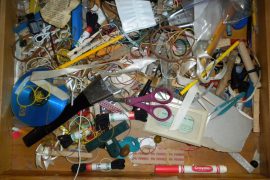
    When I decided to organize my junk drawer two weeks ago, I did what most folks do — I purchased a drawer divider set with a variety of different sizes.  The idea is to group like things together.  The pencils go in one section, pens in another.  Littler compartments hold paper clips and Box Tops.  And the biggest container is for my precious scissors, which seem to go missing at least once every other day.

    In fact, this is the No. 1 tennet of organization: A place for everything and everything in its place.  If I have a designated spot for my daughter’s erasers, they won’t be strewn around my kitchen counters or tossed into the silverware drawer.  (And she won’t be screaming in a fit of last-minute homework, “I can’t find an eraser!)

    At least that’s the idea.

    And that idea is as old as dirt.  In fact, it has its roots in mathematics, specifically set theory, which wasn’t formalized until Georg Cantor, a German mathematician, published an article on the subject in 1874.  This blew the socks off of the mathematics community — mainly because he proposed that there are two kinds of infinities.

    But I digress.

    Kindergarteners learn about set theory, when they circle like things on a worksheet.  And many parents probably wonder why this is such a big deal.

    In short, set theory is the basis of our numerical systems — among many other things.  Mathematics craves order.  Knowing why things are alike or different can help us solve problems quickly and effortlessly.  Just like knowing where my scissors go (and putting them there) makes it easier for me to find them later on.

    As an example, let’s look at the set of whole numbers.

    {0, 1, 2, 3, 4, 5, 6, 7, … }

    (Okay, just so no fancy-schmancy mathematician jumps down my throat, I have to note here that there is some disagreement about whether 0 belongs in this set.  But for most of the rest of the world, that’s a point not worth arguing about.)

    When you know the set of whole numbers, you can determine whether or not a number is in that set.  For example:

    0.25 is not a whole number

    60% is not a whole number

    π is not a whole number

    -17 is not a whole number

    But: 6,792,937 is a whole number

    But why do you care? Honestly, I think the biggest reason is so that you can talk about math.  In this case, set theory tells us the difference between whole numbers, integers, decimals, rational numbers, etc. — even if you don’t remember what all of these are.

    (And those of us who know a little bit about math also know that whole numbers are in the set of integers, which are in the set of rational numbers, which are in the set of decimals.)

    So this is how math is like organizing.  Both depend on set theory.

    I’m not saying that you have to be organized to do math.  Lord knows I’m not.  But the underlying organization of math points to big clues about how it’s done.  Even more basic sets, like geometric shapes can apply in our everyday lives.

    The bottom line is this: If  you think  you can get your house or office or car organized (and I believe you can!), you can certainly organize all of what you know about math and put it to good use.  That way, you’ll always know where your area of a triangle is.

    How do you think about the structure of numbers or shapes or arithmetic operations?  This points to your intuitive understanding of set theory.  Share your thoughts in the comments section!

  • Getting organized bit by bit

    Getting organized bit by bit

    “My house is a disaster.”

    How many times have you uttered these words or heard someone else say them?  You and they are not alone.  Getting organized is one of the most common New Year’s resolutions.  But like losing weight, it’s easier said than done.

    But how do you manage this daunting task? If you’re inclined to take a week off of work, with high hopes of a sparkling, organized home after five long days, you may want to reconsider.  If you’re not already organized, why would you want to spend so much time cleaning out your linen closet and kitchen cabinets?

    On this point, the experts agree: a little goes a long way.  So most suggest that devoting only 15 minutes a day to organization can yield big benefits.  Let’s take a look at the numbers.

    If you devote five days, for (let’s be generous) 10 hours a day, you’ll end up working 50 hours total, right?  (That’s 5 days x 10 hours or 50 hours.)  And you’d probably also have a sore back and a week’s worth of vacation lost to your label maker and plastic bins and lids.

    But what if you committed to 15 minutes a day, 5 days a week?  How much time will you have spent?

    15 minutes x 5 days = 75 minutes

    75 minutes ÷ 60 minutes = 1.25 hours (or 1 hour and 15 minutes)

    Gosh, I spend more time in a week figuring out what’s for dinner.

    So what if you started on January 1 and stuck with it throughout the month?

    There are 22 weekdays in January

    15 minutes x 22 days = 330 minutes

    330 minutes ÷ 60 minutes = 5.5 hours

    That’s less than the time it would take for you to watch the first two films in the Lord of the Ringstrilogy!

    So let’s take this a bit farther.  If you managed to keep this resolution for an entire year, how much time will you have spent organizing?  Let’s assume there are 250 workdays in the year.  (You’re not going to organize on a holiday are you?)

    15 minutes x 250 days = 3,750 minutes

    3,750 minutes ÷ 60 minutes = 62.5 hours

    So by devoting a mere 15 minutes a day to organizing, you can end up spending more time over the year than if you took a week off and worked on the task for 10 hours a day.  Plus, I guarantee you’ll be much more relaxed.

    But what can you accomplish in 15 minutes?  Here’s a short list:

    • Cleaning out your junk drawer
    • Going through seasonal clothes and deciding what to give away, toss or keep.
    • Alphabetizing your spice rack.
    • Culling through your kids’ artwork and filing or scanning special pieces.
    • Scanning your bookshelves for titles you’re ready to part with.
    • Setting up a spot for your mail, keys, purse and jacket.

    By the end of one week, you could have a tidy junk drawer, trimmed summer wardrobe, room on your bookshelves and a regular spot for your keys.  By the end of the year?  Who knows what you could accomplish!

    Have any organizing tips to share?  Post your ideas in the comments section.  I’ll bet I (or someone else) can find the math in that technique!

  • Math at Work Monday: Janine the professional organizer

    Math at Work Monday: Janine the professional organizer

    Either A&E Television is super smart or I’m easily manipulated.  On January 1, the cable channel ran a marathon of Hoarders, the documentary-style television program that shows extreme hoarders getting help to deal with their illness and their (often disgustingly) cluttered and dirty homes.

    I watched several episodes.

    Let’s get one thing straight: I am not a hoarder.  But like most folks, I do have a clutter problem.  Hoarders makes me feel better about my own issues, while learning a bit about how to let go of material things.  And besides, professional organizing has always been a fascinating career.  The process of helping someone get organized — their spaces, their collections, their time! — is akin to waving a magic wand.

    Getting organized is one of the most common New Years resolutions, so I’ve invited professional organizer Janine Adams, who owns Peace of Mind Organizing in St. Louis, Missouri.  Not surprisingly, she uses math in her work.  Here’s how.

    What do you do for a living? 

    I help people create order in their homes and their lives. I specialize in working with folks who are overwhelmed by clutter and for whom getting organized is a lifelong challenge. Though no two clients are alike, I typically help in the area of decluttering, then creating systems to help people function smoothly in their homes. My special skill is in gently guiding people who have a special relationship with their things so that they can let go of stuff and feel okay about it.

    When do you use basic math in your job?

    When someone has too much stuff to fit into their space, we sometimes have to figure out what percentage of their things they might need to part with in order to be able to store everything. So the client might agree that he or she needs to part with three of a particular type of item for every one kept, for example. When creating storage systems, I typically try to subdivide spaces using bins, so I use simple math to figure out how many bins will fit on a shelf, for example. When working with clients on creating habits and routines and time management, we break down the day into small increments and try to figure how long things will take and what can actually get done in a given amount of time.

    Some organizers do a lot more space planning than I do (I’m spatially challenged, so I don’t do space planning). I imagine they use more complicated math!

    professional organizer

    On the financial side of my business, I use math all the time, calculating my fees (I typically charge by the hour) as well as in calculating what I owe my subcontractors. I pay sales tax on any items I buy wholesale, but sometimes I round up or down to a whole number when I’m charging the client. Then, for bookkeeping purposes, I have to calculate the base price and the sales tax on it so that they equal the whole number.

    Do you use any technology to help with this math?

    I use the calculator on my iPod to check my math when I’m calculating what I’m owed (or owe subcontractors). I want to make sure I get it right. I also use a calculator when I’m figuring out sales tax. I use Quickbooks to help me with my bookkeeping and appreciate its math functionality.

    How do you think math helps you do your job better?

    If I didn’t know how to do basic math, I wouldn’t be able to run a business. I think it’s that simple. I feel like I’m constantly calculating fees, expenses, time available. Math is essential!

    How comfortable with math do you feel?

    This is very basic math. I’m comfortable with it!

    What kind of math did you take in high school?

    I was in an accelerated math program, but stopped at second year algebra, in 10th grade, because I didn’t enjoy it very much, to be honest. But I felt pretty good at it. I also took accounting classes, which have helped me in my two businesses (writing and organizing) and with home finances. What’s interesting to me is that I’m much better at basic math (the kind I use in every day life) than my husband is and he majored in applied mathematics in college.

    Do you have questions for Janine?  Ask them in the comments section.  And be sure to come back on Wednesday and Friday.  I’ll show you exactly how you can use math to help yourself get organized.

  • Watching the Weight Go Down

    Watching the Weight Go Down

    I suspect I’m not alone in one of my New Years resolutions: to eat better, exercise more and lose weight.  (Ack!  Did I just write that out loud?) Like other women in their mid-forties, I have found my metabolism screeching to a halt and my weight creeping up and up.  So last night, I launched my most recent — and hopefully last — attempt at getting into better habits.

    But I’m not fooling myself.  This is a long process with a lot of little steps, some forwards and a few backwards.  My issue is staying motivated.  I do well for a while, and then I slip up — and eventually give up.  So, I’ve got a good plan that should allow me to make incremental changes and leave lots of room for mistakes.  And to accomplish this, I’ve got both measurable and soft goals.

    Sure, I want to eat better (I can count each serving of veggies I eat or glass of water I drink.)  And I want to exercise more.  (I can count my hours at the gym or steps I take from my car to the grocery store.)  But for me, those are big changes that will include a lot of frustrating missteps.  In order to stay focused, the real measurement will be my weight.

    My goal is to lose 25 pounds. And I’ll track this by weighing myself once a week.

    So how long will it take me to lose the weight? This is where the math comes in.  Here’s what I know:

    1. I want to lose a total of 25 pounds.
    2. I will probably lose between 0.5 and 2 pounds each week.

    Does this mean I’ll be sitting on a beach in a string bikini in August?  (That’s a joke.  I’ve never worn a bikini in my life.)  Let’s look at the math.

    A half pound and two pounds is a pretty wide spread, so based on past experience and my inclination to be more conservative, I’m going to estimate that can lose about a pound each week.  So I can reasonably expect to lose all of the weight in 25 weeks.

    Whatever you expect to lose in a week, the math is simple:

    total weight lost goal ÷ loss per week = number of weeks

    25 pounds ÷ 1 pounds per week = 25 weeks

    So if you think you can lose 2 pounds per week, it’ll take you 12.5 weeks to lose 25 pounds:

    25 pounds ÷ 2 pounds per week = 12.5 weeks

    But there’s one more step I need to take.  I don’t think in terms of weeks.  My brain focuses on months. How many months will it take me to lose the weight?

    Again, I’m going to estimate.  While there are approximately four weeks in each month, that’s not an exact figure (except in February during a non-leap year).  But since I’m not measuring out medication or figuring out how much to send into the mortgage company or solving problems for my eighth grade math teacher, I don’t have to be exact.  So I’m going to go with four weeks in a month.

    I already figured out that I can probably reach my goal in 25 weeks.  To find out how many months that is, I can just divide by 4 (the number of full weeks in a month):

    25 weeks ÷ 4 weeks per month = 6.25 months

    Ta da!  I can reasonably expect to lose this weight in six months.  That means if all goes well, I should be at my goal by June.

    Like me, are you hoping to lose weight in 2012?  Do the math to see when you’re likely to reach your goal.  And if you want to share, feel free in the comments section.  (It’s scary, but you can do it!)Save

  • Turning Over a New Leaf

    Turning Over a New Leaf

    2012 is just around the corner, and people all over the world are making promises to themselves and others that they may not keep. Yep, it’s New Years resolution time.

    Confession time: I’m not so great at keeping resolutions.  And apparently, I’m not alone.  According to a 2010 study, 60% of all Americans have made resolutions at some point in their lives, and 41% did so in 2011.  Unfortunately:

    1. Only 23% surveyed indicated that they had made “significant, long-term” change in 2010
    2. 29% said they had made a “minor change”
    3. Approximately 49% made no change at all

    So there’s no point in making resolutions, right?  Based on this research, isn’t your chance of failure greater than your chance of success?

    Mathematically speaking, it doesn’t work out that way.  That’s because events like success or failure of a New Years resolution are not random.

    Rolling a die is random.  (You have just as much chance of rolling a 3 as a 5.)  Picking a certain card from a full deck is random.  (You have just as much chance of choosing the queen of hearts as the two of spades.)  And flipping a coin is random.  (You have a 50/50 chance of the coin landing on heads.)

    But you can’t judge your success or failure in making resolutions based on the research that is done on others’ experiences.  Whether you keep or break a resolution is not random.

    In fact, there’s tons of research out there that shows why some folks are able to keep their resolutions, while others are not so successful.  Here are some suggestions:

    1.  Keep it simple.  When you make huge lists of resolutions and complex plans for keeping them, it’s likely that  your brain just can’t keep up.  In fact, willpower is the first thing to go.

    2. Believe in yourself.  People who believe they can meet their goals actually do!

    3. Get support from others.  When you’re made accountable for your actions, it’s easier to stick to your plans.

    4.  Be specific. Think of your long-term goal as a series of smaller steps and focus on each one individually.

    5.  Remember that change is a process.  Setbacks will happen.  It’s what you do with those little failures that make a difference in your ultimate success.

    For the next month, we’ll take a week-by-week look at New Years resolutions — and how math can help you meet your goals.  Stay turned!

    P.S. If your New Year’s resolution has anything to do with saving money, losing weight or learning new hobbies — but the math around those goals is frustrating at best — Math for Grownups could be a big help!

    Do you make New Year’s resolutions?  Why or why not?  How successful have you been in the past?  Care to share this year’s resolutions?

  • Best posts of 2011

    Best posts of 2011

    It’s been a mere eight months since this blog launched.  And it’s been only six months since Math for Grownups (the book) hit the shelves.  What a crazy time it’s been!

    In reviewing the posts that you dear readers loved most, I came up with this list.  And in case you missed anything, I thought I’d share these posts again.  Happy New Year!

    Math Secret #2: You Were Born This Way

    Nope, you weren’t born without a math gene.  In fact the opposite is true — you were born with a natural instinct for mathematical concepts.  Really!

    Top 10 Highest Paying Degrees

    “Holy crap!” That’s what I indelicately exclaimed when I saw the list of 10 highest-paying degrees, as determined by the PayScale College Salary Report.  I didn’t expect to see American Literature or Elementary Education, but I also didn’t expect this.

    When Journalists Get the Math Wrong

    One of the most eventful weeks of my year was when USA Weekend profiled my book — and got the math wrong.  The really interesting part, though, were the responses.  Apparently making math mistakes in public is unforgivable to some.  No wonder people are afraid to do math!

    There’s More than One Way to Skin a Math Problem

    The more I talk to people about math, the more I hear this refrain: “I don’t like math, because math problems have only one answer.” Peshaw!

    Summer Session: What your rising first grader should know

    Math for Grownups blog readers tend to fall into two camps: grownups who are not parents and really hate math (or think they’re not good at it), and parents who are worried that they’re going to pass along their math anxiety to their kids.

    Are there any topics you’d like to see covered here at Math for Grownups next year?  Share them in the comments section or shoot me an email.

  • Math at Work Monday: Best of 2011

    Math at Work Monday: Best of 2011

    Math for Grownups readers love Math at Work Monday.  And here are the top 10 interviews of the year.

    Mary Ellen the FBI Profiler

    In her book, Dangerous Instincts: How Fear Can Betray Us, Mary Ellen O’Toole, PhD, puts these experiences to work everyday life.  And in this interview, she reveals how she uses math in her work.

    Melissa the Speech Therapist

    Lots of people think of speech therapists in the school setting, working with kids.  But my sister, Melissa, works with adults, who are critically ill or recovering from an injury or illness in rehab.

    Katie the Costume Designer

    As a costume designer and technician, Katie Curry worked for the Berry College Theatre Company and the Atlanta Shakespeare Festival. She recently started her own venture called Nancy Raygun Costuming that caters to folks who are into cosplay and conventions or just want a fun costume.

    Jennifer the Retail Buyer

    Merchandise at your favorite store doesn’t magically appear on the store shelves.  In fact, there’s a lot of planning that goes into the number and types of candy bars that fill checkout-line racks. And that’s where Jennifer Cassara comes in.

    Graham the Fish Hatchery Technician

    Graham Laing is my brother, and I don’t think he’d be offended by my telling you that some of us in the family were a little worried that he might not amount to anything.  But that’s another story for another day.  Today, he’s afish hatchery technician, which basically means he raises trout — “from eggs to eating size,” he says.

    Tiffany the 6th Grade Teacher

    I know what you’re thinking. “It’s so obvious how a 6th grade teacher would use math! She’s teaching fractions and division and percents!” But there’s always a lot more to teaching than the rest of us may think.

    Brette the Cookbook Author

    When my friend and fellow writer, Brette Sember let me know that she has a cookbook coming out, I jumped at the chance to feature her here.  It should be no surprise that math is a critical ingredient of all recipes.  The Parchment Paper Cookbook is no exception.

    Shana the Jewelry Designer

    Art and math are diametrically opposite, right?  Wrong. Shana Kroiz is a Baltimore-based, acclaimed jewelry designer and artist, whose work has been shown in the some of the country’s most esteemed galleries and museums, including The Smithsonian and the Museum of Arts and Design in New York City.

    Kim the Copywriter

    If you’ve ever visited the website of a prescription medication or picked up a brochure from your doctor’s office, you’ve seen the kind of work that Kim Hooper does.  And she’s proof that math and writing are not mutually exclusive endeavors.

    Ron the Web Designer

    Ron S. Doyle is both a web designer and a freelance writer.  In fact, he’s found a particular niche in developing web sites for other freelance writers.  He’s also got a wicked sense of humor and uses math in his work.

    I’m planning for the New Year. Who would you like to see interviewed for Math at Work Monday?  Share in the comments, or shoot me an email.

  • Using Math to Wrap Gifts

    Using Math to Wrap Gifts

    My shopping is done.  I’ve got no more baking to do.  And save one, all of the great holiday parties are wonderful memories.

    But I still have this stack of gifts to wrap.

    I figure there are two kinds of people in the world: those who painstakingly dress each gift with crisp paper and color-coordinated bows; and those who haphazardly slap on some paper and call it a day.  I’m not so precise about most things, but you can put me in the first camp as far as gift wrapping goes.

    Still, I’m mighty lazy.  I don’t measure out paper or use double-sided tape.  Instead I use a little bit of geometry to get my gifts just right.  It’s not hard at all.

    The trick to a perfectly wrapped gift is to have just enough — not too much and not too little — paper to cover the package.  And to do that, use a box, if the item is oddly shaped.

    Now consider the width of the box.  Line the box up on one end of the paper, like this:

    And then turn the box up on the left edge, over onto the other large side and up again on the last edge, like this:

    You want to have some left over paper on the left.  This will overlap so that there’s no gap in the seam.

    Now you can look at the length of the package.  This is where things get a little tricky.  You need a little more than half the height of the package.  (I just eyeball it, but you can be more precise, if you want.)  You’re ready to cut.

    So your paper is cut.  (Did you notice that throughout that easy process, you thought about the width, length and height of the box?  That’s the geometry at work here, folks.)  It’s time to start wrapping.  Turn the box upside down onto the paper.  This way, the seam will be on the bottom of the box.

    Wrap one of the long sides of the paper over the box and secure with tape.

    Do the same with the other side, making sure that the paper is tightly wrapped around the box.

    Now it’s time to address the sides of the gift.  Fold down the top paper, so that it’s flush against the box.  If you’ve eyeballed your measurement correctly, the paper won’t be too long or two short.  Then fold in each side of the paper, making little angles.  Crease each one with your fingernail.  Then fold the last flap up, so that it looks like an envelope.  Use tape to secure that flap.

    The other side is much easier, because now you can put the box up on the side you just wrapped.

    Once everything is folded and taped up, use your fingernail to make sharp creases along each of the edges of the box.  Add a bow — I like using wired bows made of fabric, because they’re easy to manage, and I can reuse them again next year.  Ta-da!  The perfect gift!

    Do you have a gift-wrapping technique to share?  If so, tell us in the comments section.