Category: Math for Grownups

  • Last-Minute Mathy Gifts for Kids

    Last-Minute Mathy Gifts for Kids

    Looking for a last-minute gift for your budding Eistein?  You’ve come to the right place.

    I’m not about to suggest that kids love “educational toys.”  But one thing is for sure — kids learn best when they’re having fun.

    I’ve gathered a few of my most favorite gift ideas for kids–whether they like math or not.  The best part is that these gifts for sale at your local Target, bookstore or toy store, for not much cash.

    Games

    SET is a sneaky — and honestly fun — way for kids to learn and practice logic and set theory.  The object of the game is notice similarities in the cards, each of which has a variety of shapes that differ in number, shape, color and shading.  I promise, this is a cool way to spend some time with your kids.  (Ages 6 and up)

    Yahtzee?  Yep.  There’s quite a bit of math involved, in fact.  Developing a good strategy requires a solid understanding of probability.  And being able to quickly spot a full-house, three-of-a-kind or four-of-a-kind involves spacial understanding.  Then there’s adding up the scores to find totals.  See?  Math is all over this game. (Ages 8 and up)

    Toys

    Kids (and grownups) can create complex and simple mazes and runs in a variety of different marble run toys, some with transparent tubes and others with brightly colored pieces.  Where’s the math?  First off, kids are playing with their spacial abilities, noticing where the marble goes when the track positions are changed.  Then there’s the experience of trial and error — which goes hand in hand with math. (4 years and up)

    For the tiny set, you can’t go wrong with shapes.  Toys like shape sorters help toddlers and preschoolers learn their shapes.  You can extend the learning by encouraging other ways of sorting — like colors.  (15 months to 5 years)

    Books

    David Schwartz writes really wonderful math and science books that don’t smack kids over the head with their educational focus.  How Much Is a Million is one of my favorites.  Illustrated by Steven Kellog, the book demonstrates how much a million is.  (Grownups will probably learn something from this one, too!) (Ages 3 and up)

    There’s no sneakier way to tap into a kid’s curiosity about math than with The Phantom Tollbooth, by Norton Juster.  This classic children’s novel takes readers on a mythical journey of Milo and his “watchdog,” Tock.  The book touches on a variety of mathematic topics — from infinity to three-dimensional shapes.  Bonus: there’s an equal emphasis on language, including idioms and puns.  It’s bound to be a homerun for any young reader.  Oh, and 2011 is the 50th anniversary of this classic. (Ages 10 and up)

    Do you have any great gift ideas for kids?  Share them in the comments section!

  • Math at Work Monday: Kim the candle maker

    Math at Work Monday: Kim the candle maker

    Good grief the winter holidays include a lot of candles!  Earlier this month, Christians began lightingAdvent candles; Hanukkah begins tomorrow night at sunset; Thursday is the Winter Solstice; andKwanzaa starts on December 26.  

    That’s a lot of wax!

    Lately, I’ve been fascinated by how candles are made, and so I reached out to Kim Meade, owner ofAdirondack Chandler Candles.  In the interview below, she explains how math plays a role in candle making.  It’s a longer interview than usual, but Kim provided such great details, and I didn’t want to leave anything out!

    Can you explain what you do for a living?

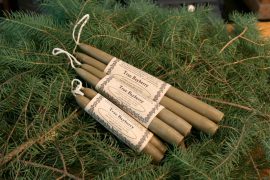
    I make candles the same way they have been done for centuries, dipping candles in a variety of waxes, including paraffin, True Bayberry, and beeswax.  I have a hand made carrousel that allows me to dip 120 pairs of taper candles per dip.  I also make votives, tea lights, potpourri tarts and other items with wax in them.  This is a full time job for me.  I sell my candles to more than 100 retail shops, as well as several consignment shops and on Etsy. I also have a retail website as well as a very small retail shop in my studio.

    When do you use basic math in your job?

    I use math every day.  I have recipes that I use to make my candles in a variety of scents and colors.  I have to weigh the wax and adjust dyes and formulas depending on how much new wax I add to my batch.  For example, a fresh, new batch of wax requires 75 lbs of wax.  When I finish each dip, I always have a minimum of 30 lbs left over since the dippng vat has to remain full.  At the end of the day, I save the leftover for the base for the next dip of this particular scent or color.  The next time I am going to do this particular scent or color, I have to determine how much more wax I have to add to the melter.  This is basic addition and subtraction.

    Then I have to calculate the percentage of dye and fragrance that I have to add.  For example, if I have added 45 new pounds of wax, I have to calculate the proportions — 45 lbs vs. 75 lbs.  If I add 24 ounces of fragrance for a 75 lb batch of a particular scent and 5 Tbs of dye, how much would I add for a batch with only 30 lbs of new wax?  (I always use a calculator for these calculations!)

    I also have to consider the strength of the dye.  Green dye is much more “potent” than, for example, yellow dye.  I have color ratios that I use.  If combining dyes for custom colors, I have to look at these ratios to determine how they will affect the end result  For example, I may use only 1/2 the green dye vs. a red dye for a particular result.

    With each dip, I determine how many of each size candle I have to make. I routinely make 6″, 9″ and 12″ candles.  I have to look at my sales projections and determine how many of each candle size I have to make.  I then measure the amount of wicking that I have to cut. As an example, for a 6″ candle, I need to cut a piece of wick that is 12″ long, since the wicking will hang over the holder to allow me to dip a pair of candles.  I also have to add 5″ extra to give room for the wick to hang over the holder.

    I have to ensure that the candles are at larger than the 7/8″ standard taper base, but not so large they look malformed.  Wax will shrink when it cools, and temperature and humidity can affect it, so I have to be aware of each of these factors.  Temperature plays an important role, specifically if it is warmer than 76 degrees.  Over 80 degrees in studio temperature will negatively affect candle integrity.  Although my candles will be fine above 80 degrees, they will not cool correctly and will have imperfections in them as they cool.  Candles cannot be in a draft, as it will cause them to curve, so I have to consider weather (specifically in the summer).  I cannot run an air conditioner during production.

    I have a melter that I use to melt the 75 lbs of wax required for each batch.  Each wax has a different melt point optimum pouring temperature, and flash point (point at which the wax will ignite).  If combining waxes, calculations are made to determine correct melt point and pouring temperature.   Fragrance also has a flash point.  Wicks have different coatings on them (i.e., standard melt point, high melt point, super high melt point).    I load this melter the night before, and have a timer that I use to start the wax melting at the appropriate time.  It takes approximately 5 hours for the wax to melt to the correct temperature. so my first math calculation is to determine when to have the timer set to come on, depending on when I plan to start the day.  Some days I try to get two dips done in one day (so I have to start very early).  The second melt takes less time since the melter is already hot, so I have to make an educated “guess” on how long it will take based on temperature and size of the batch.

    When making votives or tealights, I have to add other additives to the wax, such as stearic acid, vybar and other additivies depending on what is being made.  These are based on proportions compared to the weight of the wax.   I usually melt less wax, using a melting pot and a hot plate to melt this wax.  Usually I will melt 5- 10 lbs, so I have to calculate how long it will take to melt, and how much dye,fragrance, etc to add along with the additivies .  I base the dye on the original 75 lb recipe.

    Finally, I use math during the packaging and shipping.  I have to determine correct box size, weigh the candles and gather measurements from shipping boxes.

    Do you use any technology to help with this math?

    I always use a calculator or computer to do my math calculations.  Just a few percentage points off in the production of my candles can ruin an entire batch.  I made an entire batch one time with just 1/2 a teaspoon too much green dye and had to redo the dip and the candles I made, although beautiful, were the wrong color for the scent.

    How do you think math helps you do your job better?

    Just about everything I do requires math.  I have several sizes of wicking that  I use depending on the size and type of wax I am using.  Large pillar candles require a larger wicking than, for example a 4″ petite, 1/2″ bas candle.  Votive candles require larger wicks  than tea lights.  I also have all the proportions and ratios to consider.  Without math, my candles would not have the correct proportions and most likely would not be successful.

    How comfortable with math do you feel?

    I actually do not like doing math at all.  But, at my job it is second nature to me now.  Without it, my products would not be successful.  For example, I order 500 lbs of wax at a time, but each candle is only ounces in weight.  I add ounces of fragrance to the entire batch, but how much of that cost is in each single candle?  I purchase wicking by the yard, but the candle is measured in inches.  Dye are purchased by the pound, but measured into the recipe by teaspoon or tablespoon.  I have some complex spreadsheets that I have created in Excel that allow me to plug in the cost of my raw materials and it calculates the cost of my individual batch and candles.  But, even with this, the cost of my raw materials changes at different times, and some of the materials I use, such as dyes, will last for several years.

    What kind of math did you take in high school?

    In high school I took algebra, geometry, trigonometry and calculus.   I was very good at algebra, found geometry to be difficult, was pretty good at Trigonometry and found that I really enjoyed Calculus.

    I have actually continued to learn ways to do math throughout my varied careers.  There are always things to learn to help you do your job better.  Learning to use Excel was a big boost for my business.  It helps me to compare prices, past years sales, calculate my formulas, project raw material requirements, etc.  It is amazing, when I think about it, how much math I use daily.  I am used to doing it, but considering it for this interview, I realized that I use math in almost every aspect of my candlemaking, from ordering raw materials through to the finished product and sales.

    Do you have questions for Kim?  Ask them in the comments section!

  • The 12 Days of Christmath

    elebrate Christmas, you’re heading into the home stretch!  As of this morning, there are nine days until the fat man comes down the chimney.  I hope you’re more ready than I am!  (My careful schedule has gone to pot, in some ways, derailed by a sick kid, aging dog and some unexpected work stuff.  But I’m getting back on track.)

    If you’ve hung out with me here at Math for Grownups for a while, you know how much I love Vi Hart.  This chick is something else — a musician and a “recreational mathematician.”  (According to her site, she now calls herself a recreational mathemusician.)

    In short, Vi is the daughter of a math professor and a wonderful musician in her own right.  She creates these really, really cool videos that explore the intricacies of mathematical concepts — from number theory to geometry.

    Yeah, she’s a huge geek, but she’s one of those geeks who won’t make you feel dumb, and she’s funny.

    This week, I came across her video, The Gauss Christmath Spectacular.  (Gauss was a 16th and 17th century mathematician who dabbled in a huge array of topics, from optics to statistics.)  There’s some stuff in here that will probably fly right over your head, but don’t let that discourage you.  Instead, grab a cup of eggnog, plop your favorite high school or college student next to you, and jot down the math that you do recognize.  You’ll probably surprise yourself.

    Without further ado, Vi Hart’s take on the 12 Days of Christmas (my absolute favorite Christmas song when I was five years old — much to my parents’ dismay).

    What did you recognize?  Show off in the comments section!
  • Cookie Exchange Math

    Cookie Exchange Math

    Ah, the cookie exchange!  What better way to multiply the variety of your holiday goodies.  (You can always give the date bars to your great aunt Marge.)

    The problem with this annual event is the math required to make five or six dozen cookies from a recipe that yields three dozen.  That’s what I call “cookie exchange math.”

    Never fear! You can handle this task without tossing your rolling pin through the kitchen window. Take a few deep breaths and think things through.

    To double or triple a recipe is pretty simple — just multiply each ingredient measurement by the amount you want to increase the recipe by.  But it’s also pretty darned easy to get confused, especially if there are fractions involved.  (And there are always fractions involved.)

    The trick is to look at each ingredient one at a time.  Don’t be a hero!  Use a pencil and paper if you need to.  (Better yet, if you alter a recipe often enough, jot down the changes in the margin of your cookbook.)  It’s also a good idea to collect all of your ingredients before you get started.  That’ll save you from having to borrow an egg from your neighbor after your oven is preheated.

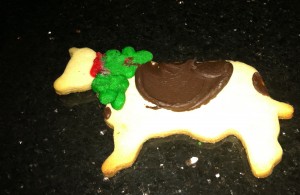
    Each year, I bring cow cookies to my neighborhood cookie exchange.  What are cow cookies, you ask?  Just what they sound like: sugar cookies cut into the shape of a cow.  The spots are made of melted chocolate.  (They’re Holsteins, of course.)  And around each of their little necks, I create little (icing) wreaths with red (icing) berries.

    (Why do I make cow cookies?  It’s a long story.  But I’ve been these to holiday parties for more than 20 years now.  Kids love ’em.)

    The problem is that my cow-shaped cookie cutter is larger than most other, eh-hem, more traditional Christmas cookie cutters.  So, while my recipe says it yields 36 to 48 cookies, I know I won’t get that many.

    So each year, I triple the recipe.  That way I have enough for the cookie exchange (5 dozen), plus some to take to my mom’s house and give away to friends.

    I can’t share the recipe here, because it’s copyrighted by Better Homes and Gardens (otherwise known as the Red Plaid Cookbook).  But we can look at the ingredient amounts.  My recipe requires the following measurements of various ingredients:  1/3 cup, 2 cups, 1 tsp and 3/4 cups.

    Since I’m tripling the recipe, I’ll need to multiply each of these amounts by 3. Then I can measure out the ingredients using the altered amounts.

    The first three calculations are simple, but what about that last one?

    The really easy way to get around this fraction is to fill a  one-fourth cup 9 times.  And honestly, if that’s how your brain works, go for it.

    But if you want to, you could turn the fraction into a mixed number.  Here’s how:

    Ta-da!  In only a few steps, I’ve done the simple math needed to alter this recipe.  Now, I just need to keep my fingers out of the bowl — so that I can actually bring enough cookies to the exchange.  (Honestly, I’d rather eat the dough than the baked and decorated cookies!)

    What are your holiday recipe math tricks?  Can you think of other, more creative, ways to alter a recipe.  Share your thoughts in the comments section.

  • Math at Work Monday: Nicole the candy maker

    Math at Work Monday: Nicole the candy maker

    Math is a chief ingredient in the kitchen, and those who make a living creating the sweets many of us crave during the holidays depend on calculations every day.

    Nicole Varrenti is the chief candy maker and owner of Nicole’s Treats. Like many artisans of all kinds, she makes small batches by hand and ships to buyers all over the world through her Etsy shop.  Here’s how she uses math in her job.

    Can you explain your job?

    I hand make Belgian chocolate candy and other edible treats like granola, spoon fudge, and caramel sauce. I opened my Etsy shop in August 2008, but I have been making candy for more than 20 years.

    When do you use basic math in your job?  

    I use math DAILY! I need to measure ingredients for my treat recipes and weigh my products to ensure my customers receive the amount of product they ordered. I measure and weigh boxes to prepare them for shipment. Also, I triple check all my orders to make sure all amounts, charges and weights are correct. From start to finish, on one order, I use math at least five times.

    Do you use any technology to help with this math? 

    Of course I use old-fashioned measuring cups to measure ingredients, and a scale to weigh ingredients and packages. I use a calculator to calculate the price of my products and a computer is very useful to store spreadsheets so I can keep track of all my sales, purchases, expenses, shipping costs, etc.

    Math helps to keep my business organized so I can see how I am doing on a daily basis. Without math I would be lost and would not know how my business is performing.

    How comfortable with math do you feel?  

    Math has never been my strong suit; in fact I had a math tutor for many years while I was in middle and high school, when I took algebra, calculus and geometry. However, since I use math on a daily basis I am comfortable with math and in my skills now.

    Did you have to learn new skills in order to do the math you use in your job? 

    All of the math I learned in school has played a role in my job at some point or another. Sometimes I have had to re-learn certain math skills or just refresh my memory by practicing a bit. The only new skill I would say I had to learn was some basic accounting since I never took an accounting class.

    Nicole’s blog has gorgeous, mouthwatering photos of sweets, plus free recipes.  Visit! But first, if you have questions for her, ask them in the comments section.

  • Shop on! With Percents

    Shop on! With Percents

    Everybody loves a sale, right? The thrill of the hunt, the sense of accomplishment when landing a great deal.

    But how many times have you reached the register and realized your purchase was more than you expected?  Or have you ever passed on a purchase because figuring out the discount was way too much trouble?

    You don’t have to be afraid of the mental math that goes along with shopping.  (That goes for in-person and online sales.)  You also don’t have to be that giant geek standing in the sports goods aisle using your cellphone calculator to find 15% of $19.98.  Who has time for that anyway?

    Believe it or not, figuring percents is one of the easiest mental math skills.  And it’s one of those things that you may do differently than your sister who may do differently than your boss.  In other words, you are not required to follow the rules that you learned in elementary school.  Now that you’re a grownup, you can find your own way.

    Don’t follow?  Let’s look at an example.

    Once again you’ve put off buying Mom’s gift.  It’s just about time to leave for her house, and you have literally minutes to find the perfect present for her — at the right price.  You’ve collected $40 from your brother and sister, and you can contribute $20.  Darn it, you’re going to scour the department store until you find something she’ll like that’s in the right price range.

    And suddenly, there it is: a countertop seltzer maker, just right for Mom’s nightly sloe gin fizz. Bonus! It’s on sale — 40% off of $89.95.  But can you afford it?

    There are a variety of different ways to look at this.  But first, let’s consider what you know.

    The seltzer maker is regularly priced at $89.95.

    It’s on sale for 40% off.

    You can spend up to $60 ($40 from your sibs, plus the 20 bucks that you’re chipping in).

    You don’t necessarily need to know exactly what the seltzer maker will cost.  You just need to know if you have enough money to cover the sale price.  And that means an estimate will do just fine.  In other words, finding 40% of $90 (instead of $89.95) is good enough.

    Now you have some choices.  You can think of 40% in a variety of ways.

    40% is close to 50%

    It’s pretty easy to find 50% of $90 — just take half.

    50% of $90 is $45

    So, if the seltzer maker was 50% off, you could afford it, no problem.  But is 40% off enough of a discount?  You probably need to take a closer look.

    40% is a multiple of 10%

    It’s not difficult to find 10% of $90 either.  In fact, all you need to do is drop the zero.

    10% of $90 is $9

    What is 40% of $90?  Well, since 40% is a multiple of 10%:

    There are 4 tens in 40 (4 · 10 = 40)

    and

    10% of $90 is $9

    so

     4 · $9 = $36

    It’s tempting to think that this is the sale price of the seltzer maker.  Not so fast!  This is what the discount would be.  To find the actual price, you need to do one more step.

    $90 – $36 = $54

    Looks like you can afford the machine. But there’s an even more direct way to estimate sale price.

    40% off is the same as 60% of the original price

    When you take 40% off, you’re left with 60%. That’s because

    40% + 60% = 100%

    Or if you prefer subtraction

    100% – 40% = 60%

    So you can estimate the sale price in one fell swoop.  Like 40%, 60% is a multiple of 10%.

    There are 6 tens in 60 (6 · 10 = 60)

    and

    10% of $90 is $9

    so

     6 · $9 = $54

    The estimated sale price is $54, which is less than $60.  You snatch up the race-car red model and head for the checkout.

    There are so many other ways to estimate sales prices using percents.  Do you look at these differently?  Share how you would estimate the sale price in the comments section.

  • Math at Work Monday: Elana the personal shopper

    Math at Work Monday: Elana the personal shopper

    On the whole, I don’t like shopping.  But I do like shopping for Christmas gifts. Still, at around this time of year, I’m about ready to hand over my list to someone else — say a personal shopper?  And if she can help me find that perfect outfit for Saturday night’s holiday party?  Even better.

    Meet Elana Pruitt, a personal shopper in the L.A. area of California.  Elana isn’t just a shopper.  She helps her clients figure out what they need and how to find it. She also writes about fashion at her blog, Good Girl Gone Shopping. Here’s how she uses math in her job.

    Can you explain what you do for a living?  

    I am a personal shopper and wardrobe consultant. My day-to-day schedule is never the same because the services I carry out are based on the every individual’s needs. I am committed to helping men and women find quality fashion not just for affordable cost, but at their specific budget. My job entails a variety of duties for my clients: re-organizing closets, styling new outfits using the clothes they already own to prove the versatility of their wardrobe, shopping with (or without) the client at particular stores or online, styling new purchases with their existing wardrobe after a shopping trip, and conducting online research.

    Although my services are affordable, I realize that hiring a personal shopper and wardrobe consultant is a luxury. So the other half of my job entails writing about fashion. On my blog, Good Girl Gone Shopping, I provide helpful information about shopping and fashion, with references to our culture, entertainment, and the celebrity phenomenon.

    When do you use basic math in your job?  

    I’ve never been asked this question before – it’s a good one! In thinking about how I incorporate math into my job, I realize that I use it frequently. From counting items in a client’s closet to calculating my gas mileage for a shopping trip to scheduling appointments throughout the month. Everything I do involves the basics of math: addition, subtraction, multiplication, division, and percentages. Most of the time, I don’t consciously think about the fact that math is a natural, necessary, and unavoidable component of my business. The main time when I am aware that I am using math is when there is a transaction of sorts. I charge hourly rates and a commission percentage of purchases, which needs to be clearly defined to the client. In addition, I sell advertising space on my Good Girl Gone Shopping blog. This also needs to be clearly structured for the client to understand (ads can be sold on a 6-month basis or yearly). Those two specific situations are when I am so happy I paid attention in math class throughout college!

    Do you use any technology to help with this math?  

    I am usually old school – I use a good ol’ pencil and paper most of the time. Then to double check my work, I use the calculator either on my computer or from my phone.

    How do you think math helps you do your job better?

    For my job, it’s not that it makes it better – it’s just a part of it. Math is that essential to my work as a personal shopper, wardrobe consultant, and fashion blogger.

    How comfortable with math do you feel?  

    Basic math is second nature to me. Algebraic formulas take more effort. But fortunately, I’m doing something right, because I am able to successfully see my job through, from the consultation with the client to follow-up communication after my service with him or her is complete.  Overall, I feel comfortable with math…basic math.

    What kind of math did you take in high school?  

    I took Pre-Algebra, Algebra, and Geometry. I do recall struggling with Geometry. I have always respected those who excel in the study of math, because it requires such analytical thinking. I hate to say I wasn’t good at it, but let’s just say I would never choose to enter that field!

    Did you have to learn new skills in order to do the math you use in your job? 

    The skills I use now are pretty much standard. Students everywhere need to erase this thought from their brain, “I don’t know why I’m taking this class, I won’t need it in the real world when I grow up!” The journey throughout adulthood can be amazing if you are knowledgeable and skilled in a multitude of areas. Never say never!

    Have you ever wondered how personal shopping works? Now’s your chance to ask Elana.  Post your question in the comments section!
  • Math at Work Monday: John the coffee roaster

    Math at Work Monday: John the coffee roaster

    We’re rounding out our month of nesting today and Wednesday. What’s cozier than a cup of hot coffee?  If you’ve ever wondered where your morning cup of Joe comes from, meet John Curry, owner of Buona Caffe, an artisan coffee roaster.  

    Can you explain what you do for a living?

    I roast and sell specialty coffee.

    When do you use basic math in your job?

    I use math to figure out how much coffee I need to roast for our orders. When coffee is roasted, it loses about 18% of its weight. I have to take that into account in my calculations. On my blends, I have to calculate proportions of coffees, whether it’s for a 12-ounce retail bag or a 5-pound bag for a restaurant. We also use math for brewing coffee – different brewing methods require different amounts of grounds and ratios to water.

    We have to consider shipping weights when we order green coffee beans. And I use basic math for running the business – tracking sales and outstanding invoices, forecasting sales, that kind of thing.

    I use math is just about every aspect of roasting and selling coffee. Math is a very important part of running your own business. Money is all numbers!

    Do you use any technology to help with this math?

    Yes. I use a calculator to do proportions for blends. Accuracy is very important.

    How do you think math helps you do your job better?

    Without it, I couldn’t be sure of any of my measurements. Since we sell a food product, it’s very important that our product weighs what the label says it weighs and that our proportions are accurate. If we don’t do the right math every time, our coffee won’t taste as good as it should!

    Upperline

    How comfortable with math do you feel?

    I feel relatively comfortable with math all the time. I use it with hobbies as well, such  as woodworking. I also use math with spreadsheets.

    What kind of math did you take in high school?

    That was a long time ago! I know I took geometry. I didn’t take any higher level math. I did not like math, and I was not good at it. I was better at geometry than other kinds of math. I feel more comfortable with math now than I did then.

    Did you have to learn new skills to do this math?

    I didn’t have to learn new skills to do this math. I do a lot of percentages and ratios.

    So what are your big questions about roasting coffee?  Ask John!

  • Math at Work Monday: Thanksgiving edition

    Math at Work Monday: Thanksgiving edition

    Ever have one of those weeks?  That was me last week.  I just couldn’t get my act together, and before I knew it, it was the weekend, and I had struck out — for the first time — on getting a compelling and interesting Math at Work Monday interview.

    Shucks.

    Then I remembered: I’m so blessed to have wonderful things in life, including a great archive of amazing Math at Work Monday interviews.  And I’m betting many of you haven’t read them all.

    So, I’m celebrating Thanksgiving a little early this year.  Taking it a little easy. Counting my blessings rather than my shortcomings.  Please enjoy some of my favorite Math at Work Monday interviews.  I’m so thankful for everyone who has shared their experience and insight with everyone in the Math for Grownups family!

    Brette the Cookbook Author: Need a little Thanksgiving dinner inspiration?  Brette is your gal!

    Ron the State Anatomy Board Director: Plenty of people are thankful for the medical research provided by cadavers.

    Mary Ellen the FBI Profler: Need I say more?

    Alison the Shop Owner: As you’re gearing up for holiday shopping, check out how shop owners make buying decisions.

    Come back on Wednesday, when I’ll publish a special excerpt from my book — and get the scoop on how to time Thanksgiving dinner so everything ends up on the table, hot and perfectly cooked!

  • Using a diagram: Making curtains

    Using a diagram: Making curtains

    Curtains are the ultimate nesting project.  Not only do they finish off a room, but they keep out drafts and provide privacy.  And lined curtains are even cozier.  Making curtains is not as hard as it may seem.  If I can do it, so can you — I promise.  All it takes is some skill in measuring, a good plan and the ability to sew a straight line.

    Most curtain panels are just rectangles.  So you need to know two things:  the width and the height of the panel that you’ll be making.  And that means knowing a little bit about the measurements of your window.

    For these kinds of projects, I always count on a trusty diagram.  I don’t pull out the graph paper — any scrap will do.  The key is to measure carefully.

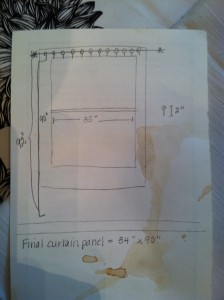
    I have three windows that I’ll be covering, but they’re all the same size and shape — so one drawing would do it.  My goal was to determine the height and width of the finished curtains.  Then I could take those dimensions to figure out how much fabric to cut.

    (Yes, that’s a giant coffee stain. It was Saturday morning — early. But I didn’t get the coffee on anything else.)

    I wanted floor-length curtains, so I measured from the top of the curtain rod (or where that rod would be) to the floor.  Then I needed to take into consideration the curtain rings.  I’m lazy — give me a break, lined curtains are enough work! — so I chose to use clip-on curtain rings.  (In my drawing, those are the little circle things at the top of the window.) That added about 2″ to the hardware at the top of the curtains, but meant I wouldn’t need to sew tab tops or button holes or a pocket for a curtain rod.  (Besides I like the look.)

    The measurement from the floor to the top of the rod is 92″, so the finished curtain panel would need to be 90″.  (92″ – 2″ = 90″)

    Now for the width.  There is all sorts of advice for this measurement, but most sources say to make a curtain panel like I was planning, each one should at least 1.5 to 2 times as wide as the window itself.

    But threw that advice out of the window.  As I described on my guest post for Harmony Art on Wednesday, I felt the design of the fabric was strong enough that I didn’t need more than around 34″ for each panel width.  This had another benefit: because the fabric I was using was 110″ long, I only needed one yard of fabric per panel.

    (Did you see what I just did there?  I broke the rules!  Being a grown up is really freeing.)

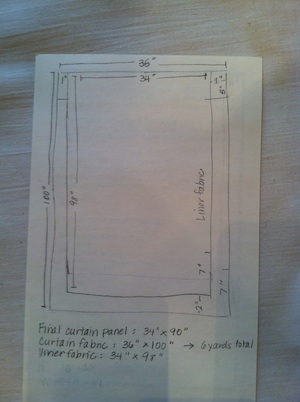
    So, now I had my finished fabric width and length, but that’s not how much fabric I would cut.  Nope, I have to consider the hems, unless I was okay with frayed edges.  (I’m not.)  And that required a second diagram.

    Notice that there are two rectangles here: The larger one is for my curtain fabric. The smaller one represents the lining.

    Basically, I have two rectangles here. The larger one is my curtain fabric.  The smaller one is my lining.  If you think of this diagram as looking at the back of the curtain, that will make sense.

    The ultimate goal was to figure out how much fabric I needed to cut — based on the finished size of the curtain panel.  So what I ended up doing is adding to the finished panel size.  Here’s the basic formula for the length:

    top hem + finished panel + bottom hem

    For my design, that meant:

    5″ + 90″ + 5″ = 100″

    (Ignore the 7″ measurements at the bottom of the drawing.  They should have read 5″.)

    Same goes for the sides:

    left hem + finished panel + right hem

    1″ + 34″ + 1″ = 36″

    Ta-da!  I now know what size to cut my curtain fabric: 100″ x 36″

    The lining is a bit different.  I want the top edge of the lining to line up with the curtain fabric.  This way, the top of the curtain is sturdy enough for the curtain clips.  But the sides should be smaller, to allow for the little “frame” of curtain fabric all the way around.  An added benefit is that I don’t have to hem the lining fabric at all — the rough edges will just tuck inside the curtain fabric hem.

    Lining length: 100″ – 2″ = 98″

    Lining width: 36″ – 1″ – 1″ = 34″

    If I’ve done my math correctly, the only thing left to do is cut, iron and sew!

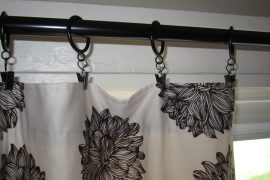
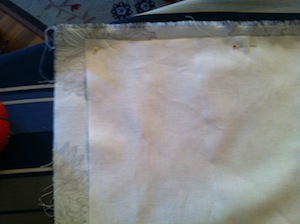
    This is the lining pinned to the curtain fabric. (The top doesn’t match up perfectly because of the selvedge, or manufactured edge, of the curtain fabric.)

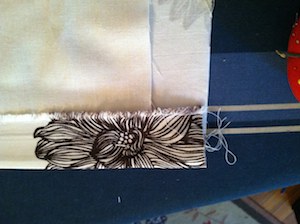
    Starting the top hem of the curtain (upside-down). First I fold the rough edge over and iron.

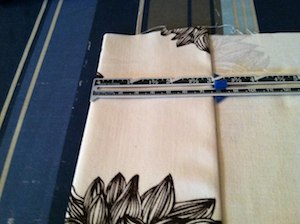
    … Then I fold over to tuck in the rough edges of the fabric and make the finished hem.

    After a few hours of cutting and ironing and ironing and ironing and sewing and ironing, I finally had two finished curtain panels:

    So I’m already looking at my mistakes. This weekend I’m going to revisit at that right panel, which seems a bit long. I’ll probably take out the top hem and re-do it.

    The diagrams made all the difference in the world with this project.  Without them, I would have had a terrible time visualizing what I needed.  And honestly, that little bit of math was much easier than the sewing (and ironing and ironing and ironing and ironing).

    When have you used a diagram to help you solve a problem or complete a project?  Share your experience in the comment section!

  • Fabric Math: How does width affect the bottom line?

    Fabric Math: How does width affect the bottom line?

    So you’re buying fabric for a project. Whether you’re doing the sewing yourself or sending it out to a professional seamstress, tailor or upholsterer, the width of the textile is a big consideration.

    Fabric is typically sold by the yard, and it’s manufactured in standard widths, usually ranging from 40 inches to 110 inches.  The wider the material, the more area you’ll actually take home per yard. (There’s more to consider here, including the way the pattern runs and the grain of the fabric.  But we’ll save those details for another post.)

    Naturally, wider fabric also sports a higher price tag per yard.  And doing the math can help you figure out if it’s a good deal or not.  That’s why textile designer Harmony Susalla asked me to write a guest post for her blog.  A snippet appears below.  Read the rest on Harmony’s site.

    When you’re a complete fabric junkie like I am, you’re always looking for a bargain.  Of course, my eye is drawn to gorgeous designer fabrics with really high thread count. Swoon!  But the cost—well, that can bring on a real fainting spell.

    That’s why I started out sewing with fat quarters.  I found fabrics that I loved—and could easily afford—and figured out really cool things I could make with them.  Little, zippered change purses, box-bags for balls of yarn and knitting needle rolls.  I sewed and sewed and sewed.  And I was very happy.

    Until I started eyeing my bare windows and mismatched sofa and side chairs.  If I could make all of those little things, I could make big things—like curtains and slipcovers—too.

    But cotton fabrics are generally 40”, 54”, 60” or 72” wide.  And that meant I was buying alot of fabric.

    That’s when I met decorator fabrics.  And then I found HarmonyArt.  These babies come in 110” widths—plenty wide for the 98” long drapes I had planned.  And you can’t deny that Harmony’s designs are gorgeous.  Perfect for curtains, tablecloths, slipcovers, and heck, if I quilted, even quilts!

    The prices were much higher though.

    Click over to Harmony’s blog to read the rest.  And come back on Friday to get the scoop on my latest sewing project–new curtains for my living room, using Harmony’s fabric.  Meantime, share your experiences using math in the sewing room.  What kind of math have you had to use to complete a sewing project?  Share your story in the comments section.

    (Harmony and I organized a barter for this guest post; she sent me one yard of her Evelyn fabric in exchange for the post.)

  • Math at Work Monday: Harmony the fabric designer

    Math at Work Monday: Harmony the fabric designer

    You may not know this about me yet, but I’m a fabric junkie.  In fact, when I finished my book last winter, my reward was a day-trip to New York City to shop at Mood Designer Fabrics.  I need rehab. 

    So when Harmony Susalla contacted me to ask if I’d do a guest post on her blog, I jumped at the chance — and I asked her to do an interview with me.  Harmony is a wonderful textile designer, who works in organic cotton.  

    Can you explain what you do for a living?

    As a textile designer I create patterns and designs that are printed on fabrics.  Since 2005, I have owned my own organic-cotton fabric company.

    When do you use basic math in your job?

    For a design to be printable using rotary screens, the design has to fit a particular circumference of the screens.  Typically the circumferences are 25.25″ or 36″.  So I use division on a regular basis because I need the repeat of the design to fit into a number that is divisible into the circumference size.   For example:  If I am using a 36″ screen then, depending on the size of the motifs, the repeat may end up being 18″ or 12″ or 9″ or 6″ or 4.5″ — or even smaller — but it must be a factor of 36.

    I remember quite a few years ago I was working for a design firm and we had to do a diagonal stripe that repeated. I was doing it the hard way, meaning I would make manual adjustments, test, readjust, and test again until it eventually worked out.  My colleague and friend at the time, Freya, went home and came back the next day with a formula.   I was VERY impressed and still have that piece of paper with the formula on it.  I still reference it. But it helped me to realize that with the use of basic math skills, I could save a lot of time and effort in my work, and ensure the quality of the final design.

    Also, as a small business owner, I am constantly using math to calculate charges, create order estimates, figure out cost and profit margins, determine MSRPs (manufacturer’s suggested retail price), etc.

    Do you use any technology to help with this math?

    Just last week, I made a spreadsheet of all of the various repeat sizes for the 25.25″ screen size. One of my customers sent me a design she wanted printed, but the design was not created in an appropriate repeat size. I had to use the list I created  in Excel to find the closest repeat-size option for her design and make the necessary adjustments.

    I use QuickBooks to generate invoices which does basic multiplication and addition for me.  I also use Excel on a fairly regular basis.

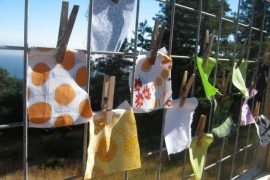
    These are only a few of Harmony’s designs. (Photo courtesy of Harmony Susalla.)

    How comfortable with math do you feel?

    On a scale of 1 to 10, I’d rate myself a 5.   I am really comfortable with simple math.  Work math seems natural. I actually really enjoy having math I learned in school apply to my daily life.  So much of our formal education is forgotten because we just don’t use it, but I get to use math on a daily basis.

    What kind of math did you take in high school?

    In high school, I was always in the advanced math classes. My senior year, I was placed in calculus.  Until that point, math had been pretty easy for me, but suddenly I was lost.  I think I lasted about 2 weeks before I dropped the class.  It was the first time I can remember truly feeling “stupid.”  I was then placed in regular senior math, and it was so easy that I was held after class by my teacher who believed I had an attitude problem.  While the teacher would go over homework from the day before I would be working on the current night’s homework.  I would finish before class was over, and then stare out the window (because I didn’t need help).  This was the behavior that convinced her I had an attitude problem.  After that, I had to pretend to be paying attention to the lesson being taught, even though it was material I already knew.

    Did you have to learn new skills in order to do the math you use today?

    This is a good question. I think that most of the math I use today I learned in school, with the exception of some of the accounting terminology and applications that were new to me. But because I had a good base in math, it was relatively easy to learn on my own.

    This entire week will be devoted to fabrics. Come back on Wednesday to see what I wrote for Harmony’s blog.  On Friday, I’ll show you how I made some gorgeous curtains for my new living room out of Harmony’s Evelyn print.

    In the meantime, post your questions for Harmony here. She’s happy to respond!