Today, I have the great honor of guest posting at Simple Mom, a wonderful, practical and easy-going spot on the web for home managers. The subject of the day is problem solving and the deck I built a few years ago.
Simple problem solving skills can make the impossible possible.
You’ve probably figured out by now that math in your everyday life isn’t much like the worksheets and timed drills you suffered through in elementary and middle school. And in the real world, you can leave those way, way behind.
That’s because grownup math has more to do with problem solving than remembering that 7 times 8 is 56. Most of us don’t use trigonometry or calculus. But basic math skills figure into some of the most critical decisions of each day—how to save money, save time and save your sanity. These days, you need to know how much top soil to order for your flower bed or what time your parents will arrive in Boston, if they’re driving in from St. Louis.
Four summers ago, I decided to build a deck—something I’d never done before. This process taught me a lot about the math I already knew and how to fill in the gaps with some pretty simple problem solving skills.
Read the rest of the post, and comment there to win one of 10 paperback copies of Math for Grownups. (You can comment here, but it won’t get you in the drawing, so make sure to head over to Simple Mom.)
Film Friday is taking the day off (it’s basement is flooded and it’s worried that its rare collection of film reels–including outtakes of Citizen Kane where Orson Wells reveals that “Rosebud” is actually a reference to the Fibonacci Sequence–might be under water), but you can check out past Film Friday editions, if you really miss it.Save
First, I found out that USA Weekend— the weekly newspaper supplement that appears in more than 800 newspapers in the U.S. and is read by 4.7 million people each week — published a cool, little story about Math for Grownups this weekend. “Man,” I thought. “This is great!”
Then I read the first and only (at the time) comment:
In “Benefits vs. Raise” I am surprised you made the common mistake of thinking you will make less money if you get a raise. If you move to a higher tax bracket it is only the incremental money that is taxed at the higher rate. You should print a correction.
Long story short: my explanation in Math for Grownups is correct. Sadly, for Gregory Connolly, the reporter who wrote this otherwise really nice story, some of the information in the article was not. In a few days the geeky little corner of the blogosphere that pays attention to these things went nuts. I’ve gotten emails, nasty tweets and more — even after I posted what I think is a very level-headed response to the original comment, letting readers know that the error was the reporter’s. And even after USA Weekend posted an excerpt from my book that explains (correctly) how math and the tax system work in this situation.*
Hoo-wee! When math, taxes and mistaken reporting collide, sparks fly!
I’m still trying to figure out if this is a good thing for me or a bad thing. (Is any publicity good publicity?) But this whole experience illustrates a few interesting points:
1. Math matters. When you think that you don’t need to understand how math applies to the tax code, think again, my sister and brother. I’ve got dozens of internet commenters and tweeters begging to convince you differently. And quite honestly, they’re not as nice as I am.
2. It’s critical to check your assumptions. I’m convinced that Mr. Connolly wouldn’t have made the same mistake had he really considered what he was writing. Yes, it’s a common mistake and even an element of misinformed political rhetoric to believe that a raise could actually be bad for a person. But really? Does that make sense? Just like with math problems, checking to see if the answer is reasonable can save anyone from a lot of heartache. (And I’m thinking this reporter has had at least some heartache this week.)
3. There’s good reason that people are scared of math — big, mean, know-it-alls shame us into believing that a simple misunderstanding or mistake will bring down entire civilizations, crush the delicate sensibilities of our dear children and bring us perilously close to either left- or right-wing political domination. In other words, if we don’t get every single syllable and number absolutely correct, we are wrong, wrong, wrong and nothing can save us from eternal shame and damnation.
(How many of you felt this way in school?)
But whether or not these internet commenters, bloggers and tweeters would like to admit it, not much about math will cause such drastic, awful consequences. Sure, there may plenty of people more than willing to shout, “YOU’RE WRONG!” rather than admit that they, too, sometimes feel like math is hard and the tax system can be difficult to comprehend. But in the end, I’m here to say that the basic math that most of us have to do everyday both matters and won’t kill you.
The fact that I’m still alive, sober and writing about this after the frenetic tongue lashing I’ve received over the last few days is testament to this. You can survive making math mistakes (or other’s math mistakes). And I honestly hope that someone is telling the poor Gregory Connolly this very thing.
So let’s fess up. What was your last math mistake? Did it cause the ground to open up and swallow up innocent puppies and kittens? Or did you just lose a little cash or miss the previews at a movie or put too much fertilizer on your lawn?
Share your math horror stories in the comments section.
*Update: USA Weekend is continuing to finesse its response to this situation. The last section of the article has now been rewritten to correct the mistake, and the excerpt from my book has been removed.
Is your Kindle or Nook hankering for some math? Is your tablet or computer sorely lacking in number crunching?
Today is your lucky day. Actually, this week is your lucky week!
Until Friday, September 10, you can download Math for Grownups for free — yep, $0 0¢ — on your eReader or computer. That’s how much I and my publisher (Adams Media) love you.
So what are you waiting for? Click on over to the Adams Media blog to get your free electronic copy of Math for Grownups.
Oh, and if you’re a traditionalist, you can purchase Math for Grownups at your local bookstore or online at Amazon or Barnes and Noble.
Math for Grownups is taking the day off, so I thought it would be nice to post a few of my favorite Math at Work Monday interviews, in case you missed any of them.
Marie Grace the Knitwear Designer: Those cute little booties that Aunt Lottie knitted for your baby daughter? They were likely designed by someone like Marie Grace, who uses math to figure out how many rows are knitted and how many are purled.
Ron the Web Designer: Just last week, Ron told me that he actually used a math proof to help him figure out some design elements. He’s the only person I know who admits to regularly using the Golden Mean.
Graham the Fish Hatchery Technician: So far, this is the most popular Math at Work Monday edition ever. Maybe that’s because most folks ask, “What the heck is a fish hatchery technician?” Maybe it’s because there’s a photo of Graham holding an enormous snapping turtle by its tail.
Shana the Jewelry Designer: I’m fascinated by Shana’s process and studio. Her work is so organic and yet requires a tremendous amount of math and science.
Melissa the Speech Therapist: My first Math at Work Monday Q & A, Melissa revealed how math helps her test her adult patients’ cognitive abilities. Until she answered my questions, she didn’t really know how much she uses math in her job — like many of the folks I’ve interviewed.
Even if you weren’t in the predicted path of Hurricane Irene, you likely heard about pretty much nothing but last weekend. We Americans love our big storms. There’s been lots of grumbling lately about over-hyped media coverage, especially since the hurricane was downgraded to a Category 1. But this was a bad storm — big, slow moving and full of rain.
Remarkably, the storm followed the path that meteorologists predicted: hitting landfall in North Carolina and moving up the east coast, hugging the shore. How did they know?
This video from The Weather Channel gives a really good explanation.
By the way, I apologize for being absent online for much of this week. I didn’t have power until Monday, and then it took another three days for my internet connection to be restored. Hope everyone else fared well!
I know what you’re thinking. “It’s so obvious how a 6th grade teacher would use math! She’s teaching fractions and division and percents!”
There’s always a lot more to teaching than the rest of us may think. And that’s why I asked Tiffany Choice to answer today’s Math at Work Monday questions. Ms. Choice was my daughter’s 4th grade teacher, and she’s the best elementary math teacher I’ve ever met. She truly made the math fun, and she really got into her lessons. I know this for sure, because I had the pleasure of subbing for Ms. Choice while she was on maternity leave. Let me tell you, those kids loved her — and so do I!
Last year, Ms. Choice moved to Fairfax County, Virginia. She’s getting ready to start teaching 6th grade there. In honor of what was supposed to be our first day of school — until Hurricane Irene changed our plans! — here’s how she uses math in her classroom.
Can you explain what you do for a living? I teach state-mandated curriculum to students. My job also includes communicating to parents progress and/or concerns, appropriately assessing my students, and analyzing data to drive my instruction and lessons.
When do you use basic math in your job? I use math all the time — mostly basic addition, subtraction, multiplication and division. When I plan lessons, I need to appropriately plan for activities that will last a certain length of time. Then, when I am teaching the lessons, I am watching the clock and using timers to keep my lessons moving or calculating elapsed time.
I also use math to grade assignments and calculate grades. I break a student’s grade into 4 categories; participation, homework, classwork, test/projects. Each category has a different weight. Participation and homework are each 10 percent, while classwork and test/projects are each 40 percent. Then for each grading period, I average grades and take the appropriate percentage to get the overall grade.
I also use math to analyze data and drive my instruction. After quarter assessments or chapter tests are given, I look for trends. Which questions did the majority of students get incorrect? If I notice out of 60 students only 30% of them got a certain question correct this says to me that most of them (42 to be exact) got the question wrong. I need to figure out why and go back.
I will also use math to group my students for games and activities. When I originally plan for them I always assume all students will be present. However, with absences and such I have to use last-minute division to regroup them. I move desks around into different groups periodically during the year, and that requires division as well.[pullquote]It’s completely normal to feel anxious or nervous about math. But a great teacher at any level (primary to college) will help you “get it.” Just don’t give up.[/pullquote]
When I plan for field trips, I have to calculate the total cost for each student depending on the fees involved. Then, I have to count large amounts money that has been collected to account for the correct amounts.
Do you use any technology (like calculators or computers) to help with this math? At my first teaching job, I had a computer program that calculated grades for me, but when I left and went to a new district I didn’t have that software, so I did grades all by hand using a calculator.
How do you think math helps you do your job better? The whole point of my job is to get students to learn and become great thinkers. I wouldn’t be able to find or focus on areas of weakness if I wasn’t able to properly analyze data and comprehend what it really means to me.
What kind of math did you take in high school? Did you like it or feel like you were good at it? I only took algebra and geometry in high school. I was terrible at math in high school and didn’t enjoy it or “get it” until college. I started in a community college and I had to take two developmental math classes before I could take what was required. It was during those developmental courses I finally “got it” and began to actually enjoy it. Everything finally made sense.
It’s completely normal to feel anxious or nervous about math. But a great teacher at any level (primary to college) will help you “get it.” Just don’t give up.
Did you have to learn new skills in order to do this math? The math I use to do my job is math that is taught up to the middle school level. I didn’t have to learn anything special.
Thanks so much, Ms. Choice! (I don’t think I can ever call her Tiffany!) If you have questions for Ms. Choice, just ask them in the comments section. She has agreed to come back to Math for Grownups to talk a bit about how parents can work with their kids’ math teachers, so stay tuned for more advice from her.
That’s what I indelicately exclaimed when I saw the list of 10 highest-paying degrees, as determined by the PayScale College Salary Report. I didn’t expect to see American Literature or Elementary Education, but I also didn’t expect this.
1. Petroleum Engineering
2. Chemical Engineering
3. Electrical Engineering
(Seeing a trend here?)
4. Materials Science and Engineering
5. Aerospace Engineering
6. Computer Engineering
(What do these things have in common?)
7. Physics
8. Applied Mathematics
9. Computer Science
10. Nuclear Engineering
Dang, that’s a lot of math there. Here’s some more: The typical entry level salary for someone with a petroleum engineering degree is $97,900. The typical entry level salary for someone with a degree in, oh let’s say, English is $30,968. The English major can expect to earn about 32% of what the petroleum engineering graduate earns.
So, I’m not breaking my promise that you don’t have to be BFFs with math. But I do want to point out that math-intensive degrees are getting a lot of attention from employers, who are willing to pay big bucks. If I had to guess–and this is just a guess–some of the reason that engineers, physicists and applied mathematicians earn so much is because there aren’t many of them. At least compared to the number want ads in these fields.
So, if you’re a parent or a high school kid or a college student thinking of changing your major, consider the sciences (for your kid or yourself). If you’re afraid of the math, learn to cope with your anxiety.
Or at least don’t diss these geeks. Their bank accounts are probably bigger than yours.
Don’t know what a physicist or applied mathematician might do? Over the weekend, I interviewed a physicist who helped develop a math model that can predict how a tumor will grow and metastasize. Save
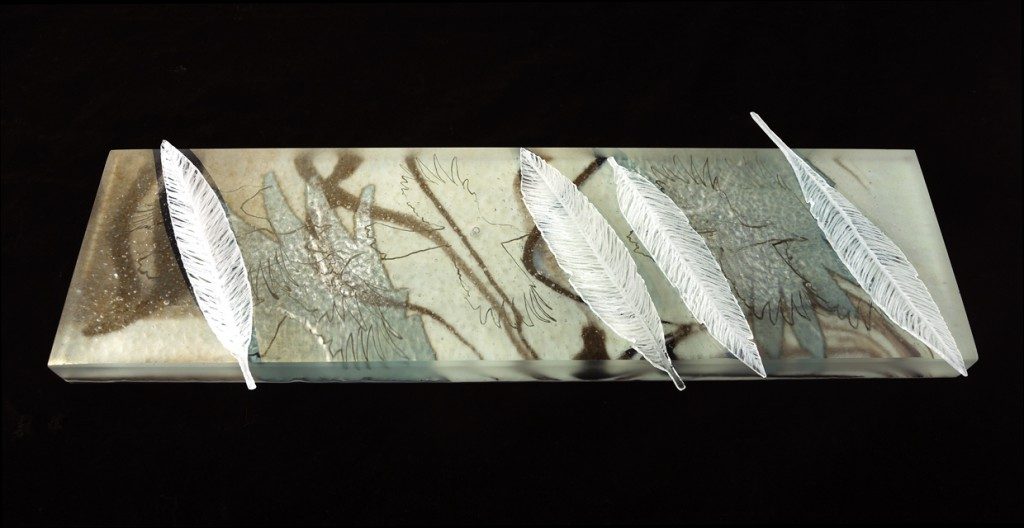
Ursula Marcum practices an amazing art form called kiln-formed glass, which she can explain better than I. Her pieces are layered and rich, unlike any other glass I’ve ever seen. Like most artists, Ursula does quite of bit of basic math in her work, and she shares the details here.
What do you do for your living?
I’m an artist who works in kiln-formed glass. Rather than blowing glass, which people may be familiar with, I cut up and compose individual pieces of glass, then I fire it all in a specialized kiln to get the result I’m after. Each piece may take several firings. I then sell the completed works at art fairs and to shops as well as a show at galleries. I also teach kiln-formed glass classes at Vitrum Studio, which specializes in this medium.
When do you use basic math in your job?
Because I’m self-employed, and therefore wear many hats, I use math ALL the time, for all kinds of reasons. Most of the time it’s basic computation, but I work with fractions quite often because of all of the measurings I have to do. For example, if I’m making a glass patter, I need to measure all the pieces of glass so that they fit together and, ultimately, fit into a ceramic mold that guides the glass into a particular shape. Or, I need to center a piece of hardware that’s going to go on the back of a hanging panel.
Sometimes, though, I need to refer to specific formulas. Let’s say I’m doing a sculptural piece. When I put the glass in the kiln, at a certain point the heat will turn the glass from a solid into a liquid and, if I’ve made the correct calculations, it will fill a void that is in a plaster mold. I need to figure out the volume of the void so that I know how much glass, by weight, to use. This is one of several formulas that I have in a notebook which I refer to again and again.
Do you use any technology (like calculators or computers) to help with this math?
I use both calculators and computers to help me because I know that when used correctly they are accurate! In order to do something like the volume formula that I spoke of earlier, I will first use a calculator to convert the numbers to the metric system. It makes it so much easier. I also use the computer to help me keep track of things like inventory and finances. It’s much faster than using a pencil and paper, though I use those tools, too.
drawer #4 from Marcum’s collections series
How do you think math helps you do your job better?
Accuracy is very important, and a piece of artwork looks professional because of the details. If my corners aren’t square, or my hardware is off-center, or I don’t have enough glass to completely fill the mold, that is sloppy work. If I can’t keep the financial books in order, or I don’t know what inventory I have on hand, I will be out of business pretty quickly.
How comfortable with math do you feel?
The work that I do help me to become comfortable with math. I am the sole proprietor, so if I don’t do it, there isn’t anyone else to take up the slack! Practice, practice, practice made it feel less scary. Eventually, I got to the point where I had enough confidence to feel comfortable with the math I was doing, as well as believe that I could figure out something new that came my way.
Bird Feathers
What kind of math did you take in high school?
I really, really struggled with math in school once I got past basic arithmetic. The exception was geometry, which I aced. In hindsight, I understand that I did well in this class because I was (and still am) a strong visual learner. Because there were shapes that I could draw and relate to, geometry made sense to me in a way that algebra never did. I got through trigonometry with the help of a very, very patient teacher who stayed after school two days a week to tutor me. It was so frustrating for me though – and I’m sure it was for her, too! At the time I thought, “Well, I’ll just get through this and then I’ll NEVER use math again.” Admittedly, it was a bit short-sighted. Not only does my job require math, but LIFE also requires math.
Did you have to learn new skills in order to do this math?
Mostly, I had to learn to confront my fear of math. I had been taught all of the skills that I needed for my work, I just didn’t believe that I knew how to use them. But I loved working with the glass, and I had the desire to make my work to the best of my ability, and that meant that I had to brush up on those dusty old math skills.
If math makes you nervous, see if you can apply it to something you love. It’s a great motivator!
Do you have questions for Ursula? Visit her on her Facebook page.
Earlier this month, I did a podcast with Arin Greenwood at Out of the Storm News. We talked about how math confidence can help folks make good financial decisions–and how if you don’t trust your math abilities, you may avoid the math and make poor financial decisions.
And in June, I did a guest post for Michelle Rafter at WordCount, about the 5 math skills that all journalists need to master. Again, with solid math skills, journalists can better report the stories we need to read or watch or listen to.
Today’s Film Friday kind of brings those two ideas together, with a twist. The popular and brilliant Khan Academy breaks down the unemployment numbers in a way that can really help you understand what they really mean.
It’s kind of depressing but definitely worth 12 minutes of your time.
Earlier this week, I provided a guest post about math anxiety and kids for Imp3rfect Mom. I wasn’t surprised to get a comment from a reader asking about how to deal with her math anxiety.
My son is an adult so my question concerns me. I’m almost 60 and I’ve been mathphobic (big time) since I was in 6th grade. At that point math just crashed and burned for me and I struggled for the rest of school. Now I am self studying for a designation related to my job (the job itself doesn’t require math ability) but I have to learn some equations for the Time Value of Money for the last exam. I look at that chapter and just freeze. I actually am telling myself “well, if I just skip that part and study real hard, I’ll still pass the test.” This is ridiculous! How do I conquer 50 years of Fear of Math?
I’m sure you can hear the frustration in her writing. (Do you ever feel the same way?) I anxious about certain things–making difficult phone calls, traveling to places where English is not the predominant language, or asking someone for help when I’m lost. (That last one is so silly, isn’t it?)
I’ve talked about the roots of math anxiety–the insistance that the goal is the right answer, timed calculations and an expectation of perfection–but now it’s time to share some ways to cope.
Allow yourself to fail. This is not so easy when you’re dealing with your finances or preparing to take a test. But when you’re learning (or relearning) something, you will make mistakes. Heck, even when you have something down cold, you can screw up. If you’re feeling anxious about math, set up low-stakes scenarios when failure isn’t a big deal. Try things on your own, for example, and allow someone you trust to check your work.
Ask yourself, “How hard can it be?” I’ve said this before, if I can do this stuff, so can you. I don’t have the typical “math brain.” I can’t do mental calculations, and sometimes I forget really basic facts like 6 x 7. And believe me, if a fourth grader can do these tasks, so can you.
Make it fun. I swear, I’m not violating math secret #3 (You Can Skip the Love). You don’t have to have fun or love math to be good at it. Still, if you’ve read my book, you know what I mean. Too often, math is cut-and-dry, boring numbers. When it’s presented or explored using real-world stories with funny characters, it’s a lot more tolerable. So, whether you’re studying for a test or trying to explain a concept to your kid, try making up problems using Sesame Street characters or your crazy Aunt Miriam who has 76 cats and wears a fedora. The sillier the better.
Find resources that work for you. I’m a big DIYer. And everything I know about sewing, painting, renovations and carpentry, I learned from Google. I promise. Besides my book, there are amazing resources out there for folks who need a little refresher. You can even find videos on YouTube or Flickr tutorials. But be careful: sometimes mathematicians think they’re being really helpful, when they’re not. Don’t let yourself be overwhelmed by minute details or unrelated tangents. Click through these resources quickly until you find what you need.
Trust your gut. Just because a textbook or a friend has the information you need, doesn’t mean you need to follow that advice or process. This is the beauty of being a grownup–we don’t have to follow the rules that a teacher sets out for us. Think about when you feel comfortable with math. Is it in the kitchen? When you’re gardening? When you’re doing your budget? What is it about that process that is less threatening? Use what you know about yourself–and your learning style–to step into these other, scary places.
So I’d love to hear from you now. What tricks have you used to conquer your anxiety or fear–about anything? If you have dealt with math anxiety in the past, what has helped? Share your ideas in the comments section.
When my friend Alisa Bowman asked me to answer some math questions for a health blog she writes for, I didn’t quite expect what she sent over. In terms of health, I’m usually asked how to find BMI or how to calculate the perfect caloric intake. Here’s what Alisa wanted to know:
I’ve heard that treadmill readouts are notoriously inaccurate. Is there a way to figure calories burned in your head?
I’m at book club. How many glasses of wine can I drink and still be safe to drive home?
If I am at high altitude, how do I figure out how long to boil an egg to make sure I don’t get salmonella?
I had no idea how to answer these, so I put my reporter cap on and did some research. I was especially interested in the last question, as I’ve had zero experience cooking at high altitudes. And I found the answer really interesting! Maybe you will, too.
(By the way, Alisa is the author of an amazing book, called Project Happily Ever After, that her story of how she went from wishing her husband dead to falling back in love with him. Check out her site.)
I loved Alisa’s random questions. They made me think, and I learned something — which is the best part of being a writer. Do you have random math questions? Have you been in a situation when you think math could help, but you’re not sure how? If so, post your question in the comments section or drop me a line. If it’s a good fit, I’ll answer it in an upcoming blog post!
Things that make many kids anxious: a new school, big dogs, the deep end of the swimming pool, bees, strangers, nightmares, math.
Did you notice something there? For many children, math and bees are equally frightening or at least nerve-wracking.
Not all kids have math anxiety, but it’s not uncommon for elementary, middle or high school students to express nervousness about learning math or taking math tests. At the same time, these students may also feel less confident in their math skills or even say that they hate math.
Want to know how to eleviate math anxiety–for your kids and yourself? Check out my guest post at Imp3rfect Mom. You could win a free copy of Math for Grownups!Would you like me to guest post at your blog? Or do you know of a blog that I would fit right in with? I’ve got lots of ideas to share with anyone who will listen! And I promise I’m a good guest. I wipe out the sink after I brush my teeth and don’t mind if the cat sleeps on my pillow. Get the details here.