Category: Math for Parents

  • Last-Minute Mathy Gifts for Kids

    Last-Minute Mathy Gifts for Kids

    Looking for a last-minute gift for your budding Eistein?  You’ve come to the right place.

    I’m not about to suggest that kids love “educational toys.”  But one thing is for sure — kids learn best when they’re having fun.

    I’ve gathered a few of my most favorite gift ideas for kids–whether they like math or not.  The best part is that these gifts for sale at your local Target, bookstore or toy store, for not much cash.

    Games

    SET is a sneaky — and honestly fun — way for kids to learn and practice logic and set theory.  The object of the game is notice similarities in the cards, each of which has a variety of shapes that differ in number, shape, color and shading.  I promise, this is a cool way to spend some time with your kids.  (Ages 6 and up)

    Yahtzee?  Yep.  There’s quite a bit of math involved, in fact.  Developing a good strategy requires a solid understanding of probability.  And being able to quickly spot a full-house, three-of-a-kind or four-of-a-kind involves spacial understanding.  Then there’s adding up the scores to find totals.  See?  Math is all over this game. (Ages 8 and up)

    Toys

    Kids (and grownups) can create complex and simple mazes and runs in a variety of different marble run toys, some with transparent tubes and others with brightly colored pieces.  Where’s the math?  First off, kids are playing with their spacial abilities, noticing where the marble goes when the track positions are changed.  Then there’s the experience of trial and error — which goes hand in hand with math. (4 years and up)

    For the tiny set, you can’t go wrong with shapes.  Toys like shape sorters help toddlers and preschoolers learn their shapes.  You can extend the learning by encouraging other ways of sorting — like colors.  (15 months to 5 years)

    Books

    David Schwartz writes really wonderful math and science books that don’t smack kids over the head with their educational focus.  How Much Is a Million is one of my favorites.  Illustrated by Steven Kellog, the book demonstrates how much a million is.  (Grownups will probably learn something from this one, too!) (Ages 3 and up)

    There’s no sneakier way to tap into a kid’s curiosity about math than with The Phantom Tollbooth, by Norton Juster.  This classic children’s novel takes readers on a mythical journey of Milo and his “watchdog,” Tock.  The book touches on a variety of mathematic topics — from infinity to three-dimensional shapes.  Bonus: there’s an equal emphasis on language, including idioms and puns.  It’s bound to be a homerun for any young reader.  Oh, and 2011 is the 50th anniversary of this classic. (Ages 10 and up)

    Do you have any great gift ideas for kids?  Share them in the comments section!
  • The 12 Days of Christmath

    elebrate Christmas, you’re heading into the home stretch!  As of this morning, there are nine days until the fat man comes down the chimney.  I hope you’re more ready than I am!  (My careful schedule has gone to pot, in some ways, derailed by a sick kid, aging dog and some unexpected work stuff.  But I’m getting back on track.)

    If you’ve hung out with me here at Math for Grownups for a while, you know how much I love Vi Hart.  This chick is something else — a musician and a “recreational mathematician.”  (According to her site, she now calls herself a recreational mathemusician.)

    In short, Vi is the daughter of a math professor and a wonderful musician in her own right.  She creates these really, really cool videos that explore the intricacies of mathematical concepts — from number theory to geometry.

    Yeah, she’s a huge geek, but she’s one of those geeks who won’t make you feel dumb, and she’s funny.

    This week, I came across her video, The Gauss Christmath Spectacular.  (Gauss was a 16th and 17th century mathematician who dabbled in a huge array of topics, from optics to statistics.)  There’s some stuff in here that will probably fly right over your head, but don’t let that discourage you.  Instead, grab a cup of eggnog, plop your favorite high school or college student next to you, and jot down the math that you do recognize.  You’ll probably surprise yourself.

    Without further ado, Vi Hart’s take on the 12 Days of Christmas (my absolute favorite Christmas song when I was five years old — much to my parents’ dismay).

    What did you recognize?  Show off in the comments section!

  • Cookie Exchange Math

    Cookie Exchange Math

    Ah, the cookie exchange!  What better way to multiply the variety of your holiday goodies.  (You can always give the date bars to your great aunt Marge.)

    The problem with this annual event is the math required to make five or six dozen cookies from a recipe that yields three dozen.  That’s what I call “cookie exchange math.”

    Never fear! You can handle this task without tossing your rolling pin through the kitchen window. Take a few deep breaths and think things through.

    To double or triple a recipe is pretty simple — just multiply each ingredient measurement by the amount you want to increase the recipe by.  But it’s also pretty darned easy to get confused, especially if there are fractions involved.  (And there are always fractions involved.)

    The trick is to look at each ingredient one at a time.  Don’t be a hero!  Use a pencil and paper if you need to.  (Better yet, if you alter a recipe often enough, jot down the changes in the margin of your cookbook.)  It’s also a good idea to collect all of your ingredients before you get started.  That’ll save you from having to borrow an egg from your neighbor after your oven is preheated.

    Each year, I bring cow cookies to my neighborhood cookie exchange.  What are cow cookies, you ask?  Just what they sound like: sugar cookies cut into the shape of a cow.  The spots are made of melted chocolate.  (They’re Holsteins, of course.)  And around each of their little necks, I create little (icing) wreaths with red (icing) berries.

    (Why do I make cow cookies?  It’s a long story.  But I’ve been these to holiday parties for more than 20 years now.  Kids love ’em.)

    The problem is that my cow-shaped cookie cutter is larger than most other, eh-hem, more traditional Christmas cookie cutters.  So, while my recipe says it yields 36 to 48 cookies, I know I won’t get that many.

    So each year, I triple the recipe.  That way I have enough for the cookie exchange (5 dozen), plus some to take to my mom’s house and give away to friends.

    I can’t share the recipe here, because it’s copyrighted by Better Homes and Gardens (otherwise known as the Red Plaid Cookbook).  But we can look at the ingredient amounts.  My recipe requires the following measurements of various ingredients:  1/3 cup, 2 cups, 1 tsp and 3/4 cups.

    Since I’m tripling the recipe, I’ll need to multiply each of these amounts by 3. Then I can measure out the ingredients using the altered amounts.

    The first three calculations are simple, but what about that last one?

    The really easy way to get around this fraction is to fill a  one-fourth cup 9 times.  And honestly, if that’s how your brain works, go for it.

    But if you want to, you could turn the fraction into a mixed number.  Here’s how:

    Ta-da!  In only a few steps, I’ve done the simple math needed to alter this recipe.  Now, I just need to keep my fingers out of the bowl — so that I can actually bring enough cookies to the exchange.  (Honestly, I’d rather eat the dough than the baked and decorated cookies!)

    What are your holiday recipe math tricks?  Can you think of other, more creative, ways to alter a recipe.  Share your thoughts in the comments section.

  • Shop on! With Percents

    Shop on! With Percents

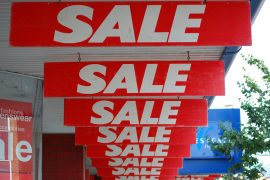
    Everybody loves a sale, right? The thrill of the hunt, the sense of accomplishment when landing a great deal.

    But how many times have you reached the register and realized your purchase was more than you expected?  Or have you ever passed on a purchase because figuring out the discount was way too much trouble?

    You don’t have to be afraid of the mental math that goes along with shopping.  (That goes for in-person and online sales.)  You also don’t have to be that giant geek standing in the sports goods aisle using your cellphone calculator to find 15% of $19.98.  Who has time for that anyway?

    Believe it or not, figuring percents is one of the easiest mental math skills.  And it’s one of those things that you may do differently than your sister who may do differently than your boss.  In other words, you are not required to follow the rules that you learned in elementary school.  Now that you’re a grownup, you can find your own way.

    Don’t follow?  Let’s look at an example.

    Once again you’ve put off buying Mom’s gift.  It’s just about time to leave for her house, and you have literally minutes to find the perfect present for her — at the right price.  You’ve collected $40 from your brother and sister, and you can contribute $20.  Darn it, you’re going to scour the department store until you find something she’ll like that’s in the right price range.

    And suddenly, there it is: a countertop seltzer maker, just right for Mom’s nightly sloe gin fizz. Bonus! It’s on sale — 40% off of $89.95.  But can you afford it?

    There are a variety of different ways to look at this.  But first, let’s consider what you know.

    The seltzer maker is regularly priced at $89.95.

    It’s on sale for 40% off.

    You can spend up to $60 ($40 from your sibs, plus the 20 bucks that you’re chipping in).

    You don’t necessarily need to know exactly what the seltzer maker will cost.  You just need to know if you have enough money to cover the sale price.  And that means an estimate will do just fine.  In other words, finding 40% of $90 (instead of $89.95) is good enough.

    Now you have some choices.  You can think of 40% in a variety of ways.

    40% is close to 50%

    It’s pretty easy to find 50% of $90 — just take half.

    50% of $90 is $45

    So, if the seltzer maker was 50% off, you could afford it, no problem.  But is 40% off enough of a discount?  You probably need to take a closer look.

    40% is a multiple of 10%

    It’s not difficult to find 10% of $90 either.  In fact, all you need to do is drop the zero.

    10% of $90 is $9

    What is 40% of $90?  Well, since 40% is a multiple of 10%:

    There are 4 tens in 40 (4 · 10 = 40)

    and

    10% of $90 is $9

    so

     4 · $9 = $36

    It’s tempting to think that this is the sale price of the seltzer maker.  Not so fast!  This is what the discount would be.  To find the actual price, you need to do one more step.

    $90 – $36 = $54

    Looks like you can afford the machine. But there’s an even more direct way to estimate sale price.

    40% off is the same as 60% of the original price

    When you take 40% off, you’re left with 60%. That’s because

    40% + 60% = 100%

    Or if you prefer subtraction

    100% – 40% = 60%

    So you can estimate the sale price in one fell swoop.  Like 40%, 60% is a multiple of 10%.

    There are 6 tens in 60 (6 · 10 = 60)

    and

    10% of $90 is $9

    so

     6 · $9 = $54

    The estimated sale price is $54, which is less than $60.  You snatch up the race-car red model and head for the checkout.

    There are so many other ways to estimate sales prices using percents.  Do you look at these differently?  Share how you would estimate the sale price in the comments section.

  • Watch Your Language (And Your T-Shirts)

    Earlier this year,

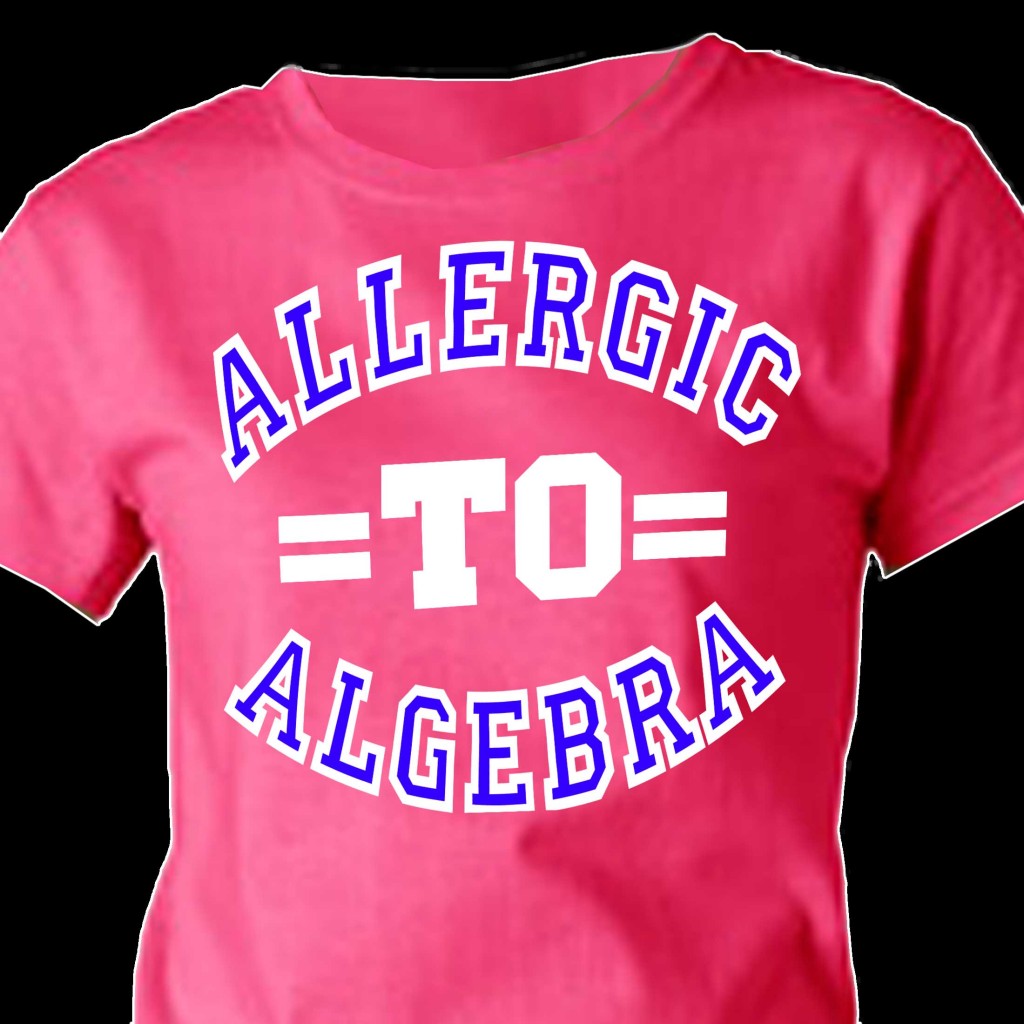
    This Forever 21 shirt is no longer available. (Thank goodness!)

    Forever 21 and J.C. Penny had problems with moms and teen girls, when they retailed their own versions of math-as-gender-warfare–t-shirts that read: Allergic to Algebra and I’m Too Pretty for Homework, So My Brother Does It for Me.  Within days, the shirts disappeared from the shelves and their websites.

    I wrote a guest blog post about this for Dara Chadwick’s wonderful blog You’d Be So Pretty If, which is devoted to encouraging positive body image in girls.

    I was a great high school student. I did well in all of my classes (Okay, so I did fail band that one grading period because I didn’t turn in my practice sheets.). I was a responsible and eager student. But there was one subject that was a challenge for me: French.

    I tried. I really did. But for whatever reason, the most romantic of all of the romance languages did not come easy. I had good teachers. I studied. I paid attention in class.  But the best I could do was a low B — and that was with a lot of hard work.

    Still, I didn’t have a t-shirt that read, “French Phobic.” I’ve never heard of a Barbie doll that says, “French is Hard!”

    So what’s the deal with math?

    Math is hard. But so is writing, reading, playing an instrument, painting, soccer, woodshop and, yes, French. In fact, if teachers and coaches are doing their jobs, students will feel challenged — which can bring up a variety of other feelings, from frustration to enthusiasm.

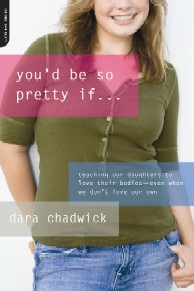
    You’d Be So Pretty If… by Dara Chadwick.

    Read the rest here, and be sure to comment.  Also, check our Dara’s wonderful book You’d Be So Pretty If…  Anyone who knows a teenage girl should!

    So what do you think about these t-shirts?  Are they all in fun or bad for girls?  Why does math get such a bad rap?  Share your ideas in the comments section.

  • Allergic to Algebra? Use these resources

    Photo courtesy of Dimitri N

    One of the complaints I’ve heard about Math for Grownupsis that it only covers basic math.  And I’m not apologetic about that.  The whole point of the book is to make basic math a little less mysterious and a little more practical.

    But there may be times when you need an Algebra II refresher or review of basic calculus facts.  If we don’t use this stuff we lose it.

    Throughout the years, I’ve discovered a few really wonderful websites that offer just this kind of assistance.  From explaining basic math in theoretic terms (which may be necessary to help our kids with their middle school math homework) to reviewing more complex math topics, these sites are really wonderful.  When you need a little more than the basics, I recommend taking a look.

    The Math Forum @ Drexel University

    This site offers a wide variety of resources for parents, teachers and students.  But the part I love the most is Ask Dr Math.  Hundreds of college professors answer math-related questions from students, teachers and parents around the world.  These responses are archived in a searchable database. Plus there are broad categories to browse, like Formulas and Middle School.

    Purplemath

    This site is devoted to algebra–from absolute value to solving systems of linear equations.  Students (and parents) can skim lessons for quick answers or read them carefully for more in-depth review of the topics.  You can also post a question in the forums and receive a thoughtful response that invites you to think critically or refers you back to the lessons themselves.  (There are no quick answers here!)

    Mathwords

    Have you forgotten what a Cartesian plane is?  Are you wracking your brain trying to remember why the y-intercept is a big deal?  Mathwords offers definitions for thousands of math terms.  There are no examples or explanations here, but sometimes knowing a definition is enough to jog the old synapses. Right?

    Do you have any favorite math resources?  Share them in the comments section!

  • Wooden Sandals: A math lesson

    Wooden Sandals: A math lesson

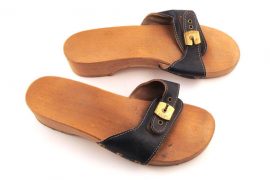
    When I was a teenager in the 1980s, I wanted a pair of tan Dr. Scholl’s sandals so badly I could taste it.  Each time my mother took us to the Eckerd drug store, I made sure to stroll down that aisle to check them out.

    “Those are the dumbest shoes I’ve ever seen in my life,” Mom said, and she flat out refused to buy them for me.

    Today, I’d have to agree.  With hard, wooden soles and an adjustable strap that featured a gold buckle and grommets, these were not what Tim Gunn would consider classic fashion pieces.

    But I wanted those shoes dearly.

    They cost $14.95—pricy for a kid with no job and a $1 a week allowance.  My mom suggested I save up my own money for them.  But savings from my February birthday was long gone, and by the time I saved enough allowance, summer would be over.  These shoes were definitely not fall footwear.

    So, my mother came up with another idea: to ask my father for a loan. And that’s exactly what I did.

    Both of my parents were educators—my mother an elementary school librarian and my father a division chair and sometimes-teacher at the local community college.  It’s fair to say that the man never missed an opportunity to give me a lesson about money management.  And these lessons also often included a little bit of math.

    The Dr. Scholl’s loan was no different.

    Instead of giving me the money outright and keeping my allowance for the next 15 weeks, I got a simple-interest loan that was to be paid within a certain time period.  I don’t remember how long the term or what the interest rate was. But I did continue to receive my weekly allowance and paid a portion of that amount each week for the loan.  Dad even helped me calculate how much more I’d be paying for the sandals with the interest.

    As a kid who only wanted her hands on a pair of fad sandals, I thought this was overly complex.  But my desire for those shoes was great, and this was the only way I’d get them.  So I agreed.  I signed the contract he wrote out by hand and paid off that loan, plus the interest, bit by bit.

    Today, as the parent of an 11-year-old daughter, I’m amazed by my father’s foresight.  It really is a brilliant little trick, and one that has served me very, very well.

    Six years later, my dad took me down to the Bank of Speedwell to get a loan for my first car—a 1984 Toyota Camry that I bought from my aunt for $2,000.   This time he explained compound interest, just before he cosigned for the loan.

    And that lesson didn’t stop with me.  Two years later, my sister gave me the most amazing gift when I graduated from college—an upright piano that she purchased from a neighbor.  She paid Bud and Ginia Cabell $20 a month for I don’t know how long.  (And now my daughter plays Mozart waltzes on that very instrument.)

    Dad with my niece Addison in 2006

    The thing that I know about my dad is that he wasn’t afraid to delve into the tough stuff with us—including managing our money.  That often required a few calculations, and I often resisted his lessons.

    When it came to these little real-world lessons, I’m sure I was a royal pain in the you-know-where, but in the end, those experiences were much more meaningful than anything I learned in school—and they were less expensive than anything I could learn on my own.

    My daughter hasn’t asked for her version of ugly, wooden sandals, but I’m waiting for that moment.  And when she does, I’ll be ready with a contract and a little lesson in simple interest and regular payments.

    Did you get any surprise lessons like this one when you were little?  Or do you have plans to do something similar with your own kids — or grandkids, nieces, nephews, neighborhood kids?  Share your stories in the comments sections below.

  • Homework Help: 4 middle school math facts you probably forgot

    Photo courtesy of .raindrops.

    Every so often, at around 7:00 p.m., I’ll get a call from someone I know.  “I don’t understand my kid’s math homework,” they’ll say.

    These folks aren’t dumb or bad at math.  But almost always, they’ve hit a concept that they used to know, but don’t remember any more.  And those things can trip them up — big time. So, I thought it might be helpful to review 4 middle school math facts that may give parents trouble.

    Every number has two square roots.

    This is the question that prompted this blog post.  I got a call from a friend who didn’t understand this question in her daughter’s math homework: “Find both square roots of 25.”  Both?

    Most adults have probably forgotten that each number has two square roots. That’s because we are typically only interested in only one of them — the positive one.

    Yep, the square roots of 25 are 5 and -5.  In other words:

    sqrt{25} = 5 and -5

    It should be pretty easy to see why this is true.  (You just have to remember that when you multiply two negative numbers, your answer is positive.)

    5 · 5 = 25

    -5 · -5 = 25

    1 is not prime.

    This question came up in my own daughter’s homework last week — a review of prime and composite numbers.  Remember, prime numbers have only two factors, 1 and the number itself.  So, 7 is prime.  And so are 13, 19 and even 3.  But what about 1?

    Well, it turns out the definition of a prime number is a little more complicated than what we may assume.  And I’m not even going to get into that here.

    But there is a way for less-geeky folks to remember that 1 is not prime. Let’s look at the factors of each of the prime numbers we listed above:

    7: 1, 7

    13: 1, 13

    19: 1, 19

    3: 1, 3

    Now, what about the factors of 1?

    1: 1

    Notice the difference?  Prime numbers have two factors, 1 and the number itself.  But 1 only has one factor.

    0 is an even number.

    This idea seems to trip up teachers, students and parents.  That’s because we tend to depend on this definition of even: A number is even, if it is evenly divisible by 2.  How can you divide 0 into two equal parts?

    It might help to think of the multiplication facts for 2:

    2 x 0 = 0

    2 x 1 = 2

    2 x 2 = 4

    2 x 3 = 6 …

    All of the multiples of 2 are even, and as you can see from this list, 0 is a multiple of 2.

    Anything divided by 0 is undefined.

    Okay, this gets a little complex, so bear with me.  (Of course, if you want, you can just memorize this rule and be done with it.)

    First, we can describe division like this:

    r={a/b}

    Using a little bit of algebra you can get this:

    r · b = a

    So, what if = 0?

    r · 0 = a

    That only works if is also 0, and 0 ÷ 0 gives us all kinds of other problems.  (Trust me on that.  This is where things get pretty darned complicated!)

    So how many of you have thought while reading this, “I will never use this stuff, so what’s the point?” You may be right.  Knowing that 0 is an even number is probably not such a big deal.  But at least your kid will think you’re extra smart, when you can help him with his math homework.

    What are your math questions?  Is there anything that’s been bugging you for ages that you still can’t figure out?  Ask your questions in the comments section.  I’ll answer some here and create entire posts out of others.

  • Math Secret #4: You do use algebra

    Photo courtesy of .raindrops

    It’s the No. 1 question asked of math teachers: “When will I ever use this stuff?”

    And in terms of upper-level math — conic sections, radicals, differentiation and the quadratic formula — the answer may very well be, “Not much.”  (Unless you’re in one of those jobs with top-paying degrees.)

    As I hope you know by now, basic math is ubiquitous.  We encounter percents, fractions, formulas, the order of operations (Please Excuse My Dear Aunt Sally) and geometry pretty regularly.  But algebra?  When was the last time you solved for x?

    Algebra describes the relationships between values, and how those values change when we introduce variables.  In short, algebra is based on equations or expressions:

    3+x

    x2+4x-7

    y=5x+9

    (Are your hands sweating or have your eyes glazed over? Hang in there.  I promise this won’t be overwhelming.)

    In its simplest form, algebra can be described as the process of solving for a variable.  And you probably did that with random equations for a good portion of your high school math education.

    Boring.

    Except for word problems, none of the equations had much to do with real life, which is one way that we math educators have sucked all of the life out of math.

    But I’m guessing that at least some of you use algebra pretty darned regularly–without even knowing it.  Let me show you how.

    As a freelance writer, I’m responsible for maintaining my business records, which for me include expected and actual income, invoices and goals.  I could purchase accounting software for this or hire someone to do the work for me, but to be honest, my business is pretty small.  I have a lot of experience with spreadsheets, and so six years ago, I built one that I still use to track all of my business finances and goals.

    Why does this work?  Formulas.  One formula gives me the total of all of my invoices for each month and and another spits out the percent those are of my monthly goal.  I have created formulas that give the percent of my income that is generated from each of my revenue streams.  And because of formulas, I can instantly see how much income has been invoiced but not received.

    But maybe this isn’t such a great example.  Most small businesses or self-employed folks use ready-made accounting programs for these tasks.

    Meet my good friend, Rebecca.  Like many of us in my neighborhood, Rebecca’s family gets milk delivered once a week by a local dairy.  (I know!  Cool, right?)  But unlike me, she shares her delivery with her next-door neighbor.  And that requires a little bit of math.  Here’s how she explains it:

    As you know there are bottle deposits, bottle charges, delivery charges and of course milk (or other product) charges. The charges go to only one credit card. Keeping track of these is a challenge if you don’t want to have to write a check to your neighbor every week – and who wants that? So we have worked out a “kitty” (nice, eh, milk – kitty. ha ha) system where we pay a lump sum to the person whose credit card is being charged. But then we have to know when the kitty is running out.

    In other words, each of the families contributes to the kitty, and those funds are used to pay the milk bill on one family’s credit card account.  Rebecca uses a spreadsheet to keep up with how much money is in the kitty at any given time.  When the kitty runs low, she knows to ask her neighbor for a contribution.

    Rebecca’s milk delivery spreadsheet

    Why doesn’t Rebecca ask for the same monthly payment in the kitty?  Well, this is where the algebra comes in.  Not only can we order milk, but also yogurt, meats, eggs and cheese. That means the weekly orders vary.  And — here’s where you can use that English degree — when elements vary, they’re called variables.

    Ta-da!  Algebra in real life.  (Gosh, I’m so proud!)

    These spreadsheet formulas are so useful that algebra teachers are using them to demonstrate how algebra is indeed useful in everyday situations.

    So, when was the last time you used a spreadsheet?  Did you create a formula?  Did you know you were using algebra?  Tell us about it in the comments section.

  • Film Friday: When will I ever use this stuff?

    It’s the perennial question from students of all ages: “When will I use this stuff?” So when tutor, Ryan faced this query (probably for the upteenth time), he took to the streets to find the answer.  What he found is in the video below:

    And of course I have some thoughts — for teachers and students.

    It is absolutely true that series (that’s what the funny looking E — an uppercase sigma — means in this problem) are not the stuff of ordinary folks in non-science fields.  But they’re not as difficult as they seem.  It’s the notation that’s confusing.

    Skip this part, if you don’t really want to do any algebra today.

    A series is just the sum of a sequence (or list) of numbers.  That’s it.  Nothing more, nothing less.  So when you have

    sum{n=1}{7}{3n-1}

    you’re simply saying, “Find the sum of the first 7 values of 3n-1, where the first value of n is 1.” In other words: 2 + 5 + 8 + 11 + 14 + 17 + 20 = 77.

    Now back to my opinions.

    Okay, so I don’t need to know what a series is in order to visit the grocery store or get a good deal on a car or even figure out how much I earned this year over last year.  But here’s what I wish some of those folks who were interviewed for this video had been able to say:

    “That funny-looking E is a Greek letter, right?”

    “Doesn’t this have to do with adding things together?”

    “Hey, I dated a girl from {Sigma}{Sigma}{Sigma} once!”

    And second, this tutor did pick a humdinger of a problem to focus on.  Series (and their brothers, sequences) are not the main focus of any mathematics course.  But honestly, they wouldn’t be taught if they weren’t useful somewhere.  And boy-howdy are they useful!

    So, here are a few ways that real people do use series in their real jobs (courtesy of Algebra Lab and Montana State University:

    1.  Architecture:  “An auditorium has 20 seats on the first row, 24 seats on the second row, 28 seats on the third row, and so on and has 30 rows of seats. How many seats are in the theatre?”

    2.  Business: “A company is offering a job with a salary of $30,000 for the first year and a 5% raise each year after that. If that 5% raise continues every year, find the amount of money you would earn in a 40-year career.”

    3. Investment Analysis: “A person invests $800 at the beginning of each year in a superannuation fund.  Compound interest is paid at 10% per annum on the investment. The first $800 was invested at the beginning of 1988 and the last is to be invested at the beginning 2017. Calculate the total amount at the beginning of 2018.”

    4. Physics: “The nucleii of a radioactive isotope decay randomly. What is the total number of nucleii after a given period of time?”

    And this brings me to some additional news of the week.  Sol Garfunkel (Consortium for Mathematics and Its Applications) and David Mumford (emeritus professor of mathematics at Brown) made a bit of a splash on Wednesday, with an editorial in the New York Times: How to Fix Our Math Education.

    Their proposal is that we teach tons of math that applies to everyday life — and focus on those applications. (Yay!) And we ditch “highly conceptual” math for folks who won’t need it for their jobs. (Boo!)

    Hopefully, you’ve already identified the problem: How do we know if a kid won’t decide to go into physics or engineering or high school math education? Hell, how do we even attempt to lure them into these fields, if they don’t see the math at all?  (And by the way, physics, engineering and applied mathematics were recently identified as the top-paying degrees in the U.S.)

    Look, I empathize with the student who isn’t interested in what any of the Greek letters mean in math class.  And I think it’s true that most folks won’t use these skills at all after high school.  (It is worth mentioning that everyone depends on series in their daily lives–they just don’t see the math.) But my response to the kid who asks, “What’s this good for?” is to tell him where it can be applied.

    And if he says he won’t be going into any of those fields, I would say, “Suck it up, cupcake, because you’re too darned young to know for sure.”

    Please share your thoughts in the comments section.  Do you agree that these concepts should be taught in high school, even though most kids won’t use them in their everyday lives? How do you think we should encourage more students to go into science, technology, engineering and math (STEM) fields? 

  • Top 10 Highest Paying Degrees

    Estimated reading time: 1 minute, 31 seconds

    Photo courtesy of gadgetdude

    “Holy crap!”

    That’s what I indelicately exclaimed when I saw the list of 10 highest-paying degrees, as determined by the PayScale College Salary Report.  I didn’t expect to see American Literature or Elementary Education, but I also didn’t expect this.

    1. Petroleum Engineering

    2. Chemical Engineering

    3. Electrical Engineering

    (Seeing a trend here?)

    4. Materials Science and Engineering

    5. Aerospace Engineering

    6. Computer Engineering

    (What do these things have in common?)

    7. Physics

    8. Applied Mathematics

    9. Computer Science

    10. Nuclear Engineering

    Dang, that’s a lot of math there.  Here’s some more: The typical entry level salary for someone with a petroleum engineering degree is $97,900.  The typical entry level salary for someone with a degree in, oh let’s say, English is $30,968.  The English major can expect to earn about 32% of what the petroleum engineering graduate earns.

    So, I’m not breaking my promise that you don’t have to be BFFs with math.  But I do want to point out that math-intensive degrees are getting a lot of attention from employers, who are willing to pay big bucks.  If I had to guess–and this is just a guess–some of the reason that engineers, physicists and applied mathematicians earn so much is because there aren’t many of them.  At least compared to the number want ads in these fields.

    So, if you’re a parent or a high school kid or a college student thinking of changing your major, consider the sciences (for your kid or yourself).  If you’re afraid of the math, learn to cope with your anxiety.

    Or at least don’t diss these geeks.  Their bank accounts are probably bigger than yours.

    Don’t know what a physicist or applied mathematician might do?  Over the weekend, I interviewed a physicist who helped develop a math model that can predict how a tumor will grow and metastasize.  Save

  • Feeling Anxious about Math? Here’s how to cope

    Photo courtesy of Sasha Wolff

    Earlier this week, I provided a guest post about math anxiety and kids for Imp3rfect Mom.  I wasn’t surprised to get a comment from a reader asking about how to deal with her math anxiety.

    My son is an adult so my question concerns me. I’m almost 60 and I’ve been mathphobic (big time) since I was in 6th grade. At that point math just crashed and burned for me and I struggled for the rest of school. Now I am self studying for a designation related to my job (the job itself doesn’t require math ability) but I have to learn some equations for the Time Value of Money for the last exam. I look at that chapter and just freeze. I actually am telling myself “well, if I just skip that part and study real hard, I’ll still pass the test.” This is ridiculous! How do I conquer 50 years of Fear of Math?

    I’m sure you can hear the frustration in her writing.  (Do you ever feel the same way?)  I anxious about certain things–making difficult phone calls, traveling to places where English is not the predominant language, or asking someone for help when I’m lost.  (That last one is so silly, isn’t it?)

    I’ve talked about the roots of math anxiety–the insistance that the goal is the right answer, timed calculations and an expectation of perfection–but now it’s time to share some ways to cope.

    Allow yourself to fail. This is not so easy when you’re dealing with your finances or preparing to take a test.  But when you’re learning (or relearning) something, you will make mistakes.  Heck, even when you have something down cold, you can screw up.  If you’re feeling anxious about math, set up low-stakes scenarios when failure isn’t a big deal.  Try things on your own, for example, and allow someone you trust to check your work.

    Ask yourself, “How hard can it be?” I’ve said this before, if I can do this stuff, so can you.  I don’t have the typical “math brain.”  I can’t do mental calculations, and sometimes I forget really basic facts like 6 x 7.  And believe me, if a fourth grader can do these tasks, so can you.

    Make it fun.  I swear, I’m not violating math secret #3 (You Can Skip the Love). You don’t have to have fun or love math to be good at it.  Still, if you’ve read my book, you know what I mean.  Too often, math is cut-and-dry, boring numbers.  When it’s presented or explored using real-world stories with funny characters, it’s a lot more tolerable.  So, whether you’re studying for a test or trying to explain a concept to your kid, try making up problems using Sesame Street characters or your crazy Aunt Miriam who has 76 cats and wears a fedora. The sillier the better.

    Find resources that work for you. I’m a big DIYer.  And everything I know about sewing, painting, renovations and carpentry, I learned from Google.  I promise.  Besides my book, there are amazing resources out there for folks who need a little refresher.  You can even find videos on YouTube or Flickr tutorials.  But be careful: sometimes mathematicians think they’re being really helpful, when they’re not.  Don’t let yourself be overwhelmed by minute details or unrelated tangents.  Click through these resources quickly until you find what you need.

    Trust your gut. Just because a textbook or a friend has the information you need, doesn’t mean you need to follow that advice or process.  This is the beauty of being a grownup–we don’t have to follow the rules that a teacher sets out for us.  Think about when you feel comfortable with math.  Is it in the kitchen? When you’re gardening?  When you’re doing your budget? What is it about that process that is less threatening?  Use what you know about yourself–and your learning style–to step into these other, scary places.

    So I’d love to hear from you now.  What tricks have you used to conquer your anxiety or fear–about anything?  If you have dealt with math anxiety in the past, what has helped? Share your ideas in the comments section.