Things that make many kids anxious: a new school, big dogs, the deep end of the swimming pool, bees, strangers, nightmares, math.
Did you notice something there? For many children, math and bees are equally frightening or at least nerve-wracking.
Not all kids have math anxiety, but it’s not uncommon for elementary, middle or high school students to express nervousness about learning math or taking math tests. At the same time, these students may also feel less confident in their math skills or even say that they hate math.
Want to know how to eleviate math anxiety–for your kids and yourself? Check out my guest post at Imp3rfect Mom. You could win a free copy of Math for Grownups!Would you like me to guest post at your blog? Or do you know of a blog that I would fit right in with? I’ve got lots of ideas to share with anyone who will listen! And I promise I’m a good guest. I wipe out the sink after I brush my teeth and don’t mind if the cat sleeps on my pillow. Get the details here.
Turn “Goodnight Moon” into a math book by counting selected items on each page.
When my daughter was born more than 11 years ago, I knew a few things: Physically connecting with her would help us bond, breastfeeding is best, and reading to her—even at a very young age—was critical for later language development.
Even when she was a mere four months old, she had an established bedtime ritual, which included at least 10 minutes of reading. But no one mentioned math. Apparently, infants can appreciate Goodnight Moon, but not Euclid.
My kid was lucky, though. With a math educator for a mom, she got a great foundation in math well before she could even walk. I didn’t have special plans to introduce math early; I just did it.But what’s a non-mathy parent to do?Find out in my guest post at One Mama’s Daily Drama. (Psst… it’s not hard at all!)Would you like me to guest post at your blog? Or do you know of a blog that I would fit right in with? I’ve got lots of ideas to share with anyone who will listen! And I promise I’m a good guest. I wipe out the sink after I brush my teeth and don’t mind if the cat sleeps on my pillow. Get the details here.What kinds of math activities have you done with your kids? Share your ideas in the comments section!
You probably find it pretty darned easy to encourage literacy. In fact, there are countless magazine articles and books and workshops out there on this very subject. And so all good parents read to their kids every night, play word games with them, give them magnetic letters for the fridge.
But what about math? If you’re like most parents, the idea of working math into the day probably seems down right daunting. Scary even.
It’s not as hard as you think, especially if you’re willing to give into your children’s demands for a regular allowance. Money is an instant math lesson—and can motivate even the most reluctant student (adult or child).
Would you like me to guest post at your blog? Or do you know of a blog that I would fit right in with? I’ve got lots of ideas to share with anyone who will listen! And I promise I’m a good guest. I wipe out the sink after I brush my teeth and don’t mind if the cat sleeps on my pillow. Get the details here.
According to the headlines, we were born either good or bad at math. At least that’s how this study is being interpreted by bloggers and news outlets. Except that’s not necessarily what the study concludes.
This makes me mad. Really mad. I have not read the full study, but nothing in the abstract–or even the stories and blog posts about this study–suggests that people are born with or without math ability. Instead, it seems that the cheeky headlines were just too good to pass up.
Here’s what the study author, post-doctoral student Melissa Libertus, does say:
The relationship between ‘number sense’ and math ability is important and intriguing because we believe that ‘number sense’ is universal, whereas math ability has been thought to be highly dependent on culture and language and takes many years to learn… Many questions remain and there is much we still have to learn about this.
And here’s the nitty gritty on the study itself. A group of 200 children, with an average age of 4 years old, was given a number sense test. (You can take the exact same test here). These children were then asked to perform a variety of age-appropriate math tasks, including counting, reading numbers and computations. The results make a lot of sense: children who performed well on the number sense test did better on the math tests.[pullquote]No one says that we’re born good or bad at reading. We’re all expected to learn to read–and read well. So why do we say that about math?[/pullquote]
But the results seem to be misrepresented by media and others. These kids were selected precisely because they haven’t had any formal math education. They’re preschoolers. So, according to many news reports, kids are either born with number sense or get it from formal education.
Rubbish.
If you had a child in the last 10 or 15 years–or know someone who has–you are probably familiar with the big, big push for early literacy. Parents are encouraged to read to their kids, even when they’re babies, which research has shown helps the children develop age-appropriate literacy skills. In fact, kids who have had access to pre-reading experiences as infants, toddlers and preschoolers do much better with reading in elementary school. (This is one of the tenets of Head Start programs around the country.)
No one says that we’re born good or bad at reading. We’re all expected to learn to read–and read well. So why do we say that about math?
Just like the researcher, I think this study raises more questions. And here’s the really big one: What can parents do to boost their kids’ numeracy before formal education begins? (I actually wrote about this earlier this week.)
I still maintain that we are born with an innate understanding of math–just like we’re born knowing something about language. But without stimulating this understanding, kids can fall behind their peers or at least not reach their full potential. We read to little children so that they can learn to read on their own. And we should be doing something similar with kids so that they can do math.
A friend and fellow math blogger, Bon Crowder has launched an amazing program she’s calling Count 10, Read 10. It’s a simple idea: Parents should spend 10 minutes each day reading to their young kids and 10 minutes doing some sort of math with them. But nobody is saying flash cards, worksheets or chalkboards are necessary. The trick is to sneak the math into everyday activities, which can be as simple as counting the steps your new walker takes.
So here’s what I think happened with the news reports of this study: reporters, editors and bloggers simply tapped into their own misconceptions about math–and even their own math anxiety–and distorted the message. For many people, it’s a “fact” that some people are just naturally bad at math. I hope you’ll help me challenge that notion.
Meanwhile, be careful what you read.
P.S. A great math educator, David Wees has also chimed in on this topic, and shares–more eloquently–some of the same concerns I have. Read it!
So what do you think? Are people born good or bad at math? Can parents help develop numeracy in their children? How? Share your ideas in the comments section.
So you think you don’t use math on a daily basis? Think again.
You may not be solving for x, and the distance formula may not roll off the tip of your frontal lobe—mainly because you haven’t used it in years and years. But if you can put “parent” among your titles, you do math. I promise.
Just look at a typical day:
Read the rest of my guest post at Math is Not a Four Letter Word. You might be surprised by how much math the average parent does in a day!
By the way, would you like me to guest post at your blog? Or do you know of a blog that I would fit right in with? I’ve got lots of ideas to share with anyone who will listen! And I promise I’m a good guest. I wipe out the sink after I brush my teeth and don’t mind if the cat sleeps on my pillow. Get the details here.
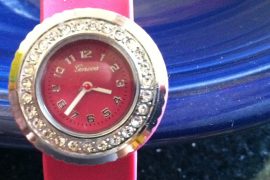
My daughter just bought a hot-pink slap watch. She thinks it’s cool because it’s a slap watch, that’s pink–with tiny Diamonique stones encircling the face.
I think it’s cool because it’s not digital.
Like most middle school kids, my daughter is not so good at reading an analog clock. In fact she resists it like crazy. But today, as I sit in the Philadelphia airport waiting for my 5:55 pm flight to Seattle, I’m thinking about how useful her new watch will be.
Read the rest of my guest post at www.TravelSavvyMom.com. Then share your opinions on digital vs. analog clocks. Which one helps you calculate time fastest?
Boy, do I remember those early days of parenting my daughter. I was working full time, coddling a strong-willed toddler, trying to serve balanced meals, selecting great books to read to her and trying to keep my house and yard clean enough that my neighbors wouldn’t call Child Protective Services on me.
Adding one more thing to the list would have made my head blow off of my shoulders.
And yet, today, we are being asked to do that one more thing: introduce numeracy to our little Janes and Johns. In other words, math.
Want some tips on how parents can develop numeracy in their little kids–and keep their own heads on their shoulders, right where they belong? Read the rest of this post at Words To Eat By, where I guest posted today.
By the way, would you like me to guest post at your blog? Or do you know of a blog that I would fit right in with? I’ve got lots of ideas to share with anyone who will listen! And I promise I’m a good guest. I wipe out the sink after I brush my teeth and don’t mind if the cat sleeps on my pillow. Get the details here.
What’s the one thing most parents have in common? We push our kids. “Eat your veggies.” “Do your homework.” “Unload the dishwasher.” And even though it sounds like nagging, these lessons are the ones that help our kids grow into successful adults.
But when it comes to math, are you doing all that you can to ensure that your child or teen will be successful? Do you even know what those things are? The best advice may actually be surprising.
Turns out, there are a few very simple steps you can take that will make a huge difference in how your child performs in mathematics and perceives his or her math skills.
Are you worried about your child’s math skills? Relax and read the rest of my guest post at Flynn Media.
By the way, would you like me to guest post at your blog? Or do you know of a blog that I would fit right in with? I’ve got lots of ideas to share with anyone who will listen! And I promise I’m a good guest. I wipe out the sink after I brush my teeth and don’t mind if the cat sleeps on my pillow. Get the details here.
Today, I’m visiting Frisco Kids, a blog written by my friend and fellow freelancer, Debbie Abrams Kaplan. She has posted a Q&A with me about Math for Grownups, and as well as my thoughts about kids and math. I hope you’ll visit and even post a comment!
By the way, would you like me to guest post at your blog? Or do you know of a blog that I would fit right in with? I’ve got lots of ideas to share with anyone who will listen! And I promise I’m a good guest. I wipe out the sink after I brush my teeth and don’t mind if the cat sleeps on my pillow. Get the details here.
Okay, so most parents really do understand how to encourage literacy. We read signs, the backs of cereal boxes, the comic section and of course classics like Harry Potter and the Deathly Hallows. But injecting a little everyday math into long summer days can be a bit of a challenge.
Good Morning America to the rescue!
In a regular feature, the morning show brings in a “sneaky teacher” to show parents how to continue learning through July and August. And my good friend and fellow freelance writer, Debbie Abrams Kaplan was featured last week.
It’s a cool video, but unfortunately, I can’t figure out how to embed it. So just click on the picture below to view it. It’s worth the extra step! (Debbie’s kids — and she! — are adorable.)
couple of weeks ago, a fellow freelance writer wrote me about her foray into graduate school. She needed to brush up on some math skills, and she wasn’t sure how. I have a feeling that her questions weren’t unique. Whether you need to learn a little extra to help your kid with his homework or you need to take a math class to further your education, learning math again (or for the first time) can be daunting.
Luckily, my friend and fellow math blogger, Bon Crowder offered to write a guest post on this very topic. I swear, Bon and I were separated at graduation or something, because we approach math education in very similar ways. Plus she’s fun. (See? Math folks aren’t always boring and difficult to understand!)
I wanted to title this “Being a Great Adult Learner.”
But that’s dumb. All adults are great learners. If we weren’t, we’d be stumbling around, bumping into doors, starving and naked. We know how to learn, and the proof is that we’re still alive.
And dressed.
The question is “What makes you learn?”
1) You need confidence.
Confidence involves two things: feeling worthy and knowing you have the ability.
When people feel they’re entitled to something, they’re more likely to feel confident in getting it. Hang around any Best Buy service desk and you’ll see this in action. People say all kinds of strange things when trying to return a broken product, and these things are said with a sense of entitlement. BY GOLLY they’re going to get their way!
So how do you gain worthiness and ability? You’re worthy of it because you already have it. And you’re able to do it because you already do.
You have it all. It’s just hidden behind a wall of words you or someone else (or both) has told you for years. Now’s the time to ignore everybody, even yourself.
Because here’s the gosh-honest truth: There is not a single thing within a mathematician that is not within you.
You’ve done math since you were a kid. Even before you were in school. You knew at a deep level that if there was one toy and there was another kid around, you’d better run like the dickens to get it. There’s no dividing that toy evenly between kids.
You balance your checkbook (or you would be in jail right now), you probably have some rough idea of your gas mileage, and you know that if you have 12 people coming over, you’re going to have to double or triple that recipe for shepherds pie. You know math. Now’s the time to admit it.
So say this every night before your prayers. If you don’t pray at night, say it twice:
I do math. Today I woke up on time because I calculated how long it would take to get dressed. I knew how much money to spend because balanced my checkbook. I figured out how much weight I needed to lose – and I used math to do it.
Modify this statement to fit your lifestyle and run with it. Every night.
2) You need the right environment.
Once you’ve tapped in to the realization that you’re inherently good at math, you need the right learning environment.
This includes location, timing and the other people involved. If you have to drive too far away after working all day and all you get is a lousy quarter-pounder-with-cheese, you’re going to be tired, grumpy and irritable. If your class is full of teenagers fresh out of high school and the professor is 400 years old and believes in death by PowerPoint, things are not going to go well.
How do you know the right environment?
Look at all the learning experiences you’ve had through the years. List out the good ones and the bad ones. And then dig deep – what made the good ones good? Why were the bad ones so detrimental?
Include timing, location, student body, temperature in the room and details of the instructor. List out the attitude of the instructor, his/her teaching style, voice intonations – even how he wrote on the board.
Pick out the deal-breakers and the nice-to-haves and write them on a special piece of paper. This is your official “Environment Requirement” page. Laminate it, put it in Evernote, tatoo it to your bottom – whatever you do to keep it close so you can refer to it often.
How do you make sure your Environment Requirements are honored?
Here’s where that sense of entitlement comes back into play. If your class has a deal-breaker environment element, do something about it. Think, “If this were a faulty remote control that I bought at Best Buy, how would I handle it?”
Ask the instructor to manage the loud students better. Ask building maintenance to change the temp of the room (or bring a sweater). Don’t sign up for a class during a time when you’ll be tired, hungry and irritable.
And if you can’t change the environment – leave. Drop the class. Get your money back.
If it were a crappy remote control, that’s what you’d do, right?
You’re dressed…
And fed. You learn all the time. And you do math.
Now go find a class that fits and have fun!
Bon Crowder publishes www.MathFour.com, a math education site for parents. But that’s not all! Bon has launched a really, really, really cool initiative called Count 10, Read 10. While parents are encouraged to read to their infants, toddlers and preschoolers, we’re rarely encouraged to inject a little bit of math into the day. Bon will show you how. Take a look at her blog for more information on developing math literacy (or numeracy). I’ll be writing about this more in the coming months.
A few years ago, I got this idea that I wanted to learn how to sew. My mother in law bought me a lightweight machine at a yard sale for $10. So I decided it was time to teach myself how to sew. How hard could it be?
Turns it, not so much, when you have the internet at your fingertips. With a few searches, I unearthed great Flickr tutorials for zipper pouches, blog posts with step-by-step instructions on how to make box bags and a really, really amazing month-long series of fat-quarter projects on a blog called Sew, Mama, Sew!
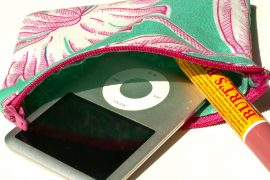
One of my zipper pouches made from ModGirls Sis Boom by Jennifer Paganelli
A fat quarter is a piece of 18″ x 22″ fabric. In most cases, it’s a quarter of a yard, but not cut from one side of the width to the other. And it’s a cheap and easy way to buy those gorgeous designer fabrics, like Amy Butler, Moda and Alexander Henry. This is a big deal, because I was quickly realizing that I’m a fabric addict. The editors and contributors at Sew, Mama, Sew had great projects for fat quarters: purses, journal covers, pin cushions, crochet hook rolls and even fabric boxes. I was in heaven!
When I published Math for Grownupsand learned that a virtual tour would be a great way to promote the book, my first thought was that maybe — just maybe! — I could guest post on Sew, Mama, Sew. Imagine my surprise when the editors there jumped at the chance. I felt like I was one of the cool kids.
And today is the big day. You can read my guest post, “Nothing but Net,” which talks about how we can mentally (and physically) translate 2-dimensional figures into the 3rd dimension. That’s what patterns are, after all. Even if you don’t sew, this skill is a great one to have!