Category: Math for Writers

  • For the Love of Math

    For the Love of Math

    Last Friday, my family adopted a sweet, little poodle puppy, named Zipper. The foster mother, Sally, had brought him from a Mexico shelter to her own home in Silver Springs, Md. During the home visit on Friday, we talked about our careers, and I mentioned that I write about math. That’s when she told me about her neighbor, the mathematician and novelist.

    “You two should meet!” she said. Apparently, we have some of the same ideas about math.

    Well, I did “meet” Manil Suri today, via the pages of the New York Times op-ed section. His excellent piece, “How to Fall in Love with Math” points out some ideas I’ve been extolling for years — along with a couple that I might have said were hogwash a couple of weeks ago.

    As a mathematician, I can attest that my field is really about ideas above anything else. Ideas that inform our existence, that permeate our universe and beyond, that can surprise and enthrall.

    Yes, yes, and again I say, yes! Mathematics is not exclusively about numbers. Hell, arithmetic is only a teeny-tiny fraction of what mathematics really is. Mathematics is the language of science. It’s a set of systems that allow us to categorize things, so that we can better understand the world around us.

    Math is a philosophy, which I guess is what makes us math geeks really different from the folks who are merely satisfied with knowing how to reconcile their accounting systems or calculate the mileage they’re getting in their car. We mathy folks are truly interested in the ideas behind math — not just the numbers.

    Last week, I attended a marketing intensive, a workshop during which I outlined my current career and explored how I want to take things to the next level. I’m ready to think bigger, and I need a plan to get me there.

    The other entrepreneurs there thought there was real value in my creating a coaching service for entrepreneurs. My services would center around the numbers that these folks need to make their businesses survive and thrive. Marketing numbers, sales numbers, accounting numbers. They resisted the word “math” and advised me to really underscore the numbers.

    From a purely marketing standpoint, I completely get it. I don’t have so much of a math wedgie that I can’t understand that the word “numbers” may be less threatening than “math.” So why not just go for it?

    But the entire process left me thinking about what it is that draws me to mathematics. And ultimately what will drive me in a career, what moves me to get up in the morning and say, “Let’s go!” If you’ve been around here long, you know that it ain’t the numbers, sisters and brothers.

    At the same time, I can’t say that I love math. But maybe that’s semantics, too. For the last two years, I’ve said that I’m attracted to how people process mathematics. But isn’t that just philosophy? So, isn’t that just math? This is what Suri had to say:

    Despite what most people suppose, many profound mathematical ideas don’t require advanced skills to appreciate. One can develop a fairly good understanding of the power and elegance of calculus, say, without actually being able to use it to solve scientific or engineering problems.

    Think of it this way: you can appreciate art without acquiring the ability to paint, or enjoy a symphony without being able to read music. Math also deserves to be enjoyed for its own sake, without being constantly subjected to the question, “When will I use this?”

    At first, I disagreed with Suri’s thesis that math is worth loving — for math’s sake alone. But his analogy here is right on target. I couldn’t paint my way out of a paper bag, but each and every time I see “Starry, Starry Night” at MOMA, I catch my breath.

    We come back to a failure to educate, as Suri so wonderfully elucidates in his piece. When we allow people who hate — or don’t appreciate — math to teach the subject, well, does anyone think that’s a good plan?

    At any rate, I hope you’ll take a look at Suri’s piece. Meantime, I’m going to reach out to him to share my appreciation of math. Maybe there is a way — beyond teaching — for me to make a living as a math evangelist.

    What do you think? Do you notice a difference between mathematics and numbers? Have you changed your mind about math in recent years or month? Please share!

  • How This Book Editor Learned to Like Math

    How This Book Editor Learned to Like Math

    Behind every author is a great editor. And I was dang lucky to have Jennifer Lawler as my editor for Math for Grownups. What I didn’t know was that I’d helped her out, too. Who says English majors can’t do math? Here’s her story:

    A few years ago, I was working as a book development editor for Adams Media, the company that published Laura’s Math for Grownups, and I was assigned to edit the book. While I was looking forward to working with Laura, I was also a little nervous. Although I’m pretty good with basic math operations, I’m not that confident and tend to second-guess myself a lot. I just hoped that when I asked Laura questions that she wouldn’t give the dramatic sigh that my seventh-grade algebra teacher used to do when I expressed confusion.

    Fortunately, she didn’t. Laura, like her book, is a kind and supportive person. It was fun to see that aspect of her personality show up on the page. And it was a project that helped me learn more about math than I did in junior high and high school combined. I don’t mean I memorized a bunch of formulas. I mean I learned a new way to think about math.

    One of the first things Laura discussed in her book was the various ways people use to arrive at an answer to a problem. For years, I’d felt like I was doing math wrong, even though I was getting the correct answer, because I had a bunch of little shortcuts and methods I used that I had never been taught by a teacher in school. Laura showed how that is just fine—and she also emphasized the point that often in life we don’t need to be exact, we just need to be reasonably close. We can estimate, another habit I have that I always thought was somehow wrong of me to be using.

    Because Math for Grownups was meant to be a review of  mathematical concepts for people just like me, I figured that any question I asked Laura was a question that a reader like me might have. So for the first time in my life, or at least since seventh grade, I didn’t feel embarrassed about asking math questions. “I’m doing it for the reader!” I told myself, and then Laura would either explain what I had missed or add a note or a sidebar to address the question. As the process continued, I felt more and more confident about my abilities. And I stopped beating myself up for making a mistake. Do I agonize over a typo in an email I dash off to a friend? No, because I know I’m a good writer and so I don’t feel defensive about it. But I used to beat myself up for simple math mistakes that anyone can make. That just made me feel even worse about math.

    Laura pointed out that even mathematicians make mistakes in simple computations. For some reason, I hadn’t made that connection before. If I, a professional writer, can make a spelling error in an email, then of course even a mathematician can sometimes multiply 9 x 9 and come up with 72.

    One of the things that working with Laura taught me was to ask myself questions about my results in order to catch those simple mistakes—questions along the lines of, “Does this answer seem reasonable?” So, if I’m doubling a recipe, and my calculation for the double batch shows an amount smaller than for the single batch, I know I’ve done something wrong. This is the math equivalent of proofreading, and once I understood how it worked, I was a lot more confident about my answers.

    By the same token, I learned that I could look it up, just the way I do for a word I can’t remember how to spell. There’s nothing shameful about not remembering the formula for calculating volume. And I’ve dog-eared many pages in Laura’s book where I can find formulas I use a lot but can never seem to remember. I can never remember how to spell “occasionally” (have to look it up every.single.time) but I don’t think that somehow makes me a bad writer. Working with Laura taught me how to apply this same type of thinking to my math skills.

    My greatest reward? Now I deal with math like a grownup, instead of like that frustrated seventh-grader I once was.

    Jennifer Lawler is the author or coauthor of more than thirty nonfiction books as well as sixteen romances under various pen names. Her publishing experience includes stints as a a literary agent and as an acquisitions editor. She just released the second edition of Dojo Wisdom for Writers, the second book in her popular Dojo Wisdom series. She also offers classes in writing book proposals, planning a nonfiction book for self-publishing authors, and writing queries and synopses for novelists at www.BeYourOwnBookDoctor.com (under the “classes” tab).

    And have you heard? I’m working on a new ebook, Math for Writers. Stay tuned for details!

  • Getting Aware of Common Core Standards

    Getting Aware of Common Core Standards

    Not all of us are parents or teachers, but I’ve long asserted that education is a “public good,” something that each and every one of us should be very, very concerned with. When kids don’t graduate or graduate with poor critical thinking skills, a lack of curiosity of the world around them or a dearth of basic math, reading and writing abilities, everyone suffers. And in a world where STEM-based employers are recruiting and paying more, we owe it to the next generation to do better.

    (This is not to say that our educational system doesn’t have some absolutely enormous issues in other areas. Perhaps the biggest problems our schools face are not academic at all. I believe that if our country took a good, hard look at poverty, violence and teacher care, we’d make huge strides in the right direction. But this post is about academics.)

    Enter the Common Core Standards. For decades, each state has developed and cultivated its own standards – or objectives required by each basic course, from history to language arts to biology. But over the last 20 years, a movement has grown to standardize these objectives across the country. With this umbrella of standards, what little Johnny is learning in Arkansas will be similar to what little Patrice is learning in Maine.

    Right now, the Common Core Standards only cover English (language arts) and math. They’ve been adopted by 45 states. (Alaska, Nebraska, Texas and Virginia haven’t adopted them at all, and Minnesota adopted only the English language arts standards.) Standards for other subjects are in the works, including science and social studies.

    For the last six months, I’ve been writing and editing curricula designed to meet the Common Core Standards for mathematics. I’ve gotten a pretty good feel for what they are, and I have to say that I like them for the most part. Here are some general thoughts I have:

    Students will learn certain concepts earlier. I haven’t spent much time with the elementary level standards, but at least in middle and high school, various mathematical topics will be introduced earlier in the standards. For example, exponential functions (an equation with x as an exponent, like with exponential decay or compound interest) is covered in Algebra I, rather than Algebra II. 

    The result is two-fold. As the standards are rolled out, some students will be left behind. In other words, kids who started school without Common Core may have a hard time catching up or bridging the gap. Second, students will have the opportunity to learn more mathematics throughout their high school career. The idea is to better prepare them for STEM in college and careers.

    The emphasis is on critical thinking. This part, I love, love, love. For example: geometry proofs are back! And rather than compartmentalizing the various branches of mathematics, students will make connections between them. I just wrote a lesson that looks at how the graphs, equations and tables for various functions – linear, quadratic and exponential – are alike and dissimilar. Previously, students may never have seen these functions together in the same unit, much less the same lesson.

    This means that assessments will change. Students will be asked to explain their answers or verbalize the concepts. Expect to see much more writing and discussion in math class.

    Applications, applications  applications. Math is no longer done for math’s sake. And this couldn’t be better news. As I’ve said here many times before, math is pointless until it’s applied. Students should get this first-hand with Common Core, which outlines very specific applications for various concepts.

    The idea here is to demonstrate that the math they’re learning is useful. The result? Hopefully more students will choose to enter STEM careers or major in these fields in college.

    Students learn in different ways. Modeling plays a big role in the new standards, which means that students can approach the math in a variety of ways – from visualizing the concepts to using manipulatives like algebra tiles to working out equations in more traditional ways to graphing. This way, students can enter the material from a variety of different doors. And that can translate to greater success.

    Sure, there is a lot to be concerned about (most especially the gap that we expect to see in student performance), but from my perspective the Common Core Math Standards are a step in the right direction. It’s important to know that these do not form a federal curriculum; the states are still responsible for choosing curricula that meet these standards, and education resource companies are scrambling to meet these meets. (That means I’m very, very busy these days!) It’s also important to know that chucking old ideas and implementing new ones puts a huge burden on already over-taxed schools and school systems. Finally, there is no doubt that this initiative was driven by the textbook companies, which means we’re still beholden to politics and capitalism.

    But in looking at the standards alone, I think Common Core is excellent. If we can implement the standards well and keep them in place for a while, I think our kids will benefit.

    What do you think of Common Core? Share your thoughts in the comment section.

  • Boston Marathon: How FBI profilers use math

    Boston Marathon: How FBI profilers use math

    We can all agree that the horrific events at Monday’s Boston Marathon sent a chill down our country’s collective spine. The two bombs that exploded have made us afraid and sad and hopeless. One message that seemed to ease many’s pain and fear was from Mr. Rogers, who once said:

    When I was a boy and I would see scary things in the news, my mother would say to me, ‘Look for the helpers. You will always find people who are helping.’ – Fred Rogers

    This is an amazing idea in the midst of the mayhem and terror that followed the explosions. There were dozens and dozens and dozens of people who ran toward the bomb sites, because that’s what they do – help those in need.

    In the days that have followed, the FBI and others have been investigating the explosions, gathering information that will likely lead to an arrest and hopefully a conviction. Our natural question in these situations is, “Why?” Catching the person or people who did this will help us find that answer.

    It shouldn’t surprise you to know that these investigators will depend on mathematics to help them solve this crime. From measuring the trajectory of the shrapnel to piecing together a timeline of events, math is a critical component in investigation.

    A while back, I had the pleasure of interviewing Mary Ellen O’Toole, a former FBI profiler and author of Dangerous Instincts: How Gut Feelings Betray Us. She answered my questions about how she used math as a profiler. And I’m betting that this holds true for the investigation in Boston, as well.

    Math at Work Monday: Mary Ellen the FBI profiler

    Can you explain what you do for a living?

    For half of my career, I worked in Quantico, at the FBI’s Behavioral Analysis Unit, the very unit that is the focus of the television show Criminal Minds. While there I tracked down, studied, and interviewed some of the world’s most infamous criminals, and I analyzed their crime scenes, too. These criminals included Gary Ridgeway (the Green River Killer), Ted Kaczynski (the Unabomber) and Derrick Todd Lee (the serial killer of Baton Rouge.) I worked everything from white-collar crime to work place and school violence to kidnappings to serial murder.

    Since my retirement in 2009, I’ve worked as a consultant to law enforcement, corporate security, administrators, and many other professionals. I also teach at the Smithsonian, FBI Academy and many other locations.

    When do you use basic math in your job?

    As I and other profilers worked to solve a crime, we used every type of math from basic addition to geometry and pattern analysis to statistics and probability to reasoning and logic.

    Read the rest of the interview.

    If you’d like to share your wishes for the victims of the Boston Marathon bombing, please feel free to do so in the comments section. 

  • Math Awareness Month: What’s Your Story?

    Math Awareness Month: What’s Your Story?

    Lots of people make one of two incorrect assumptions about me. I’m a writer, so they initially assume that I don’t have a good relationship with math. And when they find out that I have a degree in math, they assume that I love to sit down and solve trigonometry problems all day long.

    Sure, I like math. I’ve said it a hundred times – math is a useful tool. I feel comfortable using math to figure out problems that I have, like how much fabric I need to order to recover my couch or the number of calories in a 3/4 serving of granola. (Yes, I actually do that second thing on a regular basis.) But I’ve never been head-over-heels in love with math.

    What do I really love? A good story. And so for the third year, I’m inviting you to share your math story. Telling others how you came to love, like or hate math is an interesting process. I’ve learned that education – and particularly teachers – make a huge difference in how people feel about math. Get a great teacher, and you have a much better chance of at least coming out of the class appreciating math. But a burned out, cynical or, worse, mean teacher can destroy any positive feelings a student might be cultivating about math.

    Why share your story now? Well, April is Math Awareness Month, which is not about appreciating math. Nope. The goal of this month is to simply encourage people to notice the math around them. (Which is also my personal goal with this blog and my book.) The first step can be telling the story that helped form your impressions of math. Is there something blocking your understanding or appreciation? Could be.

    Before you share your story, you may want to read some others’. Start with mine, and then check out how math almost ruined Lisa Tabachnick Hotta‘s life and how Siobhan Green learned to use math, despite an early bad experience.

    Then tell your story in the comments section. Do you like math, hate it, don’t care one way or the other? Does math make your hands sweat? Why do you think you have these feelings about math? Do you have a sad story — giving up and giving in? Or did you triumph? Whatever your personal experience, I want to hear from you. And if you’d like more space, feel free to contact me about a special guest post.

    So what are you waiting for? Share your story today.

    P.S. The official theme for this year’s Mathematics Awareness Month is sustainability. That’s a wonderful topic, but I think for many of us, it’s a little esoteric. So I’m going to pull back and focus on some more mundane topics this month. However, math educators should check out the Math Awareness Month website for ideas on how to relate this theme to the classroom. There are some really cool resources there.

  • That’s So Random: Getting sampling right

    That’s So Random: Getting sampling right

    On Wednesday, we talked about sample bias, or ways to really screw up the results of a survey or study. So how can researchers avoid this problem? By being random.

    There are several kinds of samples from simple random samples to convenience samples, and the type that is chosen determines the reliability of the data. The more random the selection of samples, the more reliable the results. Here’s a run down of several different types:

    Simple Random Sample: The most reliable option, the simple random sample works well because each member of the population has the same chance of being selected. There are several different ways to select the sample — from a lottery to a number table to computer-generated values. The values can be replaced for a second possible selection or each selection can be held out, so that there are no duplicate selections.

    Stratified Sample: In some cases it makes sense to divide the population into subgroups and then conduct a random sample of each subgroup. This method helps researchers highlight a particular subgroup in a sample, which can be useful when observing the relationship between two or more subgroups. The number of members selected from each subgroup must match that subgroup’s representation in the larger population.

    What the heck does that mean? Let’s say a researcher is studying glaucoma progression and eye color. If 25% of the population has blue eyes, 25% of the sample must also. If 40% of the population has brown eyes, so must 40% of the sample. Otherwise, the conclusions may be unreliable, because the samples do not reflect the entire population.

    Then there are the samples that don’t provide such reliable results:

    Quota Sample: In this scenario, the researcher deliberately sets a quota for a certain strata. When done honestly, this allows for representation of minority groups of the population.  But it does mean that the sample is no longer random. For example, if you wanted to know how elementary-school teachers feel about a new dress code developed by the school district, a random sample may not include any male teachers, because there are so few of them. However, requiring that a certain number of male teachers be included in the sample insures that male teachers are represented — even though the sample is no longer random.

    Purposeful Sample: When it’s difficult to identify members of a population, researchers may include any member who is available. And when those already selected for the sample recommend other members, this is called a Snowball Sample. While this type is not random, it is a way to look at more invisible issues, including sexual assault and illness.

    Convenience Sample: When you’re looking for quick and dirty, a convenience sample is it. Remember when survey companies stalked folks at the mall? That’s a convenience or accidental sample. These depend on someone being at the right (wrong?) place at the right (wrong?) time. When people volunteer for a sample, that’s also a convenience sample.

    So whenever you’re looking at data, consider how the sample was formed. If the results look funny, it could be because the sample was off.

    On Monday, I’ll tackle sample size (something that I had hoped to include today, but didn’t get to). Meantime, if you have questions about how sampling is done, ask away!

  • One in a Million: How sample bias affects data

    One in a Million: How sample bias affects data

    Continuing with our review of basic math skills, let’s take a little look-see at statistics. This field is not only vast (and confusing for many folks) but also hugely important in our daily lives. Just about every single thing we do has some sort of relationship to statistics — from watching television to buying a car to supporting a political candidate to making medical decisions. Like it or not, stats rule our world. Unfortunately, trusting bad data can lead to big problems. 

    First some definitions. A population is the entire group that the researchers are interested in. So, if a school system wants to know parents’ attitudes about school starting times, the population would be all parents and caregivers with children who attend school in that district.

    sample is a subset of the population. It would be nice to track the viewing habits of every single television viewer, but that’s just not a realistic endeavor. So A.C. Nielsen Co. puts its set-top boxes in a sample of homes. The trick is to be sure that this sample is big enough (more on that Friday) and that its representative.  When samples don’t represent the larger population, the results aren’t worth a darn. Here’s an example:

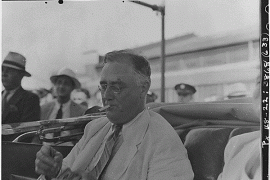
    Ever hear of President Landon? There’s good reason for that. But on Halloween 1936, a Literary Digestpoll predicted that Gov. Alfred Landon of Kansas would defeat President Franklin Delano Roosevelt come November.

    And why not? The organization had come to this conclusion based on an enormous sample, mailing out 10 million sample ballots, asking recipients how they planned to vote. In fact, about 1 in 4 Americans had been asked to participate, with stunning results: the magazine predicted that Landon would win 57.1% of the popular vote and an electoral college margin of 370 to 161. The problem? This list was created using registers of telephone numbers, club membership rosters and magazine subscription lists.

    Remember, this was 1936, the height of the Great Depression and also long before telephones  and magazine subscriptions became common fixtures in most families. Literary Digest had sampled largely middle- and upper-class voters, which is not at all representative of the larger population.  At the same time, only 2.4 million people actually responded to the survey, just under 25 percent of the original sample size.

    On Election day, the American public delivered a scorching defeat to Gov. Landon, who won electoral college votes in Vermont and Maine only. This was also the death knell for Literary Digest, which folded a few years later.

    This example neatly describes two forms of sample bias: selection bias and nonresponse bias. Selection bias occurs when there is a flaw in the sample selection process. In order for a statistic to be trustworthy, the sample must be representative of the entire population. For example, conducting a survey of homeowners in one neighborhood cannot represent all homeowners in a city.

    Self-selection can also play a role in selection bias. If a poll, survey or study depends solely on participants volunteering on their own, the sample will not necessarily be representative of the entire population. There’s a certain amount of self-selection in any survey, poll or study. But there are ways to minimize the effects of this problem.

    Nonresponse bias is related to self-selection. It occurs when people choose not to respond, often because doing so is too difficult. For this reason, mailed surveys are not the best option.  In-person polling has the least risk of nonresponse bias, while telephone carries a slightly higher risk.

    If you’re familiar with information technology, you know the old adage: Garbage in, garbage out. This definitely holds true for statistics. And this is precisely why Mark Twain’s characterization of number crunching — “Lies, damned lies and statistics” — is so apropos. When the sample is bad, the results will be too, but that doesn’t stop some from unintentionally or intentionally misleading the public with bad stats. If you plan to make good decisions at any point in your everyday life, well, you’d better be able to cull the lies from the good samples.

    If you have questions about sample bias, please ask in the comments section. Meantime, here are the answers to last Wednesday’s practice with percentage change problems: –2%, 7%, –6%, –35%. Friday, we’ll talk about sample size, which (to me) is a magical idea. Really!

  • Smaller Crowds: Calculating Percentage Change

    Smaller Crowds: Calculating Percentage Change

    No, I did not have the flu. No, I did not fall off the face of the earth. No, I did not abandon my math-writing career in favor of tightrope walking at the circus. In fact, I have simply been overworked. Apparently math writers are hard to find, and with the Common Core State Standards Initiative coming down the pike, I’ve had more work than I can handle. That’s a good thing — except when I can’t find time to blog or eat a nutritious meal or even get a full night’s sleep. Don’t feel sorry for me. But please don’t be mad at me for the radio silence, either. Thank you.

    When last we met, percentages were the topic of discussion. I had promised to shed some light on the mysteries of percentage increase and percentage decrease. This is, by far, the most-often asked question from writers. From time to time, I’ll meet a freelancer who is trying to find the percentage decrease of a company’s profit over the previous year. Or a freelancer may want to know how to calculate the percentage increase of  her income over the previous quarter.

    Trust me. This is not difficult. But it is confusing. So my challenge is to lay this out in a way that you can both understand and remember. Let’s go.

    First a definition. Percentage change — which can be either an increase or a decrease — is simply a comparison of values. In this case, we’re comparing the new value to the old value and expressing that as a percent.  And here’s how you do that:

    (new value – old value) ÷ old value

    That’s it. But let’s break it down. The change is found by subtracting the new value from the old value. And the percentage is found by dividing that answer by the old value. In other words:

    Change:new value – old value

    Percentage:divide by old value

    This should make sense, because change is often found by subtracting. If you pay for $15 worth of gas, using a $20 bill, your change is $5 — which is also $20 – $15. Likewise, percent means division. To find what percent 15 is of 20, you divide: 15 ÷ 20.

    Let’s look at this with an example. The crowds at President Obama’s first inaugural were much, much larger than at his second. It is estimated that 1.8 million people were on the mall in 2009, while only 540,000 showed up two weeks ago. (It’s worth noting that no one can say for sure how many people attend any event on the Washington Mall. These are simply estimates, which can vary widely.) What is the percentage decrease of the crowds from 2009 to 2013?

    Change: 540,000 – 1,800,000 = –1,260,000

    Percentage: –1,260,000 ÷ 1,800,000 = –0.7 = –70%

    So attendance at the second inaugural had decreased by 70%. (Notice that negative sign? Whenever the percentage change represents a decrease, the percentage will be negative.)

    Follow the exact same process to find the percentage increase. Each year — no matter who is in office — the cost of inauguration events goes up. President Obama’s first inauguration had a price tag of $160 million. While we won’t know how much the 2013 inauguration cost for several months, we can compare 2009 to Bush’s second inauguration in 2005, which totaled $158 million. What is the percentage change from 2005 to 2009?

    Change: 160,000,000 – 158,000,000 = 2,000,000

    Percentage: 2,000,000 ÷ 158,000,000 = 0.01 = 1%

    The cost of the inaugural increased by 1% from 2005 to 2009. (Because the answer is positive, we know the percentage change represents an increase.)

    For percentage change problems, don’t worry about whether you’re finding the percentage increase or percentage decrease. The answer — negative or positive — will reveal that. Instead, focus on the two steps: 1) New number – old number; 2) Divide by old number; 3) Change the decimal to a percent.

    Practice with these examples. I’ll post the answers on Friday.

    Find the percentage change:

    1) In 2011, a company posted profits of $305 million. In 2012, profits were $299 million.

    2) When she was in the fifth grade, Sally was 54 inches tall. As a sixth grader, she’s 58 inches tall.

    3) Springfield has begun a recycling program in an effort to reduce the trash collected in the city. The year before the recycling program was enacted, the city collected 160,000 tons of trash. The year after the program began, the city collected 151,000 tons of trash.

    4) Since her son went off to college, Margo has noticed that her grocery bills have declined. In July, she spent $327 on groceries, while in September, she spent $213.

    Questions about this process? Do you find percentage change differently? Share them in the comments section. Meanwhile, here are the answers to the last blog post’s percent problems: 27, 250, 20, 90, 140.

  • Finding Percentages and the Numbers That Go With Them

    Finding Percentages and the Numbers That Go With Them

    So yesterday, we reviewed some really basic stuff about percentages. Like: 10% is the same thing as 1/10 or 0.1. Easy peasy, right? Well, today it’s time to really put this stuff to work, finding percentages of numbers or the numbers, given the percentages. Oy. I can hear you groaning from here.

    Most folks forget when to multiply and when to divide. So I’m going to show you a process that works no matter what kind of percentage problem you’re doing. For reals. It’s why it was important for you to know about turning percentages into fractions. Let’s start with an example.

    You’ve had your eye on a gorgeous cashmere sweater for months and it’s finally on sale. But can you afford it? The original price is $125, but it’s now on sale for 30% off. Do you multiply or divide or what to find out what you’d be saving with this sale?

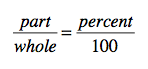
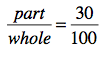
    All you need for this problem — and pretty much all other percentage problems — is to set up a proportion. What is that, you ask? A proportion is made up of two equal ratios or fractions. The proportion you need for a percentage problem is this one:

    If you can remember this proportion — and how to use it — you’re home free. So let’s dissect it a bit to help you remember. The fraction (or ratio) on the right of the proportion represents the percentage itself. You should recognize this from yesterday, when you learned to change a percent to a fraction, right? So in this problem, that ratio will be 30 over 100. That’s because the sweater is 30% off.

    The ratio on the left is a little tricker, but not by much. It is the percent off of the sweater over the original price of the sweater: the part of the price over the whole price. Got it? The original price (or whole price) is $125. But we don’t know the discount (or part of the price). Let’s call that x.

    DON’T PANIC! That little old x isn’t going to hurt you one bit. Promise. Just because you have an x in your math problem does not make it too challenging to solve.

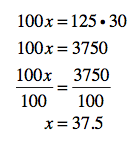
    But yes, you will need to solve for x. This involves two, very simple steps: Cross multiply and then get by itself. There are tons and tons of shortcuts for this kind of a problem, but for now, we’re going to stick with the more scenic route.

    To cross multiply, just multiply the by 100 and then the 125 by the 30.

    100x = 125 • 30Do you have to have the equation in that order? Nope. 125 • 30 = 100x works the same way. Heck you can even multiply in any order. Now, just start simplifying and getting x by itself:

    Now, remind me, what is x? Is the price of the sweater? Nope. It’s what you would save if you bought the sweater at 30% off. The sale price of the sweater is $125 – $37.5 or $87.50.

    That wasn’t so painful, was it?

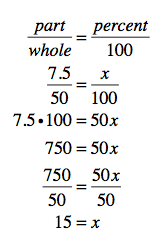
    But what if you needed to know what percent a number was of another number? Let’s say you just had lunch with your dad, who is known for being a bit stingy. He left a $7.50 tip on a $50 check. Was it enough? Well, set up that proportion, why don’t you?

    What’s the whole? $50 or the total cost of lunch. And what’s the part? That would be the tip or $7.50. You are trying to find the percent, and 100 is always 100. Substitute, cross multiply, isolate x and voila!

    Looky there, good old Dad did okay with the tip — 15%.

    You can also use this proportion to find the whole, when you know the percentage and the part. Just substitute what you know, shove xin there for what you want to find and follow the same darned steps as the previous examples.

    Seriously ya’ll, if you can remember this one proportion, percentages will no longer be a huge stumbling block. But I can hear a couple of you whining: “What about percent increase or percent decrease???” You’ll have to wait until Friday. (Promise. It’s not all that difficult either.)

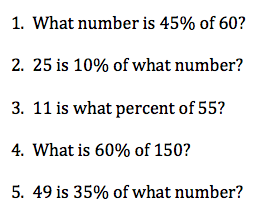
    This is a good thing to practice, so try out these problems. Remember: Identify the part, whole and percent before you use the proportion. (That’s not going to be as easy with these, because they’re not word problems.) Then cross multiply and get x by itself.

    Questions about this process? Do you have any better ideas? (I’ll bet you do!) Share them in the comments section. Meanwhile, here are the answers to yesterday’s percent problems: 11/20, 41/50, 3/20, 0.04, 0.31, 1.4. How did you do?

  • Exit Polling: A statistics refresher

    Exit Polling: A statistics refresher

    Most of you are probably sick to death of Political campaign polls. But these numbers have become a mainstay of the American political process. In other words, we’re stuck with them, so you might as well get used to it — or at least understand the process as well as you can.

    Last Friday, I wrote about how the national polls really don’t matter. That’s because our presidential elections depend on the Electoral College. We certainly don’t want to see one candidate win the popular vote, while the other wins the Electoral College, but it’s those electoral votes that really matter.

    Still, polls matter too. I know, I know. Statistics can be created to support *any* cause or person. And that’s true. (Mark Twain popularized the saying, “There are lies, damned lies, and statistics.”) But good statistics are good statistics. These results are only as reliable as the process that created them.

    But what is that process? If it’s been a while since you took a stats course, here’s a quick refresher. You can put it to use tomorrow when the media uses exit polls to predict election and referendum results before the polls close.

    [laurabooks]

    Random Sampling

    If I wanted to know how my neighbors were voting in this year’s election, I could simply ask each of them. But surveying the population of an entire state — or all of the more than 200 million eligible voters in the U.S. — is downright impossible. So political pollsters depend on a tried-and-true method of gathering reliable information: random sampling.

    A random sample does give a good snapshot of a population — but it may seem a bit mysterious. There are two obvious parts: random and sample.

    The amazing thing about a sample is this: when it’s done properly (and I’ll get to that in a minute) the sample does accurately represent the entire population. The most common analogy is the basic blood draw. I’ve got a wonky thyroid, so several times a year, I need to check to see that my medication is keeping me healthy, which is determined by a quick look at my blood. Does the phlebotomist take all of my blood? Nope. Just a sample is enough to make the diagnosis.

    The same thing is true with population samples. And in fact, there’s a magic number that works well enough for most situations: 1,000. (This is probably the hardest thing to believe, but it’s true!) For the most part, researchers are happy with a 95% confidence interval and a ±3% margin of error. This means that the results can be trusted with 95% accuracy, but only outside ±3% of the results. (More on that later.) According to the math, to reach this confidence level, only 1,000 respondents are necessary.

    So we’re looking at surveying at least 1,000 people, right? But it’s not good enough to go door-to-door in one neighborhood to find these people. The next important feature is randomness.

    If you put your hand in a jar full of marbles and pull one marble out, you’ve randomly selected that marble. That’s the task that pollsters have when choosing people to respond to their questions. And it’s not as hard as you might think.

    Let’s take exit polls on Election Day. These are short surveys conducted at the voting polls themselves. As people exit the polling place, pollsters stop certain voters to ask a series of questions. The answers to these questions can predict how the election will end up and what influenced voters to vote a certain way.

    The enemy of good polling is homogeneity. If only senior citizens who live in wealthy areas of a state are polled, well, the results will not be reliable. But randomness irons all of this out.

    First, the polling place must be random. Imagine writing down the locations of all of the polling places in your state on little strips of paper. Then put all of these papers into a bowl, reach in and choose one. That’s the basic process, though this is done with computer programs now.

    Then the polling times must be well represented. If a pollster only surveys people who voted in the morning, the results could be skewed to people who vote on their way home from their night-shift or don’t work at all or who are early risers, right? So, care is made to survey people at all times of the day.

    And finally, it’s important to randomly select people to interview. Most often, this can be done by simply approaching every third voter who exits the polling place (or every other voter or every fifth voter; you get my drift).

    Questions

    But the questions being asked — or I should say the ways in which the questions are asked — are at least as important. These should not be “leading questions,” or queries that might prompt a particular response. Here’s an example:

    Same-sex marriage is threatening to undermine religious liberty in our country. How do you plan to vote on Question 6, which legalizes same-sex marriage in the state?

    (It’s easier to write a leading question asking for intent rather than a leading exit poll.)

    Questions must be worded so that they illicit the most reliable responses. When they are confused or leading, the results cannot be trusted. Simplicity is almost always the best policy here.

    Interpreting the Data

    It’s not enough to just collect information. No survey results are 100 percent reliable 100 percent of the time. In fact, there are “disclaimers” for every single survey result. First of all, there’s a confidence level, which is generally 95%. This means exactly what you might think: Based on the sample size, we can be 95 percent confident that the results are accurate. Specifically, a 95% confidence interval covers 95 percent of the normal (or bell-shaped) curve.

    The larger the random sample, the greater the confidence level or interval. The smaller the sample, the smaller the confidence level or interval. And the same is true for the margin of error.

    But why 95%? The answer has to do with standard deviation or how much variation (deviation) there is from the mean or average of the data. When the data is normalized (or follows the normal or bell curve), 95% is plus or minus two standard deviations from the mean.

    This isn’t the same thing as the margin of error, which represents the range of possibly incorrect results.

    Let’s say exit polls show that Governor Romney is leading President Obama in Ohio by 2.5 percentage points. If the margin of error is 3%, Romney’s lead is within the margin of error. And therefore, the results are really a statistical tie. However, if he’s leading by 8 percentage points, it’s more likely the results are showing a true majority.

    Of course, all of that depends — heavily — on the sampling and questions. If either or both of those are suspect, it doesn’t matter what the polling shows. We cannot trust the numbers. Unfortunately, we often don’t know how the samples were created or the questions were asked. Reliable statistics will include that information somewhere. And of course, you should only trust stats from sources that you can trust.

    Summary

    In short, there are three critical numbers in the most reliable survey results:

    • 1,000 (sample size)
    • 95% (confidence interval or level)
    • ±3% (margin of error)

    Look for these in the exit polling you hear about tomorrow. Compare the exit polls with the actual election results. Which polls turned out to be most reliable?

    I’m not a statistician, but in my math books, you’ll learn math that you can apply to your everyday lives and help you understand polls and other such things.

    P.S. I hope every single one of my U.S. readers (who are registered voters) will participate in our democratic process. Please don’t throw away your right to elect the people who make decisions on your behalf. VOTE!

  • Why National Polls Don’t Matter: Electoral college math

    Why National Polls Don’t Matter: Electoral college math

    This post makes me scared. Not because the math is challenging or because I’m worried about the election. I’m afraid of looking partisan or being accused of ideology. (It’s happened before!) But I can’t avoid election math any longer, so I’ve decided to take the plunge — today and Monday — into these shark-infested waters, trusting that my readers (and new guests) will put away their partisan differences if only for a few hours. Do for the sake of the math.

    There’s no denying the math that goes on in elections. There are polls, ad buys, the number of minutes each candidate has spoken during debates — and yes, the electoral college. Whatever you may think of our dear map, it is how elections are decided in this country — for the most part.

    There’s no reason to expect a repeat of Election Day (and the weeks following) 2000 this year. So I thought it would be a good idea to review the electoral map — from a mathematical perspective — so that we can better understand its power. First some history.

    During the Constitutional Convention in 1787, the founding fathers quickly rejected a number of ways to select the country’s president: having Congress choose the president, having state legislatures choose and direct popular vote. The first two ideas were tossed based on fears of an imbalance of power — giving Congress or the states too much control. They also worried that a direct popular vote would be negatively influenced by the lack of consistent communication. In other words, without information about out-of-state candidates, voters would simply choose the candidate from their own states. And then there was the very real fear that a candidate without a sufficient majority would not be able to govern the entire nation.

    So, these fine men drew up a fourth option: a College of Electors. The first design, which is outlined in Article II of the U.S. Constitution, was pitched after four Presidential elections, after political parties emerged. Much of the original system remained, but the 12th Amendment to the Constitution instituted a few changes to reflect the country’s new party system. Here what the electoral college looks like today:

    • The Electoral College consists of 538 electors.
    • Each state is allotted the same number of electors as it has Congress members (Senators and Representatives)
    • Therefore, representation in the Electoral College is dependent on each state’s population. More populous states have more electoral votes; less populous states have fewer electoral votes.
    • The 23rd Amendment to the Constitution gives the District of Columbia 3 electoral votes, event though it is not a state.
    • Each state has its own laws governing how electors are selected. Generally, electors are selected by the political parties themselves.
    • Most states have a “winner takes all” system, which means that the candidate with the majority of the direct popular votes in the state gets all of the electoral votes.
    • However, Maine and Nebraska have a proportional system, which means the electoral votes can be divided between candidates.

    Whew!

    Some basic calculations allow the media and election officials and the candidates themselves to make really good predictions on election night in most situations. But the electors don’t officially cast their votes until the first Monday after the second Wednesday in December. Then, on January 6 of the following calendar year in a joint session of Congress, the electoral votes are counted, and the President and Vice-President are declared. (Got all that?) Almost always, though, the losing candidate concedes the election on election night or the next day, making the electoral vote and counting a mere formality.

    The thing that makes this complex is that each state has a different number of electoral votes. In order to win the presidential election, a candidate must secure at least 270 electoral votes. And that’s why you’re probably seeing a red and blue (and purple?) map in your newspaper, on television and online.

    In my state, there is no question which candidate will take all of the electoral votes. Maryland has been staunchly Democratic for several decades. And there’s no mystery about Texas, which is about as red as a state can get. But if it were a contest between Maryland’s and Texas’ electoral votes, Governor Romney would win. That’s because Texas has 38 electoral votes, while Maryland has 10.

    Right now, there are lots and lots of predictions out there concerning how the electoral college will vote. (Personally, I think Nate Silver0 of the New York Times is the most reliable source. Dude has a killer math brain, correctly predicting the electoral college outcomes in 49 of the 50 states in the 2008 election. In that same election, he correctly predicted all of the 35 Senate races.) But there’s little doubt about many of the states. A few swing states will certainly claim this election: Colorado, Florida, Iowa, New Hampshire, Ohio, Virginia and Wisconsin. Mathematically speaking, we’re talking about 89 votes:

    • Colorado: 9
    • Florida: 29
    • Iowa: 6
    • New Hampshire: 4
    • Ohio: 18
    • Virginia: 13
    • Wisconsin: 10

    Now out of those, which states would you guess the candidates really want to win? Yep, the ones with the highest number of electoral votes. So to them, the most important states in these last days of the campaign are Florida, Ohio and Virginia. (Where do you draw the line? I chose more than 10 electoral votes.)

    If you live in one of these three states, you are acutely aware of this fact. Unless you don’t have a television set or listen to the radio or have a (really) unlisted phone number.

    So what does this mean? Right now, it means that President Obama is likely to win the election. There are scenarios that show the opposite outcome — and there are even a few that produce a tie. However, most political analysis says that it’s Obama’s to lose at this point. This is despite the fact that most polls show the popular vote at a statistical dead heat (in other words, any lead by either candidate is well within the margins of error).

    Because our founding fathers made a decision that we wouldn’t elect our presidents with a direct popular vote. What matters in these last days are the popular votes in the swing states — most importantly Florida, Ohio and Virginia — though there are scenarios that give Mitt Romney the edge without winning all of the swing states.

    If you are a complete geek about election numbers, do visit Silver’s FiveThirtyEight blog at the New York Times. His math is good, regardless of what some conservative pundits have claimed in recent weeks.

    EDITOR’S UPDATE: Sam Wang of the Princeton Election Consortium also has great analysis. Hurricane Sandy has messed with his servers, so the site looks pretty rudimentary, but he is updating his site regularly. It’s pretty cool to compare Silver’s and Wang’s conclusions — especially on a day-by-day basis.

    I also highly recommend a really slick interactive tool put out by the New York Times. It graphically illustrates ways in which the electoral votes could swing the election in either way, based solely on the math. Unlike Silver’s blog, this section does not offer a prediction of who will will win, but describes the various scenarios for each candidate.

    Whatever you think of the candidates and the issues, vote. No matter what, vote. Our votes — even outside swing states — matter. It’s our responsibility as U.S. citizens to declare our preferences. And in my mind, if you don’t vote, you can’t complain.

    Coming on Monday… a look at the polls themselves. What makes a good poll? How should we average folks interpret polls? Can they really tell us what’s going on?

    What are your thoughts on the math of the electoral college? (I get it. These discussions can get heated. Please be respectful in your comments. I will not approve or will delete any comments that I deem outside the bounds of civility. Thank you for playing nice.)

  • Saving Face: Avoiding performance math

    Saving Face: Avoiding performance math

    If there’s one thing most folks assume about me, it’s this: That I am some sort of mathmagician, able to solve math problems in a single bound — quickly, in public and with a permanent marker.

    Nothing could be farther from the truth.

    I don’t like what I call performance math. When I’m asked to divvy up the dinner tab (especially after a glass of wine), my hands immediately start sweating. When friends joke that I can find 37% of any number in my head, I feel like a fraud. I’m not your go-to person for solving even the easiest math problem quickly and with little effort.

    Truth is I really cannot handle any level of embarrassment. And I’m very easily embarrassed. I’m the kind of person who likes to be overly prepared for any situation. This morning, before contacting the gutter company about getting our deposit back because they hadn’t shown up, I had to re-read the contract and literally develop a script in my head. What if I misunderstood something and was — gasp! — wrong about the timeline or terms of our contract?

    Oh yeah, and I hate being wrong. About anything.

    In short, I’m not much of a risk taker. Unlike many of my friends and some family members, I can’t stand the thought of failing publicly. Imagine writing a math book with this hang up! Thank goodness for two amazing editors, who checked up behind me.

    I’m also not a detailed person. Not one bit. I’m your classic, careless-mistake maker — from grade school into grownuphood. I’m much more interested in the big picture, and I am easily lured by the overreaching concepts, ignoring the details that can make an answer right or wrong.

    For years and years, I worried about this to no end. How could I be an effective teacher, parent, writer, if I didn’t really care about the details or I had this terrible fear of doing math problems in public? What I learned very quickly in the classroom was this: Kids needed a math teacher like me, to show them that failing publicly is okay from time to time and that math is not a game of speed or even absolute accuracy. (It’s never a game of speed. And it’s frequently not necessary to have an exact answer.)

    Two weeks ago, as I sat down with my turkey sandwich at lunch, the phone rang. It was a desperate writer friend who was having some trouble calculating the percentage increase/decrease of a company’s revenue over a year. (Or something like that. I forget the details. Go figure.) She really, really wanted me to work out the problem on the phone with her, and I froze. I felt embarrassed that I couldn’t give her a quick answer. And I worried that I would lose all credibility if I didn’t offer some sage insight PDQ.

    But since I have learned that math is not a magic trick or a game of speed, I took a deep breath, gathered my thoughts and asked for some time. Better yet, I asked if I could respond via email, since I’m much better able to look at details in writing than on the phone. I asked her to send me the information about the problem and give me 30 minutes to get back with her.

    Within 10 minutes, I had worked out a system of equations and solved for both variables. She had her answer, and I could solve the problem without the glare of a spotlight (even if it was only a small spotlight).

    My point is this: Math isn’t about performing. If you like to solve problems in your head or rattle off facts quickly or demonstrate your arithmetic prowess at cocktail parties, go for it. That’s a talent and inclination that I sometimes wish I had. But if you need to retreat to a quiet space, where you can hear yourself think and try out several methods, you should take that opportunity.

    Anyone who criticizes a person’s math skills based on their ability to perform on cue is being a giant meanie. And that includes anyone who has that personal expectation of himself. There’s no good reason for math performance — well, except for Mathletes, and those folks have pretty darned special brains.

    Do yourself a favor and skip math performance if you need to. I give you permission.

    Do you suffer from math performance anxiety? Where have you noticed this is a problem? And how have you dealt with it?