Raise your hand if you’ve heard of M.C. Escher. Now raise your hand if you know what tessellations are.
Surprise! If you know of M.S. Escher’s work, you are also familiar with tessellations — even if you don’t recognize the term. In fact, if you have or have seen a tiled floor, tessellations are familiar to you.
A tessellation is a pattern of identical, interlocking shapes. There can be no space between the shapes and none of the shapes can overlap. Escher created complex tessellations of birds, lizards and fish. But even simple, square tiles are tessellations.
This video shows how they are made. Don’t watch it expecting a tutorial. Just look at how the shapes are formed and then replicated and rotated to form the tessellation. A design like this one is pretty complex, but it’s interesting to see it in motion.
(There is no sound with this video, so there’s no need to crank up your speakers.)
Bonus! I found this really great video that shows how to make a tessellation. Check it out.
Where have you seen tessellations? When do you think they’re useful or interesting to see? Leave your comment!
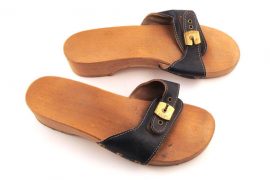
When I was a teenager in the 1980s, I wanted a pair of tan Dr. Scholl’s sandals so badly I could taste it. Each time my mother took us to the Eckerd drug store, I made sure to stroll down that aisle to check them out.
“Those are the dumbest shoes I’ve ever seen in my life,” Mom said, and she flat out refused to buy them for me.
Today, I’d have to agree. With hard, wooden soles and an adjustable strap that featured a gold buckle and grommets, these were not what Tim Gunn would consider classic fashion pieces.
But I wanted those shoes dearly.
They cost $14.95—pricy for a kid with no job and a $1 a week allowance. My mom suggested I save up my own money for them. But savings from my February birthday was long gone, and by the time I saved enough allowance, summer would be over. These shoes were definitely not fall footwear.
So, my mother came up with another idea: to ask my father for a loan. And that’s exactly what I did.
Both of my parents were educators—my mother an elementary school librarian and my father a division chair and sometimes-teacher at the local community college. It’s fair to say that the man never missed an opportunity to give me a lesson about money management. And these lessons also often included a little bit of math.
The Dr. Scholl’s loan was no different.
Instead of giving me the money outright and keeping my allowance for the next 15 weeks, I got a simple-interest loan that was to be paid within a certain time period. I don’t remember how long the term or what the interest rate was. But I did continue to receive my weekly allowance and paid a portion of that amount each week for the loan. Dad even helped me calculate how much more I’d be paying for the sandals with the interest.
As a kid who only wanted her hands on a pair of fad sandals, I thought this was overly complex. But my desire for those shoes was great, and this was the only way I’d get them. So I agreed. I signed the contract he wrote out by hand and paid off that loan, plus the interest, bit by bit.
Today, as the parent of an 11-year-old daughter, I’m amazed by my father’s foresight. It really is a brilliant little trick, and one that has served me very, very well.
Six years later, my dad took me down to the Bank of Speedwell to get a loan for my first car—a 1984 Toyota Camry that I bought from my aunt for $2,000. This time he explained compound interest, just before he cosigned for the loan.
And that lesson didn’t stop with me. Two years later, my sister gave me the most amazing gift when I graduated from college—an upright piano that she purchased from a neighbor. She paid Bud and Ginia Cabell $20 a month for I don’t know how long. (And now my daughter plays Mozart waltzes on that very instrument.)
Dad with my niece Addison in 2006
The thing that I know about my dad is that he wasn’t afraid to delve into the tough stuff with us—including managing our money. That often required a few calculations, and I often resisted his lessons.
When it came to these little real-world lessons, I’m sure I was a royal pain in the you-know-where, but in the end, those experiences were much more meaningful than anything I learned in school—and they were less expensive than anything I could learn on my own.
My daughter hasn’t asked for her version of ugly, wooden sandals, but I’m waiting for that moment. And when she does, I’ll be ready with a contract and a little lesson in simple interest and regular payments.
Did you get any surprise lessons like this one when you were little? Or do you have plans to do something similar with your own kids — or grandkids, nieces, nephews, neighborhood kids? Share your stories in the comments sections below.
Two things you should know: First off, I once worked in the marketing and public relations department at Virginia Stage Company, an Equity theatre. Second, I love to sew (and don’t have enough time these days to delve into my stash of fabric). So, I am absolutely thrilled to welcome Katie Curry to Math for Grownups today. As a costume designer and technician, she’s worked forthe Berry College Theatre Company and the Atlanta Shakespeare Festival. She recently started her own venture called Nancy Raygun Costuming that caters to folks who are into cosplayand conventions or just want a fun costume.
What do you do for a living?
I design and build costumes for theatre productions as well as make custom clothing for individuals. I sketch my ideas and then make them into real pieces for people to wear.
When do you use basic math in your job?
I use basic math every time I sit down to work. Sewing is full of fractions — the standard seam allowance is 5/8 of an inch — and drafting costume pieces is all about angles where different pieces meet. It would slow me down a whole lot if I couldn’t add and subtract fractions as I go.
Do you use any technology to help with this math?
Most of the time I just end up using the calculator on my phone or just old school pencil and paper when I’m figuring out how much I need to take in a garment or that kind of thing. There are a number of computer-assisted drafting programs that can come in handy when it comes to design, but since I’m just getting started I don’t have all the fun toys that a lot of designers do. So for now, just a calculator and some brain power.
How do you think math helps you do your job better?
From Eurydice, a play by Sarah Ruhl, at the Berry College Theatre Company in 2010.
With just the actor’s measurements, you can draft costume pieces just using a little math. That means, you don’t have to go through the tons of fittings to drape a pair of pants. Just put the measurements into a series of equations, and you get the exact lengths and angles that you need to draw in order to start construction.
How comfortable with math do you feel?
I am in no way comfortable with math. I have never been the type who could make sense out of a lot of numbers, so I was pretty bummed when I walked into my first costuming classes and was immediately handed a ruler. It took me a while to warm up to the idea that I would be doing math regularly, when all I wanted to do was make costume pieces. But once you see the end results of a long drafting session, everything starts to make a lot more sense. I don’t feel incredibly comfortable with a lot of other math outside of my profession, though. I can do basic things like balance my checkbook, but don’t ask me complicated things about statistics unless you just want a blank stare.
What kind of math did you take in high school?
In high school I took the simplest math I could get away with. I’ve taken algebra I and II, geometry and statistics and I’ve disliked every one of them. If I brought home a B in an English class it was a travesty, but if I brought home a C+ in a math class the sentiment was, “All you have to do is try your best and somehow manage to pass.” I am in no way a math-minded individual, so I’ve always tried to avoid doing it as much as I can.
From The Beaux’ Stratagem, by George Farquhar, at the Berry College Theatre Company in 2010.
Did you have to learn new skills in order to do this math for your job?
I definitely had to learn new skills for building costumes. Costume drafting isn’t exactly something that gets covered in high school math classes, so there were a lot of equations and fractions that I was unfamiliar with that I needed to get very comfortable around. Despite the fact that I’d taken classes that were fraction heavy, I’d never actually had to use them on a daily basis until I started sewing every day.
Do you have questions for Katie? (Do you need a costume?) Ask them in the comments section, and she’ll come by sometime to respond.
So, I’ve seen an abacus (or the plural, abaci), but until this video, I’d never seen one in action.
Now, I’m not a big fan of speed in math, but I have to admit this is pretty darned cool — especially when the kids imagine the abacus to solve problems without it.
But how does an abacus work?
There’s a great (though complex) explanation here. But here’s the really cool thing: to use an abacus, you have to have a really strong, knee-jerk sense of numeracy. So, it’s not so much a shortcut as a demonstration of a great understanding of math basics.
Every so often, at around 7:00 p.m., I’ll get a call from someone I know. “I don’t understand my kid’s math homework,” they’ll say.
These folks aren’t dumb or bad at math. But almost always, they’ve hit a concept that they used to know, but don’t remember any more. And those things can trip them up — big time. So, I thought it might be helpful to review 4 middle school math facts that may give parents trouble.
Every number has two square roots.
This is the question that prompted this blog post. I got a call from a friend who didn’t understand this question in her daughter’s math homework: “Find both square roots of 25.” Both?
Most adults have probably forgotten that each number has two square roots. That’s because we are typically only interested in only one of them — the positive one.
Yep, the square roots of 25 are 5 and -5. In other words:
sqrt{25} = 5 and -5
It should be pretty easy to see why this is true. (You just have to remember that when you multiply two negative numbers, your answer is positive.)
This question came up in my own daughter’s homework last week — a review of prime and composite numbers. Remember, prime numbers have only two factors, 1 and the number itself. So, 7 is prime. And so are 13, 19 and even 3. But what about 1?
Well, it turns out the definition of a prime number is a little more complicated than what we may assume. And I’m not even going to get into that here.
But there is a way for less-geeky folks to remember that 1 is not prime. Let’s look at the factors of each of the prime numbers we listed above:
7: 1, 7
13: 1, 13
19: 1, 19
3: 1, 3
Now, what about the factors of 1?
1: 1
Notice the difference? Prime numbers have two factors, 1 and the number itself. But 1 only has one factor.
0 is an even number.
This idea seems to trip up teachers, students and parents. That’s because we tend to depend on this definition of even: A number is even, if it is evenly divisible by 2. How can you divide 0 into two equal parts?
It might help to think of the multiplication facts for 2:
2 x 0 = 0
2 x 1 = 2
2 x 2 = 4
2 x 3 = 6 …
All of the multiples of 2 are even, and as you can see from this list, 0 is a multiple of 2.
Anything divided by 0 is undefined.
Okay, this gets a little complex, so bear with me. (Of course, if you want, you can just memorize this rule and be done with it.)
That only works if a is also 0, and 0 ÷ 0 gives us all kinds of other problems. (Trust me on that. This is where things get pretty darned complicated!)
So how many of you have thought while reading this, “I will never use this stuff, so what’s the point?” You may be right. Knowing that 0 is an even number is probably not such a big deal. But at least your kid will think you’re extra smart, when you can help him with his math homework.
What are your math questions? Is there anything that’s been bugging you for ages that you still can’t figure out? Ask your questions in the comments section. I’ll answer some here and create entire posts out of others.
For many of us, math is like hearing — something we take for granted on a daily basis. As an audiologist, Julie Norin pays close attention to both on a day-to-day basis. Here’s how she uses math in her work and what she thinks of it.
What do you do for your living?
I work as a clinical audiologist which means I help people who have hearing loss and other related ear problems. Essentially, I measure a patient’s ability to hear and distinguish between sounds. After analyzing the test results along with other medical data, I make a diagnosis and determine a course of treatment. Most often, the course of treatment involves fitting a patient with hearing aids, which I then program according to their hearing needs, but I may also refer my patients for continued medical care by their primary care physician, an ear, nose, and throat physician, a cochlear implant specialist, or a neurologist. I also spend a great deal of time counseling my patients and the family members of my patients regarding the diagnosis of hearing loss and treatment plan.
When do you use basic math in your job?
I use basic math daily. When testing a patient, I use simple addition and subtraction to determine differences between the ears, as well as to determine the presentation levels of the various test signals. When testing a patient’s speech discrimination abilities, I use division and calculate percentages, and with other tests I rely on a formula of ratios and statistics to determine whether results are normal or not. I also make buying decisions for the clinic where I work. I use math to calculate clinic expense and net revenue. Our clinic provides a sliding-scale reduced fee, which is based on a person’s financial standing. This can vary between a 20% and 80% discount, so I am always applying basic math to calculate those patients’ fees.
Do you use any technology to help with this math?
My diagnostic equipment is computerized and has some technology built in, so the math can be calculated during speech discrimination testing, as long as I am tracking patient responses using the computer. But every so often, I wind up doing the caluclations myself. Hearing aids are typically programmed using a designated fitting formula, which is calculated based on age, size of the ear canal and degree of hearing loss. In terms of factoring clinic expenses and net revenue, I will pretty much always rely on a calculator if there is one close by. I like to be absolutely sure about the numbers. Especially since I work for a non-profit agency.
How do you think math helps you do your job better?
I wouldn’t be able to do my job if I didn’t have an understanding of math, especially when I’m testing, because the equipment is not able to determine differences between the ears or calculate presentation levels. It also helps me to understand test results, and determine what instruments are suitable to accomodate a patient’s needs.
How comfortable with math do you feel?
I have never really felt comfortable with math. I still don’t. Hearing science and the study of acoustics are both incredibly math based, so during my studies I had to learn how to do complicated algebra and logarithic equations, which I had never understood. I was fortunate to have the most amazing professor when I went back to earn my second bachelor’s before pursing my doctorate in audiology. I could not have made it through without her.
What kind of math did you take in high school?
I actually made it all the way to 7th grade before my teacher at the time recognized that I did not know how to do long division or fractions. I could usually solve the equations, but I had my own bizarre way of doing it. By the end of that year, I was able to do the math correctly, but I never considered myself a strong math student. I remember taking algebra, geometry, and trigonometry in high school, but I know I never really learned or understood any of it. I’m not sure how I managed to pass any of those classes. I remember taking a basic math class my first semester of college and being so glad that would be the last math class I would ever have to take. Little did I know I would go back to school years later and wind up doing more math than ever.
I still have a recurring nightmare about that college math class I took as a freshman. It’s the end of the semester, time for the final exam, and either I never went to the class or I did, but never learned anything, and now I have to take the exam!
Did you have to learn new skills in order to do the math you do at work?
I don’t think I had to learn new skills for the math I use day to day, but I definitely had to learn new skills in order to get through my grad school programs. I feel much more confident about my skills now than I did back in high school. Especially when it comes to algebra. I actually enjoy it, now that I know how to do it.
Thanks so much to Julie for visitin Math for Grownups today. If you have questions for her, ask them in the comments section
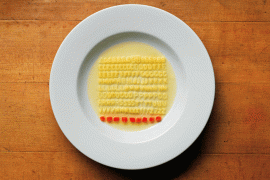
I’m not sure I could live with Ursus Wehrli. A Swiss artist and comedian, his ideas of order are a bit extreme. You’ve probably seen his carefully arranged bowl of alphabet soup:
This is basic set theory — and we started learning how to do it in kindergarten. But take a closer look. While Wehrli decided to put his letter-shaped pasta in alphabetical order with the carrots at the bottom, he could have chosen something different — say vowels first or grouping all of the letters with curves. (Psst… this is one of those times when math is neither right nor wrong.)
While it’s easy to see how he arranged elements in sets for this picture, some of his other endeavors are a bit more complex. See for yourself in this week’s Film Friday clip:
Now, what do you think? What is the criterion for each set? Give me your take in the comments section.
It’s the No. 1 question asked of math teachers: “When will I ever use this stuff?”
And in terms of upper-level math — conic sections, radicals, differentiation and the quadratic formula — the answer may very well be, “Not much.” (Unless you’re in one of those jobs with top-paying degrees.)
As I hope you know by now, basic math is ubiquitous. We encounter percents, fractions, formulas, the order of operations (Please Excuse My Dear Aunt Sally) and geometry pretty regularly. But algebra? When was the last time you solved for x?
Algebra describes the relationships between values, and how those values change when we introduce variables. In short, algebra is based on equations or expressions:
3+x
x2+4x-7
y=5x+9
(Are your hands sweating or have your eyes glazed over? Hang in there. I promise this won’t be overwhelming.)
In its simplest form, algebra can be described as the process of solving for a variable. And you probably did that with random equations for a good portion of your high school math education.
Boring.
Except for word problems, none of the equations had much to do with real life, which is one way that we math educators have sucked all of the life out of math.
But I’m guessing that at least some of you use algebra pretty darned regularly–without even knowing it. Let me show you how.
As a freelance writer, I’m responsible for maintaining my business records, which for me include expected and actual income, invoices and goals. I could purchase accounting software for this or hire someone to do the work for me, but to be honest, my business is pretty small. I have a lot of experience with spreadsheets, and so six years ago, I built one that I still use to track all of my business finances and goals.
Why does this work? Formulas. One formula gives me the total of all of my invoices for each month and and another spits out the percent those are of my monthly goal. I have created formulas that give the percent of my income that is generated from each of my revenue streams. And because of formulas, I can instantly see how much income has been invoiced but not received.
But maybe this isn’t such a great example. Most small businesses or self-employed folks use ready-made accounting programs for these tasks.
Meet my good friend, Rebecca. Like many of us in my neighborhood, Rebecca’s family gets milk delivered once a week by a local dairy. (I know! Cool, right?) But unlike me, she shares her delivery with her next-door neighbor. And that requires a little bit of math. Here’s how she explains it:
As you know there are bottle deposits, bottle charges, delivery charges and of course milk (or other product) charges. The charges go to only one credit card. Keeping track of these is a challenge if you don’t want to have to write a check to your neighbor every week – and who wants that? So we have worked out a “kitty” (nice, eh, milk – kitty. ha ha) system where we pay a lump sum to the person whose credit card is being charged. But then we have to know when the kitty is running out.
In other words, each of the families contributes to the kitty, and those funds are used to pay the milk bill on one family’s credit card account. Rebecca uses a spreadsheet to keep up with how much money is in the kitty at any given time. When the kitty runs low, she knows to ask her neighbor for a contribution.
Rebecca’s milk delivery spreadsheet
Why doesn’t Rebecca ask for the same monthly payment in the kitty? Well, this is where the algebra comes in. Not only can we order milk, but also yogurt, meats, eggs and cheese. That means the weekly orders vary. And — here’s where you can use that English degree — when elements vary, they’re called variables.
Ta-da! Algebra in real life. (Gosh, I’m so proud!)
These spreadsheet formulas are so useful that algebra teachers are using them to demonstrate how algebra is indeed useful in everyday situations.
So, when was the last time you used a spreadsheet? Did you create a formula? Did you know you were using algebra? Tell us about it in the comments section.
If you’ve been following the Math for Grownups blog, you know how often math plays a role in art. Turns out that it’s not only useful in creating art but caring for it as well.
Ann Shafer, associate curator of the prints, drawings and photographs collection at Baltimore Museum of Art, uses math in surprising ways–and surrounded some of the greatest artwork of the 20th and 21st centuries.
Can you explain what you do for a living?
I curate and organize exhibits, like the Baker Artist Awards, which runs from September 7 to October 2. I also teach classes using the BMA’s world class works on paper collection, and I search out and present objects for acquisition. Finally, it’s ultimately my responsibility to be sure that the BMA’s collection of 65,000 prints, drawings, photographs and books is well cared for.
When do you use basic math in your job?
We are always calculating how much an acquisition fund might generate, given market levels. This allows us to secure funding for new purchases for our collection. I often assign accession numbers to complex objects like books, sketchbooks and portfolios. A piece’s accession number is unique and follows a pattern that tells something about the piece, including when it was acquired and which collection it belongs to.
Do you use any technology to help with this math?
I confess I use the computer to check currency rates when I’m looking at overseas dealers’ prices.
How do you think math helps you do your job better?
Without math, I couldn’t keep such a large collection in order!
How comfortable with math do you feel?
Math still intimidates me. But the more I practice, the better I feel about it. We always ask dealers for discounts, so my percentage figuring has gotten pretty good!
What kind of math did you take in high school?
I really liked geometry because it was more visual than theoretical.
Spoken like a true art lover! If you have questions for Ann, ask them in the comments section.
Today, I have the great honor of guest posting at Simple Mom, a wonderful, practical and easy-going spot on the web for home managers. The subject of the day is problem solving and the deck I built a few years ago.
Simple problem solving skills can make the impossible possible.
You’ve probably figured out by now that math in your everyday life isn’t much like the worksheets and timed drills you suffered through in elementary and middle school. And in the real world, you can leave those way, way behind.
That’s because grownup math has more to do with problem solving than remembering that 7 times 8 is 56. Most of us don’t use trigonometry or calculus. But basic math skills figure into some of the most critical decisions of each day—how to save money, save time and save your sanity. These days, you need to know how much top soil to order for your flower bed or what time your parents will arrive in Boston, if they’re driving in from St. Louis.
Four summers ago, I decided to build a deck—something I’d never done before. This process taught me a lot about the math I already knew and how to fill in the gaps with some pretty simple problem solving skills.
Read the rest of the post, and comment there to win one of 10 paperback copies of Math for Grownups. (You can comment here, but it won’t get you in the drawing, so make sure to head over to Simple Mom.)
Film Friday is taking the day off (it’s basement is flooded and it’s worried that its rare collection of film reels–including outtakes of Citizen Kane where Orson Wells reveals that “Rosebud” is actually a reference to the Fibonacci Sequence–might be under water), but you can check out past Film Friday editions, if you really miss it.Save
First, I found out that USA Weekend— the weekly newspaper supplement that appears in more than 800 newspapers in the U.S. and is read by 4.7 million people each week — published a cool, little story about Math for Grownups this weekend. “Man,” I thought. “This is great!”
Then I read the first and only (at the time) comment:
In “Benefits vs. Raise” I am surprised you made the common mistake of thinking you will make less money if you get a raise. If you move to a higher tax bracket it is only the incremental money that is taxed at the higher rate. You should print a correction.
Long story short: my explanation in Math for Grownups is correct. Sadly, for Gregory Connolly, the reporter who wrote this otherwise really nice story, some of the information in the article was not. In a few days the geeky little corner of the blogosphere that pays attention to these things went nuts. I’ve gotten emails, nasty tweets and more — even after I posted what I think is a very level-headed response to the original comment, letting readers know that the error was the reporter’s. And even after USA Weekend posted an excerpt from my book that explains (correctly) how math and the tax system work in this situation.*
Hoo-wee! When math, taxes and mistaken reporting collide, sparks fly!
I’m still trying to figure out if this is a good thing for me or a bad thing. (Is any publicity good publicity?) But this whole experience illustrates a few interesting points:
1. Math matters. When you think that you don’t need to understand how math applies to the tax code, think again, my sister and brother. I’ve got dozens of internet commenters and tweeters begging to convince you differently. And quite honestly, they’re not as nice as I am.
2. It’s critical to check your assumptions. I’m convinced that Mr. Connolly wouldn’t have made the same mistake had he really considered what he was writing. Yes, it’s a common mistake and even an element of misinformed political rhetoric to believe that a raise could actually be bad for a person. But really? Does that make sense? Just like with math problems, checking to see if the answer is reasonable can save anyone from a lot of heartache. (And I’m thinking this reporter has had at least some heartache this week.)
3. There’s good reason that people are scared of math — big, mean, know-it-alls shame us into believing that a simple misunderstanding or mistake will bring down entire civilizations, crush the delicate sensibilities of our dear children and bring us perilously close to either left- or right-wing political domination. In other words, if we don’t get every single syllable and number absolutely correct, we are wrong, wrong, wrong and nothing can save us from eternal shame and damnation.
(How many of you felt this way in school?)
But whether or not these internet commenters, bloggers and tweeters would like to admit it, not much about math will cause such drastic, awful consequences. Sure, there may plenty of people more than willing to shout, “YOU’RE WRONG!” rather than admit that they, too, sometimes feel like math is hard and the tax system can be difficult to comprehend. But in the end, I’m here to say that the basic math that most of us have to do everyday both matters and won’t kill you.
The fact that I’m still alive, sober and writing about this after the frenetic tongue lashing I’ve received over the last few days is testament to this. You can survive making math mistakes (or other’s math mistakes). And I honestly hope that someone is telling the poor Gregory Connolly this very thing.
So let’s fess up. What was your last math mistake? Did it cause the ground to open up and swallow up innocent puppies and kittens? Or did you just lose a little cash or miss the previews at a movie or put too much fertilizer on your lawn?
Share your math horror stories in the comments section.
*Update: USA Weekend is continuing to finesse its response to this situation. The last section of the article has now been rewritten to correct the mistake, and the excerpt from my book has been removed.
Is your Kindle or Nook hankering for some math? Is your tablet or computer sorely lacking in number crunching?
Today is your lucky day. Actually, this week is your lucky week!
Until Friday, September 10, you can download Math for Grownups for free — yep, $0 0¢ — on your eReader or computer. That’s how much I and my publisher (Adams Media) love you.
So what are you waiting for? Click on over to the Adams Media blog to get your free electronic copy of Math for Grownups.
Oh, and if you’re a traditionalist, you can purchase Math for Grownups at your local bookstore or online at Amazon or Barnes and Noble.