Category: Math for Grownups

  • Thanksgiving by the Numbers

    Thanksgiving by the Numbers

    It’s turkey time here in the U.S. — the weekend we celebrate family, friends and all of the blessings in our lives. And since I’m certainly thankful for math (seriously!), I thought we should take a look at some interesting Thanksgiving numbers.

    391: The number of years since the first Thanksgiving

    90: The estimated number of Wampanoag tribe members who attended the first Thanksgiving

    1789: The year of the first “national day of Thanksgiving”

    40: The number of years that Sarah Josepha Hale advocated for an annual, national Thanksgiving holiday

    254 million: The number of turkeys expected to be raised in the U.S. in 2012

    6: The number of “home economists” who were hired to answer 11,000 phone calls for the Butterball Turkey Hotline‘s inaugural year in 1981

    50: The number hired to answer more than 100,000 calls last year.

    165: The number of degrees of a safely cooked turkey, according to the Federal Food and Drug Administration (FDA)

    768 million: Projected number of pounds of cranberries expected to be produced in the U.S. in 2012

    50: Percent increase in plumber calls and visits on the day after Thanksgiving, over any other Friday of the year

    43.6 million: Number of Americans expected to travel more than 50 miles during the 2012 Thanksgiving holiday

    90: Percent expected to travel by car

    25: Number of balloon floats in this year’s Macy’s Thanksgiving Day Parade

    How are you spending your Thanksgiving holiday? What math is involved? Share your responses in the comments section.

  • The Cult That Changed Geometry

    The Cult That Changed Geometry

    While the development of numbers continued for many, many centuries, even before the discovery or invention of zero, the Greeks were responsible for a long, long period filled with mathematical advances. By 600 B.C., a fellow named Thales of Miletus brought Babylonian mathematical discoveries to Greece, which were used to calculate distance and other measurements.

    But the big player in Greece was Pythagoras. (Yes, you should recognize that name.) Born in 580 B.C. in Samos, he met old-man Thales when he was but a young lad. Perhaps Thales convinced him to travel to Egypt so that he could learn the mathematics of the Babylonians. At any rate, when Pythagoras returned from his journey, he settled in Croton (which is on the eastern coast of Italy) and this is where things get strange — at least by our modern standards.

    Pythagoras established a philosophical and religious school that was made up of two societies: the akousmatikoi (hearers) and mathematikoi (learned). And while his followers look much like a cult to us, Pythagoras was in fact developing the world’s first intentional, philosophical society. Members — both men and women — were intent on living a contemplative and theoretical life, and as such divorced themselves from the culture at large, becoming completely devoted to philosophical and mathematical discovery.

    But in order to do this, they had to follow a very strict set of rules, which included vegetarianism, giving up all personal possessions and absolute secrecy. And then there are the really strange orders: do not pick up something that has fallen; do not touch a white rooster; do not look in a mirror beside the light.

    That’s not all. Mysticism infused almost all the Pythagoreans did, which led to some really off-the-wall mathematical ideas, like their understanding of numbers.

    1. Nothing exists without a center, and so the circle is considered the parent of all other shapes. It was called the monad or “The First, The Essence, The Foundation, and Unity” — or according to Pythagoras, “god and the good.”
    2. The dyad was a line segment and considered to be the “door between One and Many.” It was described as audacity and anguish, illustrating the tension between the monad and something even larger.
    3. And then there’s the triad, which of course represents the number 3. Continuing in their pseudo-anthropomorphism of numbers, the triad is considered the first born, with characteristics like wisdom, peace and harmony.

    I could go on. Seriously. But while the ideas of the Pythagoreans were kind of kooky, this band of deep-thinking brothers and sisters advanced mathematics in some pretty significant ways. First of all, they began classifying numbers as even and odd, prime and composite, triangular, square, perfect and irrational. Through their strange ideas of numbers, they popularized geometric constructions. They are also attributed with the discovery of the five regular solids (tetrahedron, hexahedron, octahedron, iscosahedron and dodecahedron).

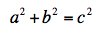
    But their biggest discovery is the theorem named for Pythagoras. The Pythagorean Theorem states that the in a right triangle, the square of the longest side is equal to the sum of the squares of the remaining two sides. In other words:

    This is more than just a silly formula you needed to memorize in high school. Carpenters use it to be sure that they have right angles (in other words that their door frames, decks, and walls are “square”). It’s useful to find the diagonal of a television set (which is how those contraptions are measured for some reason), if you only know its length and width. And it’s the basis of a great deal of additional math discovery, like the distance formula and various area formulas.

    It’s a big, honkin’ deal. And in some ways, we’re lucky it survived the secrecy of the Pythagoreans. Pythagoras wrote nothing down. (If tin foil had been invented, he might have been wearing a hat of the stuff.) But despite its closed society, this cult of nutty mathematicians and philosophers is considered one of the most important influences in all of history.

    What do you remember of Pythagoras from your high school geometry class? Have you used the Pythagorean theorem in your everyday or work life? If so, how?

  • The Number that Changed the World: History of numbers, part 3

    The Number that Changed the World: History of numbers, part 3

    Things were moving right along in the invention and use of number systems. The Sumerians started things off sometime during the 3rd millenium, when their budding commerce system helped them invent the first set of written numbers. The Egyptians systematically engineered a formal base-ten system that morphed from hieroglyphics to the much-easier-to-write hieratic numbers.

    But something was missing. Something really important — and really, really small.

    The Greeks advanced geometry considerably. (More on that next week.) But in the Roman Empire, mathematical invention and discovery virtually stopped — with the exception of Roman numerals. These were widely used throughout Europe in the 1st millenium, but like the number systems that came before, it was positional and did not use place value.

    But why weren’t these systems using place value? It all comes down to zero. Up to this point, this seemingly inconsequential number was absent.

    There is some debate about this, of course. Some historians assert that sometime around 350 B.C. Babylonian scribes used a modified symbol to represent zero, which astronomers found useful to use this placeholder in their notations. And on the other side of the world, the Mayans used a symbol for zero in their “Long Count” calendar. But there is no evidence that zero was used for calculations.

    Along came the Indian mathematician and astronomer, Brahmagupta, who was the first person in recorded history to use a symbol for zero in calculations. But India’s relationship with zero started well before that.

    In ancient and medieval India, mathematical works were composed in Sanskrit, which were easily memorized because they were written in verse. (I am not kidding.) These beautiful sutras were passed down orally and in written form through the centuries. Thus the idea of zero — or śūnya (void), kah (sky), ākāśa (space) and bindu (dot) — was first introduced with words. Eventually, an actual dot or open circle replaced these words, as Indians began using symbols to represent numbers.

    Brahmagupta used zero in arithmetic — adding, subtracting, multiplying and even dividing using the all-important number. All of that was well and good, except for division. It wasn’t until Sir Isaac Newton and his German counterpart Gottfried Wilhelm Leibniz came along that it was established that dividing by zero is undefined.

    But really, the big deal here was not doing arithmetic. Nope, it was place value. This is so important that we all take it for granted. It’s the difference between $65 and $605 or the difference between 0.02% and 2%. See, zero isn’t just a place holder — in our number system it can represent a place value. You think math is hard now? Imagine doing calculations with Roman Numerals! Without place value and our humble zero, this work is exceedingly difficult.

    This is a relatively new idea in the scheme of things. Almost 3,000 years had passed, since the Sumerians developed the first written number. Zero was introduced in India sometime around 400 A.D., though it didn’t show up in a text until around 600 A.D. Through trade routes, zero began showing up in the Middle East and China, but it took a very long time — the middle of the 12th century! — for Europeans to begin using zero and place value.

    And that’s pretty much it — the very long history of our current number system, without which most other major discoveries, like calculus, trigonometry or geometry, could not be developed.

    Of course there is much, much more to say about numbers themselves. For example, they’re arranged in a system based on their particular characteristics, kind of like the way we categorize animals or plants. Positive whole numbers are called natural numbers;positive and negative numbers are called integers; fractions and terminal decimals are rational numbers, and so on. This is connected to a fascinating (to me) branch of mathematics, called abstract algebra. But that’s a story for another day.

    What surprised you about the history of numbers? And how about that zero? Ask your questions or make comments here.

  • Count Like an Egyptian: A history of numbers, part 2

    So the Sumerian system of numbers — as far as we know, the first in the world — came into being rather naturally and out of necessity. But the Egyptians took things one step further, and they did it very systematically. Priests and scribes invented a system of numbers that included tally marks and hieroglyphics. In doing so, they developed a base-ten system featuring different symbols for different numbers.

    The Egyptian people were very fortunate. With few neighbors, they didn’t have spend time worrying about war or defending themselves from attack. They also lived in a very fertile area, making agriculture less troublesome than it might have been. All of this freed up their time to do things like develop a numerical system and make big advances in mathematics. (You know, the ordinary stuff we do when we live in peace and have lots of food and water.)

    Hieroglyphics could be used to express a wide variety of numerical values — all the way to one million! The symbol for one was a tally mark, so four tally marks represented 4, and so on. But 10 was expressed as a horseshoe shape and 100 a coiled rope. A little tiny prisoner begging for forgiveness was the hieroglyphic for 1,000,000. (I’d love to know the story behind that one.)

    Yes, I drew these myself. No, I am not an artist or an ancient Egyptian. But you probably knew that.

    While these characters could be arranged to represent an almost endless set of whole numbers and even fractions, the Egyptians were missing a critical numeral: zero. This meant that with all of their advances, Egyptian numbers had no place value system.

    All of this allowed the Egyptians to take huge steps in the development of arithmetic, including the four basic operations — addition, subtraction, multiplication and division — and using numbers for measurement. Without these advances, we would have no great pyramids.

    As the ancient society moved to the much more portable and easier-to-use papyrus and ink to record words and numerals, hieroglyphs gave way to hieratic numerals. These are more akin to brush strokes, and allowed the Egyptians to write larger numbers with fewer symbols. It’s pretty easy to see that this sped things up quite a bit.

    On Friday, we’ll visit ancient India, where the most amazing creation/discovery revolutionized the system of numbers. (Seriously, this was a big, big deal!)

    Can you imagine having to use hieroglyphics to balance your checkbook? If you have questions about the Egyptian system of numbers, ask them in the comments section.

  • The World’s First Numbers

    The World’s First Numbers

    When the world began 4.54 billion years ago, it didn’t come with numbers. They didn’t appear with the dinosaurs or first mammals or even the first homo sapiens. That’s because numbers were createdas a way to describe the world. And that is a big-honkin’ deal.

    Think about it: Numbers make our daily lives much, much easier — from knowing how much time you have before you must get out of bed to setting the table with the correct number of plates at dinner time. You simply cannot get through your day with encountering numbers — not just once, or twice or a dozen times, butthousands and thousands of times. (Do you see what I did there?)

    So if numbers haven’t been with us since the beginning of time, where the heck did they come from? Well, that history is pretty challenging to tell, but this week I’ll give you a little overview, starting with the Sumerians.

    Sumer was a region of Mesopotamia, roughly where Iraq is today. The Sumerians made so many discoveries and inventions that the region is often called the Cradle of Civilization. Before this time, people used tallies to count things and geometric figures showed up in art and decoration. But these representations were not really mathematical, and they weren’t used widely and systematically.

    It was the rise of cities that really set things in motion. As Sumerians developed commerce, they developed one of the world’s first system of numbers. To keep things fair, people needed a way to keep track of sales and barters. First, they counted on tallies. But there were no numerals associated with the hatch-marks they were using to show the number of sheep in a herd or eggs in a basket.

    (Here is a good time to underscore the difference between a number and a numeral. It’s a teeny-tiny distinction, but an important one. A numeral is a character or symbol that describes a number. A number is the actual value of the numeral. So 3 is a numeralBut if I say I have three kittens, well, I’m talking about the number of sweet, little, purring balls of fur curled up on my lap.)

    The Sumerians took things a little further with their whole commerce thing — they started systematically subtracting. See, if I had five goats, I’d be given five special tokens. If I sold off one of them, I’d have to give back one of my tokens. To keep track of this natural back-and-forth of trading and selling, merchants began to keep clay tablets of tallies that showed not only the number of baskets or cows or whatever they had at any moment, but a sales history.

    And so, arithmetic was born. Oh, and writing. Ta-da! (Those Sumerians were smart and resourceful.)

    Now, as this process developed over time, the Sumerians settled on a base 60 system of numbers. We have a base ten system, which in very, very basic terms means two things: we have ten basic numerals that are used to write all other numbers (0-9) and our numbers are described in sets of 10 or multiples of ten.

    But not the Sumerians. They liked 60, a number that should be very familiar to us, since it’s the basis of our system of time. That’s probably no accident, right?

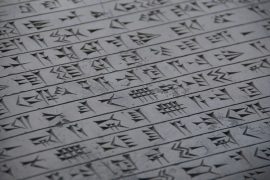
    Eventually, the Sumerians developed their own set of numerals, called cuneiform numbers. They looked like the inscription in the photo above.

    So there you have it. The world’s first numerals — near as we can tell. Next up: The Egyptians.

    (Disclaimer: I’ll be the first to admit that this history is a lot more complex than can be described here. And I’d bet my last dollar that there are a few historians out there who disagree with the generally accepted history of Sumerians and mathematics. There’s so much we don’t know about his ancient history.)

    Got questions about the Sumerians or the development of numbers? Ask them below. Was anything in this story surprising or particularly interesting? I’d love to hear what you think.

  • A Mathematical Time Machine

    A Mathematical Time Machine

    Was mathematics invented or discovered?

    (I’ll give you a second or two to really think about that.)

    Most non-mathematicians have never really given that question much thought. Math has just always been there. An isosceles triangle has always had two congruent sides, and 3 + 8 has always equalled 11. But the reality is this: since the beginning time, human kind has struggled to find ways to describe its world. And one important outcome of this struggle is what I call the language of mathematics. Whether math was invented or discovered, the people involved were fascinating and scary and funny and sometimes sad. And that’s why I’ve decided to devote the remainder of November to the history of mathematics. Here are a few of the stories I hope to share with you.

    1. There was the 1st Century Roman who, while taking a bath, figured out the idea of displacement. What did he do? Well, naturally, he shouted “Eureka!” and went running down the streets in his birthday suit. (Or so the story goes.)

    2. Then there was the 5th century, mystical cult that demanded complete loyal and secrecy from its members. And by the way one of its members discovered one of the most useful and important facts about right triangles.

    3. In the 1600s, the surrogates of two mathematicians — one in England and the other in Germany — held heated debates over who had actually invented (or discovered) calculus.

    4. A child prodigy born in 1777 was confounding his teachers and managing his father’s business accounts at the tender age of five. He went on to make a staggering number of contributions in number theory, statistics and algebra, including normal distribution and the bell curve. He also apparently chose work over being at his wife’s deathbed, saying, “Ask her to wait a moment; I’m almost done.”

    5.  A girl (gasp!) made significant contributions to the fields of abstract algebra and physics in 19th and 20th century Germany.

    6. After cracking World War II German codes for the Brits and playing a major role in the birth of computer science, one fellow was arrested for the crime of homosexuality, chose chemical castration over prison and is said to have killed himself by cyanide poisoning at the age of 42.

    Clearly, the history of mathematics is full of comedy and tragedy. The stories weave in and out of major world developments and the histories of other sciences. At the least, some of these stories are entertaining. Others help us make connections between ideas that lead to our own personal revelations. Still others remind us that while these contributions have provided the underpinning of how we understand our world today, the people behind them were just that — people.

    So climb aboard this mathematical time machine. I’m still trying to decide whether to take it chronologically or by subject or perhaps even with a more random approach. Let’s just see what happens, shall we?

    Do you have a question about the history of mathematics? If so, please share it in the comments section. I’m happy to take suggestions of topics I should consider.

  • Exit Polling: A statistics refresher

    Exit Polling: A statistics refresher

    Most of you are probably sick to death of Political campaign polls. But these numbers have become a mainstay of the American political process. In other words, we’re stuck with them, so you might as well get used to it — or at least understand the process as well as you can.

    Last Friday, I wrote about how the national polls really don’t matter. That’s because our presidential elections depend on the Electoral College. We certainly don’t want to see one candidate win the popular vote, while the other wins the Electoral College, but it’s those electoral votes that really matter.

    Still, polls matter too. I know, I know. Statistics can be created to support *any* cause or person. And that’s true. (Mark Twain popularized the saying, “There are lies, damned lies, and statistics.”) But good statistics are good statistics. These results are only as reliable as the process that created them.

    But what is that process? If it’s been a while since you took a stats course, here’s a quick refresher. You can put it to use tomorrow when the media uses exit polls to predict election and referendum results before the polls close.

    [laurabooks]

    Random Sampling

    If I wanted to know how my neighbors were voting in this year’s election, I could simply ask each of them. But surveying the population of an entire state — or all of the more than 200 million eligible voters in the U.S. — is downright impossible. So political pollsters depend on a tried-and-true method of gathering reliable information: random sampling.

    A random sample does give a good snapshot of a population — but it may seem a bit mysterious. There are two obvious parts: random and sample.

    The amazing thing about a sample is this: when it’s done properly (and I’ll get to that in a minute) the sample does accurately represent the entire population. The most common analogy is the basic blood draw. I’ve got a wonky thyroid, so several times a year, I need to check to see that my medication is keeping me healthy, which is determined by a quick look at my blood. Does the phlebotomist take all of my blood? Nope. Just a sample is enough to make the diagnosis.

    The same thing is true with population samples. And in fact, there’s a magic number that works well enough for most situations: 1,000. (This is probably the hardest thing to believe, but it’s true!) For the most part, researchers are happy with a 95% confidence interval and a ±3% margin of error. This means that the results can be trusted with 95% accuracy, but only outside ±3% of the results. (More on that later.) According to the math, to reach this confidence level, only 1,000 respondents are necessary.

    So we’re looking at surveying at least 1,000 people, right? But it’s not good enough to go door-to-door in one neighborhood to find these people. The next important feature is randomness.

    If you put your hand in a jar full of marbles and pull one marble out, you’ve randomly selected that marble. That’s the task that pollsters have when choosing people to respond to their questions. And it’s not as hard as you might think.

    Let’s take exit polls on Election Day. These are short surveys conducted at the voting polls themselves. As people exit the polling place, pollsters stop certain voters to ask a series of questions. The answers to these questions can predict how the election will end up and what influenced voters to vote a certain way.

    The enemy of good polling is homogeneity. If only senior citizens who live in wealthy areas of a state are polled, well, the results will not be reliable. But randomness irons all of this out.

    First, the polling place must be random. Imagine writing down the locations of all of the polling places in your state on little strips of paper. Then put all of these papers into a bowl, reach in and choose one. That’s the basic process, though this is done with computer programs now.

    Then the polling times must be well represented. If a pollster only surveys people who voted in the morning, the results could be skewed to people who vote on their way home from their night-shift or don’t work at all or who are early risers, right? So, care is made to survey people at all times of the day.

    And finally, it’s important to randomly select people to interview. Most often, this can be done by simply approaching every third voter who exits the polling place (or every other voter or every fifth voter; you get my drift).

    Questions

    But the questions being asked — or I should say the ways in which the questions are asked — are at least as important. These should not be “leading questions,” or queries that might prompt a particular response. Here’s an example:

    Same-sex marriage is threatening to undermine religious liberty in our country. How do you plan to vote on Question 6, which legalizes same-sex marriage in the state?

    (It’s easier to write a leading question asking for intent rather than a leading exit poll.)

    Questions must be worded so that they illicit the most reliable responses. When they are confused or leading, the results cannot be trusted. Simplicity is almost always the best policy here.

    Interpreting the Data

    It’s not enough to just collect information. No survey results are 100 percent reliable 100 percent of the time. In fact, there are “disclaimers” for every single survey result. First of all, there’s a confidence level, which is generally 95%. This means exactly what you might think: Based on the sample size, we can be 95 percent confident that the results are accurate. Specifically, a 95% confidence interval covers 95 percent of the normal (or bell-shaped) curve.

    The larger the random sample, the greater the confidence level or interval. The smaller the sample, the smaller the confidence level or interval. And the same is true for the margin of error.

    But why 95%? The answer has to do with standard deviation or how much variation (deviation) there is from the mean or average of the data. When the data is normalized (or follows the normal or bell curve), 95% is plus or minus two standard deviations from the mean.

    This isn’t the same thing as the margin of error, which represents the range of possibly incorrect results.

    Let’s say exit polls show that Governor Romney is leading President Obama in Ohio by 2.5 percentage points. If the margin of error is 3%, Romney’s lead is within the margin of error. And therefore, the results are really a statistical tie. However, if he’s leading by 8 percentage points, it’s more likely the results are showing a true majority.

    Of course, all of that depends — heavily — on the sampling and questions. If either or both of those are suspect, it doesn’t matter what the polling shows. We cannot trust the numbers. Unfortunately, we often don’t know how the samples were created or the questions were asked. Reliable statistics will include that information somewhere. And of course, you should only trust stats from sources that you can trust.

    Summary

    In short, there are three critical numbers in the most reliable survey results:

    • 1,000 (sample size)
    • 95% (confidence interval or level)
    • ±3% (margin of error)

    Look for these in the exit polling you hear about tomorrow. Compare the exit polls with the actual election results. Which polls turned out to be most reliable?

    I’m not a statistician, but in my math books, you’ll learn math that you can apply to your everyday lives and help you understand polls and other such things.

    P.S. I hope every single one of my U.S. readers (who are registered voters) will participate in our democratic process. Please don’t throw away your right to elect the people who make decisions on your behalf. VOTE!

  • Why National Polls Don’t Matter: Electoral college math

    Why National Polls Don’t Matter: Electoral college math

    This post makes me scared. Not because the math is challenging or because I’m worried about the election. I’m afraid of looking partisan or being accused of ideology. (It’s happened before!) But I can’t avoid election math any longer, so I’ve decided to take the plunge — today and Monday — into these shark-infested waters, trusting that my readers (and new guests) will put away their partisan differences if only for a few hours. Do for the sake of the math.

    There’s no denying the math that goes on in elections. There are polls, ad buys, the number of minutes each candidate has spoken during debates — and yes, the electoral college. Whatever you may think of our dear map, it is how elections are decided in this country — for the most part.

    There’s no reason to expect a repeat of Election Day (and the weeks following) 2000 this year. So I thought it would be a good idea to review the electoral map — from a mathematical perspective — so that we can better understand its power. First some history.

    During the Constitutional Convention in 1787, the founding fathers quickly rejected a number of ways to select the country’s president: having Congress choose the president, having state legislatures choose and direct popular vote. The first two ideas were tossed based on fears of an imbalance of power — giving Congress or the states too much control. They also worried that a direct popular vote would be negatively influenced by the lack of consistent communication. In other words, without information about out-of-state candidates, voters would simply choose the candidate from their own states. And then there was the very real fear that a candidate without a sufficient majority would not be able to govern the entire nation.

    So, these fine men drew up a fourth option: a College of Electors. The first design, which is outlined in Article II of the U.S. Constitution, was pitched after four Presidential elections, after political parties emerged. Much of the original system remained, but the 12th Amendment to the Constitution instituted a few changes to reflect the country’s new party system. Here what the electoral college looks like today:

    • The Electoral College consists of 538 electors.
    • Each state is allotted the same number of electors as it has Congress members (Senators and Representatives)
    • Therefore, representation in the Electoral College is dependent on each state’s population. More populous states have more electoral votes; less populous states have fewer electoral votes.
    • The 23rd Amendment to the Constitution gives the District of Columbia 3 electoral votes, event though it is not a state.
    • Each state has its own laws governing how electors are selected. Generally, electors are selected by the political parties themselves.
    • Most states have a “winner takes all” system, which means that the candidate with the majority of the direct popular votes in the state gets all of the electoral votes.
    • However, Maine and Nebraska have a proportional system, which means the electoral votes can be divided between candidates.

    Whew!

    Some basic calculations allow the media and election officials and the candidates themselves to make really good predictions on election night in most situations. But the electors don’t officially cast their votes until the first Monday after the second Wednesday in December. Then, on January 6 of the following calendar year in a joint session of Congress, the electoral votes are counted, and the President and Vice-President are declared. (Got all that?) Almost always, though, the losing candidate concedes the election on election night or the next day, making the electoral vote and counting a mere formality.

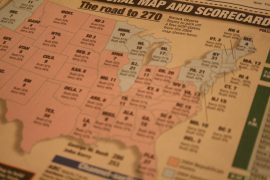
    The thing that makes this complex is that each state has a different number of electoral votes. In order to win the presidential election, a candidate must secure at least 270 electoral votes. And that’s why you’re probably seeing a red and blue (and purple?) map in your newspaper, on television and online.

    In my state, there is no question which candidate will take all of the electoral votes. Maryland has been staunchly Democratic for several decades. And there’s no mystery about Texas, which is about as red as a state can get. But if it were a contest between Maryland’s and Texas’ electoral votes, Governor Romney would win. That’s because Texas has 38 electoral votes, while Maryland has 10.

    Right now, there are lots and lots of predictions out there concerning how the electoral college will vote. (Personally, I think Nate Silver0 of the New York Times is the most reliable source. Dude has a killer math brain, correctly predicting the electoral college outcomes in 49 of the 50 states in the 2008 election. In that same election, he correctly predicted all of the 35 Senate races.) But there’s little doubt about many of the states. A few swing states will certainly claim this election: Colorado, Florida, Iowa, New Hampshire, Ohio, Virginia and Wisconsin. Mathematically speaking, we’re talking about 89 votes:

    • Colorado: 9
    • Florida: 29
    • Iowa: 6
    • New Hampshire: 4
    • Ohio: 18
    • Virginia: 13
    • Wisconsin: 10

    Now out of those, which states would you guess the candidates really want to win? Yep, the ones with the highest number of electoral votes. So to them, the most important states in these last days of the campaign are Florida, Ohio and Virginia. (Where do you draw the line? I chose more than 10 electoral votes.)

    If you live in one of these three states, you are acutely aware of this fact. Unless you don’t have a television set or listen to the radio or have a (really) unlisted phone number.

    So what does this mean? Right now, it means that President Obama is likely to win the election. There are scenarios that show the opposite outcome — and there are even a few that produce a tie. However, most political analysis says that it’s Obama’s to lose at this point. This is despite the fact that most polls show the popular vote at a statistical dead heat (in other words, any lead by either candidate is well within the margins of error).

    Because our founding fathers made a decision that we wouldn’t elect our presidents with a direct popular vote. What matters in these last days are the popular votes in the swing states — most importantly Florida, Ohio and Virginia — though there are scenarios that give Mitt Romney the edge without winning all of the swing states.

    If you are a complete geek about election numbers, do visit Silver’s FiveThirtyEight blog at the New York Times. His math is good, regardless of what some conservative pundits have claimed in recent weeks.

    EDITOR’S UPDATE: Sam Wang of the Princeton Election Consortium also has great analysis. Hurricane Sandy has messed with his servers, so the site looks pretty rudimentary, but he is updating his site regularly. It’s pretty cool to compare Silver’s and Wang’s conclusions — especially on a day-by-day basis.

    I also highly recommend a really slick interactive tool put out by the New York Times. It graphically illustrates ways in which the electoral votes could swing the election in either way, based solely on the math. Unlike Silver’s blog, this section does not offer a prediction of who will will win, but describes the various scenarios for each candidate.

    Whatever you think of the candidates and the issues, vote. No matter what, vote. Our votes — even outside swing states — matter. It’s our responsibility as U.S. citizens to declare our preferences. And in my mind, if you don’t vote, you can’t complain.

    Coming on Monday… a look at the polls themselves. What makes a good poll? How should we average folks interpret polls? Can they really tell us what’s going on?

    What are your thoughts on the math of the electoral college? (I get it. These discussions can get heated. Please be respectful in your comments. I will not approve or will delete any comments that I deem outside the bounds of civility. Thank you for playing nice.)

  • Welcome Sandy! Meteorology and math

    Welcome Sandy! Meteorology and math

    Things are looking bad for those of us in Hurricane Sandy’s path. Like most of my neighbors I spent the weekend cleaning up the yard and cleaning out the local grocery stores. But one thing is certain: In a short while, my electricity will be out, and I can expect to be living like Laura Ingalls Wilder in the city for at least a few days. That means no computer, no internet.

    So for part of this week, at least, I’m bringing you some topical (not tropical!) highlights from posts past. First up is my interview with on-air meteorologist, Tony Pann. Here’s how he uses math in his work. (I’m betting he’s pretty darned busy this morning!)

    Math at Work Monday: Tony the on-air meteorologist

    Tony Pann is an on-air meteorologist for WBAL-TV 11 in Baltimore, Maryland.

    I have been a television meteorologist for 22 years. Since 2009, I’ve been working as part of the morning team at WBAL TV.

    When do you use basic math in your job?

    I use math everyday! The computer models that we use to forecast the weather, are based on very complicated formulas derived from fluid dynamics. The atmosphere acts very much like a body of water, so the same mathematics can be applied to both. Each day, over a dozen different computer models are run predicting the state of the atmosphere at different time frames. An initial set of data is entered at a specific starting time, then the model shows us it’s interpretation of what the state of the atmosphere will be at certain time intervals. For example, the data might be entered at 7 a.m., then the model will predict the temperature, wind speed, and barometric pressure at 10 a.m., 1 p.m. and 4 p.m. Some of these models are short range, and only extend out to 48 hours, while others go all the way out to 365 hours from the starting point!

    So let’s say there are 13 models that do this same thing each and every day, two or three times a day. It’s my job as a meteorologist to interpret all of that data, and translate it into the very understandable and reliable seven-day forecast that you see on TV. With so much data out there, the intuition and experience of the forecaster is very important. Since each model takes in the same starting data, but is run on a different formula, they all come up with different answers. For example, one model might say the high temp for today is going to be 45 and another could say 50. Or one could predict 6 inches of snow and the other says 1 inch. It’s my job to decide which one is right and why.

    Sometimes I don’t trust any of them, and I’ll do a quick calculation on my own.  Here’s an equation that I can use to calculate the high temp for the day by hand:

    I then go on TV, and try and explain it all in an interesting manor — at least that’s the goal.

    Did you have to learn new skills in order to do the math you use in your job? 

    In order to get a degree in meteorology, you actually have to learn all of the math that the computers are doing to give us those answers. It’s not easy! By the time we are finished, we’re just a class or two short of having a minor in mathematics. It’s great to know what the computers are doing, but I’m glad we don’t have to work it out by hand anymore. If not for the wonderful training in the world of mathematics, I most certainly would not be doing this job.

    Do you have questions for Tony? Ask them in the comments section, and I’ll let him know to peek in! He’ll be a bit busy for a while, so be patient!

  • Saving Face: Avoiding performance math

    Saving Face: Avoiding performance math

    If there’s one thing most folks assume about me, it’s this: That I am some sort of mathmagician, able to solve math problems in a single bound — quickly, in public and with a permanent marker.

    Nothing could be farther from the truth.

    I don’t like what I call performance math. When I’m asked to divvy up the dinner tab (especially after a glass of wine), my hands immediately start sweating. When friends joke that I can find 37% of any number in my head, I feel like a fraud. I’m not your go-to person for solving even the easiest math problem quickly and with little effort.

    Truth is I really cannot handle any level of embarrassment. And I’m very easily embarrassed. I’m the kind of person who likes to be overly prepared for any situation. This morning, before contacting the gutter company about getting our deposit back because they hadn’t shown up, I had to re-read the contract and literally develop a script in my head. What if I misunderstood something and was — gasp! — wrong about the timeline or terms of our contract?

    Oh yeah, and I hate being wrong. About anything.

    In short, I’m not much of a risk taker. Unlike many of my friends and some family members, I can’t stand the thought of failing publicly. Imagine writing a math book with this hang up! Thank goodness for two amazing editors, who checked up behind me.

    I’m also not a detailed person. Not one bit. I’m your classic, careless-mistake maker — from grade school into grownuphood. I’m much more interested in the big picture, and I am easily lured by the overreaching concepts, ignoring the details that can make an answer right or wrong.

    For years and years, I worried about this to no end. How could I be an effective teacher, parent, writer, if I didn’t really care about the details or I had this terrible fear of doing math problems in public? What I learned very quickly in the classroom was this: Kids needed a math teacher like me, to show them that failing publicly is okay from time to time and that math is not a game of speed or even absolute accuracy. (It’s never a game of speed. And it’s frequently not necessary to have an exact answer.)

    Two weeks ago, as I sat down with my turkey sandwich at lunch, the phone rang. It was a desperate writer friend who was having some trouble calculating the percentage increase/decrease of a company’s revenue over a year. (Or something like that. I forget the details. Go figure.) She really, really wanted me to work out the problem on the phone with her, and I froze. I felt embarrassed that I couldn’t give her a quick answer. And I worried that I would lose all credibility if I didn’t offer some sage insight PDQ.

    But since I have learned that math is not a magic trick or a game of speed, I took a deep breath, gathered my thoughts and asked for some time. Better yet, I asked if I could respond via email, since I’m much better able to look at details in writing than on the phone. I asked her to send me the information about the problem and give me 30 minutes to get back with her.

    Within 10 minutes, I had worked out a system of equations and solved for both variables. She had her answer, and I could solve the problem without the glare of a spotlight (even if it was only a small spotlight).

    My point is this: Math isn’t about performing. If you like to solve problems in your head or rattle off facts quickly or demonstrate your arithmetic prowess at cocktail parties, go for it. That’s a talent and inclination that I sometimes wish I had. But if you need to retreat to a quiet space, where you can hear yourself think and try out several methods, you should take that opportunity.

    Anyone who criticizes a person’s math skills based on their ability to perform on cue is being a giant meanie. And that includes anyone who has that personal expectation of himself. There’s no good reason for math performance — well, except for Mathletes, and those folks have pretty darned special brains.

    Do yourself a favor and skip math performance if you need to. I give you permission.

    Do you suffer from math performance anxiety? Where have you noticed this is a problem? And how have you dealt with it?

  • Engineering tops highest-earning degrees — again

    Engineering tops highest-earning degrees — again

    With the economy still struggling along and a price of a college degree outpacing ordinary inflation, more and more personal finance experts are suggesting that students choose a major based on its earning potential. And true to form, this year’s American Community Survey data shows that STEM (science, technology, engineering and mathematics) degrees continue to promise much higher incomes than even business degrees. And so today, instead of interviewing someone about how they use math in their job, I thought I’d take a look at this data.

    In 2011, 59 million Americans (25 years and older) held bachelor’s degrees. The most popular degree is business (20%), with education coming in second (12%). In fact, those with business degrees were the most likely to be employed. But here’s where the rubber hits the road: those with engineering degrees continue to out-earn business majors by about $25,000 a year (based on median salaries).

    Yes, you read that right.

    And the hits keep coming (again, based on median salaries): those with mathematics, computer science or statistics degrees earn $13,000 more each year, as do those with physical science degrees. Even if a STEM degree holder was not working in that humanities degree holders were (naturally) at the low end of the earning potential, along with education,

    But money isn’t everything. Those in STEM careers are more likely be employed in full-time, year-round jobs. (Curiously, teachers aren’t considered year-round employees, which I think skews the data somewhat.) The mathy/sciencey types are also less likely to be unemployed.

    I am not one to suggest that someone get a degree merely for the earning potential. If you don’t want to be an engineer, don’t major in that field. It sounds a little woo-woo, but I firmly believe in the general idea that we should all be following our bliss (and being smart about what that means financially).

    Where I think this data matters — big time — is much farther down the educational ladder. Students who learn to love (or at least appreciate) STEM subjects are much more likely to consider these as a field of study. On the other hand, many of you can personally attest to the fact that it’s hard to fall in love with these subjects — and play catch up with the concepts and foundation needed to excel in them — when you’ve learned to hate them or have zero confidence in your abilities.

    In other words, the work starts in elementary and middle school. For students reach their real earning potential and for employers to find qualified experts for the jobs that they do have, we really must make STEM a priority in these grades. That doesn’t mean more testing or introducing concepts at a younger age. (In my opinion, those strategies are counterproductive.) It means finding truly gifted STEM teachers who are able to motivate their students and overcome our epidemic of mathematics anxiety and general apathy towards the subject.  It means approaching STEM subjects with excitement and a sense of discovery. It means encouraging, not discouraging, exploration in these subjects.

    So I ask you: What are you doing to help with this?

    Interested in how things broke down numerically? Here are a few median salaries from the American Community Survey:

    • Engineering, $91,611
    • Computers, mathematics, statistics, $80,180
    • Physical and related sciences, $80,037
    • Business, $66,605
    • Literature and languages, $58,616
    • Education, $50,902
    • Visual and performing arts, $50,484

    What do you think? Should college students choose a degree based on earning potential? Or should they “follow their bliss”? How can schools help students develop an interest in the fields that offer a higher earning potential? Share your comments!

  • Boo! Scaring up savings at Halloween

    Boo! Scaring up savings at Halloween

    I’ve admitted it here before: I’m a dedicated DIYer. Pinterest is a huge playground for me, and I scout craft shows for ideas I can try at home. Like most Martha Stewart wanna bes, I leave a lot of projects undone. It can turn out to be an expensive past time.

    After years of this back-and-forth, I’ve realized one important few thing: sometimes DIY is more expensive — in money and time. That’s why I included the following in my book, Math for Grownups. Yes, the example is based on my own, personal experience, except that the ending turned out differently. (The obscure character? Luna of Harry Potter fame.) Had I really thought it through before heading to Joann’s Fabric, I would have saved myself some cash and a lot of time.

    Rita loves Halloweʼen, and she loves making her kidsʼ costumes. This year, her 10-year-old daughter has requested a velvet-like cape and gown so that she can dress as some obscure character from her favorite novel about magical kids.

    The pattern Rita is using calls for 7 yards of fabric, 2 fancy fasteners, and 3 yards of fringe. Looking at the Sunday circular for the local fabric store, she sees that crushed panne velvet is on sale for $2.99 per yard and the fringe is priced at $4 per yard. Rita guesses that the fasteners are about $5 each. To estimate her costs, she adds everything together:

    (7 • $2.99) + (3 • $4) + (2 • $5)

    (In case you lost track, that’s 7 yards of fabric at $2.99 per yard, 3 yards of fringe at $4 per yard, and 2 frog clasps at $5 each.)

    $20.93 + $12 + $10 = $42.93

    A terrifying price!

    Rita is starting to think that a trip to a thrift shop might be a better investment of her time and money. Sometimes doing it yourself just isn’t worth it.

    Do you have any scary costume stories? How have you learned to save money while DIY and celebrating Halloween?