For the last week, I’ve been suffering from a terrible cold of some sort, which has now taken up residence in my chest. Sometimes I have my voice, sometimes I don’t. Sometimes I sleep, most of the time I don’t. Sometimes I have energy, most of the time I’m sprawled out on my sofa hoping that something watchable will show up on my television set. So, I’m taking the easy way out with a short post today.
Having gone back and forth between the drugstore many times in the last week, I can’t help but wonder how much this whole thing is costing me.
At the grocery store today, I bought two bags of oranges for $5. A good night’s sleep is free and so is tap water. Prevention is the cheapest medicine. Lesson learned.
I’ll be back on Friday with a real post — unless I continue to go downhill with this stuff. In the meantime, if you’d like to share your cost-cutting strategies for dealing with or avoiding the common cold, I’m all ears. It’s likely I’ll be reading it at 2:00 this morning, while in the midst of a coughing fit. (Yeah, you should feel sorry for me.)
Oh and if this isn’t enough of a math fix for you, yesterday was Ada Lovelace Day — honoring all of the women who are tops in STEM (science, technology, engineering and mathematics) fields. Share your favorite brainy chick at the Math for Grownups facebook page.
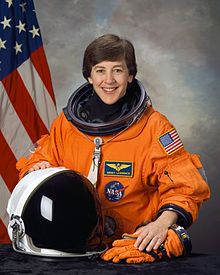
Meet Wendy Lawrence, a real, live astronaut who has logged more than 1,225 hours in space. Cool, huh? From 1995 until 2005, Lawrence took four trips into space, including the last Shuttle-Mir docking mission on Discovery. She also took rides in Endeavor and Atlantis.
And, duh, she used lots and lots of math as an astronaut. She breaks it down below.
Wendy Lawrence
Can you explain what you do for a living?
As a NASA astronaut, first and foremost, your job is to support NASA’s human spaceflight program. For example, one of my jobs in the Astronaut Office was to oversee the training of astronauts who would spend five to six months on the International Space Station (ISS). In this job, I had to work closely with representatives of the other participating space agencies to determine the specific content and length of the training flow.
Certainly, the highlight of being an astronaut was having the opportunity to be assigned to a mission! I was very fortunate to have the opportunity to fly on the space shuttle four times. On my first flight, STS-67, we performed astronomical observations with the three telescopes that we had in the payload bay. My next two flights, STS-86 and 91, went to the Russian space station Mir. My last flight, STS-114, was the first shuttle flight after the Columbia accident and we went to the ISS.
When do you use basic math in your job?
Astronauts use math regularly. We often fly in the T-38 jet for crew coordination training and to travel to other locations for mission training and support. Before every landing, the crew (front seat pilot and back-seater) needs to calculate the landing speed. This requires basic addition, subtraction and division. We subtract 1000 from the current amount of fuel and then divide that number by 100. We then add the result to the basic landing speed (155 kts or knots). Here’s an example:
2000-1000 = 1000
1000 ÷ 100 = 10
Landing speed is 155 + 10 = 165 kts
We also have to use math when we fly the space station robotic arm. This arm was built by the Canadian space agency. They used centimeters to measure distances and centimeters are displayed on the control panel. When NASA astronauts ride on the arm during a spacewalk, they typically measure distances in inches and feet. For example, the space-walker may say that he or she needs to move 12 inches to the right. Knowing that there are 2.5 centimeters per inch, the robotic arm operators can make the conversion to 30 centimeters (typically done in our heads) and then fly the arm to that new location (based on the numbers displayed on the control panel).
Do you use any technology to help with this math?
Typically, we when fly in the T-38 jet or fly the station robotic arm, we don’t use calculators or computers to help us with this math. When your hands are on the controls of the jet or the robotic arm, it is hard to use a calculator!
How do you think math helps you do your job better?
When we fly the T-38, it is a matter of safety. We could quickly get ourselves into trouble if we don’t land the jet at the proper speed.
How comfortable with math do you feel?
I studied engineering in college, so I do feel very comfortable with math.
What kind of math did you take in high school?
I took geometry, algebra II, trig and pre-calculus in high school. I did enjoy math, but I did feel like I needed to work hard to be good at it.
Did you have to learn new skills in order to do the math you use in your job?
Basically, for the situations that I have already described, I could use the math skills that I learned in school.
No surprise that Wendy uses lots of math, right? But I was a little surprised that she used so much mental math. And I didn’t expect her to say that she had to work hard at math in high school. What surprised you? Share in the comments section.
I’m of the age when I should be lifting weights — to help manage my increasingly decreasing metabolism and ward off bone density loss. And actually, I like strength training. But not as much as Greg Everett, founder of Catalyst Athletics and Olympic-style weightlifting coach. The author of Olympic Weightlifting for Sports, Greg is considered an expert on this sport, which requires quite a bit of calculations. Take a look.
Can you explain what you do for a living?
As a coach for my competitive weightlifting team, most of my time is spent creating training programs for my weightlifters and coaching them during their daily training. I also write and edit books, as well as program our website.
When do you use basic math in your job?
I use math every day. Most commonly, I use it to calculate training weights based on percentages of a lifter’s maximum lift, or to calculate a percentage based on the weight used. I also have to convert pounds to kilograms often; the sport of weightlifting uses kilograms officially, but sometimes individuals only know weights in pounds. During program design, I also use math to calculate other figures like volume (in this case, the number of repetitions performed in a given time period) to allow me to track and plan a lifter’s training. And of course, I have to be able to add the weights on the barbell quickly to know what a lifter is lifting. In weightlifting, weight plates are color coded to make this easier.
Do you use any technology to help with this math?
I do use a calculator frequently during program design for calculating percentages because I need it to be accurate. Calculations of volume are done with functions in the Excel spreadsheets I use to write programs. I normally do pound/kilo conversions in my head as much as possible just for the sake of practice.
How do you think math helps you do your job better?
Understanding some fundamental math concepts allows me to design better training programs and develop my weightlifters more successfully. Without math, there would be too much guesswork, and training athletes to high levels of performance requires accuracy.
How comfortable with math do you feel?
I didn’t particularly enjoy math as a student, although I never struggled with it. I’m comfortable with the math I use frequently in my work and am fairly comfortable with basic algebra, geometry and the like. I feel like I have the math tools to be able to solve problems in life well, but certainly any more complex math I learned as a student has been forgotten simply because I don’t use it often enough.
What kind of math did you take in high school?
Just the standard algebra and geometry; I didn’t take any advanced math courses in high school and was an English major in college. I felt that I was good at math to the degree that I was interested. That is, I never struggled with the concepts or the execution, but I also didn’t push myself beyond what I needed to learn. In retrospect, I wish I had put more time and effort into math and the sciences in school to build a better foundation.
Did you have to learn new skills in order to do the math you use in your job?
I didn’t need to learn anything new for my job; what I learned in school was adequate. As I mentioned previously, I wish now that I had more exposure to more advanced math and science as a young student. At that time, I wasn’t interested enough to pursue it beyond basic requirements, but at that age you can’t predict well what you’ll end up doing in life. My advice to students would be to put as much time and effort into your schooling as possible because that time will be your greatest opportunity to learn. You can certainly regret not knowing enough, but you’ll never regret knowing more than you need.
Even jocks use math! Do you use math in your exercise program? Share your experiences in the comments sections — along with any questions you have for Greg. I’ll ask him to swing by and respond!
In the IT field, there are many machines and programs that are really confusing and difficult to understand. Not only do we have to trust and depend on these machines, but also the people who service them. Joe Thompson is one of the good guys. He provides assistance to the users and companies when they need it most. From consulting to maintenance, Joe and his colleagues are there for us when our technology isn’t working quite right. (Joe is also one of my former geometry students. It’s been great to reconnect with him and see how accomplished he is now!)
Can you explain what you do for a living?
Red Hat’s consultants help customers get our products working when they have specific needs that go beyond the usual tech support. We are essentially advanced computer system administrators on whatever our customers need us to be to get Red Hat’s products to work for them. Common consulting gigs are setting up Red Hat Satellite to manage the customer’s servers, or doing performance tuning to make things run faster or a “health check” to verify things are running as efficiently as possible.
We just put out a marketing video about our consulting for public-sector clients, actually:
The most common is when tuning a system to perform well, or configuring various things. Unit conversions and base conversions are especially important.
IT has a long-running math issue actually: does “kilo” mean “1000” (a round number in base 10), or “1024” (a round number, 10000000000, in base 2)? There are various ways people try to indicate which is intended, like using a capital K vs. a lowercase k, or using KiB vs. KB. This matters in a lot of cases because when you get up into large data sizes, the difference between round numbers in base 10 and base 2 gets pretty big. A 1-TB hard drive (a typical size today, maybe even a little small) is a trillion bytes — 1000 to the fourth power, not 1024 to the fourth power. The difference is about 10% of the actual size of the drive, so knowing which base you’re dealing with is important.
Then there are units that have to be converted. A common adjustment for better performance is tweaking how much data is held in memory at a time to be transmitted over the network, which is done by measuring the delay between two systems that have to communicate. Then you multiply the delay (so many milliseconds) by the transmission speed (so many megabits or gigabits per second) and that gives the buffer size, which you have to set in bytes (1 byte = 8 bits) or sometimes other specified units.Sometimes software writers like to make you do math so they can write their code easier. If a program has options that can either be on or off, sometimes a programmer will use a “bitfield” — a string of binary digits that represent all the options in a single number, which is often set in base 10. So if you have a six-digit bitfield and want to turn off everything but options 1 and 6, you would use the number 33: 33 = 100001 in binary.
Do you use any technology (like calculators or computers) to help with this math? Why or why not?
I’ve always done a lot of arithmetic in my head and I can at least estimate a lot of the conversions without resorting to a calculator. I’ll break out the calculator if the math is long and tedious though, like averaging a long column of numbers, or if I need a precise answer quickly on something like how many bytes are in 1.25 base-10 gigabits — I can do the billion divided by 8 and come out with 125 million bytes per base-10 gigabit, and then multiplying by 1.25 I know I’m going to be in the neighborhood of 150 million bytes, but I need the calculator to quickly get the exact answer of 156250000 bytes. If I’m on a conference call about that kind of thing I’ll use the calculator more than otherwise.Google introduced a new feature a couple of years ago that will do basic math and unit conversions for you, so if I’m deep into things or just feeling lazy I can also just pull up a web browser and type “1.25 gigabits in bytes” in the search bar, and Google does it all for me. But recently I noticed I was reaching for the calculator more, and arithmetic in my head was getting harder, so I’ve been making a conscious effort to do more head-math lately.
How do you think math helps you do your job better?
Without math, I couldn’t do my job at all 🙂 Even so little a thing as figuring out how long a file will take to transfer takes a good head for numbers. As soon as you dig under the surface of the operating system, it’s math everywhere.
How comfortable with math do you feel? Does this math feel different to you ?
I’m pretty comfortable with math. A lot of my off-time hobbies touch on computers too so it’s a lot of the same math as work even when I’m not working.
What kind of math did you take in high school? Did you like it/feel like you were good at it?
I took the standard track for an Advanced Studies diploma from grades 8-11 (Algebra I, Geometry, Algebra II, Advanced Math), plus AP Calculus my senior year, and always did well. I didn’t expect to like Geometry going in because it’s not one-right-answer like a lot of math, but I ended up enjoying the logical rigor of proofs. (Though I do recall giving my Geometry teacher fits on occasion when my proofs took a non-standard tack…)
Did you have to learn new skills in order to do the math you use in your job? Or was it something that you could pickup using the skills you learned in school?
Most of it was learned in school, although base conversion isn’t something we spent a lot of time on. I got good at it through long, frequent practice as you might guess…
Do you have a question for Joe? Send me your question and I will forward it to him.
For many folks along the East Coast, Halloween will (at the very least) be postponed, thanks to the very real terror of Super Storm Sandy. I know all of us keep these folks in their thoughts.
And the rest of us? For the most part, tonight marks a very strange annual tradition here in the U.S.: going door to door in costume, asking for free candy. To mark the occasion, I’ve collected some scary statistics about the night of tricks and treats. Read at your own risk! Bwa-ha-ha-ha! (Um… that’s my attempt at an evil laugh.)
170 million: The number of people who plan to celebrate Halloween in the U.S. (National Retail Federation)
$79.82: The average spent on costumes, decorations and candy this year. (National Retail Federation)
Yes, you read that right — pediatric plastic surgeon. But don’t make the dumb assumption that I did when I first met Dr. Rick Redett. He’s not doing nose jobs on preteens. He’s expertly repairing cleft lips and palates, doing skin grafts and addressing nerve injuries at Johns Hopkins Children’s Center. And this is pediatrics, so he’s working with teeny-tiny parts — little hands and noses and even nerves in these little bodies. One measurement that’s even a little bit off can mean a very big problem.
It’s no wonder that Dr. Redett uses lots of math in his work — from conversions to measurements to basic geometry. On top of that, he helped found Bring Hope Through Healing, a non-profit that helps fund surgical trips to South and Central America, so that children (and even a few adults) with cleft palates and lips can get restorative surgery. But in terms of his everyday job? Here’s how he uses math.
Can you explain what you do for a living? I am a pediatric plastic surgeon, caring for children with cleft lip and palate, nerve injuries, congenital and traumatic hand problems and burns.
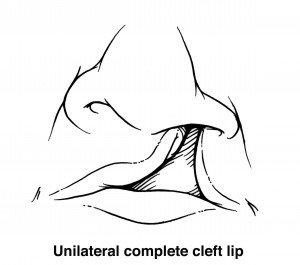
When do you use basic math in your job? Most of the medicines we give children are weight based, which means we give a specific amount of medicine calculated using the weight of the baby. Giving too little or too much medicine may be harmful. I also use math during surgery. When a baby is born with a cleft lip, one of the nostrils is much bigger than the other. To determine how much smaller I need to make the bigger nostril, I use device which measure the diameter of each nostril. Multiplying the difference in diameter of the nostrils by 3 (approximately π) will equal the amount of tissue which needs to be removed from the bigger nostril to make it the size of the smaller nostril.
Notice how the nostril on the left is larger than the one of the right. Rick uses the formula for the circumference of a circle to help him even out the nostrils along with repairing the cleft lip.
Do you use any technology to help with this math? I use an app on my iPhone when calculating medication doses in children
How do you think math helps you do your job better? I couldn’t do my job without math.
How comfortable with math do you feel? I enjoyed math in school and am comfortable using it at work. Most of the math I use at work is relatively simple but necessary to practice medicine safely.
What kind of math did you take in high school? Math was one of my favorite classes in high school. I especially liked trigonometry
Did you have to learn new skills in order to do the math you use in your job? I didn’t have to learn anything new, but I have had to review things that I didn’t know I’d need. When I was learning how to make the nostrils symmetric during cleft lip surgery, I had to look up the formula for the circumference of a circle (C = dπ, where C is circumference, d is diameter and π can be rounded 3.14).
Did you think that the formula for the circumference would ever be useful? I was surprised. Oh, and parents, next time your little one is at the doctor or (god forbid) needs surgery, be glad that the doctor took math! If you have questions for Dr. Redett, post them here. I’ll let him know about them and get answers for you.
Wednesday on Facebook, I had the most amazing experience. Suffering from an all-day migraine, I had spent the afternoon bored out of my mind, obsessively checking Facebook while the television droned in the background. At one point, this status update from my friend Alyson appeared in my feed:
ALGEBRAAAAAAAAAAAAAAAAAAA!!! (Shaking fist angrily in air at math gods)
I was Batman and here was the bat signal. How could I help?
The first response was from someone I didn’t know and very typical: “Outside of college, you don’t really need it, right?” I rolled my eyes inwardly and thought about why Alyson might need to solve an algebra problem. Then I remembered her incredibly bright son, who is completely enamored with computers. I mean in love with the machines. I’d bet my last dollar that the boy will find himself programming or engineering or something in STEM as an adult. In other words, he would need algebra.
I posted a few questions to see how I could help, and eventually Alyson posted the original equation to solve:
Whew! It is a doozy, right? Alyson had one very specific question: how to handle the last term of the equation: . I told her the simple answer — that it was the same thing as . Still a teacher at heart, I wanted to see what she could do with that information. Was it enough to help her solve the problem?
Meanwhile lots of other people were chiming in, and Alyson was expressing lots of feelings:
And just so everyone knows, I suck at fractions. Always have, always will. When I took SAT and ACT and whatever else, I literally turned all fractions into decimals because I can never remember how to add, subtract, divide, multiply, etc. fractions.
I’m close to crying…I still don’t understand what you’re saying. He worked the whole thing out at got what my online algebra check thing says is a wrong answer, and I’m trying to work it out so I can figure out how to get the RIGHT answer and I really do think I’m going to cry…
Frustration cry. Because I didn’t think I’d ever use math. And I was wrong. For the record. Sorry, Mrs. Blankenship.
This is a super smart lady. She edits college-level courses of all kinds, and she’s had a successful freelance writing career for many years. And I can completely identify with her frustration. I’d been struggling with Venn diagrams and conditional statements all day. No wonder I had a migrane.
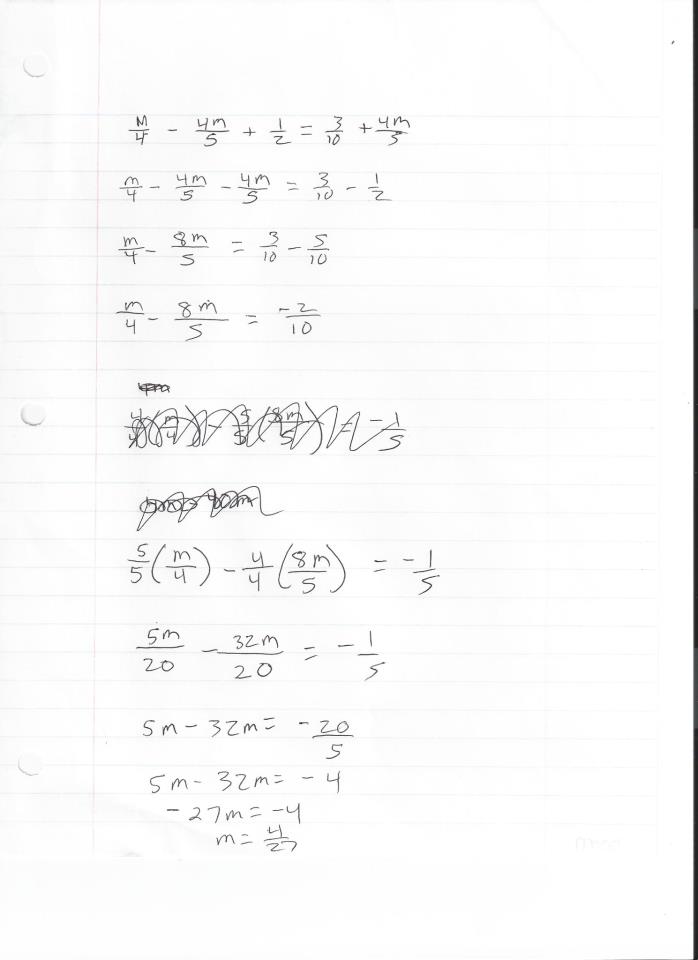
But then something really amazing happened. Really amazing. A mutual facebook friend and writer, Jody (owner of Charlotte on the Cheap) tagged us both in her status update:
Do I have it right? Do I?
She had attached this photo:
At 6:15 on a Wednesday evening, she had not only worked out a challenging pre-algebra problem but also taken the time to scan it and post on Facebook. She was so excited. And, yes, she had gotten the correct answer.
She had also done it differently than I did. But that’s not even the best part. Alyson saw Jody’s process and looked carefully — very carefully. She posted this:
I worked through it on my own twice using your strategy, which ended up making a lot of sense to me once I talked it out a few times. So now I can explain it to [my son] and actually have a clue what I’m talking about. THANK YOU.
Within an hour, another of Alyson’s friends had posted one more way to do the problem. It was a smorgasbord of solutions!
But here’s the very best part: with all of these threads, there were very few people chiming in to say that they were too dumb to help or “who cares?” In fact, I saw many more people posting things like this:
This I can do. Proof reading for grammar errors…….not so much!
I will be glad to do some algebra when the time comes.
I love math, call me, text me pictures!!!! I will PM you my number.
Why WHY WHY are you having an algebra party without ME?! I love me some equations!
It wasn’t a complete love-fest, but it was worlds different than I’m used to seeing. The tenor of the discussion was supportive and positive, rather than defeated. Sure, there’s was lots of frustration. And I’m betting that there were lots of people reading the threads and thinking, “Good god, I’m going to be in BIG trouble when my kid takes algebra.” But what played out in the end was a good experience — not just getting the right answer but learning different ways to approach the problem.
I originally became a math teacher because I was convinced of two things: math is important and anyone can do math. For years, I’ve felt pretty alone in those two estimations — especially after leaving the classroom. Yet, here was a community of people who were working from the same premise, encouraging Alyson and excitedly trying out the problem themselves.
I can’t think of a better way to end Back-to-School month at Math for Grownups. If you parents can express this enthusiasm — along with your frustration, if you have any — you’ll be doing your kids a big favor. It’s the pushing through and looking for ways to understand things differently that makes a difference. Imagine how much more empowered and confident our kids will feel if they get the message that math is important and that they can do it.
What positive messages about math have you seen lately? Have you found ways to be more encouraging about math with your own kids? Share your thoughts in the comments section.
With a blind, deaf, 18-year old toy poodle who has dementia (canine cognitive disorder), I’ve gotten to know our friendly neighborhood veterinarian very, very well. Dr. Robert Z. Berry, DVM at The Village Vet has helped us manage some strange symptoms and supported us in the last year since Roxie was diagnosed with dementia. Just like people doctors, vets must have excellent bedside manner, and Dr. Berry has it in spades.
I also noticed that he does quite a bit of math in his work. Roxie has been on a variety of medication, as we’ve looked for the right combination to keep her happy and healthy. And she’s only 6 pounds. That means converting measurements like crazy. At a recent visit, I finally got the idea to ask Dr. Berry to answer my Math at Work Monday questions. If your kid aspires to be a vet, read on!
Can you explain what you do for a living?
I examine sick and healthy animals, provide preventative care such as vaccinations or parasite (intestinal and blood born worms) screening and offer early disease detection, blood tests or imaging (xrays and ultrasound). In the case of sick animals, we can hospitalize and provide medical care or medical surgical care to help return them to normal health. Additionally we provide routine surgical and dental services such as spaying , neutering, tumor removal, dental cleaning and extractions.
When do you use basic math in your job?
Everyday, from basic math skills to algebra. Here’s an example : An animal weighs 22 pounds and needs medication which is dosed at a rate of 20 mg/kg and given three times a day. The animal’s weight is measured in pounds, so the first step is to convert to kilograms. Then I need to multiply the weight in kilograms by 20 mg/kg. Now we have a milligram dose of 200 mg. But things can get even more complex. Suppose the drug is supplied in 400 mg/ml strength? I use division or an algebraic formula to arrive at a milliliter (or cc, cubic centimeter) dose of 0.5 ml.
Do you use any technology (like calculators or computers) to help with this math?
I really prefer not to use a calculator because I think it can make my brain become lazy. It is remarkable how much agility you lose (even basic math skills) when you don’t use basic math skills on a daily basis. I calculate in my head but verify with the calculator.
How do you think math helps you do your job better?
It’s absolutely necessary with any sort of drug therapy.
How comfortable with math do you feel?
I feel very comfortable with math and have all of my life. Vets must be mentally sharp and learn to rely on their most important assets — their brains! I took calculus in high school, and I felt very confident in the class. School prepared me very adequately for the nuts-and-bolts part of my job. I was fortunate to have good teachers and also to have been raised in the time period before calculators were allowed in school. A good primary education prepares one for the rest of his or her life.
So there you have it, a vet who is both compassionate and math-savvy — a great combination! Were you surprised by the math that Dr. Berry uses in his practice? Share your response in the comments section.
If you’re on Facebook, you’ve probably seen one of a variety of graphics like the one above.
The idea is to solve the problem and then post your answer. From what I’ve observed, about half of the respondents get the answer correct, while the other half comes to the wrong answer. The root of this problem? The order of operations.
Unlike reading English, arithmetic is not performed from left to right. There is a particular order in which the addition, subtraction, multiplication, and division (not to mention parentheses and exponents) must be done. And for most of us old-timers, that order is represented by the acronym PEMDAS (or its variations).
P – parentheses E – exponents M – multiplication D – division A – addition S – subtraction
I learned the mnemonic “Please Excuse My Dear Aunt Sally” to help me remember the order of operations.
The idea is simple: to solve an arithmetic problem (or simplify an algebraic expression), you address any operations inside parentheses (or brackets) first. Then exponents, then multiplication and/or division and finally addition and/or subtraction.
But there really are a lot of problems with this process. First off, because multiplication and division are inverses (they undo one another), it’s perfectly legal to divide before you multiply. The same thing goes for addition and subtraction. That means that PEMDAS, PEDMSA, and PEMDSA are also acceptable acronyms. (Not so black and white anymore, eh?)
Second, there are times when parentheses are implied. Take a look:
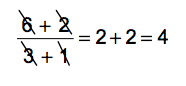
If you’re taking PEMDAS literally, you might be tempted to divide 6 by 3 and then 2 by 1 before adding.
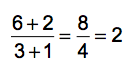
Problem is, there are parentheses implied, simply because the problem includes the addition in the numerator (top) and denominator (bottom) of the fraction. The correct way to solve this problem is this:
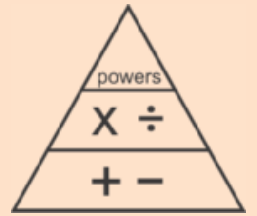
So in the end, PEMDAS may cause more confusion. Of course, as long-time Math for Grownups readers should know, there is more than one way to skin a math problem. Okay, okay. That doesn’t mean there is more than one order of operations. BUT really smart math educators have come up with a new way of teaching the order of operations. It’s called the Boss Triangle or the hierarchy-of-operations triangle. (Boss triangle is so much more catchy!)
The idea is simple: exponents (powers) are the boss of multiplication, division, addition, and subtraction. Multiplication and division are the bosses of addition and subtraction. The boss always goes first. But since multiplication and division are grouped (as are addition and subtraction), those operations have equal power. So either of the pair can go first.
So what about parentheses (or brackets)? Take a close look at what is represented in the triangle. If you noticed that it’s only operations, give yourself a gold star. Parentheses are not operations, but they are containers for operations. Take a look at the following:
Do you really have to do what’s in the parentheses first? Or will you get the same answer if you find 3 x 2 first? The parentheses aren’t really about the order. They’re about grouping. You don’t want to find 4 + 3, in this case, because 4 is part of the grouping (7 – 1 x 4). (Don’t believe me? Try doing the operations in this problem in a different order. Because of where the parentheses are placed, you’re bound to get the correct answer more than once.)
And there you have it — the Boss Triangle and a new way to think of the order of operations. There are many different reasons this new process may be easier for some children. Here are just a few:
1. Visually inclined students have a tool that suits their learning style.
2. Students begin to associate what I call the “couple operations” and what real math teachers call “inverse operations”: multiplication and division and addition and subtraction. This helps considerably when students begin adding and subtracting integers (positive and negative numbers) later on.
3. Pointing out that couple operations (x and ÷, + and -) have equal power allows students much more flexibility in computing complex calculations and simplifying algebraic expressions.
Even better, knowing about the Boss Triangle can help parents better understand their own child’s math assignments — especially if they’re not depending on PEMDAS.
Do you know Bear of Bear Snores Onand Bear Feels Sick? Or Pip ofWhere is Home Little Pip? If so, you also know my very talented friend, Karma Wilson. Karma has been a published author for 12 years (not including the three years it took for her to get published the first time). She is the author of 30 books, and begrudgingly, she admits to using math from time to time.
Can you explain what you do for a living?
I write — specifically for the 4- to 8-year-old set. It is my goal to write engaging books and poetry for children that is also appealing enough to adults that they don’t hide it under the hamper lest it be requested again. To accomplish this I utilize rhyme, alliteration and two-tier humor that is directed to children on one level, adults on another.
When do you use basic math in your job?
I wrote a rhyming counting book (Frog in the Bog), does that “count”? It only went to five, which gives you a good idea of my math skills. Seriously though, in my line of work there is a lot of math that my literary agent mostly deals with. I have to pay him 15% of my income. My royalties are usually 6.5%. My publisher holds out profits from sales in case of large returns on my books, and that’s usually 25% of my royalties. All this adds up to a good reason for me to have an agent!
Do you use any technology (like calculators or computers) to help with this math?
If I have to do math I generally do use calculators, mainly because I’m a very wordsy, artistic type and math has never been a strong suit for me. In case of serious math questions I panic and turn my friends who know math, like the amazing Laura Laing!
Karma Wilson
How do you think math helps you do your job better?
Well, for me the biggest way is with word counts. If I have a story that goes over 1000 words I better darned well subtract a bunch of those words. Wordy picture books don’t typically sell very well. Also, my words need to fit into a formula, which translates to a 32-page book with end pages that have no words. It’s important that the words to my stories fall naturally and rhythmically into that formula, which sometimes requires a break down of words per page. Luckily, I am sort of “savant” in that area, and rarely do book dummies, but I know a lot of picture book writers who are lost without that breakdown.
How comfortable with math do you feel?
I don’t feel comfortable with math at all. The math that accompanies my work is relatively simple, so it doesn’t give me panic attacks. But for my taxes and running my corporation (Karma Wilson Books Incorporated) I get a little math-addled. That’s when I turn to people who are more comfortable with math than I am, like accountants and agents.
What kind of math did you take in high school?
The highest I got to was pre-algebra. I was pretty horrible at it. That letter x never needed to fear I would discover his or her secret identity. Ha!
Did you have to learn new skills in order to do the math you use in your job?
Since I have an agent who does the hard math for me I was able to skate on my pre-algebra level skill set. However, if you’re in this industry trying to figure out the contractual stuff without an agent, you should at least have some basic accounting math skills. Otherwise, you’ll be lost in royalty rundowns and not know if your contract was fulfilled or not. It really is that important.
While my specific line of work isn’t all that math intensive, the times that I’ve wanted to understand my royalty statements were severely hampered by my fear of math. I strongly encourage every adult to refresh their math skills so they feel more confident discussing numbers with professionals in their industry.
Karma is on tour right now, promoting her newest bookBear Says Thanks. Her next stop is Denver CO at the Mountains and Plains Bookseller’s Association Author Tea on 9/21/12 at 3:45 p.m.
It’s a special Thursday edition of Math for Grownups, and today we have a guest post from Bon Crowder of Math Four, a great blog that was featured in the Wall Street Journal last month. Here’s her creative take on math and zombies.
Math isn’t only in real life, it’s in our fantasy and fear worlds too!
I’m a huge fan of The Walking Dead – the popular zombie show on AMC that returns October 14.
While watching season two, I started pondering if our heroes even had a chance against the hoards of zombies.
I realized that regardless of how science explains the start of a zombie epidemic, the way it continues and the way to stop it is explained with math.
Zombies make other zombies.
If you’re bitten or otherwise infected by a zombie, you’ll turn into a zombie yourself. Since zombies never sleep, and are constantly on the lookout for human victims, they have the ability to create many more zombies very quickly.
Killing zombies is a chore.
According to The Walking Dead the only way to kill a zombie is by ceasing brain function. In other words: removing or impaling the brain.
That sounds simple enough. But just watch one episode and you’ll see how challenging it can be!
Do we have a chance against a zombie epidemic?
There are around 30 humans in The Walking Dead. Let’s assume that represents reality: there are only 30 humans on the entire planet, and the rest of them have been turned to zombies (or will be soon).
We can do a little math to figure out how long it would take for our 30 heroes to rid the world of this epidemic.
There are a little over 7 billion people in the world. That’s 7,000,000,000. (A whole bunch of zeros, I know.)
Each hero will be responsible for killing about 230 million zombies. That’s 7,000,000,000 zombies ÷ 30 heroes.
(Notice I’m rounding like crazy – a fun thing to do when estimating anything. Including zombie deaths.)
Suppose now that each of our heroes could be expected to live 60 more years.
60 years • 365 days = about 22,000 days of life left.
We can calculate how many zombies each hero must kill per day:
230,000,000 zombies ÷ 22,000 days = over 10,000 zombies each day!
Um… we only have 24 hours in a day. That’s 1,440 minutes or 86,400 seconds. So each hero has to kill one zombie every 8 seconds.
So your kid needs some help with her math homework. Do you understand what she’s doing? Chances are, it’s not so cut and dry these days — and not because you don’t remember your middle school math lessons. Two things are going on in math ed: 1) concepts and processes are being taught differently, and 2) kids are getting more complex lessons earlier on.
All of this may leave you feeling completely helpless.
Luckily, there are some great resources out there that are there just to help you. Here are my top five.
Your child’s teacher
This is a really obvious idea, but not everyone thinks of it right away. Or maybe, like a lot of parents, you feel intimidated by the teacher or you don’t know how to ask for help. There are exceptions to the rule, but most teachers are eager to speak with parents, not only about their kids’ progress but about the best ways to help their child succeed. Find out how he or she prefers to communicate — email, phone or in person. Then use that resource as much as you possibly can.
Online textbook resources
Do you know what curriculum your child is using in math class? If not, find out, because today publishers are putting a wide-range of resources online — just for parents. This is especially true for discovery-based math programs, like Everyday Math and Investigations. The publishers of these programs know that they’re challenging for parents to grasp (since we learned very different ways of doing the math), so they’ve included very strong parent components.
This really simple website offers quick reviews of basic math ideas. Forgotten what a GCF is? You can find out here. Don’t remember how to solve for x in a proportion? This is a great place to start. Math.com also includes lists of formulas and some basic online tools, like a scientific calculator.
Focused entirely on algebra, purplemath is where you can find help with solving quadratic equationsor graphing linear equalities. Each concept includes a detailed lesson that walks you through the process and examples. Believe me, it’s been an invaluable tool for my addled brain!
Ask Dr. Math has been around since 1992, so the site has amassed a wealth of questions from math students and answers from real-live math professors. Because it is generally focused on pedagogy (the concepts behind teaching mathematics) and higher-level math, it may seem a bit overwhelming. But if you search the archive, it is likely someone has asked the very question you have. You can also submit your own questions. But don’t expect an immediate response. This site is not designed for quick, individual feedback.
So there you have it, my top five resources for parents with math questions. Got any others to share? If so please include them in the comments section. Sometimes we need all the help we can get!