What’s the best way to learn new math ideas? The answer might surprise you. But like learning a foreign language or that the little brake light on your dashboard means get to the mechanic — now! — getting the hang of math may require a little bit of discovery, rather than listening to boring lectures or reading books. And getting your Christopher Columbus on means failing a few times too. Here’s how discovery and failure play an important role in math education.
More videos are coming, so please subscribe to my YouTube channel: mathforgrownups. Also, I hope you’ll share this video on Twitter, using #failureisok and #discovermath and post it on your Facebook page. Share the Math for Grownups love!
As always, I’d love to hear what you think. Ask your questions or share your feedback in the comments section. Were you surprised by anything in the video? What do you think about having to fail in order to learn? Share in the comments section!
If there’s one thing I’ve learned in my years of freelance writing and blogging, it’s this: I should always, always celebrate accomplishments, big and small. Truth is, 2014 was a really, really big year for Math for Grownups. So I hope you’ll indulge me in this little round up of the great things that have happened since last year at this time.
And I hope you’ll spend a few moments celebrating your own wins. (Share them in the comments section, so we can all cheer for you!)
I had plans for this book since Math for Grownups published in 2011. Fear and a lot of anxiety kept me from my goal for a long time, but I finally pulled it together and got down to work. The writers I know are such smart people, and I wanted to give you all a little boost of confidence in your math abilities. As the subtitle says, with math writers can tell a better story, get published and make more money.
I’m also really proud that I self-published Math for Writers. I knew that finding a publisher would be tricky, and I wanted the autonomy of making my own decisions. It’s been a really amazing process, and I couldn’t have done it without the help of three folks: Jennifer Lawler, development editor; Sandra Hume, copy editor; and Caitlin Proctor of Design Cat Studios, who designed the cover. I highly recommend them all!
Redesign of www.mathforgrownups.com
As my reach expanded to writers and parents and teachers, I decided to put a new face on the Math for Grownups website. And with that redesign, I added more content, like quizzes, the Math Manifestoand even video. I also created a cool free gift to subscribers: a guide to overcoming math anxiety. (If you haven’t snagged yours, be sure to sign up in the bright yellow box on the right!)
Again, I owe a big debt to someone who is much smarter than I. Patrick McCarty of evolv design has been my designer for years and years. I asked for pops of color and a playful look — and that’s exactly what he gave me. Thanks, Patrick!
You could have knocked me over with a feather when I found out about this honor! Yep, that’s me, up there with Lily Tomlin, Robin Roberts, Mary Lambert and Ellen Page. Each year, GO chooses 100 lesbians who are making waves. To be on this list means more than just personal recognition — though that’s pretty darned cool! The best part was sharing the math message to a generation of women: girls can do math! (Check out my profile in the magazine.)
Hired a Virtual Assistant
This was a huge step. I’ve been a one-girl shop since I started out on my own in 2005. But with all of my big ideas, I knew I needed to step things up. Kelly Case with Time on Hand Services has been a god-send. Since the spring, she’s hanlded all of the Math at Work Monday interviews, and in the fall, she took over the newsletter. Look for her name to show up more in 2015! I’m so glad to have her on my tiny team of two.
Began Producing Video Online
Perhaps the most fun I’ve had this year is writing and producing my own video. The Math Manifesto series has been a blast. I’ve been writing math video scripts for several years, but this was my first chance to strike out on my own. And while I cringe a little seeing my face and hearing my voice, I feel really great about this accomplishment. The point is to ratchet down the anxiety and demonstrate how simple the math can be. (And sometimes I have to ratchet down my own anxiety about being on camera!)
Coming in 2015
So the best part about reviewing the previous year is the inspiration that comes. (Try it for yourself!) I’ve got big plans for next year, and I hope you’ll join me. Here’s a taste of what may come:
More video! I have a great new tool that I’m excited to use. Look for Khan Academy-like learning videos from Math for Grownups.
An online stats course for writers. This has been in the works for a while. Stay tuned for the details!
In-person speaking events. I’m showing up at a few writers conferences in 2015 (including the American Society for Journalists and Authors (ASJA) in the spring), and it looks like I’ll be working with public school teachers on implementing in-depth, project-based lessons in the classroom. I can’t tell you how excited I am to be teaching again!
New resources — for teachers and for writers. I’m developing some special items just for these audiences, and I can’t wait to share them.
A new book? This one is a little scary to announce, but I do have plans for two books. Most likely, only one will get done in 2015. Which one will be be? Not sure yet. (And I’m not spilling the beans about either one!)
Of course, I hope you all will stay with me throughout the next year. Invite your friends to subscribe, too! Math for Grownups is on the verge of something really great. Don’t miss out!
Now it’s your turn. What would you like to see here at Math for Grownups? Please share your ideas with me, in the comments section to via email: laura@mathforgrownups.com.
I’ve had such a great time this year getting to know people and their occupations on a deeper level. It’s that time of year when we reflect on what has been and dream of what will be. I’m thinking back on all the great interviews I had. A few come to mind that I’d love to share with you — just in case you missed them.
First on my mind is Mary the Non-Profit Principal. Loved her sense of humor! She knew how to turn a serious interview about math and work into an entertaining read. She is gifted on so many levels.
Then I am recalling Louisa the Greeting Card Designer. What a job! I love the creativity that she unfolds into her designs. If only some of those vibes were transmitted to me during our interview!
The next one that comes to mind is Andy the Design Director. I guess I just have a thing for the creative types! As I recall the math in his job is mostly done by the computer. Just think of it though… the math that it takes to do graphic design. The computer makes his job so much faster in so many ways.
What about Shayna the Cook Supervisor… remember her? Talk about crunching some numbers. She has to convert recipes on a daily basis as well as manage the food budget. Because I love math, that sounds like a mighty fun job! I’m not so sure about the actually cooking part though. With me at the stove, the food might not be so great!
Finally, I have to include Kathy the Company President who heads up a manufacturing company. As the president, she has a lot of numbers to look over including tolerances on the design prints, payroll, quality scores and much more. I love hearing about the industry that is the heart of so much in our country. I hope she inspires students to pursue STEM occupations. (Um… she’s also mom to Kelly, my virtual assistant, which is pretty darned cool!)
As 2014 draws to a close, I hope you all get some much deserved time off work and begin calculating your goals for next year. I’m excited about next year’s Math at Work Monday interviews, but for now it feels good to focus on the holidays. Merry Christmas and Happy New Year!
If your hands get sweaty, heart starts to race and your brain shuts down at the thought of doing math, you might have math anxiety. This is a very real condition with very real consequences — from making more mistakes to avoiding math altogether.
But there’s really great news. You can get over math anxiety. And, if you have kids, you can help them avoid getting it in the first place. This video shares a few tips. And if you want more, sign up for my free resource, Multiply Your Math Moxie: A Painless Guide to Overcoming Math Anxiety. Check out the yellow box to the right!
More videos are coming, so please subscribe to my YouTube channel: mathforgrownups. Also, I hope you’ll share this video on Twitter, using #mathanxiety and post it on your Facebook page. Share the Math for Grownups love!
As always, I’d love to hear what you think. Ask your questions or share your feedback in the comments section. Were you surprised by anything in the video? Do you have your own stories to share about your or your kids’ math anxiety? Share in the comments section!
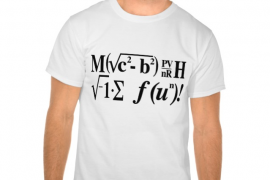
We’ve all seen them. Mathy t-shirts, mugs and social media graphics that offer a fun phrase for those who can decode the message. But have these ever made you feel a little, well, not so mathy? Me too.So let’s unlock the mysteries of these inside jokes.
I’ve gathered a few of the most common t-shirts featuring math symbols. One by one, I’ll interpret them for you. Of course if you have any ideas to share, feel free. And if you disagree with my analysis, by all means, let me know!
We’ll start with a doozy and break it down bit by bit.
M =M One of the shortcuts that these t-shirts take is simply inserting letters as variables. Or you could make an argument that the M in this example stands for mass.
This one took me a few moments to figure out. It’s based on the Pythagorean Theorem — solving for a. Here’s a quick rundown:
This is the Ideal Gas Law, which I know nothing about. But there’s some algebra to get from the law itself to this representation.
H = H Seems to me that this is simply the variable H, which could stand for just about anything. (If you have another suggestion, let me know in the comments section.)
I love this one! You may remember that you cannot take the square root of a negative number. And then you may remember that there is a very special number for the square root of -1. That number is the imaginary number — or i. It’s crazy to think that we can have imaginary numbers, but there you have it. It was important enough to create a whole new system of numbers so that we could deal with the square root of -1. (And yet, we still can’t divide by zero!)
If you were a Greek during college or remember a little bit of your Algebra II class, you’ll remember that this symbol is the Greek letter sigma. It’s used to denote summations — not the legal kind; the math kind. When you want to find the sum of a set of numbers, you can indicate it by using the letter sigma.
The last clue is a little bit of a fudge, I think. First the f and parentheses. In math-speak this represents a function, and you probably remember seeing it written like this: f(x). In this form, it means a function in terms of x. But — and here comes the not-so-accurate part, in my opinion — u raised to the nthpower is not something you would see in function notation. And u raised to the nth power doesn’t really translate to –un.
And that’s how you get “math is fun” from all of those symbols. Not too bad, eh? Next time, we’ll have some pie!
This week I had the privilege of interviewing Adam Kankiewicz who has been a solar energy meteorologist for 16 years! Some occupations use math more than others, and meteorology is one of those that relies heavily up on it. Not only does Adam know his math skills but also seems to enjoy it. Let’s learn more about what he does…
Can you explain what you do for a living?
I work with numerical weather prediction models and satellite data to estimate the energy output of PV (photovoltaic) solar systems. These estimates are used to plan projects ranging in size from home rooftop panels to large plants that cover several square miles. I also develop forecasts used by existing solar plants to predict energy production.
When do you use basic math in your job?
I use statistics when estimating long-term solar energy output. I analyze 15+ years of solar energy data to calculate an average year’s energy output based on the statistical mean. We also factor in year-to-year variability using more advanced statistical methods, such as correlation.
We use simple addition to calculate an annual sum of energy produced. The “annual sum” is a common way to report solar energy output.
Do you use any technology (like calculators or computers) to help with this math? Why or why not?
Yes, we use sophisticated computer algorithms to make our calculations. We also use Excel sheetswhen computing annual sums. Because we make hundreds of calculations a year, it wouldn’t be practical to work by hand. Also, using computers significantly reduces the margin for human error. This doesn’t mean we just push a button and get a finished result. We physically review all data and results for consistency and to make sure they’re within expected range. We also write reports interpreting the numerical results.
How do you think math helps you do your job better?
I couldn’t imagine doing my job without math. My job is very math-intensive and wouldn’t exist without math. Meteorology, in general, relies heavily on math.
How comfortable with math do you feel? Does this math feel different to you?
I feel very comfortable with all aspects of math and especially enjoy applied math (as opposed to theoretical). I look forward to the daily challenge of working with solar energy data.
What kind of math did you take in high school? Did you like it/feel like you were good at it?
I took algebra, statistics, geometry, and trigonometry. Yes, I liked all my math classes and felt math was my best area.
Did you have to learn new skills in order to do the math you use in your job? Or was it something that you could pick up using the skills you learned in school?
I did not have to learn new skills to do the math I use at work. My college math classes were intense and were enough preparation for the math aspects of my job.
Anything else you want to mention?
Thank you for interviewing me!
Interested in learning more? Adam has written a blog post for SolarToday magazine. You can find that here. And you can also see maps of monthly PV energy generation here. I don’t know about you, but I really enjoy learning more about these not-so-traditional professions.
I never was fond of the step-by-step process many of my math teachers favored. But by the time I reached high school, I figured out that math is pretty darned flexible. And in college, that lesson really took hold.
You may think that math is black and white, but honestly? There are many different ways to solve simple and complex math problems. And that’s what I explain in my latest video. Check out how you can be creative with your math solutions — and still arrive at the correct answer!
More videos are coming, so please subscribe to my YouTube channel: mathforgrownups. Also, I hope you’ll share this video on Twitter, using #flexiblemath and post it on your Facebook page. Share the Math for Grownups love!
As always, I’d love to hear what you think. Ask your questions or share your feedback in the comments section. Were you surprised by anything in the video (like how you solved the problem I propose)? Do you have your own stories to share about how you learned to find your own way to answers? Share in the comments section!
It’s gift-giving season for most of us. In honor of the winter holidays, I’ve pulled together a little list of ideas for your math geek. Or perhaps you want to encourage someone to step a little deeper into the math pool. I’ve got ideas for those folks, too. Enjoy!
Since launching this website in 2011, Math at Work Monday has been an extremely popular feature.Teachers let me know that they love sharing insight from these interviews with their students. (What better way to answer the question, “When am I ever going to use this stuff?”) Other grownups have told me that the interviews help them identify when they’re using math in their everyday lives.
Over the years, I’ve interviewed a variety of different people — from an astronaut to a fish hatchery technician to a glass artist. All jobs are terrific fits — because as we all know, Everyone Does Math.
(Did you catch my Everyone Does Math video? Check it out!)
In fact, the series has been so successful, I’m launching a special printed option for teachers and homeschoolers, including unique student-directed questions. I’ll start with one set of my favorite interviews, which can be downloaded as printable worksheets for use in the classroom or at home. Stay tuned for the details, coming in two weeks!
Now I need your help! I’m looking for new people to interview in the next month. If you or someone you know is up for it, let me know. You can email me at laura@mathforgrownups.com (include their names and email addresses). If you’ve been around for a while, you know that the process is simple. My wonderful assistant, Kelly emails a list of questions — yes, everyone gets the same questions! — you respond to the questions and email them back to Kelly. That’s all. Painless.
So what kind of folks am I looking for? You name it!
dentist, orthodontist, dental hygienist
pet groomer, dog walker
EMT
chiropractor
divorce attorney
security officer, military personnel, state trooper
archeologist
chef, pastry chef, caterer, butcher
makeup artist
interior designer
surgical nurse
prosthetic engineer
truck driver, tow truck owner
actuary
But you can probably come up with even more great ideas. If you have suggestions (but don’t have someone to recommend), go ahead and post them in the comments section.
I’m so proud of the Math at Work Monday series, and I thank you for making it so popular and for making it possible. I look forward to receiving your recommendations. Remember, email me with potential interviewee’s names and email addresses at laura@mathforgrownups.com.
By now, most of us know that girls have great math skills. Still, there are some folks out there who are holding on to the bias that boys naturally have better math abilities than girls.
In my latest Math Manifesto video, I go through some of the recent research on gender and math. It’s good news for girls and boys!
More videos are coming, so please subscribe to my YouTube channel: mathforgrownups. Also, I hope you’ll share this video on Twitter, using #mathgirls and post it on your Facebook page. Share the Math for Grownups love!
As always, I’d love to hear what you think. Ask your questions or share your feedback in the comments section. After watching the video, are you convinced — as I am — that both girls and boys have math brains? Why or why not? And to all of you grownup girls, how has your gender affected your affected your math learning and doing? Did you ever buy in to the idea that you could not do math as well as your brothers, father, husband or male classmates? I would love to hear your stories!
I am an INTP — introvert, intuitive, thinking, perceiving. If this is all Greek to you, let me be the first to introduce you to the Meyers-Briggs Personality Type. According to the Myers-Briggs Type Indicator (MBTI), this combination of letters means I am conceptual, analytical, intellectually curious, adaptable, independent and critical. I love ideas and pursue understanding.
Sounds exactly like me. Exactly.
I learned my Meyers Briggs personality type by taking a rather involved multiple-choice evaluation. But there are shorter tests online that work reasonably well. If you don’t know your type, check it out here. (I’ll wait.)
It’s pretty trendy to know what your personality type is and to identify the characteristics that you share with others. Being an INTP — remember, I love ideas and pursue understanding — I think this is a really good thing. (Also being an INTP, I think it’s a good idea for folks to get the real Meyers-Briggs test, if they plan to use the results in any serious capacity, like workplace team building or couples therapy.) You don’t have to agree with the veracity of these personality types to find them interesting and entertaining. Personally, I’ve found that knowing my type helps me make decisions — like striking out on my own as a freelance writer.
But what I find in the many, many articles on this subject is how unique the results seem. So many of my friends have said, “Wow! No wonder I feel so [misunderstood/alone/different]! Only 5 percent of the population has the same personality type as I do!”
On some level, and with some things, we all want to feel singular. Seems to me, personality types are one of those things.
But these small percentages have always bugged me a little bit. And that’s because of the math.
There are four preferences in the Meyers-Briggs personality type: introversion vs. extroversion, sensing vs. intuitive, thinking vs. feeling, and judging vs. perceiving. (I won’t get into the details of these characteristics, but do know this: judging isn’t a bad thing at all. Learn more at The Meyers Briggs Foundation website.) Since there are two options per preference, there are 16 possible personality types according to the Meyers-Briggs test.
I think we forget that there are so many different combinations. And that clouds our understanding of what is rare and what is not rare.
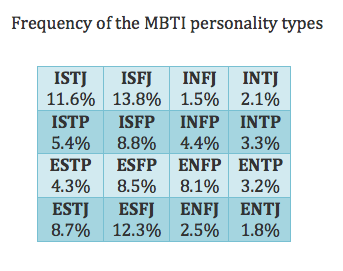
In fact, the Meyers Briggs Foundation has studied the occurrence of each of the 16 personality types in the population.
First, a disclaimer: already, this is not a random sample. The foundation used data that is reported to them, which means that only people who have taken the MBTI evaluation were in the sample studied. But what if people with a certain personality type are less likely to take a personality test? This type would not be accurately represented in the sample. And if one type is more likely to take a personality test? Those folks might appear more often in this sample than in the general population.
Still, let’s take a look.
(Data from the Meyers Briggs Foundation)
If you lined up all of the personality types in order of their percentages, the types at the middle are ISTP (5.4 percent) and INFP (4.4 percent). If you fall within 5 percent of the population, are you unusual? Well, yes. In some regard, but only if the rest of the population falls in one category outside of that 5 percent.
In terms of rarity, we often think of rates of disease. According to the American Autoimmune Related Disease Association, about 5 percent of the population in Europe and North America have an autoimmune disease. With these diseases, (including celiac disease, rheumatoid arthritis, multiple sclerosis, lupus and type I diabetes) the immune system is attacking some part of the body. (In fact, my father had autoimmune hepatitis and vitiligo and died of pulmonary fibrosis.)
If 5 percent of the population is affected by autoimmune disease, 95 percent is not. This makes autoimmune disease seem kind of usual or rare. Actually, it’s not rare by medical standards. For a disease to be considered rare in the U.S., it must affect less than 0.06 percent of the population.
And as with all math, the context matters. There are 16 personality types. If there were only three types, 5 percent is really rare. But with 16 types, well, 5 percent isn’t so unique. That’s because the other 95 percent is spread out among the remaining 15 types.
Now where this stuff gets really interesting is in certain populations. For example, in a 1992 study of college and research librarians, 11.5 percent were INTJ, while 0.8 percent were ESFP. These results definitely don’t square with the frequency in the general population. So you might be not so rare among librarians but more uncommon within the rest of the world.
I don’t mean to suggest that each of us is not a special snowflake. We are — but that’s not because of our personality types. As useful as these categories are, they certainly ignore a large part of the rest of what makes us who we are. (Meyers and Briggs knew this, of course, and their foundation works hard to be sure that the MBTIs are used ethically and responsibly.)
So go on with your special self. Fly your freak flag proudly. Just know that each of the personality types is interesting and unique in its own way. You are special, but not because of your personality type. There are just too many other possibilities!
Do you know what your MBTI type is? I love to hear about others’ personality types and how they understand them. Share your personality type stories in the comments section. Because you’re special. Just the way you are.
Today’s interview is with Mina Greenfield. She has been a speech-language pathologist for sixteen years. I enjoyed hearing not only about the math involved in her job but also about her work with children on the autism spectrum. People like Mina are becoming needed more and more as autism is on the rise. I’m so thankful that she has dedicated herself to this important job.
Can you explain what you do for a living?
I am a clinician in a private school for students on the autism spectrum. I work on interdisciplinary teams that include classroom teachers, teaching assistants, occupational therapists, and social workers. When most people think of a “speech therapist”, they think of kids that can’t say their R’s or S’s. However, my work takes a broader look at communication. Can they understand what they hear or read? Can they express their ideas? And can they use language to communicate effectively with others?
When do you use basic math in your job?
I use basic math in my job to calculate my billable hours (each 15 minute segment counts as a unit) and to compare my “scheduled vs. actual” therapy time for the week (i.e. I was scheduled to do 23.5 hours of therapy time, but a kid was absent so my actual time was 22.5). I also use math when scoring standardized tests and interpreting test scores on incoming reports. When looking at standardized tests, usually the mean =100 and the standard deviation (SD) is 15. Therefore scores between 85 and 115 are considered to be within the average range. If I read a report on a new kiddo and I see language scores that are in the 60’s or 70’s (or lower), I will be keeping a close clinical eye on him. Percentile ranks also make frequent appearances in assessments.
Do you use any technology (like calculators or computers) to help with this math? Why or why not?
I use a widget calculator on my desktop for daily and weekly billable hours. I’ve always been good at mental math so it makes that process much quicker. When scoring standardized tests, there’s a lot of basic addition to determine a raw score, but then you use the manual to look up corresponding scores which does not require math.
How do you think math helps you do your job better?
My ability to do mental math makes my job much quicker which I suppose makes me do my job more efficiently (better). I’ve been in the field long enough that I don’t have to “think” about standardized scores and what they mean. If I see a certain number, I know it indicates a certain strength or deficit.
How comfortable with math do you feel? Does this math feel different to you?
For my purposes, I feel comfortable with math all of the time. Again, I’m very thankful I’m good at mental math.
What kind of math did you take in high school? Did you like it/feel like you were good at it?
I took them all…Geometry, Trigonometry, Calculus, and AP Calculus. I also took statistics in college.
Did you have to learn new skills in order to do the math you use in your job? Or was it something that you could pick up using the skills you learned in school?
I picked up the math at my current job pretty quickly. I think compared to other professions, it’s “basic” math. (maybe?)
Questions for Mina? Let me know, and I’ll pass them on.