Category: Math for Grownups

  • Spreadsheets 101: How to Use Formulas

    Spreadsheets 101: How to Use Formulas

    This is the second post in a series about spreadsheets, called Spreadsheets 101. Click if you missed the first post, Spreadsheets are Powerful. Here’s How.

    Spreadsheets are powerful for an important reason: formulas. But if that feels like a scary word, let me reassure you. We’re not talking about the formula for finding compound interest (unless that’s what you need for your spreadsheet). In spreadsheet-speak, formulas are simple math sentences, using operations like addition and multiplication. They also employ the names of cells.

    Cell, What’s Your Name?

    First, remember that a cell in a spreadsheet is one of those little boxes in a spreadsheet. The best way to consider a cell is to think about it in terms of a column and row. The columns are identified by letters and the rows are numbered. So a cell’s name is identified by its letter (column) and number (row).

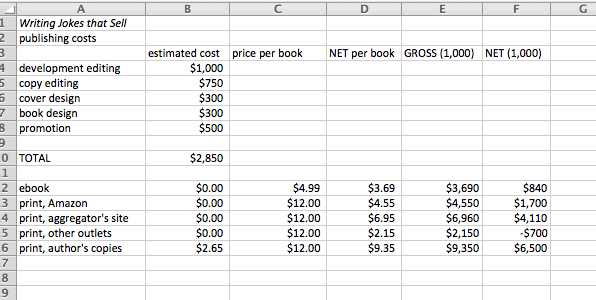
    Take a look at the spreadsheet below. There are two cells with $300. What are their names?
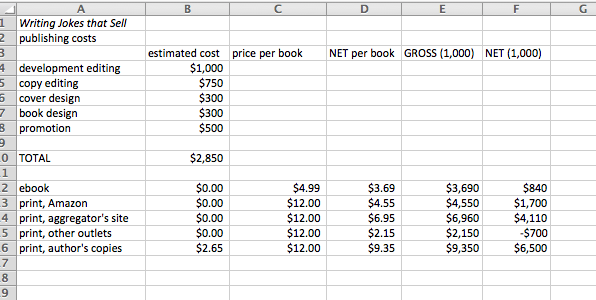
    Did you guess B6 and B7? (It’s a little tough to see the numbers, but you can count from the top to the bottom.) If so, you’re right on target. Feel free to identify some additional cells, if you need a little more practice. Remember, these cell names are going to play a role in the formulas. So it’s important to be able to identify them correctly.

    Symbolism

    For the most part, you’ll probably use really simple formulas — finding the total of a set of numbers, finding the difference between two numbers, multiplying a value by another value. When you get into more complicated formulas, you may need to pay attention to the Order of Operations (PEMDAS). This is where parentheses can really come in handy. (We’ll focus on simple formulas in this post, leaving the more complex ones for another time.)

    But first, you’ve got to know a little bit of shorthand. Because your computer does not have the same keyboard as a calculator, you’ll use ordinary keyboard symbols for a few of the math symbols. Take a look.

    +  Addition
    –   Subtraction
    *   Multiplication
    /   Division
    ^   Exponents
    =  A formula is coming!

    Notice that the symbol for multiplication is not an “x.” This is because “x” means the letter x. (It can’t mean two things at once.)

    The equals sign (=) tells the spreadsheet that a formula is coming. Otherwise, it would simply output the formula — and not the resulting value, after the formula is applied — in the cell. For that reason, each formula follows this pattern:

    =(formula)

    The word formula is the formula itself.

    Now technically, you don’t need the parentheses around the formula, but I find it useful to use them. That’s because they’re necessary with all special formulas. Either way, you must have the equals sign.

    Writing the Formula

    Before writing the formula, think about what it is that you want to accomplish. In the spreadsheet above, the estimated costs and revenues from self-publishing a book are tabulated. In cell D16, the net for each printed authors copy is $9.35. That value was found using a formula.
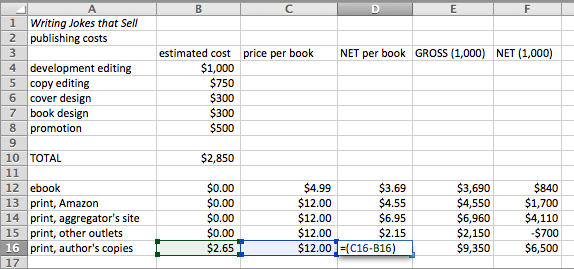
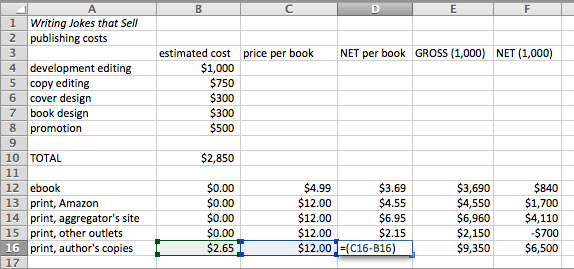
    You can see this formula in the spreadsheet above: =(C16-B16). In other words, the net for each author’s copy is the price per book minus the estimated cost of producing the book. The price per book is in cell C16 and the estimated cost of one author copy is in cell B16. So the formula is =(C16-B16). Notice there are no spaces between any characters in the formula.

    What about the net per ebook (cell D12)? The price of an ebook is quite a bit lower than a printed book, and there is no estimated cost. The net per ebook is found by multiplying the cost of the book by the royalty rate, which is usually a percentage. (Remember, you’ll need to convert the percentage to a decimal before you can multiply. Do that by moving the decimal place two places to the left.)
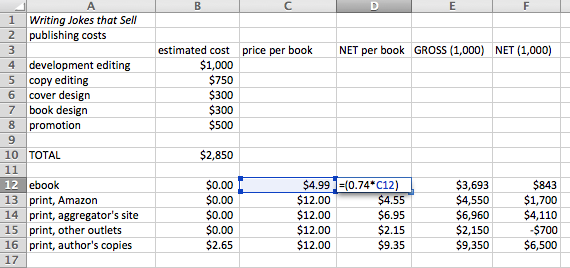
    As you can see above, the formula used to find the net per ebook is =(0.74*C12), which means 74% of the value in C12. Notice that if you want to change the book price — to see how your numbers shake out with a lower or higher price — the net per book will automatically change. That’s because the formula pulls in whatever value you have in C12.

    Special Formulas

    There’s one more thing to consider: special formulas. If you find that you’re totaling long lists of values, you can use the SUM formula and select the values you want to total. Take a look at the example below.
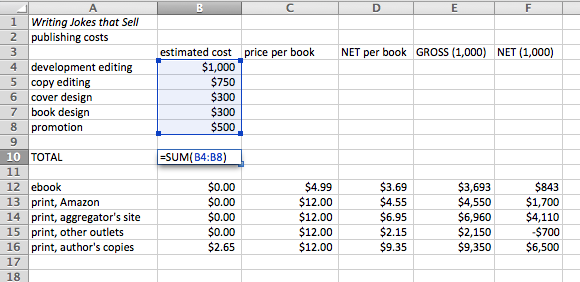
    Cell B10 is the total of all publishing costs. In other words, you want to add all of the costs together. The formula =SUM(B4:B8) simply means this: Add all of the values in the cells from B4 through B8. In this case the colon means all of the values in the cells B4 through B8.

    There is another way you can write this formula: =(B4+B5+B6+B7+B8). And if you want to do that, go for it. You’ll get the exact same answer. Of course the SUM formula is a simplified version of that same process.

    And there are lots and lots of other special formulas. You can find these by nosing around in your spreadsheet program. These programs typically include a master list of special formulas. A Google search can unearth others.

    So there you have it, a quick overview of using formulas in spreadsheets. This can be a lot more complex, depending on what you are doing. The key to remember is that a formula must appear between parentheses and after an equal sign. So play around with it. Don’t be afraid, you won’t break the program. If you find that you have some errors, stop by later to read my post on troubleshooting.

    What special formulas have you found useful in spreadsheets? Do you have some advice to share or questions you need answers for? Talk to me in the comments section! And don’t forget to read my post about troubleshooting spreadsheets.
  • Spreadsheets Are Powerful. Here’s How.

    Spreadsheets Are Powerful. Here’s How.

    This post is the first in a writer-centric series, called Spreadsheets 101. In later posts, I look at how to use formulas in spreadsheets, troubleshoot problems and create graphs. 

    Want to tell a geek from a non-geek? Ask a simple question: How do you feel about spreadsheets? Geeks will wax poetic about the grace and sensibility of spreadsheets, while non-geeks will either shrug or recoil in horror.

    At least that’s my experience.

    As a proud geek, I embrace my love of spreadsheets. As a teacher and writer, I know that not everyone is as excited about these technological marvels. Still, while I might fire up Excel for the most mundane tasks — grocery lists or wedding invitation RSVPs, for example — I do think the humble spreadsheet can be quite useful in a variety of more robust and complex settings. This is especially true for freelance writers and other entrepreneurs. We solo artists may not have access to the latest bookkeeping software or even a bookkeeper. We can’t turn to the IT team to help us project revenues for the next year or track the time spent on certain types of projects. (Most of us are the IT team.) That’s where spreadsheets can come in handy.

    What Is a Spreadsheet?

    A spreadsheet is more powerful than a table, with fewer bells and whistles than a database. The data is arranged in columns and rows. The columns are labeled with capital letters, and the rows are numbered. So each cell can be identified by its unique letter (column) and number (row). For example, A25 or FF102.

    All of the data in each row is related somehow. The same goes for the data in each column. That’s how a spreadsheet is like a table. Here’s a picture:

    In this example from Math for Writers, a writer is costing out the price of self-publishing. Notice how the columns and rows are related. In every spreadsheet, each cell (one of the little boxes) is related to the headings of the row and column that define that cell. So, $9.35 is the NET per book (column) of print, author’s copies (row) in the spreadsheet above.

    But this spreadsheet isn’t just a table. Because of the way it was built, if I change the value in cell B16, the value in D16 will also change. It’s also not a database. That’s because the data cannot be output elsewhere. For example, if I wanted to output this data onto my website — in a simple list, for example — I’d need to use a database. (Examples of databases include the contacts on your smartphone and the movie listings on Netflix. The data — names and phone numbers of contacts or names and ratings of movies — is stored in a database and output on your phone, computer or television set.) Unlike with databases, the data in spreadsheets pretty much stays put.

    When Should You Use a Spreadsheet?

    Notice that some cells contain text and some cells contain numbers. Spreadsheets are most powerful when the data is numerical. That’s because with a few carefully placed formulas, you can manipulate those numbers — quickly and easily.

    For example: in the spreadsheet above, the value $9.35 was not typed into that cell. Surprise! Instead, this values is the result of a formula. Take a look:

    When I highlight the $9.35 cell, it changes to show the formula: =(C16-B16). At the same time, cells C16 and B16 are highlighted. This formula is a really simple subtraction problem, but it’s pretty potent. That’s because if I change the value in C16 or B16, the value of D16 changes, too.

    This means you don’t have to keep up with a ton of changes. If your formulas are set up correctly, you can simply change the data in other cells as needed, and the formulas keep up with the calculations. For this reason, spreadsheets are really useful in projecting. For example, if the price of the book is changed in the above spreadsheet, you can see how the net and gross values will automatically change. In other words, you can play with the pricing and watch how the total income goes up or down as a result.

    Want to make fancy-schmancy graphs? That’s another reason to use a spreadsheet. Once your data is safe and snug inside multiple rows and columns, it can be displayed graphically with the click of a couple keys. Really. It’s that easy. (I’ll show you how in a later post.)

    And there you have it. The what and whys of spreadsheets. Stick around. In a day or two, I’ll teach you how to create the all-powerful formula. (It’s not all that magical, and it’s not all that hard either.)

    Next up: Learn how to use formulas in spreadsheets and troubleshoot problems.

    When have you found spreadsheets most useful? What frustrations have you had with spreadsheets? Share your experiences in the comments section. Also be on the lookout for my next book Math for Writers, which will be available in late January. Yes, writers do use math! I’m so excited to show you how!

  • Five Cool Math Tricks You Didn’t Know

    Five Cool Math Tricks You Didn’t Know

    When it comes to basic calculations, kids can benefit from knowing math facts cold. When the arithmetic is simple, we can focus on more complex concepts.

    That’s one reason your children are encouraged to memorize their multiplication tables. But over the years, educators have discovered that straight memorization is not always the best. In fact, when kids spend a great deal of time really unpacking what these math concepts mean, they’re far more likely to expand their understanding of many other concepts.

    So are math “tricks” a good thing or a bad thing?

    “Kids should have a way of figuring out the math fact that uses reasoning,” says Dr. Felice Shore, assistant professor and co-assistant chairperson of Towson University’s math department in Maryland. As an expert in mathematics education, Shore knows that when children’s natural curiosity is stimulated, they can make important mathematical connections that will deepen their understanding.

    “But once kids can reason their way to the answer and understand various ways to do so, these ‘tricks’ can help them get answers quickly,” she continues.

    The key is to introduce these tricks at the right age.

    “I don’t think the third or even fourth-graders should learn tricks,” Shore says. “The important mathematics at those grades is still about building an understanding of relationships between numbers—the very reasons behind math facts. Once you show them the trick, it’ll most likely just shut down their thinking.”

    But math tricks can be useful. If your fifth grader is still struggling with her multiplication tables, these can be a godsend. Even better is when they reveal something about the math that makes them work.

    If you’re going to show your child a quick way to multiply, make sure that you help her understand why the trick works. Here are five cool examples—and the math behind them.

    [laurabooks]

    Multiplying by 4

    This trick is so simple and logical, that it could hardly be called a trick. But it could come in handy for your budding Sir Isaac Newton. To multiply any number by 4, simply multiply it by 2 and then double the answer.

    35 x 4
    35 x 2 = 70
    70 x 2 = 140
    35 x 4 = 140

    Why does it work?

    This trick is based on a very simple fact:

    2 x 2 = 4

    That means that:

    35 x 4 = 35 x (2 x 2)

    And

    35 x 2 x 2
    70 x 2
    140

    The underlying lesson of this “trick” is that you can solve a multiplication problem by multiplying by its factors.

    Multiplying by 9

    Hold up both hands, with your fingers spread. To multiply 4 x 9, bend your fourth finger from the left. Count the number of fingers to the left of your bent finger—you should get 3. Then count the number of fingers (and thumbs) to the right of your bent finger—you should get 6. The answer is 36. This works when multiplying any number 1-10 by 9.

    Why does it work?

    Simple algebra can show that what you’re doing with your fingers boils down to this: When you multiply by 9, you’re really multiplying by 10 and then subtracting that number. But you don’t need to do the algebra. Some kids figure out that reasoning without the mysterious finger trick.

    You can help your child extend her understanding of the number 9 by pointing out an important piece of this trick: in the 9s multiplication tables, the digits add up to 9!

    4 x 9 = 36   —>   3 + 6 = 9

    9 x 9 = 81   —>  8 + 1 = 9

    Then you can prompt your child to notice other patterns. For example, 4 -1 = 3 and 3 + 6 = 9 and 4 x 9 = 36. The patterns in the 9s multiplication tables are endless and can lead to many other discoveries about numbers.

    Multiplying by 11

    Sure, multiplying a one-digit number by 11 is a cinch.

    4 x 11 = 44
    7 x 11 = 77

    But did you know there’s a trick to multiplying any number by 11?  Here’s how using an example: 52 x 11.

    The first digit of the answer will be 5 and the last digit of the answer will be 2. To get the digit between, just add 5 and 2.

    5 (5+2) 2
    572

    You may have noticed that when you add the two digits together, you get a one-digit number. If you get a two-digit number, things are a little trickier.

    87 x 11
    8 (8+7) 7
    8 (15) 7
    (8+1) 57
    957

    Why does it work?

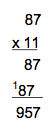
    If you think of doing long-hand multiplication by stacking the two numbers, you’ll see right away:

    But the more precise reasoning has to do with place value. What you’re really doing is multiplying 87 by 1, then multiply 87 by 10, and finally adding the two products together:

    87 x 1 = 87
    87 x 10 = 870
    870 + 87 = 957

    The trick itself is just a shortcut to the answer.

    Multiplying by 12

    Just like the previous track, you can multiply any number by 12 very quickly and easily. Let’s try it with 7 x 12.

    First multiply 7 by 10. Then multiply 7 by 2. Finally, add them together.

    7 x 12
    7 x 10 = 70
    7 x 2 = 14
    70 + 14 = 84

    Easy peasy. When this gets really impressive is with larger numbers.

    25 x 12
    25 x 10 = 250
    25 x 2 = 50
    250 x 50 = 300

    Why does it work?

    This trick works for the same reason that the 11s trick works. But there’s another way to describe it. Think of 12 as the sum of 10 and 2.

    25 x 12
    25 x (10 + 2)
    (25 x 10) + (25 x 2)
    250 + 50
    300

    Is a number divisible by 3? (Or in math terms: Is a number a multiple of 3?)

    When a number is evenly divisible by another number it is said to be a multiple of that number. In other words: since 27 is evenly divisible by 3, 27 is a multiple of 3.

    Turns out, there’s a nice little trick for this as well. Add up the values of the digits. Is that sum a multiple of 3? If so, the number itself is also evenly divisible by 3. Check it out:

    Is 543 divisible by 3?
    5 + 4 + 3 = 12
    12 is divisible by 3
    So 543 is divisible by 3

    Why does this work?

    Place value is key here, but there’s an easy way to show your child what’s happening before you even introduce the trick. Do this with something tangible, like M&Ms or pieces of cereal.

    1. Start with 45 candies.
    2. Have your child divide the candies into two piles based on the place value—one pile of 40 candies and one pile of 5 candies.
    3. Now ask your child to divide the 40 candies into groups of 10 candies. (She should notice that there are four groups of 10 candies.)
    4. Now ask her this question, “How can you change each of these groups often, so that the number is divisible by 3?” She should suggest that you take away one candy from each pile. (If not, coax her to that answer.)
    5. Have her take one candy from each group of ten and move them into another group.
    6. Point out that she has six piles of candies: four piles of 9 candies, one pile of 4 candies and one pile of 5 candies.
    7. Ask her what happens if she combines the pile of 4 candies and the pile of 5 candies. She should notice that she’ll get 9, which is divisible by 3.
    8. By now, she will probably notice that the 4 and 5 come from number 45. See if she can come up with the trick, after doing this with a few examples using the candies.

    So what do you think? Are math tricks a good idea or not? Do you have any other tricks to share? And can you explain why they work? If you need help with your math, I have written these great books to help you learn the easy way.

  • For the Love of Math

    For the Love of Math

    Last Friday, my family adopted a sweet, little poodle puppy, named Zipper. The foster mother, Sally, had brought him from a Mexico shelter to her own home in Silver Springs, Md. During the home visit on Friday, we talked about our careers, and I mentioned that I write about math. That’s when she told me about her neighbor, the mathematician and novelist.

    “You two should meet!” she said. Apparently, we have some of the same ideas about math.

    Well, I did “meet” Manil Suri today, via the pages of the New York Times op-ed section. His excellent piece, “How to Fall in Love with Math” points out some ideas I’ve been extolling for years — along with a couple that I might have said were hogwash a couple of weeks ago.

    As a mathematician, I can attest that my field is really about ideas above anything else. Ideas that inform our existence, that permeate our universe and beyond, that can surprise and enthrall.

    Yes, yes, and again I say, yes! Mathematics is not exclusively about numbers. Hell, arithmetic is only a teeny-tiny fraction of what mathematics really is. Mathematics is the language of science. It’s a set of systems that allow us to categorize things, so that we can better understand the world around us.

    Math is a philosophy, which I guess is what makes us math geeks really different from the folks who are merely satisfied with knowing how to reconcile their accounting systems or calculate the mileage they’re getting in their car. We mathy folks are truly interested in the ideas behind math — not just the numbers.

    Last week, I attended a marketing intensive, a workshop during which I outlined my current career and explored how I want to take things to the next level. I’m ready to think bigger, and I need a plan to get me there.

    The other entrepreneurs there thought there was real value in my creating a coaching service for entrepreneurs. My services would center around the numbers that these folks need to make their businesses survive and thrive. Marketing numbers, sales numbers, accounting numbers. They resisted the word “math” and advised me to really underscore the numbers.

    From a purely marketing standpoint, I completely get it. I don’t have so much of a math wedgie that I can’t understand that the word “numbers” may be less threatening than “math.” So why not just go for it?

    But the entire process left me thinking about what it is that draws me to mathematics. And ultimately what will drive me in a career, what moves me to get up in the morning and say, “Let’s go!” If you’ve been around here long, you know that it ain’t the numbers, sisters and brothers.

    At the same time, I can’t say that I love math. But maybe that’s semantics, too. For the last two years, I’ve said that I’m attracted to how people process mathematics. But isn’t that just philosophy? So, isn’t that just math? This is what Suri had to say:

    Despite what most people suppose, many profound mathematical ideas don’t require advanced skills to appreciate. One can develop a fairly good understanding of the power and elegance of calculus, say, without actually being able to use it to solve scientific or engineering problems.

    Think of it this way: you can appreciate art without acquiring the ability to paint, or enjoy a symphony without being able to read music. Math also deserves to be enjoyed for its own sake, without being constantly subjected to the question, “When will I use this?”

    At first, I disagreed with Suri’s thesis that math is worth loving — for math’s sake alone. But his analogy here is right on target. I couldn’t paint my way out of a paper bag, but each and every time I see “Starry, Starry Night” at MOMA, I catch my breath.

    We come back to a failure to educate, as Suri so wonderfully elucidates in his piece. When we allow people who hate — or don’t appreciate — math to teach the subject, well, does anyone think that’s a good plan?

    At any rate, I hope you’ll take a look at Suri’s piece. Meantime, I’m going to reach out to him to share my appreciation of math. Maybe there is a way — beyond teaching — for me to make a living as a math evangelist.

    What do you think? Do you notice a difference between mathematics and numbers? Have you changed your mind about math in recent years or month? Please share!

  • How This Book Editor Learned to Like Math

    How This Book Editor Learned to Like Math

    Behind every author is a great editor. And I was dang lucky to have Jennifer Lawler as my editor for Math for Grownups. What I didn’t know was that I’d helped her out, too. Who says English majors can’t do math? Here’s her story:

    A few years ago, I was working as a book development editor for Adams Media, the company that published Laura’s Math for Grownups, and I was assigned to edit the book. While I was looking forward to working with Laura, I was also a little nervous. Although I’m pretty good with basic math operations, I’m not that confident and tend to second-guess myself a lot. I just hoped that when I asked Laura questions that she wouldn’t give the dramatic sigh that my seventh-grade algebra teacher used to do when I expressed confusion.

    Fortunately, she didn’t. Laura, like her book, is a kind and supportive person. It was fun to see that aspect of her personality show up on the page. And it was a project that helped me learn more about math than I did in junior high and high school combined. I don’t mean I memorized a bunch of formulas. I mean I learned a new way to think about math.

    One of the first things Laura discussed in her book was the various ways people use to arrive at an answer to a problem. For years, I’d felt like I was doing math wrong, even though I was getting the correct answer, because I had a bunch of little shortcuts and methods I used that I had never been taught by a teacher in school. Laura showed how that is just fine—and she also emphasized the point that often in life we don’t need to be exact, we just need to be reasonably close. We can estimate, another habit I have that I always thought was somehow wrong of me to be using.

    Because Math for Grownups was meant to be a review of  mathematical concepts for people just like me, I figured that any question I asked Laura was a question that a reader like me might have. So for the first time in my life, or at least since seventh grade, I didn’t feel embarrassed about asking math questions. “I’m doing it for the reader!” I told myself, and then Laura would either explain what I had missed or add a note or a sidebar to address the question. As the process continued, I felt more and more confident about my abilities. And I stopped beating myself up for making a mistake. Do I agonize over a typo in an email I dash off to a friend? No, because I know I’m a good writer and so I don’t feel defensive about it. But I used to beat myself up for simple math mistakes that anyone can make. That just made me feel even worse about math.

    Laura pointed out that even mathematicians make mistakes in simple computations. For some reason, I hadn’t made that connection before. If I, a professional writer, can make a spelling error in an email, then of course even a mathematician can sometimes multiply 9 x 9 and come up with 72.

    One of the things that working with Laura taught me was to ask myself questions about my results in order to catch those simple mistakes—questions along the lines of, “Does this answer seem reasonable?” So, if I’m doubling a recipe, and my calculation for the double batch shows an amount smaller than for the single batch, I know I’ve done something wrong. This is the math equivalent of proofreading, and once I understood how it worked, I was a lot more confident about my answers.

    By the same token, I learned that I could look it up, just the way I do for a word I can’t remember how to spell. There’s nothing shameful about not remembering the formula for calculating volume. And I’ve dog-eared many pages in Laura’s book where I can find formulas I use a lot but can never seem to remember. I can never remember how to spell “occasionally” (have to look it up every.single.time) but I don’t think that somehow makes me a bad writer. Working with Laura taught me how to apply this same type of thinking to my math skills.

    My greatest reward? Now I deal with math like a grownup, instead of like that frustrated seventh-grader I once was.

    Jennifer Lawler is the author or coauthor of more than thirty nonfiction books as well as sixteen romances under various pen names. Her publishing experience includes stints as a a literary agent and as an acquisitions editor. She just released the second edition of Dojo Wisdom for Writers, the second book in her popular Dojo Wisdom series. She also offers classes in writing book proposals, planning a nonfiction book for self-publishing authors, and writing queries and synopses for novelists at www.BeYourOwnBookDoctor.com (under the “classes” tab).

    And have you heard? I’m working on a new ebook, Math for Writers. Stay tuned for details!

  • Math and Cancer and Feelings: Or, where the heck have I been?

    Math and Cancer and Feelings: Or, where the heck have I been?

    No. I do not have cancer. But in April and May and June of this year, I thought I might.

    So that’s the answer to the question in my headline. I’ve been taking a break while I deal with the roller coaster of emotions that come with suspicious mammogram and biopsy results and then surgery. First, the story.

    In April, I had an ordinary, run-of-the-mill mammogram. I’m what you call a non-compliant patient, and so I’ve only had one other mammogram in my life. Turns out both of these great experiences ended up with biopsies. My first feeling was to be totally pissed off. I’d had a biopsy before, and let me tell you, they are not fun. And since the first one showed nothing, I expected that this would be more of the same — an exceedingly uncomfortable and nerve-wracking experience that showed nothing.

    Except it didn’t. The biopsy showed “atypical” cells. This means I had something called Atypical Ductal Hyperplasia or ADH. This is not cancer. These atypical cells cannot even be called precancerous cells. My amazing surgeon explained: Research shows that women with ADH have an increased chance of those atypical cells becoming cancer. Here are the numbers:

    • Women without ADH have about a 5 percent chance of getting breast cancer.
    • Women with ADH have a 20 percent chance of getting breast cancer.
    • And that means women with ADH have four times the chance of getting breast cancer.

    For me, those numbers pointed to a very easy decision: to have the area with ADH removed. On July 5, I had a lumpectomy. Then I waited for the pathology results. I waited for 10 days.

    Anyone who has gone through something similar knows the special hell these ten days were. I am not a particularly emotional person. And yet, these ten days were downright terrifying. And here’s why.

    There was a 20 percent chance that the lumpectomy would reveal cancer. In other words, there was a slight chance that the biopsy missed any cancerous cells that were already there. Of course, that meant I had an 80 percent chance of no cancer at all.

    After the surgery, I updated my friends and family. One physician friend emailed me back: “I hope you find some solace in those stats (ie the 80%).” I assured her that I did. (No lie at that point.) And she followed up with this:

    “Glad to hear how you’re taking it. You are right about the stats.  They are often very difficult for patients, because if there is a small chance of something, but a patient has it, that patient has 100% chance of having it, right? But we as physicians use stats all the time, especially in the office setting where you don’t have any and every diagnostic test at your fingertips, and with the cost– psychological and financial– to the patient: what is the chance that this patient with this headache and those symptoms has a brain tumor? What are the chances that this person’s chest pain is a heart attack and not indigestion? It is probability, given symptoms, age, and a slew of other factors, in combination with the implications of a given diagnosis.”

    These numbers were supposed to ease my mind. Except feelings + stats + time = complete and utter freak out.

    By day nine of my waiting period, I was a total wreck. I cried all day long. I wasn’t sure if I was going to be able to sleep. I was nervous as a long-tailed cat in a room full of rocking chairs.

    Happy ending: I don’t have cancer. I know that not everyone gets that amazing news, and I am extremely grateful. I am being followed very closely, because my chances of getting breast cancer are still higher than most women’s. And I’m taking tamoxifen for the next five years, which reduces my chances by half. Those aren’t bad stats either.

    I never thought that math was the be all end all, but I have often railed against misinterpreting numbers to incite fears and advocated for the use of statistics to ease worry. Still, feelings don’t always play well with math, I’ve found. When a person is worried — scared, even — a pretty percentage may not be comforting. And that’s okay, too. We all do the best we can with what we’ve got.

    What’s your story with health and statistics? Has a percentage ever frightened you to the point of distraction or temporary insanity? Share your story here. You are not alone!

  • Math at Work Monday: Chappy the fitness coach

    Math at Work Monday: Chappy the fitness coach

    Raise your hand if you’re trying to get in shape for swimsuit season or a wedding? (I’m raising my hand!) May is prime time for folks to either get more serious about fitness or fall off the wagon. But fitness coaches like Chappy Callanta can help us stay focused to the very end — and then keep toned and slender. His gym in the Phillippines, 360 Fitness Club, not only offers expertise but equipment and classes, too. And — you guessed it — Chappy uses math. Here’s how.

    Can you explain what you do for a living?

    I develop strength and conditioning as well as general fitness programs for my gym. It involves a lot of research, a lot of experimentation and of course a lot of exercise. I also train teams and personal clients. I help them lose weight, get stronger, achieve a specific goal like running a marathon or even manage special conditions. I also write for Yahoo Philippines as their resident fitness blogger, and I maintain my own blog. My passion is fitness and wellness, and my mission is to spread the good word of being healthy to as many people as I can.

    When do you use basic math in your job?

    All the time actually. I use math when we compute for ideal weights of clients, find the right training load, or determine the number of calories one needs to consume to achieve a weight loss goal. I use math whenever I design programs for my clients. One specific situation when I use simple math would be when dealing with a weight loss client. One pound of fat is 3,500 calories. If you want to lose weight at a rate of 1 pound of week (which is doable and not too hard), you will have to create a deficit of 3,500 calories per week. I present this to a client and break down how she will be able to do it. We divide it by 7 because there’s 7 days in a week. Then we divide it by 2 because you want to lose weight through exercise and diet. That leaves you with 250 calories that you have to lose via exercise, and 250 calories through your diet. We’re just subtracting 250 calories per day from her regular diet and adding 250 calories worth of exercise per day. We compute for this using the MET system (metabolic equivalent of tasks) which takes into account the weight of a person and multiply it to the corresponding MET value of a specific activity.

    Calories Burned ÷ hour = Weight in KG • MET value

    For example, I weigh 80kg. The MET value for jumping rope is 10Mets. So if I skip rope for 1 hour I will lose 800 calories. That means if I want to lose 250 calories, the equation is:

    Time = 250 cal ÷ (800 cal ÷ 60) = 18.75 minutes

    Do you use any technology (like calculators or computers) to help with this math?

    I usually don’t since I’m so used to it already. I write it down though on paper while I’m computing it so my clients see how the math works.

    How do you think math helps you do your job better?

    It helps me to explain how the body works and how easy it is to lose or gain weight by using basic math and applying it to food and exercise. I believe that every trainer should practice mental math, so it’s easier to compute for the right training volume and intensity, as well as using the right load for each exercise.

    How comfortable with math do you feel?

    I’m relatively comfortable with basic math. There really isn’t much calculus involved in my line of work. Most of it is basic arithmetic and operations. Geometry is also important when analyzing sports and the optimal angles of the joints for a specific activity.  Research shows how the ankles, knees, and hips should be angled for example when diving off the high dive. It’s useful information and it’s pretty cool also.

    What kind of math did you take in high school?

    I took Algebra, Geometry, Trigonometry and Calculus. I enjoyed it until we got to calculus. My grades showed that I was good at it but I enjoyed Geometry the most.

    Did you have to learn new skills in order to do the math you use in your job?

    It was something that I already knew but I felt that I needed to practice it more. I practiced the equations and mental math with my clients so that today, I’m confident that I can do basic operations off the top of my head.

    Do you have questions for Chappy? Feel free to ask in the comments section, and I’ll let him know. Also, take a look at his blog, which features great, inspirational tips. 

  • Math at Work Monday: What I’ve learned

    Math at Work Monday: What I’ve learned

    It’s been a long while since I’ve posted a new Math at Work Monday interview. But this feature remains one of the most popular here at Math for Grownups. Perhaps that’s because teachers and parents like to prove to their kids, “See, you will use this stuff one day!” And I imagine that others stumble upon it while looking for career advice. At any rate, it’s been an eye-opening experience for me, too. And here are a few lessons learned.

    People don’t know they’re doing math

    I’ve intentionally  focused on careers that are not traditionally STEM related — from a textile designerto an FBI profiler to a children’s book author. And almost everyone says the same thing: “I don’t use much math in my work.” Then they follow up with a revelation – they do more math than they think!

    People do the math they want to do

    This makes a lot of sense. Why go into a career that requires skills you don’t have? Those folks who really dislike calculus are most likely not going to become physicists. Folks who hate statistics avoid careers in research. And people who have a disdain for geometry aren’t likely to become carpenters or architects. At the same time, when someone feels drawn to a career, they’re willing to whatever it takes to be successful. That often includes a little bit of math.

    People do a lot of mental math

    While most folks I interview say that they check their work with a calculator or good old back-of-the-envelope calculations, a fair amount of math is being done in their heads. This may be as simple as using fractions to mix the perfect hair color to deconstructing formulas so that the math can be done in the field, say on a fish hatchery.

    People also depend on technology

    When it comes to money, especially, or critical situations, like healthcare, a computer, spreadsheet or calculator is often a necessary tool. But often these require a clear understanding of the math going on. It’s not enough to give someone some software. These folks must know how the math works in order to use their technological tools.

    People often don’t have a good relationship with math

    This is kind of sad to me, but it’s been very true: I rarely meet someone in a non-STEM field who says that they really understood math in school and now feel really confident in their skills. Yet, all of the folks I interview for Math at Work Monday do use math. That says to me that their issues with math are often in their head – and probably not really their fault. The reality is that our educational system and other adults often fail us in this regard. It’s not about making math fun. It’s about making math useful.

    I’d like to keep Math at Work Monday going, but I need your help. Do you know someone who would be interested in being interviewed? Think of basic fields: home improvement, medicine, the arts, law, public service and more. Does your partner use math in his work? What about your next door neighbor or your sister? The answer is yes, and I’d like to interview them. Shoot me a line at llaing [at] comcast [dot] net, and I’ll reach out to them.

    What have you learned from the Math at Work series? Have you been surprised by anything? Share your thoughts in the comments section.

    P.S. I wanted to explain why I was so silent last week. Because of the horrific events in the U.S., I felt it would be trite to post about Math Awareness. Clearly our national attention was needed elsewhere, and so aside from a Boston-related post, I made the decision not to post. My thoughts continue to be with everyone in Boston and West, Texas.

  • Getting Aware of Common Core Standards

    Getting Aware of Common Core Standards

    Not all of us are parents or teachers, but I’ve long asserted that education is a “public good,” something that each and every one of us should be very, very concerned with. When kids don’t graduate or graduate with poor critical thinking skills, a lack of curiosity of the world around them or a dearth of basic math, reading and writing abilities, everyone suffers. And in a world where STEM-based employers are recruiting and paying more, we owe it to the next generation to do better.

    (This is not to say that our educational system doesn’t have some absolutely enormous issues in other areas. Perhaps the biggest problems our schools face are not academic at all. I believe that if our country took a good, hard look at poverty, violence and teacher care, we’d make huge strides in the right direction. But this post is about academics.)

    Enter the Common Core Standards. For decades, each state has developed and cultivated its own standards – or objectives required by each basic course, from history to language arts to biology. But over the last 20 years, a movement has grown to standardize these objectives across the country. With this umbrella of standards, what little Johnny is learning in Arkansas will be similar to what little Patrice is learning in Maine.

    Right now, the Common Core Standards only cover English (language arts) and math. They’ve been adopted by 45 states. (Alaska, Nebraska, Texas and Virginia haven’t adopted them at all, and Minnesota adopted only the English language arts standards.) Standards for other subjects are in the works, including science and social studies.

    For the last six months, I’ve been writing and editing curricula designed to meet the Common Core Standards for mathematics. I’ve gotten a pretty good feel for what they are, and I have to say that I like them for the most part. Here are some general thoughts I have:

    Students will learn certain concepts earlier. I haven’t spent much time with the elementary level standards, but at least in middle and high school, various mathematical topics will be introduced earlier in the standards. For example, exponential functions (an equation with x as an exponent, like with exponential decay or compound interest) is covered in Algebra I, rather than Algebra II. 

    The result is two-fold. As the standards are rolled out, some students will be left behind. In other words, kids who started school without Common Core may have a hard time catching up or bridging the gap. Second, students will have the opportunity to learn more mathematics throughout their high school career. The idea is to better prepare them for STEM in college and careers.

    The emphasis is on critical thinking. This part, I love, love, love. For example: geometry proofs are back! And rather than compartmentalizing the various branches of mathematics, students will make connections between them. I just wrote a lesson that looks at how the graphs, equations and tables for various functions – linear, quadratic and exponential – are alike and dissimilar. Previously, students may never have seen these functions together in the same unit, much less the same lesson.

    This means that assessments will change. Students will be asked to explain their answers or verbalize the concepts. Expect to see much more writing and discussion in math class.

    Applications, applications  applications. Math is no longer done for math’s sake. And this couldn’t be better news. As I’ve said here many times before, math is pointless until it’s applied. Students should get this first-hand with Common Core, which outlines very specific applications for various concepts.

    The idea here is to demonstrate that the math they’re learning is useful. The result? Hopefully more students will choose to enter STEM careers or major in these fields in college.

    Students learn in different ways. Modeling plays a big role in the new standards, which means that students can approach the math in a variety of ways – from visualizing the concepts to using manipulatives like algebra tiles to working out equations in more traditional ways to graphing. This way, students can enter the material from a variety of different doors. And that can translate to greater success.

    Sure, there is a lot to be concerned about (most especially the gap that we expect to see in student performance), but from my perspective the Common Core Math Standards are a step in the right direction. It’s important to know that these do not form a federal curriculum; the states are still responsible for choosing curricula that meet these standards, and education resource companies are scrambling to meet these meets. (That means I’m very, very busy these days!) It’s also important to know that chucking old ideas and implementing new ones puts a huge burden on already over-taxed schools and school systems. Finally, there is no doubt that this initiative was driven by the textbook companies, which means we’re still beholden to politics and capitalism.

    But in looking at the standards alone, I think Common Core is excellent. If we can implement the standards well and keep them in place for a while, I think our kids will benefit.

    What do you think of Common Core? Share your thoughts in the comment section.

  • Another Awareness: Organ donations

    Another Awareness: Organ donations

    Math shares its awareness month with another mission that is very near and dear to my heart: It is also Organ Donor Awareness Month. When I found that out earlier this week, I thought I’d indulge myself a bit and spend a post looking at the math of organ donation.

    When I was in middle school, my father learned that he had a very strange autoimmune disorder. His immune system was attacking his liver. In fact, his liver looked like that of a raging alcoholic, which he wasn’t. After months and months of testing and treatments (some pretty ugly), his doctors were finally able to get things under control. But they told us one thing that stuck with me forever: “This isn’t a terminal disease, but it is chronic. As a result, he won’t live as long as he would have if he was healthy.”

    To this day, we have absolutely no clue why my father’s immune system turned on him. When I was a toddler, he had surgery to remove part of his thyroid, because it was so overactive. As he aged, he developed other autoimmune disorders, including vitiligo, which caused his skin to lose pigment. But he kept on keeping on.

    About seven years ago, his doctors discovered liver cancer. This was a specific kind of cancer, related to his liver disease. They could remove it, but the writing was on the wall: his liver was on its last legs.

    So they put him on the liver transplant list. He stopped travelling more than a couple of hours from his hospital. He got poked and prodded. And he waited. And waited.

    I’m not sure how many people were on the list at the time. Today, there are nearly 17,000 people waiting for liver donations. Each of these individuals are scored, based on the severity of their liver damage. In 2006, when my father was on the list, the median national waiting time was 321 days. I wasn’t able to find out how many people die before receiving a liver transplant, but it’s estimated that 6,500 people die each year while waiting for a heart, kidney or liver.

    After eight months or so of waiting, my family and his doctors got worried. The tumors were coming back and multiplying. He needed a transplant soon. And so I made a decision that changed my life forever. I would donate my liver to him.

    The liver is the only organ (besides the skin) that grows back. And a live-donor liver was a great option for someone like my dad. I flew through the medical testing with flying colors.

    At about 5:00 a.m. on October 1, 2007, I was wheeled into an operating room at Virginia Commonwealth University Medical Center. They prepped me first, and then brought my father in for the transplant. The entire surgery took at least 8 hours, during which they took one full lobe of my liver and transplanted it into my father. Something like two hours of that time was devoted only to stitching up the large lambda-shaped incision that cut through my abdomen.

    After two days of recovery, my father was off the ventilator, and I was walking down the hospital corridors on my own to visit him. Within another two weeks, an MRI showed that my liver had already grown back to about 95% of its original size. (I’m not kidding!) In that time, I had lost around 20 pounds, from not being able to eat for about a week and from the energy my body spent regrowing an organ.

    I’m so sad to say that this story does not have a happy ending. I’m perfectly healthy. And my transplanted liver was doing great inside my dad. But no one knew that my father had pulmonary fibrosis. It must have been at the very, very early stages of his disease when he was tested and tested and tested prior to the transplant surgery. The doctors suspect that the progression of the disease was sped up considerably due to massive amounts of oxygen that were pumped into his lungs during surgery and while he was in intensive care.

    Had he not had this complication, I have no doubt that he would be living today. He died on November 6, 2007; his liver was still going strong.

    My point is not to share a very sad story. My point is to share with everyone some small mathematical facts about organ donation:

    1. Each day, about 18 people die, while waiting for a kidney, liver or heart. (That’s 6,500* people per year divided by 365 days.)

    2. Right now there are approximately 117,729 people waiting for a kidney, liver or heart. Each year, 4,000 more people join this list.

    3. Becoming an organ donor doesn’t have to be as dramatic as my experience was. Most donated organs are from a deceased donor. It takes a split second for you to indicate on your driver’s license that you want to be an organ donor. Or you can sign up at OrganDonor.gov.

    4. And happily, most people do not have my father’s experience. As of May 2009, 73.8% of those who had received a transplanted liver were still alive, five years after their surgery. Here are the percentages for others: 69.3% of kidney recipients, 74.9% of heart recipients and 54.4% of lung recipients.

    5. It’s not just the big organs that matter. Organs and tissues from a single deceased donor can help up to 50 people. (Yes, 50!) On average 79 people each day receive a donor organ or tissue.

    In fact, my father was so convinced of the value of organ donation that even after much of his body failed him, my father was able to donate his eyes, skin and tissue. It is an amazing thought that I and he were able to join together to do this.

    So if you haven’t taken the time to indicate that you’d like to donate your organs after death, please do so now. I don’t regret for a moment my gift to my father. At the same time, had there been more deceased donors, it wouldn’t have been necessary.

    Talk to your family about organ donation. Get some good information. And at the very least, make an intentional decision one way or the other.

    *Earlier, I had a typo here. This number has been corrected.

  • Daily Digits: My math day

    Daily Digits: My math day

    Most folks readily tell me that they don’t do any math in a day. Not a stitch. So maybe they don’t sit down and solve for x or graph a quadratic equation or use the Pythagorean Theorem. But we all do math every day. And I decided to prove it.

    It was last Tuesday — a pretty regular day.

    April 2, 2013

    6:00 a.m.: Review to-do list, estimating the time that each item would take. Count up the number of hours estimated to be sure not to exceed eight hours, while leaving time for lunch and exercise.

    7:00 a.m.: Track all Weight Watchers points that I expect to use for the day, by planning what I’ll have to eat for breakfast, lunch, dinner and snacks. Allow the online program to add everything up, but pay close attention that my breakfast and lunch are around 6 points each and that I’m using less than 8 points from my weekly extra points.

    10:00 a.m.: Review invoicing for first quarter. Within bookkeeping program, look at the data in a variety of ways: bar graphs, showing income for each month, and tables showing the income for each client. Compare income to goals and adjust expectations where necessary.

    11:00 a.m.: Set budget for new book postcard, using designer’s estimates. Compare costs of a fewer number of cards to the costs of a much larger run. Table the decision to think about things.

    12:00 a.m.: Attend weekly Weight Watchers meeting, and learn that I lost 0.4 pounds last week. Spend meeting mentally calculating how that could have happened, given the fact that I didn’t stay within my allotted daily points for a few days. Remember that balancing the equation of caloric intake and output, with variables like water retention, is way too complex for mental math. Decide to just feel fortunate and proud.

    1:00 – 3:30 p.m.: Outline online lesson about linear, quadratic and exponential functions. (Yes, this is where I and the rest of the world differs! But I wanted you to know that this curriculum doesn’t appear out of thin air.)

    4:00 p.m.: Meet with potential photographer for our wedding. Count backwards from the start of the wedding to estimate the time necessary and the cost of a second photographer. Mentally calculate how much over our budget we’d go if we hired this photographer. (Everything goes over budget, I’ve found.)

    6:30 p.m.: Meet a friend for drinks at a local restaurant. Scan menu for lowish-calorie drink, decide that since a cosmo is the same points as a glass of wine, why not have the pink drink in the fancy glass?

    7:30 p.m.: Get the check. Find the tip by taking 10% of the bill and doubling it. Then split the check evenly since we got the same drink and shared an appetizer.

    11:30 p.m.: Daughter can’t sleep. Mentally add up the number of hours of sleep we can each expect to get if she would just fall asleep right now. Finally she dozes off.

    And there you have it — my math day. As you can see, the math was tucked into various nooks and crannies. If I hadn’t been paying attention, I wouldn’t have even noticed it. And most of it had nothing to do with the way I learned to do math at school.

    So what about you? Here’s my challenge: Just for today, jot down when you’ve used math. Then share what you learned about yourself in the comments section. Did you find that you used math more than you thought? Did you discover that you’re using a kind of math that you never, ever expected? I want to know!

  • Boston Marathon: How FBI profilers use math

    Boston Marathon: How FBI profilers use math

    We can all agree that the horrific events at Monday’s Boston Marathon sent a chill down our country’s collective spine. The two bombs that exploded have made us afraid and sad and hopeless. One message that seemed to ease many’s pain and fear was from Mr. Rogers, who once said:

    When I was a boy and I would see scary things in the news, my mother would say to me, ‘Look for the helpers. You will always find people who are helping.’ – Fred Rogers

    This is an amazing idea in the midst of the mayhem and terror that followed the explosions. There were dozens and dozens and dozens of people who ran toward the bomb sites, because that’s what they do – help those in need.

    In the days that have followed, the FBI and others have been investigating the explosions, gathering information that will likely lead to an arrest and hopefully a conviction. Our natural question in these situations is, “Why?” Catching the person or people who did this will help us find that answer.

    It shouldn’t surprise you to know that these investigators will depend on mathematics to help them solve this crime. From measuring the trajectory of the shrapnel to piecing together a timeline of events, math is a critical component in investigation.

    A while back, I had the pleasure of interviewing Mary Ellen O’Toole, a former FBI profiler and author of Dangerous Instincts: How Gut Feelings Betray Us. She answered my questions about how she used math as a profiler. And I’m betting that this holds true for the investigation in Boston, as well.

    Math at Work Monday: Mary Ellen the FBI profiler

    Can you explain what you do for a living?

    For half of my career, I worked in Quantico, at the FBI’s Behavioral Analysis Unit, the very unit that is the focus of the television show Criminal Minds. While there I tracked down, studied, and interviewed some of the world’s most infamous criminals, and I analyzed their crime scenes, too. These criminals included Gary Ridgeway (the Green River Killer), Ted Kaczynski (the Unabomber) and Derrick Todd Lee (the serial killer of Baton Rouge.) I worked everything from white-collar crime to work place and school violence to kidnappings to serial murder.

    Since my retirement in 2009, I’ve worked as a consultant to law enforcement, corporate security, administrators, and many other professionals. I also teach at the Smithsonian, FBI Academy and many other locations.

    When do you use basic math in your job?

    As I and other profilers worked to solve a crime, we used every type of math from basic addition to geometry and pattern analysis to statistics and probability to reasoning and logic.

    Read the rest of the interview.

    If you’d like to share your wishes for the victims of the Boston Marathon bombing, please feel free to do so in the comments section.