Category: Math for Parents

  • Ten Things Students Wish Math Teachers Knew

    Ten Things Students Wish Math Teachers Knew

    Two weeks ago, I posted Five Things Math Teachers Wish Parents Knew. Now it’s the teachers’ turn to be on the hot seat. I asked a handful of the middle and high school students that I knew to chime in with some advice or helpful feedback for math teachers. And this is what they came up with:

    Make the math relatable.

    These kids get it — you honestly like pure mathematics and the State Board of Education has dictated that you cover x amount of material in y period of time. (See what I did there?) But when all students are doing is solving algebraic equations with no connection to the real world, the stuff won’t stick — and eyelids will shut.

    Do more “interactive stuff instead of book work.”

    Get rid of boring worksheets. Spend a few days applying the material to larger projects. Have the students design carnival games based on probability. Or track March Madness results. Or use special right triangles to find the length of a shadow and compare it to an actual shadow.

    Ensure that everyone is ready to move on — before moving on.

    Again, these students know that you have some constraints. And I’m willing to bet that most students understand that the class doesn’t revolve around them. (Okay, maybe many students, rather than most.) But if a good portion of the class isn’t following, there’s no point in barreling through to the next concept. I’ll add this: some students won’t tell you that they’re not ready to move forward. Teachers have to get creative in assessing readiness.

    Don’t call on the same students all the time.

    Everyone knows who the mathy kids are. Don’t let them dominate the discussion. A few days ago, a parent told me that her daughter’s school is really clamping down on “blurters” — kids who get the answers quickly and blurt them out. These blurters can suck all of the life out of a classroom, especially when the majority of students need a little more time and a lot more confidence. And it’s a good lesson for anyone to learn: keep your mouth shut and sit on your hands once and a while.

    Don’t refuse to call on a student who usually has the answer.

    This one’s personal. In middle school, my daughter was told to stop raising her hand all of the time — and not in a nice, encouraging way. She was crushed by this harsh order. Everyone deserves a chance to participate, at least part of the time. And besides, there are different methods for encouraging participation that don’t require teachers to single out and call on individual students. Learn these methods and use them.

    Skip the timed tests.

    They freak students out and can bring down a grade in a heartbeat. Fact is, faster isn’t smarter. Speed tests don’t allow different approaches to problems. Besides, what’s more important: automatic recall of the times tables or really understanding where these facts come from? (Please say the latter. Please say the latter.)

    Grade as much as possible.

    Give students a chance to bring up their grades with graded homework assignments. And give them feedback on their understanding as often as you can. It’s not enough for a student to know that the answer is wrong. Detailed feedback on why is critical for deeper understanding. Kids know this.

    Recognize that not all kids learn in the same way.

    Remember, the definition of insanity is doing the same thing over and over and expecting different results. If students don’t understand the concept, try explaining it in a different way. Or ask the kids to come up with their own ideas. Discovery is a great tool, and it’s often very engaging.

    Stop talking down to students.

    Yep, students really said this. And I could wallpaper my bathroom with the number of emails I’ve received from adults who felt shamed by a math teacher. Every adult that a kid meets has the power to make a positive difference in that kid’s life. Belittling, shaming and talking down to kids will have the opposite effect.

    And I’ll add #10:

    Don’t ever, ever tell students that they’re bad at math.

    Want to insure that a kid will never try at math again? Want to smash his confidence? Want to send a lasting message that she won’t be able to balance her checkbook or become an engineer or help her kid with math homework? This is a one-way ticket to that bleek future, and it can happen in a split second with an offhand remark. Remember what it was like to be a student and follow the Golden Rule.

    Do you have suggestions for math teachers? Share them (nicely) in the comments section. I’d also love to hear from students and former students who had great experiences with their math teachers. Are you a math teacher? Feel free to offer your feedback, too!

  • Journey from Math Loser to Math User

    Journey from Math Loser to Math User

    Today, I’ve asked Siobhan Green to share her math story with everyone. As the CEO Sonjara, Inc., a woman-owned technology firm, she is a huge proponent of increasing women and men’s math skills worldwide. But she hasn’t always felt confident in her math skills.  As she told me, “I think my story is not that unusual in how many of us, especially girls, too easily believe that math is hard and only for super smart math geek types.” Amen!

    I was considered a smart kid. I learned to read early, knew my numbers and letters before age 3, entered first grade early and did well in school. However, when I got to third grade, I and my teachers started noticing a discrepancy between my math scores and the rest of my school work. I would regularly get poor grades on timed math tests — two- and three-digit addition and subtraction problems —  which predominated our math education. I easily mastered the concepts presented, but when given a timed test, I would run out of time and/or make a lot of odd mistakes.

    This pattern continued in elementary school. The result was that I was either yelled at by teachers for being lazy or intentionally not focusing on my math work, or the teachers just assumed I was “bad at math.” I vividly remember one teacher saying “Yeah, girls are better at verbal skills, boys at mathematical/spacial ones. Just stick to what you are good at.”

    Things got better in seventh grade when we moved to pre-algebra. I was excellent at pre-algebra and routinely got As and Bs on tests. But I also managed to make the teacher mad when a group of students was interviewed by a local paper and I made a disparaging comment about him (I had no idea what I was doing). As a result, he recommended that I NOT move into Algebra as my grades would warrant but rather into pre-algebra/algebra, for kids who struggled. No one — not my guidance counselor, nor my parents, nor even me — remarked on this fact, as we all had agreed by that point that I was “bad at math.”

    This decision had huge implications. Math is tracked; students take algebra, then geometry, then algebra II and then trig, and only then can you take calculus. By not allowing me to go into algebra in eighth grade, I would not take calculus in high school — something that excluded me for many science (especially computer science) learning opportunities.

    The rest of my educational history with math was similar – I excelled in algebra (go figure), did fine in algebra II and trig and did surprisingly well in geometry, but my heart wasn’t in it. I also took some basic computer programing courses — BASIC and Pascal. I enjoyed these but never associated them with math, and the overwhelmingly geeky-boy atmosphere of the computer lab turned me off to more experimentation in these fields. By the time computer science camps started becoming popular in high school (in the mid/late 80s), many programs expected that students would be in advanced math classes.

    My college degree was in international affairs, which required two years of economics. I was NOT good at economics, and because I didn’t know calculus, and my antipathy for anything involving numbers, was a big part of it. I excelled in the social sciences and went onto a career in international development.

    However, over the years of my career, I noticed that I was good at technology — I was the person in the office who figured out the printers, who set up macros and templates in Word, and who taught herself basic HTML. I was also a whiz with developing databases and excel spreadsheets and was often the person who tracked expenses and invoices. I became more and more interested in using technology for international development; I did my masters’ dissertation on the Internet in Africa in 1997. Falling in love with a software developer didn’t hurt, either.

    It was actually through my husband (the math/computer science major and total math geek) that I realized I am NOT bad at math. I am in fact pretty darn good at it, and a lot of the tasks I enjoyed “count” as math!

    Andy recognized that I have a mild learning disability — dyscalculia. I transpose numbers, have a hard time retaining numbers in my head, don’t memorize numbers well (I still don’t know my 7 and 8 times tables by heart — and by now, I will never memorize them), and often misstate numbers when going from listening to writing. (Trying to capture a number left on a voicemail is torture for me.) And this is true after years of learning coping skills! He was the one who said “Your calculation mistakes are not normal. And they have NOTHING to do with your math abilities.”

    See, remember those timed tests? Thinking back, I would think one number and write down another one. Now, I always take a second to double check, but in a timed situation at age 8, I would panic and just move on to the next one. Many of the mistakes I made in the early years were down to calculation errors. When the math was based in patterns (like algebra) or depended on calculators, I did much better. But by that time, my math ability had become a self-fulfilling prophecy. The research is clear about the impact of low expectations on ability; I never pushed myself and accepted lower scores as evidence of my innate lack of talent.

    I didn’t realize that my strong abilities in building relational databases, especially to track quantitative data, counts as math! I absolutely love building databases, especially related to financial management. Those spreadsheets I use to track finances?  They speak to me and tell me a story in numbers. I had no idea that my ability to create and read those numerical pictures of my firm also counted as math.

    Andy also taught me how to program, and while I will never be a full blown developer (mainly because I don’t have time to gain in-depth programming experience), he found that I grasped the key pattern processes quite easily. This skill has been invaluable in my role as business process analyst for web application development. It helps me translate between user needs and programming architecture, which helps with figuring out edge cases and pricing.

    Today, my job as CEO of a web application company involves a lot of math. For example:

    * Pricing work, especially figuring out hourly rates for specific roles/individuals based on salary, benefits, and overhead plus profit. It is very easy to “win” enough work for bankruptcy (win the work but price it so low you don’t cover your costs). We are always repeating the joke “yeah, we lose $1 per widget sold but we will make it up in volume.” (The explanation is at the bottom.)

    * Overseeing projected and actual utilization of my staff. If our rates are based on this person being at 80% billable, and they are regularly at 75% billable, that 5% difference will eat into my profit.

    * Understanding the difference between the profit and loss statement, the balance sheet, and a cashflow statement. This is omething that every business owner must understand in order to figure out how the business is doing. You can have huge paper profits but still be in serious trouble if you cannot make payroll, or you could be cash rich but slowly going under because your easy access to credit is masking the fact you are spending more than you are earning.

    * Making decisions about how to spend money. What investment will make a bigger impact? For example, should I hire another person or pay down a loan? Should we purchase this new computer now on credit or wait until the next check comes in?

    Oh, and here’s the explanation of the above joke:  “Yeah, we lose $1 per widget sold but we will make it up in volume.” Assuming that your costs do not scale (decrease per widget based on volume), if you sell 100 widgets, you have now lost $100. And if you sell 1,000,000 widgets, you have now lost $1,000,000. It is astonishing the number of business people I meet who do not get this concept. Usually, they are not in business for long.

    Can you identify with Siobhan’s story? Share yours below. 

  • Parlez-Vous Mathematics? Math as a foreign language

    Parlez-Vous Mathematics? Math as a foreign language

    In redesigning my blog, I’ve read a lot of the posts I’ve written over the last year. In fact, take a look at this math: On average, I’ve written 13 blog posts each month or 164 posts (counting this one) since last May. And so I decided to repost this one, in honor of Math Awareness Month, which addresses the language of math.

    When I was in college, majoring in math education, I learned that math is the language of science.  In fact, we called it the Queen of the Sciences.  (You’d better believe that gave me a sense of superiority over the chemistry and physics majors!)  And yeah, I think that the math I was doing then–calculus, differential equations, statistics and even abstract algebra–is mostly useful for describing some kind of science.

    In some ways, everyday math is also the language of science.  Home cooks use ratios to ensure that their roux thickens a gumbo just right.  With proportions, gardeners can fertilize their vegetable beds without burning the leaves from their pepper plants.  And a cyclist might employ a bit of math to find her rate or the distance she’s biked.

    But I think too often we adults get caught up in the nitty gritty of basic math and lose the big picture.  This is when many of us start to worry about doing things exactly right–and when math feels more like a foreign language, rather than a useful tool.

    Earlier this week, I read a blog post from Rick Ackerly, who writes The Genius in Children, a blog about the “delights, mysteries and challenges of educating our children.”  In Why Mathematics is a Foreign Language in America and What to Do about It, he writes:

    Why do Americans do so badly in mathematics? Because mathematics is a foreign language in America. The vast majority of children grow up in a number-poor environment. We’ve forgotten that the language of mathematics is founded in curiosity.  We too often think of mathematics as rules rather than as questions.  This is like thinking of stories as grammar.  Being curious together can be a really special part of the relationship in families.

    These Stevendotted ladybugs are not wrestling. Photo credit: Andr Karwath

    And I couldn’t agree more.  For all of you parents and teachers out there: how many questions do your kids ask in one day?  10? 20? 100? 1,000?  As Ackerly points out, especially younger children are insatiably curious.  They want to know why the sky is blue and what makes our feet stink and how come that ladybug is on top of the other ladybug.

    A full 90% of the time, we can’t answer their questions. Or maybe we just don’t want to yet.  (“That ladybug is giving the other one a ride.”)  With Google‘s help, we can find lots of answers.  But how often are we asked a math-related question–by a kid or a grownup–and freeze?

    For whatever reason, many people are afraid to be curious about math.  Or they’ve had that curiosity beaten out of them.  I think that’s because don’t want to be wrong.  As fellow writer, Jennifer Lawler said to me the other day:

    It’s funny because when I make a mistake in writing—a typo, etc.—I let myself off the hook (“Happens to everyone! Next time I’ll remember to pay more attention.”) But if I misadd a row of numbers I’m all “OMG, I’m such an idiot, and everyone knows I’m such an idiot, I can’t believe they gave me a college degree, and why do I even try without my calculator?”

    The same goes for answering our kids’–or our own–calls of curiosity.

    So what if we decided not to shut down those questions?  What if it was okay to make some mistakes?  What if we told our kids or ourselves, “I don’t know–let’s find out!”  This could be a really scary prospect for some of us, but I invite you to try.

    What’s keeping you from being curious about everyday math? What do you you think you can do to change that?  Or do you think it doesn’t matter one way or the other?  Share your ideas in in a comment.

    Our first Math Treasure Hunt winner is Marcia Kempf Slosser! Congratulations Marcia, you’ve won a copy of Math for Grownups (or if you already have a copy, I’ll send you a gift card). Want to enter? All you need to do is find an example of the daily clue, which is announced on the Math for Grownups Facebook page each day. 

  • Five Things Math Teachers Wish Parents Knew

    Five Things Math Teachers Wish Parents Knew

    Parents: when it’s time for math homework, do you suddenly have something else to do? When it’s parent-teacher conference time, do you first tell the teacher that you’re no good at math yourself?

    First off, you’re not alone. It’s the number one thing I hear from parents: “I don’t know how to help my kid with math!” So I asked one of my favorite math teachers, Tiffany Choice. As an elementary and middle school teacher, Ms. Choice is a math education expert. And because of that, we instantly connected. Oh, she was also my daughter’s fourth grade teacher.

    I asked Ms. Choice to share her best advice for parents. Want to help your kid succeed at math? Here’s how.

    Just because you struggled in math class doesn’t mean your kid will.

    Don’t pass on your dislike or acceptance of not being “good at math.” Always highlight the importance of math. If you cannot provide math homework support, find someone who can. Even if your kid has to call an uncle across country to try help clarify a problem, it goes a long way.

    Math is best understood when applied to the real world.

    Show your kids how you use dollars and coins at the store. Encourage understanding when they use birthday money to buy things. Discourage them from throwing the wad of money on the counter without understanding what they are doing. Explain to your child what you are doing when balancing that checkbook, measuring a wall or following a recipe. You are your child’s first teacher.

    How you were taught to do something in math may or may not be the best way.

    Education is swiftly changing to keep up with technology and each generation. Be open to many new ways of learning math concepts. Ask your child’s teacher to show you how a concept is being presented. I’ve had parents stop in during math instruction or for an after school conference.

    Math isn’t learned right after the first lesson.

    Parents should emphasize and allot time for practice — just like we encourage practicing the piano, ballet, reading, soccer, or French.

    Realize the importance of and reinforce math vocabulary.

    Math isn’t just numbers, it’s words too. Talk about what 20% off really means when they’re asking for that new toy. Use the words “total,” “difference,” and even “mixed number.” Believe it or not, truly knowing what those math words mean helps in the long run. I hate to mention standardized tests, but it’s something that’s here to stay (at least for now). More and more, math tests are transforming into reading tests.  Most of the questions are word problems. Certain understanding of math vocabulary can and will help your child avoid the sneaky test-makers tricks.

    I’ll add one more thing: Encourage your child to explain their reasoning behind the math they’re doing — whether you’re helping with homework or asking him to divy up candy pieces at a play date. One of the biggest things that kids are being asked to do is write about math. (In my daughter’s school, these are called BCRs or Brief Constructed Response and ECR or Extended Constructed Response.) The kids who already verbalize their understanding of math will have an easier time with these tasks.

    Do you have advice for parents? Whether you’re a teacher, parent or innocent bystander share your ideas in the comments section. Have a question? Share that, too!

  • Welcome to Math Awareness Month! Share your math story

    Welcome to Math Awareness Month! Share your math story

    Oh, math! How I love thee.

    Not.

    I like math. I even appreciate math. But I can’t say that I love it. Sometimes I get a little thrill in seeing math around me. Mostly, I just feel comfortable with the math I use everyday and get anxious when I see something I haven’t used in years (like differential equations). Anyone else?

    Math is a tool. And just like a hammer or a vacuum cleaner, it probably doesn’t evoke deep emotion in many of us. Still, being aware of math makes sense. Math is everywhere but you don’t have to love it.

    To start the month, I thought I’d ask each of you to share your math stories. We all have some sort of feeling about math, whether it’s a deep-seated fear or passion or even indifference. How did you get to that place? What experiences did you have that influenced your feelings and thoughts about math?

    You can read my math story here. (Check it out. You might be surprised!) And please share your story in the comments section. I’d love to know how each of you feel about math and what got you there. (Sad and happy stories are welcome!)

    Also, don’t forget to enter this week’s Math Treasure Hunt contest on facebook. Each week, you’ll have a chance to win a copy of my book or another cool prize. Get all of the contest details here.

  • Math Awareness Month: Have you hugged your math lately?

    Get it? (Photo courtesy of jin.thai)

    April is a big deal here at Math for Grownups. Not only do we have new digs — how do you like the redesign? — but it’s Math Awareness Month.

    I saw that. You rolled your eyes. Some of you may have even groaned a little. Don’t worry — I’m not about to go all geeky on you. (Okay, maybe just a little, but it won’t be scary.) I have just one goal for Math Awareness Month: to prove that math is indeed everywhere.

    So yeah, you know this already. But what do you really notice? Time to turn on your spy eyes, because you could win a prize.

    Starting Monday, April 2, I’ll be giving away a copy of Math for Grownups each and every week. (Already have a copy? You could win something else.) At the end of the month, I’ll choose one more winner from all of the entries. How can you win? Join the Math Treasure Hunt on the Math for Grownups Facebook page.

    Here are all of the Math Treasure Hunt details.

    But wait! There’s more! This month you’ll meet new people and learn about some really cool applications of math — all designed to help you see for yourself the role that math plays in our everyday lives. We’re going to take a break from Math at Work Monday (but it’ll be back in May!). Instead you’ll hear some folks’ math stories (and hopefully share your own), get advice from real, live math teachers (for yourself and your kids), and get the scoop on some new ways that math is making our lives easier and better (like assessing liver damage after an acetaminophen overdoses).

    Want to join in? Be sure to check out the Math for Grownups Facebook page, follow me on Twitter(@mathforgrownups) and get a notice in your inbox each time a new post appears. (To do that, just fill out the little form on the right). Whether you like math or not, Math Awareness Month is for you.

    Oh, and be sure to drop me a line or comment about the new blog design. I’m really excited to make things easier to find and posts easier to read.

    Happy Math Awareness Month!

  • Using Math to Predict Hurricanes

    Okay, I’ll admit it. I don’t typically watch television news. (Sorry Tony!) But when bad weather comes along,  seeing those weather maps is often exactly what I’m looking for.

    I lived in a hurricane prone area for 15 years, weathering (eh-hem) many a storm and getting through some close misses. When you see that many big storms, you get used to the terminology (like storm surge) and develop a false confidence in your own ability to predict what’s coming.

    But as you know, a gut feeling isn’t enough. In fact, meteorologists use a complex system of previous data and what they know about how these storms act to make predictions. What they’re saying, though, is that there is a chance something will happen. And what is that based on? Probability and statistics.

  • Belated Pi Day Celebration

    You know when you were little and you got sick on your birthday? It’s not quite the same thing, but I was down and out yesterday — on Pi Day! (I didn’t even get to wear my “cool” Pi sweatshirt.) So I bring you these little tidbits a day late.

    What’s Pi Day, you ask? Flip back to yesterday’s calendar: March 14 or 3-14. Now think about the estimation of π or pi: 3.14. Ta-da!

    Here are a few ways folks have celebrated Pi Day, thanks to the watchful eyes of my wonderful Math for Grownups readers.

    Amherst College, 2004: “On March 14, or 3.14, students celebrated National Pi day by waking up at 6 a.m. and burning through 15 sticks of sidewalk chalk. Here, digits of pi trail off in front of Fayerweather Hall on National Pi Day. 2,010 digits of pi stretched from Valentine Dining Hall to Merrill Science Center.”

    Photo courtesy of Amherst College website

    Are Shakespeare’s Plays Encoded With Pi? Vi Hart strikes again. (And yes, it’s in iambic pentameter. Genius!)

    3.14 ways to celebrate Pi Day, from Carol Pinchefsky at Forbes.com. 

    Sand Art Video: If you’re a child of the 80s (like I am) or just love Tommy Tutone, click on this.

    Oh, and what does my π sweatshirt look like? It says: Now I need a verse recalling pi. Can you figure it out?

    Did you celebrate Pi Day? Tell us what you did in the comments section.

  • Composing a Painting: The Rule of Thirds

    In my interview with painter, Samantha Hand, she mentioned something called the Rule of Thirds. I’ve heard of this, but I honestly had no idea what it was about.

    Turns out the Rule of Thirds isn’t really about thirds, per se. Instead it’s about ninths. The idea is to divide the image into nine equal parts — something like this (Photo Credit: Lachlan via Compfight cc):

    There are a couple of things to notice here. First there are exactly nine rectangles inside the one rectangle — forming a 3 x 3 grid. Second, all of the smaller rectangles are congruent, which just means they are the same size and shape. Last, each of the smaller rectangles is proportional to the larger rectangle.

    What does this proportional thing mean? It’s simple, but let me explain using some numbers. Let’s say that the photo to the left measures 12 in by 6 in. (It probably doesn’t but stay with me.) From that information, we can determine the dimensions of the smaller rectangles: 12 in ÷ 3 = 4 in and 6 in ÷ 3 = 2 in. So each of the smaller rectangles is 4 in by 2 in.

    If the small and large rectangles are proportional, they’ll have the same ratio. Let’s take a look:

    12/6  =  2

    4/2  =  2

    This ratio that they have in common has a fancy name: the scale factor. (And if you know anything about drafting or making scale models, that will be familiar.)

    Now before we get too far into this, let me say that Samantha — and most painters and photographers who might use the Rule of Thirds — isn’t thinking about proportion and scale factor. But this a good example of when proportions are important and intuitive.

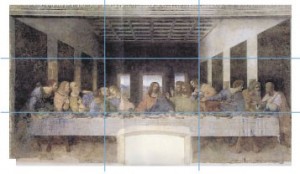
    So getting back to the Rule of Thirds — according to some research, people’s eyes are naturally drawn to where the grid lines intersect. A painter can use this information to draw viewers into the painting, especially if there are surprising elements or those that should have more emphasis. Take a look at Da Vinci’s The Last Supper.

    Image courtesy of Atelier Mends

    Notice how the table itself sits along the bottom horizontal line. The left vertical line crosses Judas, Peter and John, and the right vertical line crosses Thomas, James and Philip. Interestingly, the greatest tension in the piece is at these two points, while Jesus occupies the exact center of the painting with a calm demeanor.  Whatever your religious beliefs are, the story this painting tells is furthered by Da Vinci’s use of the Rule of Thirds.

    In a couple of weeks, you’ll meet a photographer who probably also uses the Rule of Thirds in her work.  In the meantime, see if you can superimpose an imaginary 3 by 3 grid over your favorite paintings or photographs.  How does the Rule of Thirds draw you into the piece? How does it help you notice important or surprising details?

    Have you noticed the Rule of Thirds in paintings that you love?  Share your thoughts in the comments section!

  • Heading Back to Work: The childcare dilemma

    Photo courtesy of D Sharon Pruitt

    Every day, around the world, countless mothers (and quite a few fathers) are considering the same question: Now that my kids are older, is it time to go back to work?  The U.S. Census reported that there were 5 million stay-at-home mothers in 2010.  And the decision to forgo paid employment in favor of days filled with finger paint, potty-training and Mommy-And-Me playgroups is certainly rife with emotion and even debate.

    It’s also very personal, and not just because these choices reflect our unique sets of values.  The decision to be a stay-at-home parent — or to return to work — is a financial one.

    Let’s face it, if the family needs the money, going back to work sure beats sharing a one-bedroom apartment with three kids, a dog and a snoring partner.  Right?  But the math has to work out.

    That’s because for many parents, returning to work means paying for childcare — and anyone who has done this knows it usually ain’t cheap.  The good news is that the math involved is pretty simple.  You just need to take a little time to work it out.

    Jackie has three gorgeous kids, all under the age of 6 years old.  As the economy has worsened, her husband’s salary just isn’t going as far as it used to, and besides, she’d like to get back to her career as a pediatric nurse.  The doctor she once worked for called to see if she’d be interested in a part-time position at his practice.

    Financially speaking, is this a good idea?  Let’s look at the numbers.

    If she takes this position, she can earn $210 per day, after taxes, and she would be expected to work three days a week.  The practice doesn’t offer health insurance for part-time workers, but the family is on Jackie’s husband’s plan, so that’s a non-issue.  Other benefits are minimal, as there are no sick or vacation days and no retirement fund.  (She can switch schedules with another part-time nurse to cover any days she needs off.)

    How much can she expect to earn each week?

    $210 x 3 days = $630

    Jackie can’t bring her kids to work with her or let them fend for themselves.  Nope, she’s got to think about laying out some cash for childcare, and like most folks, Jackie has a somewhat complex situation to consider.  Her oldest is in half-day Kindergarten, so she only needs part-time care for her.  But her three-year-old twins need to be looked after all day.  While her mom would love to watch the kids, the eight-hour commute to her house just isn’t practical.

    Calling on friends and neighbors, Jackie considers her options.  Pretty quickly, her decision becomes clear.  Luckily, there’s a daycare center just around the corner from her daughter’s elementary school.  Even better, it offers part-time care.  And just down the street from Jackie’s house lives a woman who offers in-home care.  She places a few calls and learns that each place has openings.

    Still, she needs to crunch the numbers.  The daycare center charges $50 per day, for part-time care.  The in-home caregiver charges $175 per week, per child.  How much of a hit will Jackie take in her take-home pay?

    First, she needs to find the cost per week for her older daughter:

    $50 x 3 days = $150

    Next, she needs to find the weekly cost for her younger children:

    $175 x 2 = $350

    Finally, she adds the two together:

    $150 + $350 = $500

    So she can reasonably expect to pay $500 per week in childcare.  That means she’ll be taking home $130 each week.

    $630 – $500 = $130

    Yikes!  What looked like a great part-time salary is now looking pretty skimpy.  But there are two more calculations Jackie considers before freaking out: Her monthly and yearly take-home after childcare costs.

    $130 x 4 weeks = $520 per month

    $130 per week x 50 weeks = $6,500

    These numbers tell her that she can contribute more than $500 each month to the mortgage payment.  Or if her husband gets that promotion he’s looking at, they could put almost $7,000 towards their savings.

    There are also other financial benefits to consider.  For example, if Jackie keeps one foot in her career, she can get up to speed (and stay ahead of) changes in her field.  And if she’s already employed at the doctor’s office, she may be better positioned for a full-time job once the kids are all in school.

    Now Jackie only has to deal with the emotional decisions — which are pretty tough.  But with these figures, she can at least say for sure how her family’s budget will benefit in the short run.

    All you parents, what went into your decision to get back in the work force or stay at home? Did you do the math to figure out if it was financially worth it?  Or did the numbers show that staying at home was much more financially viable? Share your stories in the comments section.Save

  • Getting organized bit by bit

    Getting organized bit by bit

    “My house is a disaster.”

    How many times have you uttered these words or heard someone else say them?  You and they are not alone.  Getting organized is one of the most common New Year’s resolutions.  But like losing weight, it’s easier said than done.

    But how do you manage this daunting task? If you’re inclined to take a week off of work, with high hopes of a sparkling, organized home after five long days, you may want to reconsider.  If you’re not already organized, why would you want to spend so much time cleaning out your linen closet and kitchen cabinets?

    On this point, the experts agree: a little goes a long way.  So most suggest that devoting only 15 minutes a day to organization can yield big benefits.  Let’s take a look at the numbers.

    If you devote five days, for (let’s be generous) 10 hours a day, you’ll end up working 50 hours total, right?  (That’s 5 days x 10 hours or 50 hours.)  And you’d probably also have a sore back and a week’s worth of vacation lost to your label maker and plastic bins and lids.

    But what if you committed to 15 minutes a day, 5 days a week?  How much time will you have spent?

    15 minutes x 5 days = 75 minutes

    75 minutes ÷ 60 minutes = 1.25 hours (or 1 hour and 15 minutes)

    Gosh, I spend more time in a week figuring out what’s for dinner.

    So what if you started on January 1 and stuck with it throughout the month?

    There are 22 weekdays in January

    15 minutes x 22 days = 330 minutes

    330 minutes ÷ 60 minutes = 5.5 hours

    That’s less than the time it would take for you to watch the first two films in the Lord of the Ringstrilogy!

    So let’s take this a bit farther.  If you managed to keep this resolution for an entire year, how much time will you have spent organizing?  Let’s assume there are 250 workdays in the year.  (You’re not going to organize on a holiday are you?)

    15 minutes x 250 days = 3,750 minutes

    3,750 minutes ÷ 60 minutes = 62.5 hours

    So by devoting a mere 15 minutes a day to organizing, you can end up spending more time over the year than if you took a week off and worked on the task for 10 hours a day.  Plus, I guarantee you’ll be much more relaxed.

    But what can you accomplish in 15 minutes?  Here’s a short list:

    • Cleaning out your junk drawer
    • Going through seasonal clothes and deciding what to give away, toss or keep.
    • Alphabetizing your spice rack.
    • Culling through your kids’ artwork and filing or scanning special pieces.
    • Scanning your bookshelves for titles you’re ready to part with.
    • Setting up a spot for your mail, keys, purse and jacket.

    By the end of one week, you could have a tidy junk drawer, trimmed summer wardrobe, room on your bookshelves and a regular spot for your keys.  By the end of the year?  Who knows what you could accomplish!

    Have any organizing tips to share?  Post your ideas in the comments section.  I’ll bet I (or someone else) can find the math in that technique!

  • Using Math to Wrap Gifts

    Using Math to Wrap Gifts

    My shopping is done.  I’ve got no more baking to do.  And save one, all of the great holiday parties are wonderful memories.

    But I still have this stack of gifts to wrap.

    I figure there are two kinds of people in the world: those who painstakingly dress each gift with crisp paper and color-coordinated bows; and those who haphazardly slap on some paper and call it a day.  I’m not so precise about most things, but you can put me in the first camp as far as gift wrapping goes.

    Still, I’m mighty lazy.  I don’t measure out paper or use double-sided tape.  Instead I use a little bit of geometry to get my gifts just right.  It’s not hard at all.

    The trick to a perfectly wrapped gift is to have just enough — not too much and not too little — paper to cover the package.  And to do that, use a box, if the item is oddly shaped.

    Now consider the width of the box.  Line the box up on one end of the paper, like this:

    And then turn the box up on the left edge, over onto the other large side and up again on the last edge, like this:

    You want to have some left over paper on the left.  This will overlap so that there’s no gap in the seam.

    Now you can look at the length of the package.  This is where things get a little tricky.  You need a little more than half the height of the package.  (I just eyeball it, but you can be more precise, if you want.)  You’re ready to cut.

    So your paper is cut.  (Did you notice that throughout that easy process, you thought about the width, length and height of the box?  That’s the geometry at work here, folks.)  It’s time to start wrapping.  Turn the box upside down onto the paper.  This way, the seam will be on the bottom of the box.

    Wrap one of the long sides of the paper over the box and secure with tape.

    Do the same with the other side, making sure that the paper is tightly wrapped around the box.

    Now it’s time to address the sides of the gift.  Fold down the top paper, so that it’s flush against the box.  If you’ve eyeballed your measurement correctly, the paper won’t be too long or two short.  Then fold in each side of the paper, making little angles.  Crease each one with your fingernail.  Then fold the last flap up, so that it looks like an envelope.  Use tape to secure that flap.

    The other side is much easier, because now you can put the box up on the side you just wrapped.

    Once everything is folded and taped up, use your fingernail to make sharp creases along each of the edges of the box.  Add a bow — I like using wired bows made of fabric, because they’re easy to manage, and I can reuse them again next year.  Ta-da!  The perfect gift!

    Do you have a gift-wrapping technique to share?  If so, tell us in the comments section.