Category: Math for Parents

  • Pizza Anyone? Introducing fractions (+ multiplying)

    Pizza Anyone? Introducing fractions (+ multiplying)

    Welcome to Week 2 of January’s Back to Math Basics — a quick review of the basic math that you need to do everyday math. Answers to last Friday’s integers questions are at the end of this post.

    When kids are first learning about fractions, teachers often turn to something that all but the lactose- or gluten-intolerant can appreciate — pizza! (And I can empathize with the allergy inclined. For you, imagine a dairy-free, vegetable pie with polenta crust — yum!)

    This is for very good reason: Fractions are simply parts of the whole. When you cut a pizza into 12 equal parts you are creating twelfths. To count them, you’d start at one piece and count around the pizza (or in random order, makes no diff): one-twelfth (1/12), two-twelfths (2/12), three-twelfths (3/12)… all the way to 12-twelfths (12/12) or the whole pizza (1). Half of the pizza is six-twelfths (6/12) or one-half (1/2). A fourth of the pizza is three-twelfths (3/12) or one-fourth (1/4). Get it?

    (Okay, so it’s really, really hard to write a blog post about fractions. In Word, I can depend on something call MathType to write fractions, which I’ll create for examples below. But in paragraphs, this doesn’t work so well.  So please bear with me!)

    It might make sense to start with addition and subtraction, but in this case, multiplication and division is the better start. (Spoiler alert: You’ll use multiplication to add and subtract. Really.) But just like with integers, multiplying and dividing fractions are really, really easy.

    So let’s go back to those pizzas. Let’s say your son is having a birthday party, and he wants to serve pizza. If each kid can eat 1/4 of a pizza and there are 12 kids at the party, how many pizzas do you need to buy? (Seriously, this is not as dorky a question as it might sound. I have had to figure this out IRL.)

    Are you actually multiplying two fractions here? Why, yes. Yes you are! In fact, any whole number can be written as a fraction — just use the number itself as the numerator (the top number in a fraction) and 1 as the denominator (the bottom number in a fraction). So…

    Now, here’s the multiplication rule. Just multiply the numerators together and then the denominators together.
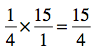
    How easy is that? But what does 15/4 really mean? This is called an improper fraction — which just means that it’s got a numerator that’s bigger than the denominator. But it has a much, much bigger meaning — improper fractions are bigger than one.

    How many pizzas is 15/4? Well this is easy too.

    Fractions mean division. So to turn an improper fraction into divide the denominator into the numerator. But 4 doesn’t divide evenly into 15. In fact, 4 goes into 15 three times, with 3 left over. (Or as your third-grade self said: 3, with a remainder of 3.)

    The whole number is the number of times 4 divides into 15. The remainder becomes the numerator of a fraction, and 4 stays in the denominator. Like this:

    Whew! What this is means is that you need 3 and 3/4 pizzas. I don’t know of any pizzeria that delivers in this way, so round up to 4 pizzas, and you should be good to go.

    That’s a lot of information. So here’s a quick summary:

    1. Any whole number can be written as a fraction. Just use the number as the numerator and put a 1 in the denominator.

    2. To multiply fractions, multiply the numerators together and then multiply the denominators together.

    3. To change an improper fraction to a mixed number, divide the denominator into the numerator. The whole number answer is the whole number in the mixed number. The remainder is the numerator, and the denominator stays the same.

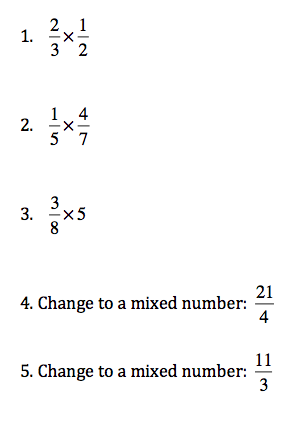
    Show me (or better yet, yourself) what you’ve got with these examples. I’ll have the answers in Wednesday’s post. Questions? Ask them in the comments section.
    Answers to Friday’s challenge questions: -30, -2, 5, 32, -14. How did you do?

  • Multiplying and Dividing — Integer Style

    Multiplying and Dividing — Integer Style

    Continuing on in our review of basic math, I welcome you to Day 2. The answers to Day 1 questions are at the bottom of the post — along with new questions. But first, let’s learn how to multiply and divide integers.

    Let’s say you have a bank account with a service fee of $15 per month. If that amount was deducted every single month, how can you represent the yearly amount for these fees? Well, you would multiply -$15 (the fee is negative because it’s taken out of the account) by 12 (the number of months in the year). But how the heck do you multiply negative and positive numbers? Let’s find out.

    Remember integers — those negative and positive numbers that aren’t fractions, decimals, square roots, etc.? I like to think of them as positive and negative whole numbers (though most real mathematicians would argue against that classification). On Wednesday, you learned how to add and subtract these little buggers. (Check out the post here, if you missed it.)  Today, we multiply and divide.

    Her’s the really good news: it is way, way easier to multiply and divide integers than to add and subtract them. First, though, it’s a good idea to understand how the rules work. When you first started multiplying numbers, you did things like this:

    2 x 3 = 2 + 2 + 2 = 6

    In other words “2 x 3” is the same thing as adding up three 2s. Get it? And because you started working with positive numbers when smacking a girl upside the head meant you “like-liked” her, you know without a shadow of a doubt that the answer is positive.

    Let’s see what happens when you multiply a negative number by a positive number:

    -2 x 3 = -2 + -2 + -2 = -6

    Now to understand this, you need to either pull up your mental number line and count or remember the addition rules from Wednesday’s post. When you add two numbers with the same sign, add the numerals and then take the sign. So -3 + -3 is -6.

    But what about multiplying two negative numbers? Admittedly, this is a little trickier to explain. It helps to look for a pattern using a number line. Let’s try it with -2 x -3.

    -2 x 2 = -4
    -2 x 1 = -2
    -2 x 0 = 0
    -2 x -1 = ?
    -2 x -2 = ?

    Based on the pattern shown on the number line, what is -2 x -1? What is -2 x -2? If you said 2 and 4, you are right on the money.

    And now we can summarize the above with some rules. Believe me, this is one math concept that is much, much easier to remember with the rules. Still, if knowing why helps anyone get it, I’m all for pulling back the curtain.

    When multiplying integers:
    If the signs are the same, the answer is positive;
    If the signs are different, the answer is negative.

    Bonus: The same rules work for division. That’s because division is the inverse (or opposite) of multiplication.

    When dividing integers:
    If the signs are the same, the answer is positive;
    If the signs are different, the answer is negative.

    The only tricky part is this: Sometimes it seems that if you are multiplying or dividing two negative numbers, the answer should be negative. It’s a trap! (Not really, but you could think of it that way, if it helps.) The key in multiplying and dividing integers is noticing whether the signs are the same or different.

    In fact, if you are doing a whole set of these kinds of problems, you can simply run through the problems and assign the signs to the answers — before even multiplying or dividing. (I tell students to do this all the time, because I think it helps them to remember the rules.)

    4 x -3 → signs are different → answer is negative
    -4 x -3 → signs are the same → answer is positive
    -4 x 3 → signs are different → answer is negative
    4 x 3 → signs are the same → answer is positive

    Then all you’d need to do is the multiplication itself:

    4 x -3 = -12
    -4 x -3 = 12
    -4 x 3 = -12
    4 x 3 = 12

    And like I said, division works the same way:

    -24 ÷ -2 = +? = 12
    24 ÷ -2 = -? = -12
    24 ÷ 2 = +? = 12
    -24 ÷ 2 = -? = -12

    Got it? Try these examples on your own.

    1. 5 x -6 = ?

    2. -18 ÷ 9 = ?

    3. -20 ÷ -4 = ?

    4. 8 x 4 = ?

    5. -2 x 7 = ?

    Questions? Ask them in the comments section. Up Monday are fractions. If you can’t remember how to add, subtract, multiply or divide fractions or mixed numbers, tune in. 

    Answers to Wednesday’s “homework.” (It’s not really homework, I promise.) -10, -4, 2, -15, -2. How did you do?

  • Pluses and Minuses: Adding and subtracting integers

    Pluses and Minuses: Adding and subtracting integers

    Welcome to Day 1 of our tour of basic math. If your New Year’s Resolution is to brush up on your math skills. You’re in the right place. 

    Winter is really the perfect time to talk about integers.

    But first, what are integers? It’s quite simple, really. They’re positive and negative whole numbers. These are integers: -547, 9, 783, and -1. These are not integers: 0.034, -0.034, √3, and -1/2.

    You are very familiar with positive integers. For the first three years of your formal education, you probably worked exclusively with these little buggers — or as you called them, “numbers.” You learned to count them, tell time with them, add/subtract/multiply/divide them, and even write them out as words.

    (Soon after, you learned about fractions and then decimals, which are not integers, but are still positive, so it was all good.)

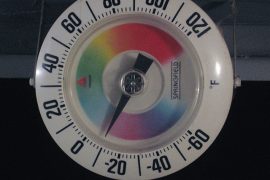
    If you’re like me, the part that completely blew your mind was when you first learned that numbers could be negative. Now that I think back, this was kind of a silly surprise in my world. I grew up in an area of the United States that gets pretty cold in the winter. This means two things: we measured temperatures with Fahrenheit and the temps got below zero. And those two things pointed to negative numbers. Duh.

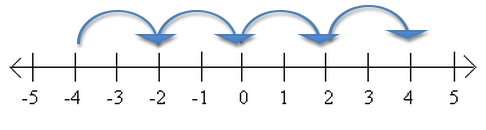
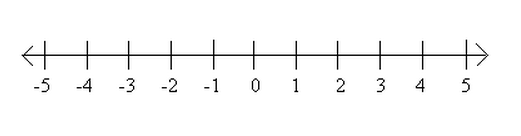
    Regardless, with a lot of work and determination, I finally understood integers, which included adding and subtracting negative and positive whole numbers. But before I show you how this is done, let’s take a look at the number line, which can help you visualize how this works.

    The number line isn’t a real thing. It’s just a way to visualize how numbers work. And the key is the zero in the middle of the line. Notice what happens on the right — the numbers get larger, one by one, right? And what happens on the left? Yep, they get smaller.

    Did you get that smaller part? If not, don’t worry. You’re just a little rusty. See, when two numbers are negative, the smaller one actually has the larger numeral. In other words -37 is smaller than -1, while 1 is smaller than 37.

    (This is a good time to note something else that you may have forgotten. If a number has no sign, it is positive. The positive sign, +, is understood.)

    If you can picture a number line, you can add and subtract integers, no problem. Here’s how:

    -1 + 3 = ?

    Start at -1 and count three places to the right. We’re counting to the right because we’re adding. What is the number on the number line? If you said 2, you’re right on target.

    4 – 5 = ?

    This time start at 4 and count five places to the left. That’s because we’re subtracting. What do you get? If you said -1, give yourself a gold star.

    So this number line thingy is pretty cool, but it’s not all that useful if you need to find an answer pretty quickly. And what happens if the second number is negative? (Well, you change direction, actually, but that’s pretty clunky and somewhat confusing. So how about if we find another process?)

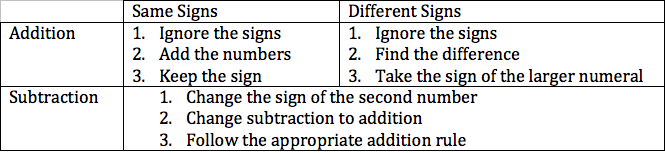
    Once you understand the why of adding and subtracting integers, you can learn an algorithm that works every single time. It goes like this:

    This is much easier to understand with an example:

    -10 + 4 = ?

    We’re adding two numbers with different signs. That means we need to ignore the signs, find the difference and take the sign of the larger numeral. But what does “find the difference” mean? It’s pretty simple, actually. Just subtract the smaller number (without the sign) from the larger number (without the sign). 10 – 4 is 6, and if we take the sign of the larger numeral, the answer is -6.

    Another way to think of “difference” is the distance between the two numbers on the number line. So if you got back to the number line, it’s a matter of counting spaces between the two numbers. Then take the sign of the larger numeral. Make sense?

    -10 + 4 = -6

    Okay, let’s try a subtraction example.

    -3 – 9 = ?

    First step is to change the subtraction to addition and change the sign of the second number.

    -3 + -9 = ?

    Now all you need to do is follow the addition rule for numbers with the same signs. That means to ignore the signs, add, and keep the sign.

    -3 + -9 = -12

    So, no need to pull out a number line for these. Just practice with these rules, and you’ll have them down in no time at all. Here are a few additional examples to help you.

    5 – 8 = 5 + -8 = -3

    -7 – 4 = -7 + -4 = -11

    3 + -3 = 0

    -12 + 8 = -4

    Now, try these out on your own. I’ll post the correct answers on Friday. And if you have questions, ask them in the comments section.

    1. 15 – 25 = ?

    2. -7 – -3 = ?

    3. 10 + – 8 = ?

    4. -3 – 12 = ?

    5. -6 + 4 = ?

  • Christmas by the Numbers

    Christmas by the Numbers

    There’s a lot more to this time of year than the 12 days of Christmas, 3 wise men or 5 golden rings. Between digging out our credit cards and stringing hundreds of twinkly lights on the gutters, most of us have more numbers than sugar plums dancing in our heads.

    And so, I bring you Christmas by the Numbers, a round up of interesting statistics about this huge holiday.

    93: Percent of Americans (in 2008) who say they celebrate Christmas

    81: Percent of Americans (in 2008) who identify with Christian faith

    $427 million: Predicted sales of Christmas cards in 2012

    4.1: Percent that holiday sales are expected to rise in 2012 over the previous year

    12: Percent that online holiday sales are expected to rise

    625,000: Predicted number of seasonal workers expected to be hired this holiday season.

    25-30 million: Number of real Christmas trees sold in the U.S. each year

    7: Average growing time (in years) of a six- to seven-foot tall Christmas tree

    4,000: Number of Christmas tree recycling programs across the country

    749.51: Dollars expected to be spent on gifts, decor and cards by the average holiday shopper this year

    60: Percent of holiday shoppers expected to “self-gift”

    1: Rank of gift cards in list of popular Christmas present requests

    10: Percent chance of a white Christmas in my city (Baltimore, MD)

    Any statistics that you’d like to see? Share your ideas in the comments section. Happy holidays!

  • Last-Minute Gifts for Geeks and Not-So-Geeks

    Last-Minute Gifts for Geeks and Not-So-Geeks

    I don’t know about you, but I’m still pulling together some gifts — with less than a week before Christmas. Each year, I try to get done before December, but no dice. I must love the stress.

    So, if you’re still looking for a little giftie or two for the geek — or geek-lover or geek-wannabe? — in your life, here are some ideas.

    Mathletic Department Hoodie

    I am not an athlete. Not by any stretch of the imagination.  But even I would wear this hoodie. It’s the perfect mix of geek and cool. Well, at least I think so.

    From Cafe Press.

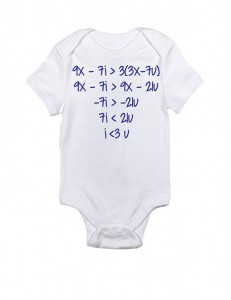
    Math Love Onesie

    It might take you a moment to see the beauty of this design. I’ll wait.

    Get it? Even if you can’t follow the solution to from start to finish, the last line is perfection. (Must speak internet.) And while you’re baby is sporting this fashionable accessory, you can review solving inequalities.

    Made by Skyhawk Press, Monterey, Cal. Available on Etsy.

    Number Cookie Cutters

    Because how else can you make a π pie? I have a set like these, and while they’re terrific for really geeky cookies, they’re also great for making cute kid-party sweets — Like a bunch of 3s for a three-year old’s party. They’re also handy when you need number “stencils.”

    Available at Barnes and Noble (order online and pick up at the store).

    Tiffany & Co. Infinity Bracelet

    Splurge for the platinum with diamonds or stuff her stocking with a more moderately priced bobble in sterling silver. Either way, you’re telling her that you mean forever in a delightfully geeky way.

    Available at Tiffany & Co.

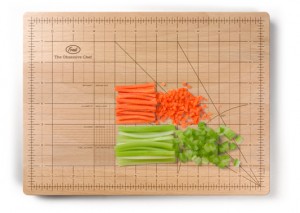
    Obsessive Chef Cutting Board

    We all have one in our families or among our friends: the home chef who cooks with the precision of a surgeon. And finally, here’s a cutting board they can truly appreciate. With guidelines for julienne, chop and mincing — and even including curves and bias marks — veggies have never been so perfectly prepared.

    Made by Fred & Friends.

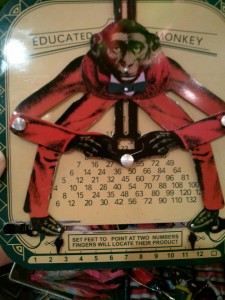
    Consul the Educated Monkey Calculator

    This has to be my very favorite find of the holiday season. A reproduction of a 1916 toy created by William Robertson, this little piece of tin can find the product of two numbers in the shake of a tail. Give it to a particularly precocious child and ask him or her to figure out why it works. (Hint: It’s all about the triangles.)

    Available at local gift shops and online.

    Need more ideas? Check out last year’s list, which offers ideas specifically for kids.

    And if you’re in the market for something funny and useful, check out my book, Math for Grownups, designed to ease the fears and pain of even the most resistent math-phobe. Promise. (Available online, at local independent bookstores and Barnes & Noble.)

    Do you have gift ideas to share? Please post about them in the comment section. (I still have a few things to pick up myself!)

  • Tis the Season to Give Generously: Do the math first

    Tis the Season to Give Generously: Do the math first

    Yesterday afternoon, I dropped off the gifts I had purchased for a mother and son who are spending the holidays in a women’s shelter. He’s not even three years old, and he’s already had a much rougher life than I. But at least this year, he’ll have a Little People fire truck and new set of ABC and counting board books.

    I don’t share this story to toot my horn. Plenty of people do as much or more than that each year. And I’m guessing their motivation is the same is mine — it feels good to give.

    At the same time my math brain loves some guidelines. I grew up Lutheran, and I was expected to tithe 10% of my allowance. It was a great practice to get into, but now that I’m not a tithing church-goer, I miss having a formula. How much giving is “enough”? How can I know if I’m pushing myself enough?

    Last year, I came across Peter Singer, who developed a really wonderful set of formulas based on a variety of different incomes. I wrote about it last fall, and I thought I point you to it today — in case you didn’t see it or need a reminder.

    The Math of Generosity

    No matter what holiday you celebrate in December, the month has traditionally marked a time for charitable giving.  The weather is growing colder in some areas, making it much tougher on the homeless.  The end of the year is creeping up, and with it the deadline for tax exemptions for charitable giving.  And holiday cheer often means counting our blessings and remembering those who are less fortunate.

    Yes, December is the time for giving.  But how much is enough? And what is too much?  As we attempt to balance our own needs (especially in these difficult economic times), many of us struggle with our own sense of guilt and generosity. Read the rest of this post.

    Do you have a formula for developing your yearly contributions? Share it — or your thoughts about using math to make charitable giving decisions — in a comment.

  • Hanukkah by the Numbers

    Hanukkah by the Numbers

    Tomorrow, at sundown, marks the beginning of the Festival of Lights or Hanukkah (or Chanukah, Chanukkah or Chanuka). By most standards, this is not a significant holiday for those who practice Judaism, but it is fun for the kids — oh and the latkes! (Until this morning, I did not know that it’s traditional to eat fried food during this holiday, to commemorate the miraculous oil that lasted eight days and eight nights. Learn something new every day.)

    [laurabooks]

    In honor of Hanukkah, I bring you some numbers that are important to this holiday. Enjoy!

    6.6 million: Estimated Jewish population in the U.S. in 2011

    2.1: Percent of the entire U.S. population in that year

    8: Days and nights of Hanukkah, and a number of days that a one-day supply of oil miraculously burned during the time of the rededication of the temple by the Maccabees.

    25: The day of the Jewish month of Kislev, on which Hanukkah is celebrated each year

    9: Including the shammus — or service — candle, number of candles in a menorah

    3: Number of blessings recited during the first night of Hanukkah

    2: Number of blessings recited during all other nights of Hanukkah

    30: Minimum number of minutes the Hanukkah candles should burn each night

    44: Total candles lit (including the shammus) overall eight days.

    4: Number of Hebrew letters inscribed on a dreidel

    92: Approximate number of years that American chocolatiers have been making chocolate gelt.

    4: Number of potatoes required for Debbie Koenig’s most delicious latke recipe. (My favorite one I’ve ever tried!)

    19: Number of celebrities mentioned in Adam Sandler’s Hanukkah Song.

    2: Number of those who are not Jewish

    What other numbers are important to Hanukkah? Share them in the comments section.

  • Time for Holiday Cookies — and Fractions

    Time for Holiday Cookies — and Fractions

    I haven’t started my holiday baking yet, but that time is just around the corner. Today, I bring you a post from last year, Cookie Exchange Math, in which I look at the fractions involved in tripling my cow cookie — yes, I said cow cookie — recipe. If you need to feed the masses, check out an easy way to manage those pesky and sometimes strange fractions that come from increasing a recipe.

    Ah, the cookie exchange!  What better way to multiply the variety of your holiday goodies.  (You can always give the date bars to your great aunt Marge.)

    The problem with this annual event is the math required to make five or six dozen cookies from a recipe that yields three dozen.  That’s what I call “cookie exchange math.”

    Never fear! You can handle this task without tossing your rolling pin through the kitchen window. Take a few deep breaths and think things through.

    To double or triple a recipe is pretty simple — just multiply each ingredient measurement by the amount you want to increase the recipe by.  But it’s also pretty darned easy to get confused, especially if there are fractions involved.  (And there are always fractions involved.)

    The trick is to look at each ingredient one at a time.  Don’t be a hero!  Use a pencil and paper if you need to.  (Better yet, if you alter a recipe often enough, jot down the changes in the margin of your cookbook.)  It’s also a good idea to collect all of your ingredients before you get started.  That’ll save you from having to borrow an egg from your neighbor after your oven is preheated.

    Read the rest here — and you’ll avoid fractions-related, messy kitchen mistakes.

    While you’re at it, check out this interview I did with fantastic candy-maker, Nicole Varrenti, owner of Nicole’s Treats. (I love her chocolate mustaches, personally.) It shouldn’t be any surprise that she uses math daily.

    Finally, if you have some holiday-related math questions, would you mind sharing them with me? What trips you up — mathematically — at this time of year? Comment below!

  • Thanksgiving by the Numbers

    Thanksgiving by the Numbers

    It’s turkey time here in the U.S. — the weekend we celebrate family, friends and all of the blessings in our lives. And since I’m certainly thankful for math (seriously!), I thought we should take a look at some interesting Thanksgiving numbers.

    391: The number of years since the first Thanksgiving

    90: The estimated number of Wampanoag tribe members who attended the first Thanksgiving

    1789: The year of the first “national day of Thanksgiving”

    40: The number of years that Sarah Josepha Hale advocated for an annual, national Thanksgiving holiday

    254 million: The number of turkeys expected to be raised in the U.S. in 2012

    6: The number of “home economists” who were hired to answer 11,000 phone calls for the Butterball Turkey Hotline‘s inaugural year in 1981

    50: The number hired to answer more than 100,000 calls last year.

    165: The number of degrees of a safely cooked turkey, according to the Federal Food and Drug Administration (FDA)

    768 million: Projected number of pounds of cranberries expected to be produced in the U.S. in 2012

    50: Percent increase in plumber calls and visits on the day after Thanksgiving, over any other Friday of the year

    43.6 million: Number of Americans expected to travel more than 50 miles during the 2012 Thanksgiving holiday

    90: Percent expected to travel by car

    25: Number of balloon floats in this year’s Macy’s Thanksgiving Day Parade

    How are you spending your Thanksgiving holiday? What math is involved? Share your responses in the comments section.

  • Saving Face: Avoiding performance math

    Saving Face: Avoiding performance math

    If there’s one thing most folks assume about me, it’s this: That I am some sort of mathmagician, able to solve math problems in a single bound — quickly, in public and with a permanent marker.

    Nothing could be farther from the truth.

    I don’t like what I call performance math. When I’m asked to divvy up the dinner tab (especially after a glass of wine), my hands immediately start sweating. When friends joke that I can find 37% of any number in my head, I feel like a fraud. I’m not your go-to person for solving even the easiest math problem quickly and with little effort.

    Truth is I really cannot handle any level of embarrassment. And I’m very easily embarrassed. I’m the kind of person who likes to be overly prepared for any situation. This morning, before contacting the gutter company about getting our deposit back because they hadn’t shown up, I had to re-read the contract and literally develop a script in my head. What if I misunderstood something and was — gasp! — wrong about the timeline or terms of our contract?

    Oh yeah, and I hate being wrong. About anything.

    In short, I’m not much of a risk taker. Unlike many of my friends and some family members, I can’t stand the thought of failing publicly. Imagine writing a math book with this hang up! Thank goodness for two amazing editors, who checked up behind me.

    I’m also not a detailed person. Not one bit. I’m your classic, careless-mistake maker — from grade school into grownuphood. I’m much more interested in the big picture, and I am easily lured by the overreaching concepts, ignoring the details that can make an answer right or wrong.

    For years and years, I worried about this to no end. How could I be an effective teacher, parent, writer, if I didn’t really care about the details or I had this terrible fear of doing math problems in public? What I learned very quickly in the classroom was this: Kids needed a math teacher like me, to show them that failing publicly is okay from time to time and that math is not a game of speed or even absolute accuracy. (It’s never a game of speed. And it’s frequently not necessary to have an exact answer.)

    Two weeks ago, as I sat down with my turkey sandwich at lunch, the phone rang. It was a desperate writer friend who was having some trouble calculating the percentage increase/decrease of a company’s revenue over a year. (Or something like that. I forget the details. Go figure.) She really, really wanted me to work out the problem on the phone with her, and I froze. I felt embarrassed that I couldn’t give her a quick answer. And I worried that I would lose all credibility if I didn’t offer some sage insight PDQ.

    But since I have learned that math is not a magic trick or a game of speed, I took a deep breath, gathered my thoughts and asked for some time. Better yet, I asked if I could respond via email, since I’m much better able to look at details in writing than on the phone. I asked her to send me the information about the problem and give me 30 minutes to get back with her.

    Within 10 minutes, I had worked out a system of equations and solved for both variables. She had her answer, and I could solve the problem without the glare of a spotlight (even if it was only a small spotlight).

    My point is this: Math isn’t about performing. If you like to solve problems in your head or rattle off facts quickly or demonstrate your arithmetic prowess at cocktail parties, go for it. That’s a talent and inclination that I sometimes wish I had. But if you need to retreat to a quiet space, where you can hear yourself think and try out several methods, you should take that opportunity.

    Anyone who criticizes a person’s math skills based on their ability to perform on cue is being a giant meanie. And that includes anyone who has that personal expectation of himself. There’s no good reason for math performance — well, except for Mathletes, and those folks have pretty darned special brains.

    Do yourself a favor and skip math performance if you need to. I give you permission.

    Do you suffer from math performance anxiety? Where have you noticed this is a problem? And how have you dealt with it?

  • Engineering tops highest-earning degrees — again

    Engineering tops highest-earning degrees — again

    With the economy still struggling along and a price of a college degree outpacing ordinary inflation, more and more personal finance experts are suggesting that students choose a major based on its earning potential. And true to form, this year’s American Community Survey data shows that STEM (science, technology, engineering and mathematics) degrees continue to promise much higher incomes than even business degrees. And so today, instead of interviewing someone about how they use math in their job, I thought I’d take a look at this data.

    In 2011, 59 million Americans (25 years and older) held bachelor’s degrees. The most popular degree is business (20%), with education coming in second (12%). In fact, those with business degrees were the most likely to be employed. But here’s where the rubber hits the road: those with engineering degrees continue to out-earn business majors by about $25,000 a year (based on median salaries).

    Yes, you read that right.

    And the hits keep coming (again, based on median salaries): those with mathematics, computer science or statistics degrees earn $13,000 more each year, as do those with physical science degrees. Even if a STEM degree holder was not working in that humanities degree holders were (naturally) at the low end of the earning potential, along with education,

    But money isn’t everything. Those in STEM careers are more likely be employed in full-time, year-round jobs. (Curiously, teachers aren’t considered year-round employees, which I think skews the data somewhat.) The mathy/sciencey types are also less likely to be unemployed.

    I am not one to suggest that someone get a degree merely for the earning potential. If you don’t want to be an engineer, don’t major in that field. It sounds a little woo-woo, but I firmly believe in the general idea that we should all be following our bliss (and being smart about what that means financially).

    Where I think this data matters — big time — is much farther down the educational ladder. Students who learn to love (or at least appreciate) STEM subjects are much more likely to consider these as a field of study. On the other hand, many of you can personally attest to the fact that it’s hard to fall in love with these subjects — and play catch up with the concepts and foundation needed to excel in them — when you’ve learned to hate them or have zero confidence in your abilities.

    In other words, the work starts in elementary and middle school. For students reach their real earning potential and for employers to find qualified experts for the jobs that they do have, we really must make STEM a priority in these grades. That doesn’t mean more testing or introducing concepts at a younger age. (In my opinion, those strategies are counterproductive.) It means finding truly gifted STEM teachers who are able to motivate their students and overcome our epidemic of mathematics anxiety and general apathy towards the subject.  It means approaching STEM subjects with excitement and a sense of discovery. It means encouraging, not discouraging, exploration in these subjects.

    So I ask you: What are you doing to help with this?

    Interested in how things broke down numerically? Here are a few median salaries from the American Community Survey:

    • Engineering, $91,611
    • Computers, mathematics, statistics, $80,180
    • Physical and related sciences, $80,037
    • Business, $66,605
    • Literature and languages, $58,616
    • Education, $50,902
    • Visual and performing arts, $50,484

    What do you think? Should college students choose a degree based on earning potential? Or should they “follow their bliss”? How can schools help students develop an interest in the fields that offer a higher earning potential? Share your comments!

  • Boo! Scaring up savings at Halloween

    Boo! Scaring up savings at Halloween

    I’ve admitted it here before: I’m a dedicated DIYer. Pinterest is a huge playground for me, and I scout craft shows for ideas I can try at home. Like most Martha Stewart wanna bes, I leave a lot of projects undone. It can turn out to be an expensive past time.

    After years of this back-and-forth, I’ve realized one important few thing: sometimes DIY is more expensive — in money and time. That’s why I included the following in my book, Math for Grownups. Yes, the example is based on my own, personal experience, except that the ending turned out differently. (The obscure character? Luna of Harry Potter fame.) Had I really thought it through before heading to Joann’s Fabric, I would have saved myself some cash and a lot of time.

    Rita loves Halloweʼen, and she loves making her kidsʼ costumes. This year, her 10-year-old daughter has requested a velvet-like cape and gown so that she can dress as some obscure character from her favorite novel about magical kids.

    The pattern Rita is using calls for 7 yards of fabric, 2 fancy fasteners, and 3 yards of fringe. Looking at the Sunday circular for the local fabric store, she sees that crushed panne velvet is on sale for $2.99 per yard and the fringe is priced at $4 per yard. Rita guesses that the fasteners are about $5 each. To estimate her costs, she adds everything together:

    (7 • $2.99) + (3 • $4) + (2 • $5)

    (In case you lost track, that’s 7 yards of fabric at $2.99 per yard, 3 yards of fringe at $4 per yard, and 2 frog clasps at $5 each.)

    $20.93 + $12 + $10 = $42.93

    A terrifying price!

    Rita is starting to think that a trip to a thrift shop might be a better investment of her time and money. Sometimes doing it yourself just isn’t worth it.

    Do you have any scary costume stories? How have you learned to save money while DIY and celebrating Halloween?