Category: Math for Parents

  • Math at Work Monday: Joe the Platform Consultant

    Math at Work Monday: Joe the Platform Consultant

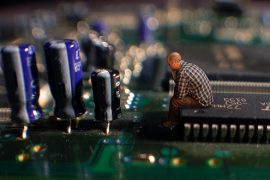
    In the IT field, there are many machines and programs that are really confusing and difficult to understand. Not only do we have to trust and depend on these machines, but also the people who service them. Joe Thompson is one of the good guys. He provides assistance to the users and companies when they need it most. From consulting to maintenance, Joe and his colleagues are there for us when our technology isn’t working quite right. (Joe is also one of my former geometry students. It’s been great to reconnect with him and see how accomplished he is now!)

    Can you explain what you do for a living?

    Red Hat’s consultants help customers get our products working when they have specific needs that go beyond the usual tech support.  We are essentially advanced computer system administrators on whatever our customers need us to be to get Red Hat’s products to work for them.  Common consulting gigs are setting up Red Hat Satellite to manage the customer’s servers, or doing performance tuning to make things run faster or a “health check” to verify things are running as efficiently as possible.

    We just put out a marketing video about our consulting for public-sector clients, actually:

    https://www.youtube.com/watch?v=eMzANG3Yhlk(We do more than just public sector and cloud, of course.)

    When do you use basic math in your job?

    The most common is when tuning a system to perform well, or configuring various things.  Unit conversions and base conversions are especially important.

    IT has a long-running math issue actually: does “kilo” mean “1000” (a round number in base 10), or “1024” (a round number, 10000000000, in base 2)?  There are various ways people try to indicate which is intended, like using a capital K vs. a lowercase k, or using KiB vs. KB.  This matters in a lot of cases because when you get up into large data sizes, the difference between round numbers in base 10 and base 2 gets pretty big.  A 1-TB hard drive (a typical size today, maybe even a little small) is a trillion bytes — 1000 to the fourth power, not 1024 to the fourth power.  The difference is about 10% of the actual size of the drive, so knowing which base you’re dealing with is important.

    Then there are units that have to be converted.  A common adjustment for better performance is tweaking how much data is held in memory at a time to be transmitted over the network, which is done by measuring the delay between two systems that have to communicate.  Then you multiply the delay (so many milliseconds) by the transmission speed (so many megabits or gigabits per second) and that gives the buffer size, which you have to set in bytes (1 byte = 8 bits) or sometimes other specified units.Sometimes software writers like to make you do math so they can write their code easier.  If a program has options that can either be on or off, sometimes a programmer will use a “bitfield” — a string of binary digits that represent all the options in a single number, which is often set in base 10.  So if you have a six-digit bitfield and want to turn off everything but options 1 and 6, you would use the number 33: 33 = 100001 in binary.

    Do you use any technology (like calculators or computers) to help with this math? Why or why not?

    I’ve always done a lot of arithmetic in my head and I can at least estimate a lot of the conversions without resorting to a calculator.  I’ll break out the calculator if the math is long and tedious though, like averaging a long column of numbers, or if I need a precise answer quickly on something like how many bytes are in 1.25 base-10 gigabits — I can do the billion divided by 8 and come out with 125 million bytes per base-10 gigabit, and then multiplying by 1.25 I know I’m going to be in the neighborhood of 150 million bytes, but I need the calculator to quickly get the exact answer of 156250000 bytes.  If I’m on a conference call about that kind of thing I’ll use the calculator more than otherwise.Google introduced a new feature a couple of years ago that will do basic math and unit conversions for you, so if I’m deep into things or just feeling lazy I can also just pull up a web browser and type “1.25 gigabits in bytes” in the search bar, and Google does it all for me.  But recently I noticed I was reaching for the calculator more, and arithmetic in my head was getting harder, so I’ve been making a conscious effort to do more head-math lately.

    How do you think math helps you do your job better?

    Without math, I couldn’t do my job at all 🙂 Even so little a thing as figuring out how long a file will take to transfer takes a good head for numbers.  As soon as you dig under the surface of the operating system, it’s math everywhere.

    How comfortable with math do you feel? Does this math feel different to you ?

    I’m pretty comfortable with math.  A lot of my off-time hobbies touch on computers too so it’s a lot of the same math as work even when I’m not working.

    What kind of math did you take in high school? Did you like it/feel like you were good at it?

    I took the standard track for an Advanced Studies diploma from grades 8-11 (Algebra I, Geometry, Algebra II, Advanced Math), plus AP Calculus my senior year, and always did well. I didn’t expect to like Geometry going in because it’s not one-right-answer like a lot of math, but I ended up enjoying the logical rigor of proofs.  (Though I do recall giving my Geometry teacher fits on occasion when my proofs took a non-standard tack…)

    Did you have to learn new skills in order to do the math you use in your job? Or was it something that you could pickup using the skills you learned in school?

    Most of it was learned in school, although base conversion isn’t something we spent a lot of time on.  I got good at it through long, frequent practice as you might guess…

    Do you have a question for Joe? Send me your question and I will forward it to him.

    Photo Credit: Dan Hamp via Compfight cc

  • Scary Statistics: Halloween by the numbers

    Scary Statistics: Halloween by the numbers

    For many folks along the East Coast, Halloween will (at the very least) be postponed, thanks to the very real terror of Super Storm Sandy. I know all of us keep these folks in their thoughts.

    And the rest of us? For the most part, tonight marks a very strange annual tradition here in the U.S.: going door to door in costume, asking for free candy. To mark the occasion, I’ve collected some scary statistics about the night of tricks and treats. Read at your own risk! Bwa-ha-ha-ha! (Um… that’s my attempt at an evil laugh.)

    170 million: The number of people who plan to celebrate Halloween in the U.S. (National Retail Federation)

    $79.82: The average spent on costumes, decorations and candy this year. (National Retail Federation)

    $113 million: The total value of pumpkin crops in the three top pumpkin-producing states (Agricultural Marketing Resource Center)

    1,818: Number of pounds weighed by the largest pumpkin on record. (Guinness World Records)

    15.2: The percent of costume ideas that come from Facebook. (National Retail Federation)

    15.1: The percent of people that will dress their pet in a costume. (National Retail Federation)

    0: The percent of pets that enjoy this tradition. (Just a guess)

    6: Number of times I went trick-or-treating as a “hobo,” because I was too lazy to do much else. (Personal data)

    268: The population of Skull Creek, Nebraska — named for “A LOT” of buffalo skulls and bones found in a nearby creek. (U.S. Census)

    1690: The number of pieces of candy that will fill an average-sized pillow case. (www.myscienceproject.org)

    41: The percent of adults who admit eating candy from their own candy bowl between trick-or-treaters. (National Candy Association)

    90: The percent of parents who admit stealing from their kids’ trick-or-treat stash. (National Candy Association)

    99.9: The percent of parents who actually steal candy from their kids’ trick-or-treat stash. (Just a guess)

    30: The percent of kids who sort their candy before digging in. (National Candy Association)

    0: Number of kids who would rather get a toothbrush than candy, while trick or treating. (Just a guess)

    Happy Halloween, everyone! Just one last word of warning: Watch out for the zombies. (Here’s how math can help you plan during a zombie apocalypse.)

    What are your Halloween plans?

  • Pre-Algebra on Facebook: How Mark Zuckerberg helped a frustrated parent

    Pre-Algebra on Facebook: How Mark Zuckerberg helped a frustrated parent

    Wednesday on Facebook, I had the most amazing experience. Suffering from an all-day migraine, I had spent the afternoon bored out of my mind, obsessively checking Facebook while the television droned in the background. At one point, this status update from my friend Alyson appeared in my feed:

    ALGEBRAAAAAAAAAAAAAAAAAAA!!! (Shaking fist angrily in air at math gods)

    I was Batman and here was the bat signal. How could I help?

    The first response was from someone I didn’t know and very typical: “Outside of college, you don’t really need it, right?” I rolled my eyes inwardly and thought about why Alyson might need to solve an algebra problem. Then I remembered her incredibly bright son, who is completely enamored with computers. I mean in love with the machines. I’d bet my last dollar that the boy will find himself programming or engineering or something in STEM as an adult. In other words, he would need algebra.

    I posted a few questions to see how I could help, and eventually Alyson posted the original equation to solve:

    algebra fractions equation
    fraction algebra
    fraction algebra

    Whew! It is a doozy, right? Alyson had one very specific question: how to handle the last term of the equation: . I told her the simple answer — that it was the same thing as . Still a teacher at heart, I wanted to see what she could do with that information. Was it enough to help her solve the problem?

    Meanwhile lots of other people were chiming in, and Alyson was expressing lots of feelings:

    And just so everyone knows, I suck at fractions. Always have, always will. When I took SAT and ACT and whatever else, I literally turned all fractions into decimals because I can never remember how to add, subtract, divide, multiply, etc. fractions.

    I’m close to crying…I still don’t understand what you’re saying. He worked the whole thing out at got what my online algebra check thing says is a wrong answer, and I’m trying to work it out so I can figure out how to get the RIGHT answer and I really do think I’m going to cry…

    Frustration cry. Because I didn’t think I’d ever use math. And I was wrong. For the record. Sorry, Mrs. Blankenship.

    This is a super smart lady. She edits college-level courses of all kinds, and she’s had a successful freelance writing career for many years. And I can completely identify with her frustration. I’d been struggling with Venn diagrams and conditional statements all day. No wonder I had a migrane.

    But then something really amazing happened. Really amazing. A mutual facebook friend and writer, Jody (owner of Charlotte on the Cheap) tagged us both in her status update:

    Do I have it right? Do I?

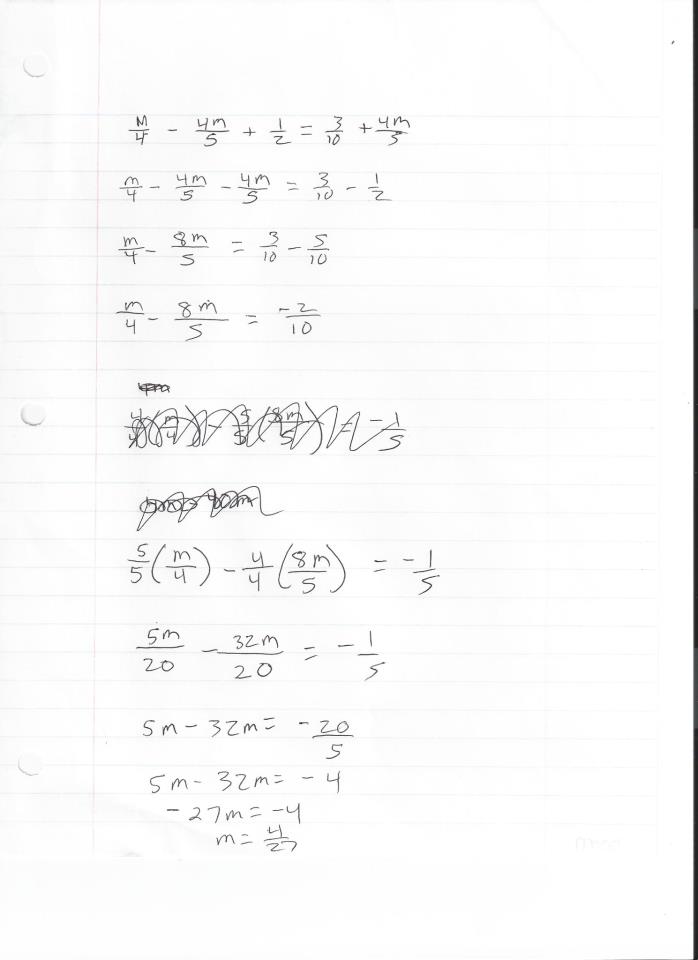
    She had attached this photo:

    At 6:15 on a Wednesday evening, she had not only worked out a challenging pre-algebra problem but also taken the time to scan it and post on Facebook. She was so excited. And, yes, she had gotten the correct answer.

    She had also done it differently than I did. But that’s not even the best part. Alyson saw Jody’s process and looked carefully — very carefully. She posted this:

    I worked through it on my own twice using your strategy, which ended up making a lot of sense to me once I talked it out a few times. So now I can explain it to [my son] and actually have a clue what I’m talking about. THANK YOU.

    Within an hour, another of Alyson’s friends had posted one more way to do the problem. It was a smorgasbord of solutions!

    But here’s the very best part: with all of these threads, there were very few people chiming in to say that they were too dumb to help or “who cares?” In fact, I saw many more people posting things like this:

    This I can do. Proof reading for grammar errors…….not so much!

    I will be glad to do some algebra when the time comes.

     I love math, call me, text me pictures!!!! I will PM you my number.

    Why WHY WHY are you having an algebra party without ME?! I love me some equations!

    It wasn’t a complete love-fest, but it was worlds different than I’m used to seeing. The tenor of the discussion was supportive and positive, rather than defeated. Sure, there’s was lots of frustration. And I’m betting that there were lots of people reading the threads and thinking, “Good god, I’m going to be in BIG trouble when my kid takes algebra.” But what played out in the end was a good experience — not just getting the right answer but learning different ways to approach the problem.

    I originally became a math teacher because I was convinced of two things: math is important and anyone can do math. For years, I’ve felt pretty alone in those two estimations — especially after leaving the classroom. Yet, here was a community of people who were working from the same premise, encouraging Alyson and excitedly trying out the problem themselves.

    I can’t think of a better way to end Back-to-School month at Math for Grownups. If you parents can express this enthusiasm — along with your frustration, if you have any — you’ll be doing your kids a big favor. It’s the pushing through and looking for ways to understand things differently that makes a difference. Imagine how much more empowered and confident our kids will feel if they get the message that math is important and that they can do it.

    What positive messages about math have you seen lately? Have you found ways to be more encouraging about math with your own kids? Share your thoughts in the comments section.

  • Forget the Ping Pong — Let’s Do Some Math

    Forget the Ping Pong — Let’s Do Some Math

    Today’s guest post is from Laura Overdeck, the ingenious creator of Bedtime Math. Don’t know what that is? Keep reading. And then go sign up for their daily email. You won’t regret it!

    As kids go back to school, it’s natural for parents to look at their bright-eyed offspring and wonder what they’ll go on to do in life. Chances are they’re hoping their kids will major in something substantial in college to lay the foundation for a great career. Unfortunately, that isn’t what we see happening: According to the National Center for Education Statistics, today more U.S. undergraduates are majoring in “leisure and recreation studies” than in all physical sciences combined (chemistry, physics, astronomy…you get the idea). And there are more than twice as many majoring in leisure studies as in math.

    Why does this happen? Why is our next generation running scared from the subjects that involve math? Can we make math the fun leisure activity that kids flock to do?

    The problem is that our culture doesn’t view math the way we view reading. Everyone knows to read to children from a young age, and most educated parents do. By the time kids get to kindergarten, even if they can’t read yet, they probably have a warm, cozy feeling about books. To them, reading is a leisure activity, an activity you do for fun when you have free time. Math, by contrast, doesn’t get the same warm, fuzzy introduction as the bedtime story. While there are plenty of magnetic number sets and 1-10 counting puzzles, for most families math at home stops as soon as the children reach toddlerdom. As a result, for a lot of kids their first real experience with math happens in school, with all the associations of homework, drilling and tests. That’s not going to make it feel like leisure. It feels like a chore.

    It’s no wonder, then, that kids start off on the wrong foot with their relationship with math.

    Kids should view math as fondly as they think about storybooks. While your child plugs away at the usually dry math material from school, it’s good to counter that with fun math at home as an antidote. By the way, that doesn’t mean forced, contrived set-ups where your child can see right through to your intentions. Luckily, there are plenty of fun activities ripe with “stealth” math that may be part of your day already:

    • Baking: Doubling recipes requires multiplying; cutting in half requires dividing; measuring 1/4-cups or 1/4-tsps uses fractions. Any time you bake, you’re quantifying ratios to make magic in the oven. Toddlers can participate by counting out chocolate chips, and of course eating them as a bonus.
    • Building: Anything that involves measuring gets kids counting, adding, and multiplying. Lego and other building toys revolve around numbers, too. And we all see how kids can entertain themselves with a bunch of cardboard boxes, especially if told they’re off limits. Cutting up pieces to assemble a fort all revolves around measurement.
    • Planning: For example, setting up party favors. They’re all sold in different quantities: 10 in one pack, 24 in another, 18 in a third. If there are 16 kids coming over, how many packs of each do you need, and what’s left over? Even putting out breakfast or dinner takes some planning and counting.
    • Sports and exercise: Kids love stopwatches, and watching the seconds tick off gives kids great exposure to counting. Distances and heights require measurement, and even counting jumping jacks, baseball swings, or the kicks to get a soccer ball to the end of a field, can involve numbers.

    All of these activities contain a ton of math as a natural part of the process, and this list is just a start. When kids get absorbed in a favorite activity, they don’t even notice they’re learning, just like when they read a bedtime story.

    To that point, math can become a part of bedtime as well. Six months ago I founded Bedtime Math, a free website that offers a fun nightly math problem every night – about electric eels, chocolate chips, zip lines into the neighbor’s pool.  Again, the idea is to take kids’ absolute favorite topics and sneak some math in there. After just six months we have over 20,000 people following us through the daily email, the website or Facebook, and parents have written that their previously math-resistant children now ask for Bedtime Math at night, thanks to this new spin on numbers.

    Again, it’s all about catching kids while they still think numbers are fun, and building on that mindset. By making math a fun part of favorite natural routines, kids will think of numbers as recreation instead of compulsory drudgery. When they enter school with that new world view, they will have an entirely different, incredibly positive experience with math at school. And with that foundation, maybe they won’t have to sink to majoring in leisure studies when they grow up.  They’ll major in math instead – for fun.

    Laura, you’re singing my song! The beauty of Bedtime Math is that it offers three levels of difficulty. Parents don’t have to try to figure out what they should expect their toddler to do or how difficult the math should be for their 2nd grader. And I guarantee — GUARANTEE! — that if you give this a try, you’ll find yourself injecting math all over the darned place.

    So what do you think about these sneaky math ideas? Are you ready to throw away the worksheets and flash cards? Have you figured out some easy ways to encourage your kids to do math — without their even knowing it? Share your ideas in the comments section.

  • More Sneaky Math for Kids: Guest post from Erin Flynn Jay

    More Sneaky Math for Kids: Guest post from Erin Flynn Jay

    When you’re balancing work and home and all sorts of other responsibilities, it can be downright overwhelming to consider doing everyday math with them, so they can perform well in school. That’s why I invited author Erin Flynn Jay to guest post on this very topic. Her recently published book,  Mastering the Mommy Tracktackles many of the questions all of us working parents have, and today she addresses math.

    How do your kids do with their math homework? Is it a struggle to get them to concentrate, or do they have a good handle on calculations?

    I grew up watching my mother tutor grammar school kids in math at our home. She was also a substitute math teacher at our local schools when I was in grammar school and high school. Because I am not a math whiz, I asked for her viewpoint on this blog post (she read this and offered a critique).

    Kids need examples, which will allow them to understand numbers better.

    — Beginning when they are toddlers, help them count their snack food like Cheerios or Goldfish from one to ten. It’s wise to get them counting at the earliest age possible.

    — When you take your kids grocery shopping, explain to them what your purchases cost. If they are learning how to add numbers in school, ask them for a total. You could ask them, “Okay we have this corn which is $2, chicken for $8 and lemonade for $2. How much money do I need? What is 2 plus 8 plus 2?”

    — Give your kids a weekly or monthly allowance depending on your budget. Take them to the pizza place or movie theater and ask them to pay for their purchase themselves. This way, they can understand the value of a dollar or 50 cents more easily. They can get change back and will get a better grasp of what their favorite items actually cost.

    — Finally, teach them how to measure their TV shows in 30 minute intervals. For example, you could say, “Alright, you can watch your show for 15 minutes before bedtime.” When the time is up, let them know 15 minutes has passed and it’s time to pack it in.

    One final suggestion is to check with your local librarian or bookstore–get recommendations for age appropriate math books. Read them one math book per night.

    When your kids sit down to do their math homework, they will perform better if you have introduced basic math concepts at the preschool age. Repetition will reap results.

    Erin Flynn Jay is a writer and publicity expert, with articles appearing in a diverse list of publications, including careerbuilder.comMSN Careers and Wealth Managers. Order her book Mastering the Mommy Track at Amazon.com or barnesandnoble.com

    Here at Math for Grownups, you’ve gotten a lot of ideas on how to sneak math into your kids’ everyday lives — from reading time to when you’re on the road. What suggestions have you tried? How have they worked out? I’d love to hear about your successes (and yes, failures)! 

  • The Problems with PEMDAS (and a solution)

    The Problems with PEMDAS (and a solution)

    If you’re on Facebook, you’ve probably seen one of a variety of graphics like the one above.

    The idea is to solve the problem and then post your answer. From what I’ve observed, about half of the respondents get the answer correct, while the other half comes to the wrong answer. The root of this problem? The order of operations.

    Unlike reading English, arithmetic is not performed from left to right. There is a particular order in which the addition, subtraction, multiplication, and division (not to mention parentheses and exponents) must be done. And for most of us old-timers, that order is represented by the acronym PEMDAS (or its variations).

    P – parentheses
    E – exponents
    M – multiplication
    D – division
    A – addition
    S – subtraction

    I learned the mnemonic “Please Excuse My Dear Aunt Sally” to help me remember the order of operations.

    The idea is simple: to solve an arithmetic problem (or simplify an algebraic expression), you address any operations inside parentheses (or brackets) first. Then exponents, then multiplication and/or division and finally addition and/or subtraction.


    But there really are a lot of problems with this process. First off, because multiplication and division are inverses (they undo one another), it’s perfectly legal to divide before you multiply. The same thing goes for addition and subtraction. That means that PEMDAS, PEDMSA, and PEMDSA are also acceptable acronyms. (Not so black and white anymore, eh?)

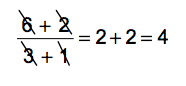
    Second, there are times when parentheses are implied. Take a look:

    If you’re taking PEMDAS literally, you might be tempted to divide 6 by 3 and then 2 by 1 before adding.

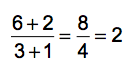
    Problem is, there are parentheses implied, simply because the problem includes the addition in the numerator (top) and denominator (bottom) of the fraction. The correct way to solve this problem is this:

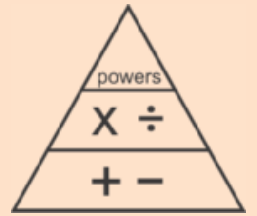
    So in the end, PEMDAS may cause more confusion. Of course, as long-time Math for Grownups readers should know, there is more than one way to skin a math problem. Okay, okay. That doesn’t mean there is more than one order of operations. BUT really smart math educators have come up with a new way of teaching the order of operations. It’s called the Boss Triangle or the hierarchy-of-operations triangle. (Boss triangle is so much more catchy!)

    The idea is simple: exponents (powers) are the boss of multiplication, division, addition, and subtraction. Multiplication and division are the bosses of addition and subtraction. The boss always goes first. But since multiplication and division are grouped (as are addition and subtraction), those operations have equal power. So either of the pair can go first.

    So what about parentheses (or brackets)? Take a close look at what is represented in the triangle. If you noticed that it’s only operations, give yourself a gold star. Parentheses are not operations, but they are containers for operations. Take a look at the following:

    Do you really have to do what’s in the parentheses first? Or will you get the same answer if you find 3 x 2 first? The parentheses aren’t really about the order. They’re about grouping. You don’t want to find 4 + 3, in this case, because 4 is part of the grouping (7 – 1 x 4).  (Don’t believe me? Try doing the operations in this problem in a different order. Because of where the parentheses are placed, you’re bound to get the correct answer more than once.)

    And there you have it — the Boss Triangle and a new way to think of the order of operations. There are many different reasons this new process may be easier for some children. Here are just a few:

    1. Visually inclined students have a tool that suits their learning style.

    2. Students begin to associate what I call the “couple operations” and what real math teachers call “inverse operations”: multiplication and division and addition and subtraction. This helps considerably when students begin adding and subtracting integers (positive and negative numbers) later on.

    3. Pointing out that couple operations (x and ÷, + and -) have equal power allows students much more flexibility in computing complex calculations and simplifying algebraic expressions.

    Even better, knowing about the Boss Triangle can help parents better understand their own child’s math assignments — especially if they’re not depending on PEMDAS.

    So what do you think? Does the Boss Triangle make sense to you? Or do you prefer PEMDAS? What to learn to solve these and other problems, buy the book that will help grown-ups like you with these and other math problems here.

  • 3 Ways to Turn Reading Time Into Math Time (Psst… You may be doing these already!)

    3 Ways to Turn Reading Time Into Math Time (Psst… You may be doing these already!)

    Yesterday, Karma Wilson stopped by to describe how she uses math in her work as a children’s book author. She’s the author of such wonderful best sellers as Bear Snores On and Bear Says Thanks. And she got me thinking about the days when I used to read her (and other’s) books to my daughter (who is almost a teenager now!).

    I guess because I like math and learned to incorporate numbers and math concepts into my everyday life pretty quickly, I naturally looked for the math hidden within each book I read to my daughter. But after having lots of conversations with other parents, I’m realizing that many don’t see the connection between literacy and numeracy. (Remember, numeracy is to math as literacy is to reading.) So I thought I’d share my ideas today in this special post.

    It’s not actually very difficult to bring math into almost any picture book. But perhaps parents think they should shoot for the stars — asking kids to add, subtract, multiply or divide. Unless that’s part of the plot, I’m guessing such ideas come off a bit forced. Or they may just suck all of the fun out of sitting down and reading with your child. So try these suggestions on for size.

    Count

    In Bear Snores On (illustrated by Jane Chapman), a hibernating bear is visited by a variety of forest animals who host a mid-winter party in his cave. The easy thing to do here is to count the animals. How many are there by the middle of the book? How many are there by the end of the book? When you count, point at each animal and say the number out loud. As your child grows, ask him to point and count.

    This process is a really easy way to reinforce something called one-to-one correspondence (or as we math geeks write, 1:1 correspondence). It’s so stupidly easy, that it’s hard to imagine kids aren’t just born knowing this. But the idea is that each animal in the book corresponds to a specific number. If you count the animals in the order that they appear in the book, the mouse will always be 1 and the raven will always be 7.

    Addition

    In Karma’s A Frog in the Bog (illustrated by Joan Rankin), the protagonist (yes, a frog in a bog) makes a very large meal of a variety of different critters in a variety of different numbers.  There is one tick, two fleas, etc. This is the perfect time to prompt some addition. After the frog eats the tick and both fleas, how many critters are there in all? Count them in the picture, again by pointing to each one and saying the numbers out loud.

    Tiny ones won’t necessarily learn to add simply by reading this book, but asking these kinds of questions can help lay the groundwork for an idea called counting up. In this process, when kids are adding two numbers, they start with one and count up using the second number. So 2 + 3 becomes 2, 3, 4, 5 — visually counting from 2 to 5 using fingers or something else concrete.

    Proportions

    Whopper Cake (illustrated by Will Hillenbrand) features a grandpa who is making a mighty big cake for Grandma’s birthday. From the title, we adults can predict that this cake is going to be huge, but your little one may not have those literary skills down pat. Guide him to that place by pointing out the sizes of things. The recipe calls for two cups of sugar, but Grandpa puts in 23 pounds of the sweet stuff. “Is that more or less sugar?” you can ask. Same with the eggs, which are increased from four to 84. Again, this may seem really basic, but young children (preschool and kindergarteners) are just learning about size comparisons. Until we teach them about bigger and smaller, they don’t have a clue.

    Bonus: Have your child play with measurements and follow an algorithm (or a set of steps) by making a Whopper Cake from the recipe at the end of the book.

    So, there you have it — a few ways to turn reading time into math time. These ideas don’t look so hard, do they? They should seem pretty darned simple. And they pay off, big time. Not only will your child be learning some basics about the foundation of numeracy and mathematics — he’ll likely pick up the message that math is everywhere and even a little bit of fun. Not even Bear should sleep through that!

    What are ways you’ve incorporated math into your kids’ nightly reading? Share your ideas in the comments section.

  • Math Homework: 5 important ways to help your kid

    Math Homework: 5 important ways to help your kid

    By 8:30 on Tuesday night, I was ready to go home and curl up with a good book. But there I was, crammed into a windowless computer lab with 25 other exhausted parents, listening to the new math teacher describe how math instruction would work this year.

    He described how the Common Core standards will change math education and showed off the fancy online curriculum that our school is lucky to have. Then he asked for questions — and the parents pounced. Poor guy.

    See, this fellow is exactly what students need. He’s tough; he’s smart; and he thoroughly understands a critical element of mathematics education: Kids have got to take risks that might not lead to a solution. Just like Sir Isaac Newton and Albert Einstein and Ada Byron Lovelace (yes, she’s Lord Byron’s daughter and the founder of scientific computing) went down long and winding roads to their discoveries, our kids must do the same.

    But the parents were having none of that. The homework that Mr. T is sending home each night is really challenging. Really challenging. My daughter was complaining and crying and slamming doors because of it. And I know we weren’t alone in our little nightly soap opera.

    As the parents got more frustrated and asked more and more questions about grading and building confidence and avoiding stress, I realized that they were missing the whole point. As parents, it’s not our job to shelter our kids from struggle and frustration. I was having a really hard time resisting the urge to step up to the front of the room and do some damage control.

    So I figured I should take this opportunity to share my ideas here. Fact is, Common Core may mean that your child is more frustrated. But there are ways to cope.

    1. Get proactive

    What do the Common Core objectives say? Well, they’re no big secret. Check out this grade-by-grade list. I want you to notice something really, really important: the list of concepts your child is expected to grasp by the end of the year is pretty darned short. At the same time, these ideas are pretty robust. The objectives cover less material and fewer facts, but they do so more deeply.

    Armed with some information about Common Core, you will be better able to set the parameters around what your child is learning at home. If solving for x is not on that list, don’t expect your child to do it. But if ratios are, it could be helpful for you to brush up on those concepts. (See Wednesday’s post for help on this.) But not so you can walk your child through a process. (Keep reading for more info on that.)

    2. Meet the teacher

    And at this meeting, don’t get hung up on grades and tests. Ask her what her teaching philosophy is. Ask what she wants you to do to help support your child’s learning. It is very possible that you’re making assumptions about your role. Depending on your child’s age, you might need to offer a great deal of help. Or you might need to back off. Your child’s teacher can tell you for sure.

    If your child has math anxiety, this is a great time to share that with the teacher. Sometimes even the best teachers inadvertently send messages to their kids that unnecessarily ups the anxiety. (Some struggle is good; too much can shut down the pathways of critical thinking.) Offering the teacher a little background in your kids’ previous math experiences can be really useful.

    3. Trust

    This is probably the hardest step, but unless you have really good reason not to, you must trust your child’s teacher. Seriously. In my observation, many parents think they understand everything about teaching, simply because they were once students.* That approach undermines teachers’ authority and ignores their education and expertise. It’s actually pretty insulting in some ways. Just because you can flush a toilet doesn’t mean you are a plumber. The same goes for teaching.

    Teachers are not just experts in their field of study (math, Spanish, English, science); they’re experts in pedagogy, which is the practice of teaching. And pedagogy is much more mysterious than trigonometry or set theory.  It’s where the science and art of teaching collide. The way in which topics are introduced and explored in the classroom is a careful dance. Sadly, some of this can be undone at home, during the homework wars.

    Unless you believe your child’s teacher is downright incompetent, you’ve got to trust that she knows what she’s doing. Chances are, there’s very good reason she sent home those challenging problems.

    *This goes for homeschooling parents, too. Anyone who has been successful with homeschooling will tell you that there’s a lot to learn about pedagogy — from the developmentally appropriate times to introduce certain concepts to proven ways to encourage exploration and discovery.

    4. Stop spoonfeeding

    Especially when kids enter middle school, we parents need to back off — big time. Yes, we want them to succeed. But what may be even more important is this lesson: failure is a part of learning.

    I don’t mean that you should be okay with a failing grade or ignore his bellowing, “I DON’T UNDERSTAND!!’ But at some point (very soon!), you must stop checking his assignments or walking him through each and every problem. You also need to endure his frustration. When children make mistakes, they can learn from them. When they struggle, they learn they can overcome adversity.When you swoop in to rescue your child from struggle and frustration, you are actually depriving him of these important lessons. (If you want your kid to live in your basement, rent-free, after graduation, ignore the above.)

    Check with your child’s teacher about the grading process for homework. Will he be expected to get the answers right? Or is the teacher merely expecting an honest effort? If effort is the main theme (and I hope it is!), quit trying to explain to your child how to do the work. Instead, offer support and encouragement. If you believe your child can succeed, he’ll believe it too.

    5. Get curious

    One of the best ways to get involved with your child’s education is to ask questions. Kids are rarely given an opportunity to verbalize what they understand about math. Curiosity is a is a huge gift you can give your kids. But in case you’re stuck, try keeping these questions in your back pocket for stressful times:

    — What do you know about the problem? (Encourages your child to think critically about the information included in the problem.)

    — What are you being asked to do? (Prompts the child to identify the question in the problem.)

    — If your math teacher were here, what would she say? (Demonstrates an alliance between yourself and the teacher, and gives you information about her expectations.)

    — What ideas do you have for solving the problem? (Helps students identify problem-solving techniques, like making a list, guess-and-check, drawing a picture, etc.)

    Read through the above questions again. What do you notice about them? Yep, not a one of them has anything to do with getting the answer. Not a single one. And that’s because it’s not your job to find the answer. Your job is to help your child move towards an answer, not solve the problem for him.And with questions like these, you’re helping your child see math as a process, not merely a solution.

    This is hard work. Even with my background in math education, I’m struggling with homework histrionics. It is no fun to come home from a long day at work, only to be pulled into an emotional tangle over math. But I will guarantee this: If you’re working with a good teacher and you practice the steps above, your child will learn to feel very confident in his math skills. And he’ll be a much better grownup for it.

    What do you think about this advice? Which of these steps are you already practicing? Which do you think are challenging to implement? Are there any that you think are downright wrong? Share your feedback in the comments below. And if you have further questions, ask them!

  • 5 Math Resources for Confused Parents

    5 Math Resources for Confused Parents

    So your kid needs some help with her math homework. Do you understand what she’s doing? Chances are, it’s not so cut and dry these days — and not because you don’t remember your middle school math lessons. Two things are going on in math ed: 1) concepts and processes are being taught differently, and 2) kids are getting more complex lessons earlier on.

    All of this may leave you feeling completely helpless.

    Luckily, there are some great resources out there that are there just to help you. Here are my top five.

    Your child’s teacher

    This is a really obvious idea, but not everyone thinks of it right away. Or maybe, like a lot of parents, you feel intimidated by the teacher or you don’t know how to ask for help. There are exceptions to the rule, but most teachers are eager to speak with parents, not only about their kids’ progress but about the best ways to help their child succeed. Find out how he or she prefers to communicate — email, phone or in person. Then use that resource as much as you possibly can.

    Online textbook resources

    Do you know what curriculum your child is using in math class? If not, find out, because today publishers are putting a wide-range of resources online — just for parents. This is especially true for discovery-based math programs, like Everyday Math and Investigations. The publishers of these programs know that they’re challenging for parents to grasp (since we learned very different ways of doing the math), so they’ve included very strong parent components.

    math.com

    This really simple website offers quick reviews of basic math ideas. Forgotten what a GCF is? You can find out here. Don’t remember how to solve for x in a proportion? This is a great place to start. Math.com also includes lists of formulas and some basic online tools, like a scientific calculator.

    Purplemath

    Focused entirely on algebra, purplemath is where you can find help with solving quadratic equationsor graphing linear equalities. Each concept includes a detailed lesson that walks you through the process and examples. Believe me, it’s been an invaluable tool for my addled brain!

    The Math Forum

    Ask Dr. Math has been around since 1992, so the site has amassed a wealth of questions from math students and answers from real-live math professors. Because it is generally focused on pedagogy (the concepts behind teaching mathematics) and higher-level math, it may seem a bit overwhelming. But if you search the archive, it is likely someone has asked the very question you have. You can also submit your own questions. But don’t expect an immediate response. This site is not designed for quick, individual feedback.

    So there you have it, my top five resources for parents with math questions. Got any others to share? If so please include them in the comments section. Sometimes we need all the help we can get!

  • X to the Power of Huh? Or, How Math Anxiety Almost Ruined My Life

    X to the Power of Huh? Or, How Math Anxiety Almost Ruined My Life

    I’m betting that many of you dear readers will identify with today’s guest post from Lisa Tabachnick Hotta. Math anxiety may still dog some of us, but it doesn’t have to ruin our lives. Read my guest post on her blog here.

    “Miss Tabachnick,” exclaimed my grade 8 math teacher.  “Please come up to the board and demonstrate how you obtained the answer to that equation; I’m sure the entire class will benefit from your explanation.”

    Sweat trickled its way from my brow to my toes. Show the class? Now? At the chalk board? Somehow I must’ve squeaked out the answer because I did graduate – from grade 8, then from high school and ultimately obtained two university degrees. (My majors, of course, had absolutely nothing to do with math!)

    Anxiety in all its sweaty glory – shaky hands, racing pulse, nausea – is pretty much the story of my life when it comes to math. Of course I’m rarely at a chalk (or smart) board deciphering mathematical problems these days as a writer, community volunteer and parent. But, you will often find me deep in “grownup” math conundrums.  Here are but a few examples:

    • Recently I was out for dinner with the girls and we were splitting the check. “Anne, you’re the accountant, you can figure out what we all owe,” I half-joked to one member of our group. She wasn’t amused. (Maybe it’s like the doctor who’s always getting asked for health tips at parties?) Her reluctance to assist me meant having to figure out not only what my drink, dinner and dessert cost but also my portion of the tax and tip – not at all easy for someone who’s math challenged!
    • My son who is (miraculously) gifted in math, asked me fairly simple questions in the car as a kind of numbers game: What’s 2 + 2, What’s 4 + 4, What’s 8 + 8, What’s 16 + 16, etc. Now, the first few questions? No problemo. But, as the numbers and queries got larger, I had to think harder to come up with the answers and, yes, that in turn increased my anxiety level.
    • Just today my kids and I were at a medical appointment. The administrator explained that receiving a response from the government to our query could take up to 30 weeks. I laughed along with the other adults who joked about government inefficiencies but, somewhere in my mind, I was still trying to figure out how many months equalled 30 weeks.

    All joking aside, being mathematically challenged has caused me enormous stress. From hiring tutors throughout middle and high school, to being told (by that same grade 8 math teacher) that I’d never amount to anything because my math skills were so poor, to ensuring that I am charging clients appropriate rates on invoices – I’ll be forever haunted by issues around math.

    So, how do I cope as a math-phobic adult? Luckily, I’ve learned to lean on my strengths – writing, communications and art. I also lean on calculators! Have you heard the expression, “fake it ‘til you make it”? I’ve also employed that strategy more than once. And, I’ve found that humor works well – I’ll just admit outright that math isn’t my forte and, while I’d be happy to volunteer as project manager or group leader, appointing me treasurer really isn’t the best idea.

    Lisa Tabachnick Hotta is a professional writer, editor, social media expert and researcher who lives just north of Toronto, Ontario. Lisa specializes on topics related to health, mental health, family, the arts and society. Check out her blog: KidsAndMentalHealth.com.

    What are your childhood memories of math anxiety? How does math anxiety influence your life now? How have you learned to get around it?

  • September: Back to School

    September: Back to School

    Got your sharpened No. 2 pencils? Graph paper? Protractors? It is definitely back-to-school time. Whether your little genius attends public or private school or learns at home with you, as a parent you can look forward to afternoons at the kitchen table talking about multiplication tables, coordinate geometry and trigonometry.

    Maybe this thought scares you a little. Maybe you are worried that you won’t be able to help your kid when she’s confused. Maybe you hate the way she’s taught math. Those are all great reasons to focus on math education this month. Throughout September, I’ll bring you posts that help boost your confidence and even understand the math your kid is doing. I’ll have guest posts about math anxiety— a huge problem for lots of kids (and adults) — and I’ll continue bringing you Math at Work Mondayinterviews, from people with cool jobs that your kids want to have.

    Have questions that you want to see addressed this month? Ask them in the comments section or send us an email. I’ll track down the answers, so that you can feel good about the math your kid is learning and your role in that process.

    To start off, let’s revisit some of the most popular Math for Grownups posts of all time. In this short series, I asked teachers, parents and kids what they wanted from each other when it comes to math education. And boy howdy, did they tell me! See if you recognize yourself in any of these lists.

    Five Things Math Teachers Wish Parents Knew

    Ten Things Students Wish Math Teachers Knew

    Ten Things Parents Wish Math Teachers Knew

    So what are you waiting for? Ask your questions in the comments section. Let’s get back to school!

  • Four Sneaky (And Fun) Math Resources

    Four Sneaky (And Fun) Math Resources

    For most of us, summer has wound down and school is either in session or just around the corner. The time for preventing summer brain drain is over. But you can continue to reinforce math skills with your kids (and even yourself!) no matter what time of year it is. Here are some really neat games, puzzles and books that help:

    Rush Hour

    As the video below shows, this game looks like it’s for little kids — but it’s not! I became obsessed with Rush Hour a few years ago, and I periodically bring it out to give myself a challenge. Additional cards can be purchased in expansion packages. Kids (and parents) can play alone or challenge one another to see who can get out of the traffic jam quickest! (Ages 8 years old and up, $19.99, ThinkFun)

    https://www.youtube.com/watch?v=-0RpbCZANto

    Sudoku

    If you’ve ever done one of these puzzles, you know that Sudoku doesn’t have much to do with everyday math. But they do reinforce pattern-identification skills, which is critical for basic math skills. These puzzles aren’t limited to numbers, either. For little kids (Kindergarten through first grade), try picture-based Sudoku. Or use a number Sudoku to help your child remember or learn his numbers.

    Connect the Dots

    For really little kids, this perennial favorite is a great way to reinforce counting numbers. But these puzzles aren’t just for tiny brains. Look for options that count by 2s or 10s or even consecutive prime numbers. Check out Monkeying Around for much more challenging designs.

    Set Game

    This is an oldie, but a goodie. The idea is to identify a “set” of three cards (from an array of 12 cards), based on four characteristics: color, shape, shading and number. It takes a while to get hang of this, but once players see the similarities and differences in the cards, the game can get really fast. Check out other games made by SET Enterprises. (Ages 8 years old and up, $12.99, SET Enterprises)

    https://www.youtube.com/watch?v=bMhJmrJVP4Q

    Books by Greg Tang  (Bonus suggestion, which wasn’t a bonus until a kind commenter pointed out that I didn’t count accurately. Oy.)

    Featuring an intuitive approach to learning and understanding math, Greg Tang‘s books aren’t contrived stories that have a math lesson. Each page is chock full of problem-solving skills that encourage kids to discover new connections in math. New York Times Bestseller, Grapes of Math centers around a series of math riddles that delve deep into kids understandings of grouping and creative addition processes. His website was just amped up with cool online games, too.

    Do you have a favorite game or book that sneaks in some math? Share it in the comments section!