Author: Math Expert

  • 5 Ways Pinterest Can Help Stop the Summer Slide

    5 Ways Pinterest Can Help Stop the Summer Slide

    I joined Pinterest last spring. I knew it was dangerous. The internet is like Alice’s rabbit hole for me — once I go down it, it’s near impossible to get back out. But I’ve found that I love using Pinterest. It inspires me and helps me stay organized. (One little click, and I’ve filed away an idea for later!) And because I’m a very visual thinker, I find that organizing my online life with Pinterest is much easier than using traditional bookmarks.

    I’m also a hopeless DIYer (hopeless in that I can’t stop trying these projects!), so my boards are filled with recipes, home projects and sewing ideas. And — you saw this coming — all of these require some math. I noticed that any one of these projects could be useful to a parent trying to stop the summer (math) slide, and I started collecting ideas.

    You can view my Stop the Summer (Math) Slide board here. (If you’re not following me on Pinterest, what’s stopping you?) Take my ideas to create a board of your own. Then add to it. I’ve outlined a few of my absolute favorites below. Please share yours in the comments section!

    1. Make a circle skirt.

    This was actually a Spring Break project that, thanks to MADE, I did with my daughter and some of her friends this spring. I’m particularly tickled with how MADE describes the math behind drawing the circle. (Suggestions: Unless you’re a very experienced sewer, avoid slippery fabrics. And if you have a serger, boy-howdy is that helpful!)

    2. Find your fuel economy.

    Your child can help you track your car’s miles per gallon. This site shows you how (and includes some other nifty tools). But really all you need to do is divide the number of miles traveled by the number of gallons used. (Remember: per means to divide.)

    3. Build a tomato trellis.

    I featured this project on my blog in June, but it’s well worth mentioning again. The beauty of this idea is that it brings in some higher-level math, like the Pythagorean Theorem and right angles. (But don’t worry, it’s not hard math.)

    4. Paint a room.

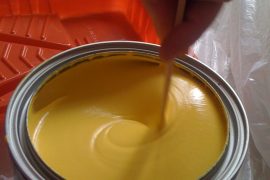
    Last year, my daughter wanted to repaint her room. I said fine, on two conditions. She had to figure out how much paint was required, and she had to help (a lot). This site shows, step-by-step, how to calculate the paint needed.

    5. Use coupons.

    In this economy, everyone needs to save some cash. Coupons are a great way to reinforce math skills, like estimation and basic operations.

    I’ll continue to add to this board, so check back from time to time and see what’s there. If you create something similar, please share it on the Math for Grownups facebook page or here in the comments section. I’d love to write another post later about what you guys have come up with!

    What are your favorite projects to do with kids? How is math involved? Share your ideas in the comments section.


  • Roll with It: Get Sneaky with Math

    Roll with It: Get Sneaky with Math

    I’ve written about this in a hundred different places, but it’s worth saying again: Parents know how to get their kids interested in reading. But in general, they don’t have a clue about math.

    If you had a child in the last 10 years in the United States, you probably heard somewhere along the way how important it is to read to said child every single day. I started reading to my daughter when she was only a couple of months old, partly to establish a bedtime routine (for the both of us) and partly because I wanted her to fall in love with books at a very young age. Reading with our children helps reinforce the parent-child bond and is a super-duper easy way to spark neurons that lead to mega brain development.

    And did I mention that reading to our kids is easy? And can be a lot of fun? (How many of us read Harry Potter aloud every night for a few years?)

    Sneaking in some math is a little more of a challenge for most parents. But I promise, it can be as easy — and is abso-tootin’-lootly as important as reading to our kids. Not only does math help our kids understand the world around them, but reinforcing the concepts kids learn at school helps counteract the summer slide or brain drain.

    But for a parent who isn’t so confident in his or her math skills, this prospect could be quite daunting. Or downright confounding. I could give you a list of ways to sneak in some math on a hot, summer day. But let’s see if you can come up with some ideas on your own. It all starts with a few questions:

    1. Think about your day from start to finish. Mentally go through it bit by bit, and see if you can come up with five ways you used math. How do you use math in your everyday life?

    2. Now, take one of those examples and consider the math. What process did you follow to solve the problem?

    3. Examine that process even closer. What math did you use in the process? 

    4. And finally think like your kid (not any kid, but your kid). How could you make your experience meaningful to your child? How would you explain the math that you did?

    Try this out for a few days. Write things down if you want or keep it all in your noggin. In other words, start noticing where, when, how and why you’re doing the math that you need to function in your everyday life. Think simple, not complex. Are you estimating how long it will take to get to work? Are you reading a clock to find out how late you are to your meeting? Are you figuring out how many pounds of beef you need to buy for the cookout? Are you thinking about how much you’ll spend on your vacation?

    Unless your child is itty-bitty, you can probably boil these things down to a level that he or she will understand. And now all you need to do is talk about these things.

    My favorite approach is to think aloud.

    “Boy, I’m late! I’m supposed to be at the office by 9:00, and it’s already 8:45. Let’s see, how late am I going to be if I leave in five minutes?”

    “Do you think it will take me less time to roll down this hill than you? Let’s find out!”

    My second approach is to ask my kid to help me. I usually claim being way too busy to handle everything on my own.

    “Could you do me a quick favor? I need to know how many hotdogs and buns I should buy for the cookout. We’re having 10 people over. The hotdogs come 8 to a package and the buns come 10 to a package. Could you figure it out for me, while I make the rest of my grocery list?”

    And lastly, I talk about math — just any old math.

    “I just noticed the other day that I never can remember what 6 times 7 is. So I figured out that if I multiply 5 and 7 and then add 7, I get the answer. Cool, huh?”

    I swear these things work with my kid. I’m not kidding. We talk about how we do math and we solve problems together. Sure, she still experiences some brain drain in the summer months, but I think all 12 year olds have a secret hole in their heads that allows far too much knowledge to fall out when they’re not in school. (And sometimes when they are in school.)

    So tell me what you think. What daily math do you do in a day? How can you repackage that math so that your kid can practice a little in the summer? Try it, and then share your experience in the comments section. Or just do some brainstorming. You come up with a math situation, and I’ll offer some suggestions for sneaking it in to time with your kids.

    P.S. If you haven’t seen Bedtime Math yet, check it out right now. Each day, three problems are posted — one for each of three age-groups — that addresses the math in a news item or a historical event. You could easily pose these questions to your kids. Ta-da! Work done for you!

  • Math at Work Monday: Ethan the game designer

    Math at Work Monday: Ethan the game designer

    Aaaaand we’re back with weekly editions of Math at Work Monday! This month, we’ll have lots of great interviews with folks who are in the kinds of jobs that kids say they want. This way, parents can tell their kids with confidence: “Yes, you will need math.”

    First up is Ethan Ham, who is a game designer and professor. Games he’s worked on include Sanctum and The Sims Online. In fact, he’s such an expert, he’s written the book on game design: The Building Blocks of Game Design (Routledge, May 2013). As you might imagine, game design is chock full of math — the kind of math that most folks don’t do regularly. Take a look.

    Can you explain what you do for a living? 

    A game designer is the person who plans out the rules for a game, whether it is a board game or a computer game. A game programmer is the person who takes the game design and implements it on a computer. I did both of these jobs professionally for about 6 years. While I still work on the occasional game project, these days I spend most of my time teaching game design (at the City College of New York, CUNY) and writing about it.

    When do you use basic math in your job?  

    The main math I use as a game designer include probability and algorithms.

    Any game that involves chance (such as the chance that a sword swing in World of Warcraft will hit) requires probability. It’s an odd branch of math and something that our intuition is often wrong about. When I teach game design, I always introduce probability by asking my students what are the odds that rolling two six-sided dice will result in at least one die coming up as a “6.” In the past 8 years I have never had a student guess the correct answer (11/36).

    (Editor’s Note: Ethan developed this dice simulator to help game designers quickly deal with probabilities. It’s very cool!)

    An algorithm is a like recipe for making a calculation. A lot of computer game design involves coming up with game mechanics in the form of algorithms.

    As a programmer, I largely use algebra, geometry and trigonometry. I don’t use calculus much, but would probably use it more often if I did games that involve modeling physics. Recently I used logarithms in some computer code that shifts the pitch of a sound.

    Beyond math, logic and problem-solving skills are incredibly important to game programming.

    Do you use any technology to help with this math?  

    Aside from the obvious need of computers to program the games, I often find myself searching the web to refresh my memory of how to calculate, for example, how to find the change in position based on an object’s vector.

    How do you think math helps you do your job better?

    It’s critical—I couldn’t do my job without it.

    How comfortable with math do you feel?  

    I’m comfortable figuring things out that I don’t initially understand (a characteristic of most programmers). So even though I don’t always have the math I need in my head, I can track it down.

    What kind of math did you take in high school?  

    Geometry, trigonometry, one semester of Advanced Placement calculus. I was reasonably good at it, but not the best in my class (except for probability).

    Did you have to learn new skills in order to do the math you use in your job? Or was it something that you could pick up using the skills you learned in school?

    Most of the math I learned in school, but I often need to re-learn it in order to put it to use.

    Do you (or your kids) have questions for Ethan? Ask them in the comments section, and I’ll be sure to let him know to come back and respond. But first, print out this quirky — and challenging — connect-the-dots picture that Ethan created. After reading the instructions on page 2, see if you (or your kid) can figure it out!

  • Algebra: Is It Too Hard for Students?

    Algebra: Is It Too Hard for Students?

    Earlier this week, Andrew Hacker, a political science professor at Queens College, City University of New York, opined in an essay for the New York Times that high schools should stop teaching higher Algebra concepts — because kids don’t get it.

    I’m sure Mr. Hacker isn’t alone in his frustration with the failure rates of students in these courses. (Trust me, math teachers are pulling their hair out, too.) Yes, math is hard. And it’s also the underpinning of our physical world. By pretending it doesn’t matter or that our future engineers, teachers, nurses, bakers and car mechanics don’t need it one eensy-teensy bit, we risk the dumbing down of our culture. And our students risk losing out on the highest-paying careers and opportunities.

    The problem isn’t the math — as Mr. Hacker eventually mentions, though obliquely. It’s how the math is taught. We need to get a handle on why students feel so lost and confused. And here are just two reasons for this.

    1. Kids don’t know what they want to be when they grow up — especially girls who end up in math or science fields.

    When I was in seventh grade, I thought I was a horrible math student. I was beaten down and frustrated. I felt stupid and turned around. Unlike my peers, I took pre-algebra in eighth grade, effectively determining the math courses I would take throughout high school. (I wasn’t able to take Calculus before graduating.)

    And that was a fine thing for me to do. Turns out I wasn’t stupid or bad at math. I just had a poor understanding of what it meant to be good at math. I had really talented math teachers throughout high school. I was inspired and challenged and encouraged. By the time I was a senior, it was too late to take Calculus, so instead I doubled up with two math courses that year.

    After graduation, I enrolled in a terrific state school and became a math major. Four years later, I graduated with a degree in math education and a certification to teach high school. And now, 22 years later, my job revolves around convincing people that math is not the enemy.

    What if I had been told that algebra didn’t matter? What if I had been shepherded into a more basic math course or track? Because higher level math courses were expected of me — and because I had excellent math teachers — I found my way to a career that I love. Even better, I feel like I make a difference.

    How many other engineers, scientists, teachers, statisticians and more have had similar experiences? How many of us are doing what we thought we wanted to do when we were 12 years old? Why close the door to discovering where our talents are? To me, that’s not what education is all about.

    Look, I can’t say this enough: I was an ordinary girl with an ordinary brain. I can do math because I convinced myself that it was important enough to take on the challenge. I was no different than most students out there today. We grownups need to figure out ways to hook our kids into math topics. I’m living proof that this works.

    2. Higher algebra concepts describe how our world works.

    How does a curveball trick the batter? How much money can you expect to have in your investment account after three years? What is compound interest?

    Students need to better understand the math in their own worlds. We do them a grave disservice when we give them problem after problem that merely asks them to practice solving for x. The variable matters when the problem is applied to something important — a mortgage, a grocery bill, the weather, a challenging soccer play.

    We can’t pretend that everyone depends on higher-level mathematics in their everyday lives. But neither can we pretend that these concepts are immaterial. Knowing some basics about algebra is critical to being able to manage our money or really get into a sports game.

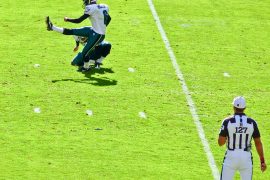
    For example, when the kicker attempts a field goal in an American football game, he is depending on conic sections — specifically parabolas. Does he need to solve an equation that determines the best place for his toes to meet the ball in order to score? Nope. But is it important for him to know that the path of the ball will be a curve, and that the lowest points will be at the points where he makes contact with the ball and where the ball hits the ground.

    That’s upper-level algebra at work. If you were to put the path of the football on a graph, making the ground the x-axis, those two points are where the curve crosses or meets that axis.

    What’s so hard about that?

    Look, we need to adjust the ways we teach math and assess math teachers. I agree that math test scores aren’t the be all, end all. I agree that most high school students won’t be expected to use the quadratic formula outside of their alma mater. (Though algebra sure is useful with spreadsheets!) And I agree that asking teachers to merely teach the concepts — without appealing to students’ understanding of how these concepts apply to their everyday lives — is draining the life out of education.

    And really, how much of the rest of our educational system is directly useful? Do I need to spout out the 13 causes of the Civil War or balance a chemical equation or recite MacBeth’s monologue? (“Tomorrow, and tomorrow, and tomorrow, Creeps in this petty pace from day to day…”) I can say with no hesitation: Nope! But learning those facts helped inform my understanding of the world. Algebra is no different.

    What do you think about the New York Times piece? Do you agree that we should drop algebra as a required course? In your opinion, what could schools do differently to help students understand or apply algebra better?

  • Back to School: Back to Math

    Back to School: Back to Math

    I remember the first week of my fifth grade year. I had a math worksheet for homework, and I was completely stumped.

    “I don’t remember how to do this stuff, Mom.”

    “What do you mean?” she said. “It’s just long division!”

    Yep, in three blissful months of summer vacation, I had completely forgotten to long divide. My mother, a teacher herself, was shocked. Brain drain can sneak up on even the pros.

    Being ready for school is much more than having a new backpack, plenty of No. 2 pencils and a healthy breakfast. Studies show that during the lazy months of summer, all kids suffer from “brain drain” or the loss of learning. In fact, students lose (on average) 2.6 months of mathematical competency in June, July and August. Wow!

    I promise: I will not tell any parents that they should be teaching math over the summer. I’m not big on academically based summer camps (unless kids desperately need remediation or love these kinds of activities). I hate the idea of kids being subjected to flash cards or worksheets when they could be playing at the pool or reading a great book.

    But I do believe — whole heartedly — that parents can help slow the loss of mathematic comprehension with some really simple and even fun activities.

    And that’s what August is about here at Math for Grownups. We’ll focus on parenting, primarily, but I’m guessing that even non-parents can gain some additional understanding from some of the activities I’ll suggest. (No one should feel left out!) I’ll also hit on a variety of grades and ages — from toddlers to college students. And I hope to bring you some Math at Work Monday interviews that will inspire even the most reluctant math student.

    But first, I want to know: What are your questions? What kinds of activities are you looking for? What topics are you having trouble helping your kids with? You ask ’em, and I’ll answer ’em — or at least point you in the right direction (perhaps to my posts at MSN.com’s Mom’s Homeroom).

    So let’s start easing back into the school mindset — so September is not a shock to anyone’s system!

    I want to hear from you! Ask your questions in the comments section or email me

  • Comparison Shopping: Get the best vacation deal

    Comparison Shopping: Get the best vacation deal

    t’s summer. It’s hot. I’m busy with 9 million things. And so today, I bring you an excerpt from my book, Math for Grownups. If you’re wondering how to figure out the best vacation deal for you, read through this example. A little bit of planning–and math!–can help you relax, while you’re saving some cash.

    Going on vacation means packing, finding someone to take care of Fido, and taking some time off from work. It also means charging some pretty hefty items on your credit card.

    The finances of vacationing can boggle the mind. And even with online trip planners and the ability to comparison-shop with the click of a mouse, planning a vacation can make you ready for another one.

    Red and Emily are ready for their second honeymoon. After 25 years of marriage, two kids, and the stress of everyday life, they deserve it. So Red is going to surprise Emily on their anniversary with a 1-week getaway to Aruba.

    For 5 years, he’s been secretly putting away a little cash here and there. He’s got $7,500 saved up, and that’s just enough to whisk his bride away for some R & R. (That’s romance and rest.) Red has even arranged for Emily to take some time off from work.
    But first he’s got to figure out how he can spend his vacation nest egg. After Emily goes to sleep, he cruises trip-planning websites looking for the best deal. And he’s very quickly overwhelmed.

    There are all-inclusive packages, non-inclusive packages, romance packages, and adventure packages. Some include the cost of flights and drinks and meals. Others offer some combination of these features.

    It’s going to be a long night.

    Within an hour or so, Red has some options scribbled down on a piece of paper. He has chosen their destination—a secluded resort with 5-star dining, access to a private beach, a spa, and great online reviews. Now it’s on to the pricing. There are a number of options:

    Because two of his options don’t include airfare, Red prices out some flights. He finds out that he can get two round-trip tickets for about $925. Not bad!

    If he chooses a non-inclusive option, he’ll need to pay for meals, drinks, and activities. And that requires more research. Red wonders whether there is a good way to estimate these.

    He considers meals first. The resort includes a free breakfast, so he won’t need to include that in his calculations. But unless they’re going with the all-inclusive option, they will have to buy lunches and dinners. Red does some more research and comes up with the following numbers:

    Average lunch → $25/person
    Average dinner → $60/person
    Average lunch → $25/person
    Average dinner → $60/person

    And because there are two of them, and they’ll be there for 7 full days:

    Lunches: $50 per day for 7 days = $350
    Dinners: $120 per day for 7 days = $840

    It looks like the cost of meals will be $350 + $850, or $1,190.

    He and Emily aren’t big drinkers, so that’s pretty simple to figure out. Assuming that the cost of drinks is pretty high, he guesses $25 a day for two fancy cocktails, and if they have a nice bottle of wine with dinner each night, that’ll run them about $200 for the week.

    ($25 • 7) + $200 = $375

    Now, Red thinks about activities. A day on a sailboat and some snorkeling sounds great ($450). Then he’d like to book a few spa treatments for Emily ($500).

    $450 + $500 = $950

    Because all of the prices so far have included tax, Red doesn’t no need to do any math for that. But he will need to tip the baggage carriers, taxi drivers, servers, and spa staff. Red takes a shot in the dark, and guesses $350 for all gratuities. (That could be too much, but it’s probably not going to be too little.)

    This is a ton of information, and Red’s legal pad looks like a football coach’s playbook. He’d better get organized if he wants to book this trip and get some sleep. Red decides to make a list.

    Package

    All-inclusive = $7,225

    Romance package: $6,150 (package) + $925 (air) =  $7,075

    Hotel + Travel: $4,340 (hotel/air) + $1,915 (meals/drinks/tips) + $950 (activities) =       $7,205

    A la carte: $3,450 (hotel) + $925 (air) + $1,915 (meals, etc.) + $950 (activities) =  $7,240

    Now Red can really consider his options.

    The most expensive choice is à la carte, but all of the totals are pretty darned close. If he goes by price alone, the clear winner is the Hotel + Travel package. But that requires him to handle everything on his own—and honestly, he’s ready for bed.

    On the other hand, the Romance package is only $70 more. And right now, that extra bit of cash seems worth it. Red pulls out his credit card and books their flights and vacation packages. Then he snuggles up next to Emily and savors his little surprise!

    How have you found the best travel deals? Share your ideas in the comments section.
  • Savings Tips from an International Traveler

    Savings Tips from an International Traveler

    I’m no big world traveler. So when faced with the prospect of filling an entire month with travel-related blog posts, I reached out to more experienced folks. Fellow freelance writer, Beth Hughes offered to write this post, detailing how she’s able to hop the globe on a limited budget. While there’s not a lot of hard math here, she does share a really smart estimation tip that helps her keep cash in her wallet–for her next trip. And you can definitely see how a little bit of planning and observation adds up to big savings. So, welcome Beth!

    When I travel, I usually head to pricey places like Japan, Hong Kong and Hawaii. Yet I’ve figured out how to make these trips without breaking the bank, even when the dollar is weak. The key is planning, observing, and a little mental trickery.

    Before you go

    Use a travel agent. Because I usually travel with a friend, my agent, Julie Sturgeon of Curing Cold Feet, creates custom group packages for us. Savings on our last 10-day jaunt to Hawaii were about $20 each, or a tank of gas. Some years, she saves us twice that.   Savings: $20-$40

    Decide how connected you must be. Free WiFi is not ubiquitous. Select a hotel with free WiFi so you can stay in touch via email and Skype if you have a smartphone or other device.  Savings: up to $20 per day

    Make sure you select a hotel that equips the rooms with an electric kettle and a refrigerator. Pack food for your arrival if you’re getting in late–small cans of pop-top tuna, packs of instant oatmeal, a little jar of peanut butter and some crackers. Pack coffee or tea, and any equipment for preparing it. Savings: about $10 per day

    Research the fees your bank’s ATM network, what it charges for ATM withdrawals and what service fee it tacks onto credit card purchases outside the United States. Your goal is to reduce the fee burden by withdrawing enough cash from an affiliated ATM to cover anticipated expenses for five or six days. You get a better exchange rate than you do at a moneychanger. In Tokyo recently, the airport moneychanger offered ¥71 for each US$1 while an affiliated bank’s ATM gave me ¥78. Stash the extra cash in your hotel room safe. Avoid using your credit card for a cash advance. The interest rates are punishing. Savingsup to $25

    Upon Arrival

    Buy a SIM card with the least expensive international call and data plan that you can top off online using a credit card. (In Japan, tourists must rent SIM cards.) The SIM card will be valid for as long as six months. You will probably leave money behind but compared with international roaming charges, it’s less than a pittance. Savings: up to $50

    After a good night’s sleep,  start saving by making breakfast in your room. While this is a traveler’s tip as old as the Appian Way I figure it saved us about $200 each on a recent Tokyo stay.

    Here’s how: Our budget hotel offered a daily breakfast buffet for ¥1,900 per person, or a whopping $208 per person if we had indulged for all nine mornings of our stay. So we traveled with a pound of ground coffee, which cost US$12, filters, a drip cone and our own tall, insulated travel mugs. That gave us each two cups of good coffee each morning with plenty left over for a boost if we returned in the afternoon before setting out on the night shift. We stocked up on individual yogurts, which averaged ¥100 each, spent about the same amount on fresh fruit and bought a pint of milk for coffee.

    Our breakfast total per person for nine days: about ¥2,000, or $25. We’re not big breakfast eaters but if we could have added in bags of granola (¥298 per) or boxes of cereal (¥350- ¥500) and still saved. Savings: $200

    Our trick for lunch in an expensive city is “Follow the office ladies!” They gravitate to good, cheap food. In Bangkok, I ended up in a utility company cafeteria that welcomed anybody who could find it, just by trailing office workers. On weekends, follow the middle-aged ladies traveling in pairs for a meal out with good chat on the side. Rarely did lunch in Tokyo cost more than $10 or $12. Wherever we ended up, and it was never a food court, we would order one of the lunch specials, always and everywhere the cheap date of meals. By making lunch the main meal of the day, we were then free to indulge ourselves with happy hours or splash out with a dainty dinner at a big-name joint. Savings: $200

    Mind Trick

    Now for my mind game, and yes, I am dim enough to trick myself by rounding down when making mental currency conversions(Editor’s note: I don’t think this is dim at all–but a pretty darned smart use of estimations!)

    Here’s how it worked on a trip to Hong Kong, where the exchange rate has been stable for the past 10 years: US$1 converting in a narrow range to HK$7.8 to HK$7.6.

    Rather than deal with decimals, I divided a price in HK dollars by US$7. This made everything from menu selections to a pink leather wallet that caught my eye seem more expensive than they were. So much for splurging in a notorious paradise for food and fashion.

    I also set a daily budget. If I came in under, I didn’t automatically roll the money over to the next day. I put it in a separate pocket in my wallet. Then, when a local friend suggested a Michelin-starred restaurant for lunch, I ponied up from my secret stash.

    Even with that magnificent meal, I returned home with US$279 of my budgeted travel kitty unspent. That’s a whisker less than half the cost of a ticket from the West Coast to Hawaii, and about one quarter the price of my next trans-Pacific flight. I’m thinking late November, early December before the holiday rush when the fares spike.

    Do you have questions for master traveler Beth Hughes? If so, please ask in the comments section. And share your own cash-saving tips for travel!

  • Beach Week: Splitting the costs for a week at the shore

    Beach Week: Splitting the costs for a week at the shore

    Each third week of July when I was a kid, my family headed down to Virginia Beach — with around 15 of our closest relatives. Along with sharing a large beach house, each family split the tab, based on the size of each family. No one got stuck with too large a bill and no one got away with a nearly-free vacation. As a child, the process seemed pretty simple, but as an adult, I know there was a lot of thought behind it all.

    The problem is that each family was of a different size. Mine had six people, while my Aunt Dottie only had two. So it wasn’t fair to add up the costs and simply divide by the number of families. Plus, little kids usually slept on the couch or in a sleeping bag on the floor, and they didn’t eat as much. Why should their parents pay as much?

    The key to this system was assigning a share to each person. Adults and teens were one share and kids 12 and under were a half-share. (I think infants were free; they don’t eat much shrimp at all.) Each share covered a place to sleep (or a fraction of the house rental) and food, which went into the kitty. On the first day, we went on a huge grocery store run to purchase all of the food for the week, using money from the kitty. Fresh corn, shrimp and other mid-week food purchases were also taken from the kitty. Any other expenses, like our one dinner out during the week, were covered out-of-pocket. Oh, and Grammy, the matriarch of the family, didn’t pay a dime.

    [laurabooks]

    But how did my parents and the other adults come to those shares? I don’t know for sure, but I can guess, based on what my addled brain remembers and what I would do.

    There were four families, all of the differing sizes. In fact, the family sizes changed from year to year, but let’s look at the last year I went to the beach:

    My family: Two adults, two teens and two under 12s or 5 shares

    Aunt Barb’s family: One adult, two teens and one under 12 or 3.5 shares

    Aunt Dottie’s family: Two adults or 2 shares

    Uncle Bud’s family: Two adults, three under 12s or 3.5 shares

    That means there were 14 shares in all. Once we figured out the cost of a share, we could find what each family owed. Make sense?

    Remember, the costs included rental and food.  Simple, right? In fact, since the money for the rental was due at different times (some upfront and the remaining when we arrived), it makes sense to have two different shares: one for the rental and one for food.  It was the 70s and 80s, but let’s look at today’s costs for this example.

    Rental total: $7,500

    Food total: $1,200

    But we can’t just divide by 4 to find the amount owed by each family. Gotta find the cost of each share. Since there were 14 shares in all, just divide.

    Rental: $7,500 ÷ 14 shares = $535.72 per share

    Food: $1,200 ÷ 14 shares = $85.72

    Note: I intentionally rounded up for a very good reason. It’s better to have too much than too little. If I rounded as I normally would (down for any value less than 5 and up for any value greater than 5), the person paying the tab would be short. Not fair!

    From there, we can figure out how much each family owes — based on the value of each share (rental and food) and the number of shares per family. All we have to do is multiply. Let’s just look at my family:

    Rental: 5 shares • $535.72 = $2,678.60

    Food: 5 shares • $85.72 = $428.60

    That means my family spent a total of $3,107.20 for our week at the beach (not counting travel and other costs). Not a bad deal for a big family!

    How has your family split the costs of a big vacation? Did you use a different process? Buy my books to learn math that you can apply to your everyday activities.

  • Back-to-School Shopping: Applying the order of operations

    Back-to-School Shopping: Applying the order of operations

    Last week, we had some fun with the order of operations at the Math for Grownups facebook page.* Turns out remembering the order that you should multiply, add, etc. in a math problem is a tough thing for adults to remember. Imagine how kids feel! But this is a really simply thing that you can apply to your everyday life — all the while, reminding your kid how it goes.

    First off, here’s the problem that we considered on facebook last week:2 • 3 + 2 • 5 – 2 = ?The answer choices were 38 and 14.I would say that the responses split pretty evenly. Lots of folks chose the incorrect answer first and then realized their mistakes.

    So what’s the correct answer? 14. Why? Because of the order of operations. A lot of us learned the order of operations — or the set of rules that establishes the order we add, subtract, multiply, divide, etc. — with a simple mnemonic:Please Excuse My Dear Aunt SallyORParentheses, Exponents, Multiplication, Division, Addition, SubtractionORPEMDAS

    (Before going further, I must acknowledge that there are some problems with this approach. First off, it doesn’t really matter if you add before your subtract or multiply before you divide. Those operations can be done in either order with no problem. Second, many teachers are approaching this differently, a topic that I’ll explore in September.)

    If you do the operations in the wrong order — add before you multiply, for example — you’ll get the wrong answer. And that’s how people got 38, instead of 14. They simply did the math from left to right, without regard to the operations.CORRECT2 • 3 + 2 • 5 – 2 = ?6 + 2 • 5 – 2 = ?6 + 10 – 2 = ?16 – 2 = 14INCORRECT2 • 3 + 2 • 5 – 2 = ?6 + 2 • 5 – 2 = ?8 • 5 – 2 = ?40 – 2 = 38

    All of this is well and good, but what does it have to do with the real world? How often are you faced with finding an answer to a problem like the one above? And that’s exactly what one reader asked me. So I promised to explain things using a real-world problem.

    Thing is, you do these kinds of problems all day long, without even thinking of the order of operations. And that’s because you’re not writing out equations to solve problems. You’re simply using good old common sense.

    Let’s say you’re going back-to-school shopping with your child. He’s chosen a pair of pants that are $15 and five uniform shirts that cost $12 each. But the pants are $5 off. What’s the total (without tax)?

    You probably won’t write an equation out for this, right? (I wouldn’t.) Instead, you’d probably just do the math in your head or scribble some of the calculations on a scrap piece of paper or use your calculator. So here goes:

    First the shirts: there are five of them at $12 each. That’s a total of $60, because 5 • 12 is 60.

    Now for the pants: all you need to do here is subtract: 15 – 5 = 10. The pants total $10.

    Finally, add the cost of the pants and the cost of the shirts: $10 + $60 = $70.

    The above should have been super easy for most of us. And — surprise! surprise! — it used the order of operations. Here’s how:15 – 5 + 5 • 12 = ?The order of operations says you must multiply before you can add:

    15 – 5 + 60 = ?

    Then you can add and subtract:

    10 + 60 = 70

    There are other ways to set up this equation. In fact, I would use parentheses, simply because I want to keep the pants’ and shirts’ calculations separate in my mind:

    (15 – 5) + (5 • 10) = ?

    The result is the same, because the process follows the order of operations — do what’s inside the parentheses first and then add.

    UPDATE: A reader asked if I’d also show how this problem can be done wrong. So here goes! When you do the operations in the wrong order, you won’t get $70.15 – 5 + 5 • 12 = ?10 + 5 • 12 = ?

    15 • 12 = 180

    That’s more than twice as much as the actual total!

    Try this with your kid. You can make it more complex by figuring out the tax. And there are lots of different settings in which this works — from shopping to figuring the tip in a restaurant and then splitting the tab to dividing up plants in the garden.  Just about any complex math problem that involves different operations requires PEMDAS. And that’s something all kids need to know about.

    When have you used PEMDAS in your everyday life? Did this example spark some ideas? Think about the math that you did yesterday — or today — and share your examples in the comments section.

    *Have you liked the Math for Grownups facebook page yet? What’s stopping you? We’re having great conversations about the math in our everyday lives. And I ask questions of my dear readers. Come answer them!

  • Time on Your Hands: Translating base 60

    Time on Your Hands: Translating base 60

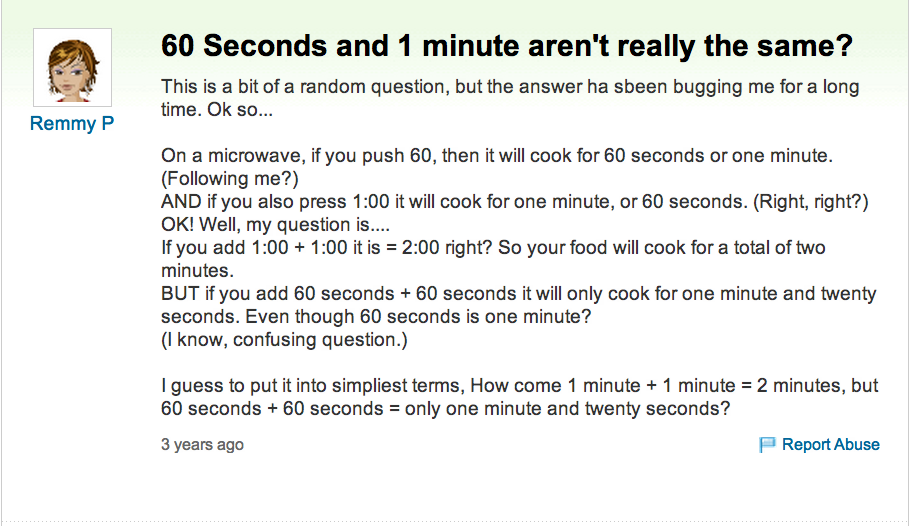
    A few weeks ago, a screen shot from Yahoo! Answers was floating around the interwebs, and a friend posted it on my facebook page asking if I would decipher it.

    This is my last day of vacation, and because this question relates very well to bases (the topic of Monday’s post), I thought I’d take an easy route today and explain it. I’m guessing that many of you can see the fallacy right away, but the question speaks to how bases work (and don’t necessarily play well together).

    Remember that our decimal system is in base 10. That means each place value depends on a multiple of 10: 10s, 100s, 1000s. This is also true for values smaller than 1: 10ths, 100ths, 1000ths. Got it?

    Our system for measuring time is different. As the questioner correctly notes, there are 60 seconds in a minute. In fact, we measure time in base 60. Seems that this derived from the Babylonian’s astronomical calculations, a very elegant system. See, 60 is the smallest number that is divisible by the first six counting numbers: 1, 2, 3, 4, 5, 6. Neat, huh? It’s also divisible by 10, 12, 15, 20 and 30, making it an even more flexible number.

    This in turn gives way to the analog clock, which is circular. Circles measure 360 degrees: base 60! In fact angles and circles are measured in base 60. (Check out this cool way to teach kids how to read an analog clock and understand circles.)

    Okay, so time is measured in base 60. All that means is that 1 minute equals 60 seconds and 1 hour equals 60 minutes. (Forget the hours and days for now.) But remember, our decimal system is base 10.

    And that’s where this questioner has gone wrong. You can measure time in base 10, but it won’t translate the same way as base 60. In other words, 120 seconds is not 1.2 minutes. Nope, it’s 2 minutes.

    And this is exactly why it’s hard for kids to learn to read analog clocks. And why microwaves might burn brain cells along with the popcorn you were having for a snack. Even though we’ve spent our whole lives using base 60 to measure time and base 10 to measure practically everything else, sometimes it’s tough to switch back and forth. Darned Babylonians.

    Have you ever gotten mixed up because time is measured in base 60? Share your story (especially if it’s travel related) in the comments section.

  • How Far? Estimating metric distances

    How Far? Estimating metric distances

    Earlier this month, I showed you how to convert currencies, when given the exchange rate. When you’re not using an online calculator, that process involves proportions, which are pretty simple to use, but do require a little figuring on paper. This same process works for any conversions, including miles to kilometers, liters to ounces, etc.

    But while being exact with your money is pretty important, estimating how far you have to drive or walk is usually good enough. So instead of going into details about metric-to-traditional measurement conversions, let’s look at how you can find these distances with a little mental math. First, you’ll need to know a few facts:

    1. A mile is longer than a kilometer. So, when you convert miles to kilometers, the answer  will be larger than the original amount. (mi –> km = larger answer)

    2. A kilometer is shorter than a mile. So, when you convert kilometers to miles, the answer will be smaller than the original amount (km –> mi = smaller answer)

    2. In fact, 1 mile equals 1.61 kilometers. And 1 kilometer equals 0.625 mile.

    3. Those values are pretty darned close to 1.5 kilometers and 0.5 mile.

    Remember, we’re estimating here, so you’re not looking for an exact answer. Forget what your middle school math teacher said about the precision of math. You don’t always need to getan exact answer. But there’s another fact you’ll need to consider:

    4. The larger the value that you’re converting, the less precise your answer will be.

    If you depend on the estimate 1 mi = 1.5 km and you’re converting 15 mi to km, your answer will be pretty close. BUT if you’re converting 1,468 mi to km, your estimate will be a lot lower than the actual answer.

    Look, estimating is no big deal. In fact it’s a really, really powerful tool that can make your life much easier. You do need to know when estimation is in your best interests and when you should pull out the calculator. (See? Math really isn’t all that black and white!)

    Let’s look at an example. Zoe has finally made it to London! She’s spending the summer studying Shakespeare and working part-time as a docent at the Tate Modern. And she’ll have some time to roam around Europe a bit. She’s rented a car so that she can chart her own path, and next Friday afternoon, she’s going to cross the channel to France, where she hopes to spend four days winding her way down to Paris and back.

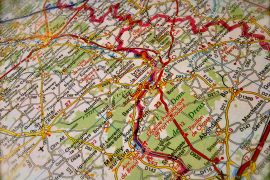
    But how long will it take her to get there? According to her map, the distance is 454 km. Since Zoe is used to miles, she’d like to convert the distance so that it makes more sense to her. She’s okay with a rough estimate, especially since she has no firm schedule. So she decides that knowing there are about 1.5 km in a mile is good enough.

    To make the math even easier, she decides to round the distance as well: 450 is pretty close to 454. Now she can easily do the math in her head, but we’ll get to that in a minute. Let’s write it out first.

    Because she’s converting kilometers (shorter) to miles (longer), her answer will be smaller than the original amount. That means she’ll need to divide.

    450 km ÷ 1.5 = 300 mi

    So she’ll travel about 300 miles to get from London to Paris — not a huge distance!

    But how could she do this in her head? For that, she’ll need to remember a few things about fractions.

    1.5 = 3/2

    450 ÷ 1.5 = 450 ÷ 3/2

    450 ÷ 3/2 = 450 • 2/3

    (That’s because when you divide by a fraction, it’s the same thing as multiplying by its reciprocal — or the same fraction upside down.)

    So in order to convert kilometers to miles in her head, she’ll need to multiply the value by 2 and then divide by 3 (which is the same as multiplying the value by 2/3. In other words:

    450 • 2/3 = (450 • 2) ÷ 3 = 900 ÷ 3 = 300

    Whew!

    But once Zoe remembers this little trick, she can estimate these conversions quickly and easily.

    30 km = ? mi

    30 km • 2 = 60

    60 ÷ 3 = 20

    30 km = 20 mi (approximately)

    Make sense? Try it for yourself: convert 75 km to mi and then use an online calculator to check your answer. Remember, if you’re using the process above, you’ll get an estimate, not an exact value!

    So take a guess: If you’re converting mi to km, what process would you use? See if you can figure it out and then offer your explanation in the comments section. Feel free to choose a value to convert, if it’s easier to explain that way.

  • The Metric System: What’s the big deal with bases?

    The Metric System: What’s the big deal with bases?

    I’m vacationing this week in sunny Radford, Virginia,and ike most parts of the United States, the metric system is not used here (to mark distances, anyway). But if you cross the border into another part of the world, there’s little doubt that you’ll be measuring kilometers rather than miles and grams instead of pounds. That’s because most of the world has embraced the metric system. (In fact, only two other countries — Burma and Liberia — have resisted the change along with the U.S.)

    Ask any scientist or mathematician: the metric system is infinitely more intuitive and much, much easier to remember and understand. But why? The answer is simple: Base 10. What this means is even simpler: in base 10 the foundational number is 10. Take a look:

    10 • 1 = 10

    10 • 10 = 100

    10 • 100 = 1,000

    and so on…

    Each time you add a digit in our number system, you are effectively multiplying by 10. That means that 99 is the last two-digit number in base ten, and 999 is the last three-digit number. In fact our entire decimal system is base ten. (But it wasn’t always like that.)

    But here’s the thing — you don’t care (and you shouldn’t really care). We are so used to base 10 that we don’t even think about it any more. It’s like knowing how to ride a bicycle or drive a car; once you learn it, you don’t even give it a second thought, but if you’re asked about it, it’s hard (or impossible) to explain.

    When you were in school, you probably were asked to convert numbers into different base systems — and this was probably pretty darned confusing. We’re not going to do that here for one simple reason: You don’t need to know how to do this. BUT it is important to know that different base systems are useful in a variety of situations and professions. For example, computers function in base 2 (or binary), which is simply a system of zeros and ones. Computer graphics depend on a hexadecimal system or base 16 (0, 1, 2, 3, 4, 5, 6, 7, 8, 9, A, B, C, D, E, F). Crazy, huh? Even less technical situations depend on a variety of bases — dozens and grosses are base 12 (one dozen is 1 • 12 and one gross is 12 • 12).

    Compared to these other bases, base 10 is pretty darned easy, right? And that’s why so many mathy folks don’t understand why our country hasn’t embraced the metric system. Yep, unlike traditional measure systems, the metric system is base ten. Let’s compare:

    Traditional system: 12 inches = 1 foot

    Metric system: 100 centimeters = 1 meter

    Traditional system: 5,280 feet = 1 mile

    Metric system: 1,000 meters = 1 kilometers

    Just a glance at these conversions and even the most math-phobic person would probably agree: the metric system is much easier to maneuver.

    But agreeing that the metric system is easier doesn’t help you with conversions when you’re traveling, does it? On Wednesday, we’ll take a look at those conversions. I’ll show you some really easy ways to estimate the conversions. Because who wants to do math on vacation?

    What other bases can you think of? How do you use them in your everyday life? Share your ideas in the comments section.