Category: Math for Grownups

  • Math at Work Monday: Aliya the staffing agency branch manager

    Math at Work Monday: Aliya the staffing agency branch manager

    With unemployment rates at record levels, temporary agencies are busier than ever.  I had the pleasure of speaking with Aliya Purtee who is the branch manager at Patrick Staffing, a temporary staffing agency.  She not only helps people get placed in jobs but also plays a big part in making sure people are paid.

    Can you explain what you do for a living?

    I am a branch manager and a payroll specialist at a staffing agency.  As branch manager, I oversee three employees.  An aspect of my role is to listen to the needs of the staff,  and then I ensure that my staff fulfills their needs.  A big part of my job is processing  payroll for about 100 employees each week. This includes checking time cards to make sure there are no additional errors. Also, I engage with approximately 50 customers per week and then our branch takes applications five days a week.

    When do you use basic math in your job?

    I consistently use basic math skills in my job.  My job consists of calculating hours for payroll, pay and bill rates. Also, I use math to generate company’s markups and to determine a burden rate for worker’s compensation. I use the company’s markup to calculate pay rates and bill rates. Some companies pay a shift premium which also requires calculation.

    Do you use any technology (like calculators or computers) to help with this math?

    I use a calculator sometimes, but most of the time I do the figures in my head. I enter the figures into the computer. Also, I issue debit cards for the employees that do not have  direct deposit set up. After the time is entered, I print a report that allows me to audit my entries so that I can double check for mistakes.

    How do you think math helps you do your job better?

    If I did not have basic math skills, I could not fulfill my duties at work.

    How comfortable with math do you feel?

    I am very confident with my math skills.  In my current position I cannot make errors.  If I do, they can have large consequences.

    What kind of math did you take in high school?

    In high school, I took algebra.  I did not like math in high school, and I refused to challenge myself with advanced classes. I really did not realize how much math is used in our everyday lives. [Tweet this]

    Did you have to learn new skills in order to do the math you use in your job?

    I did not have to learn new math skills at my job.

    The people who manage payroll could easily go unnoticed — until we didn’t get our paychecks! If you have questions for Aliya, post them in the comments section, and I’ll ask her.


  • Math at Work Monday: Sarah the Recycling Truck Driver

    Math at Work Monday: Sarah the Recycling Truck Driver

    You probably see your recycling truck driver every week and yet never think about the ins and outs of their job.  Sarah Penrod is one of those faithful people who picks up your recyclable goods on a regular basis so that you can help make the world a little greener.  I found it interesting to hear about her job.

    Can you explain what you do for a living?

    I work for South Utah Valley Solid Waste District. I drive a roll-off truck, and I haul recyclable cans and deliver compost. I also work the scale which weighs trucks as they come in and out.

    When do you use basic math in your job?

    We use math a lot in conversions. We convert pounds into ton and then calculate the price per ton. I also use geometry when I am loading or taking the container off my truck. I have to make sure that I have the right angle so the can is able to slide off correctly rather than on its side.

    Do you use any technology (like calculators or computers) to help with this math?

    We use a computer to convert most of the weights and dollar amounts for us, but I use geometric principles in my head.

    How do you think math helps you do your job better?

    I have to understand and know my angles and conversions in order to do my job effectively.

    How comfortable with math do you feel?

    I feel comfortable with basic math, but anything beyond algebra would require some refresher courses.

    What kind of math did you take in high school?

    I took Algebra and Geometry.

    Did you have to learn new skills in order to do the math you use in your job?

    No, the math was something that I already knew.

    There may be more you’d like to know about Sarah and the job of driving a recycling truck.  This is something you may not have given much thought before. Now that you’re thinking…if you think of anything else you’d like to ask Sarah, just let me know and I’ll catch her in between routes.

  • Math for Writers Virtual Book Tour, Day 2

    Math for Writers Virtual Book Tour, Day 2

    Today, thanks to Jennifer Lawler, you’ll get a sneak peek inside Math for Writers, with an excerpt about self-publishing.

    From Jennifer:

    My buddy Laura Laing is kindly allowing me to run this excerpt from her book for writers:Math for Writers: Tell a Better Story, Get Published, Make More Money. 

    I’ve known Laura for years as a colleague, and I had the opportunity to work with her on her first math book (Math for Grownups), which is how I learned to stop hating math. Laura is a fabulous teacher and she’s the reason why I didn’t quail when I had to factor some quadratic equations for a project I’m working on (I kid you not. You have no idea the weird and random projects that land on my desk.)  I knew I could do it because she taught me to have more confidence, and to recognize that there are usually many ways to solve a problem.

    Anyway, I’m pleased to offer this excerpt, which will help you  figure out how to calculate the numbers involved in self-publishing.

    Going It Alone: The Math of Self-Publishing

    Jennifer Lawler is the author or coauthor of more than forty books, mostly nonfiction, including her popular and award-winning Dojo Wisdom series (Penguin). She has written a number of romances under three pen names.

    She works as a book development editor and has taught classes on how to write a book proposal for many years. A number of her students have gone on to land publishing deals. She has also worked as a literary agent and as an acquisitions editor, giving her considerable experience on both sides of the publishing process.

    She earned her Ph.D in medieval English literature from the University of Kansas and a black belt in Taekwondo at approximately the same time. She has not quite decided which has been more useful.

    I heartily recommend Jennifer’s newest offering: Finish Your Book Bootcamp ecourse. If you have half a manuscript and are not sure how to get it finished, this is the course for you. Jennifer has the perfect mixture of kind encouragement and solid, market-tested feedback. I know that for a fact, because she edited both of my books!

    I really want you to join me. Really, I do.

    So much so, that I’m offering a special gift to those who come along for the ride. Just visit my guest posts to learn how to to claim your gifts.

    So, let’s hit the road!

  • Math at Work Monday: Michelle Matlock the Physician Assistant

    Math at Work Monday: Michelle Matlock the Physician Assistant

    Math is important in many careers, but one of the most critical is in the field of medicine.  For example, it’s very important for medicine to be dosed in correct amounts.  I’m thankful that Michelle knows her math since she is assisting physicians on a daily basis.  Even though I hope I don’t have to visit her… it’s good to know she’s there.

    Can you explain what you do for a living?

    I am a physician assistant. It is an advanced degree where I am able to interview, examine, order tests, perform minor procedures, assist in surgery, develop treatment plans and write prescriptions. Basically, I function much like a doctor.

    When do you use basic math in your job?

    All the time. I have to quickly convert pounds to kilograms because a lot of medicines are dosed in kilograms. This is especially important in trauma situations. Many medicines are weight-based like 50mg/kg divided in 3 doses per 24 hours. It gets complicated. I’m thankful that I don’t work in pediatrics because there are further calculations involving liquid and then interpreting the directions into teaspoons/mL/cc so that it makes sense to the parent based on the measuring device that is accessible to them.

    Do you use any technology to help with this math?

    Yes, I use calculators. I also use paper and pencil the old-fashioned way to visualize the conversions. Electronic medical record has settings that help and alert you if what you are ordering doesn’t make sense.

    How do you think math helps you do your job better?

    I don’t know about better, but it’s necessary.

    How comfortable with math do you feel?

    I rarely feel comfortable, but I feel safe that there are resources available to check my work so that I don’t make mistakes.

    What kind of math did you take in high school?

    I took Algebra, Geometry, and Algebra II.

    Did you have to learn new skills in order to do the math you use in your job?  

    No, not really. Occasionally I have to brush up on statistics in order to interpret research or scholarly articles and data. There isn’t much of a role for advanced math, such as trigonometry, in my daily job.

    Questions for Michelle?  Let me know, and I’ll ask her!

  • Is This Conference Worth It?

    Is This Conference Worth It?

    The right writer’s or business conference can be a boon to inspiration and the bottom line. No matter the cost or time commitment, a conference can be an invaluable investment. But most of us can’t afford to go to all of them – or even more than two or three a year. How can you evaluate whether a conference is right for you?

    When I can’t make up my mind, I’m big on creating measures. How much would this opportunity cost me — in time or money? What can I expect to get out of the experience? In short, I’m looking at ROI or return on investment. To calculate ROI, you need to know what your variables are.

    Expenses

    First off, you need to calculate how much of your cold, hard cash you’ll need to give up to attend. (That’s simple addition.) Of course, unless the conference in your living room, there will be costs other than the conference fee. Make sure you include expenses like travel, housing, and food.

    If the total is spendy, get those costs down to a minimum. Here are some ideas:

    1. Reserve your spot early. Some conferences offer early-bird rates. After a certain date the rates go up, and so do your costs. Whenever possible, plan ahead.

    2. The same goes for travel and housing costs. Travel arrangements booked at the last minute are more expensive. And if you can grab a spot at a neighboring hotel — or bunk with a friend or relative — you might just save some dough.

    3. Check to see if the conference includes meals. If there’s no breakfast offered, for example, pack something to munch on in your room, or make plans to grab some fruit, granola and yogurt at a nearby bodega or grocery. If you like to have a glass of wine at the end of the day, bring or buy a bottle to save on costs in the hotel bar.

    4. Some hotels offer free wifi — others don’t. Prepare to be online during the conference and bring your own hotspot connection, if the hotel wifi fees are too high.

    Time

    So you’ve figured out how much money you’ll probably spend. But that’s not the only consideration. If you’re going to be away for four or five days, you’ll face three realities: 1) working extra hours to get ahead before the conference, 2) working during the conference, or 3) working extra hours after the conference.

    Of course there’s a fourth option, too: Turning down work that would be due during your travel time or soon after.

    There are several ways to consider the value of your time at the conference.

    1. Using your hourly rate, estimate the amount of money you’ll “lose” by being at the conference. (But remember, this may not be an accurate assessment. Would you be billing all of the hours that you’ll be hob-knobbing with industry experts?)

    2. Consider your financial goals for that month, week or quarter. Can you meet those goals before or soon after the conference?

    3. What is your really busy time? If you are slammed from April through June, a May conference may not be in your best interest. In essence, your time is much more valuable when work is flowing like crazy.

    Opportunity

    Cost and time are easy to measure. But opportunity is the wild card. I know many, many freelance writers who start at a conference with a dollar figure in their heads. If they don’t land at least that much in assignments before arriving back home, they’ll reconsider attending in future years.

    That’s a fine way of doing things, but I think the market has changed. There aren’t too many editors who are assigning on the spot. And thanks to major cuts at major magazines, many editors (major and minor) cannot justify the cost of attending conferences.

    So I encourage you to consider the opportunity of networking. Can you leave with five new contacts (other writers, editors, publishers — not the bartender) and follow up within a week of getting home? Can you come up with 10 new ideas, whether they’re stories, informational products or blog posts? Do you have a book to promote?

    Finally, ask yourself this: “How much would I pay for a course that teaches me X?” If the conference offers you information that you would need to pay for elsewhere, it could be worth it.

    Whatever your conference formula is, strategically thinking about the benefits and costs is a good idea. You may choose to calculate a dollar figure for your ROI. And you may play it a little faster and looser. Either way, have a plan, and you won’t feel like you’ve wasted your hard earned money or precious time.

    April 24-26, I’ll make my annual trek to New York City for the American Society of Journalists and Authors convention. It’s not cheap to stay in a fancy hotel, but along with great networking, promotional opportunities and workshops, I consider this a little mini-vacation. So about half of the cost goes into my marketing/training budget for my business and the other half is part of my vacation fund. Works like a charm for me. 

    What conferences are you planning to attend this year? How do you decide which conferences are worth it? Share your ideas in the comments section.

  • Math at Work Monday: Rick Scherer the Certified Medical Dosimetrist

    Math at Work Monday: Rick Scherer the Certified Medical Dosimetrist

    In today’s world, we’ve all unfortunately been touched by cancer in one way or another.  We may have stood beside a loved one as they battled the disease, or we may have experienced it first-hand.  Rick at First Dayton Cyberknife encounters cancer patients on a daily basis as he assists in their treatment.  I’m thankful for folks like him who use their math skills effectively to help others.

    Can you explain what you do for a living?

    I am a certified medical dosimetrist at First Dayton Cyberknife. I work in radiation therapy which is used to treat people who have cancer. I make sure the radiation kills the cancer cells without harming the patient.

    The medical dosimetrist is responsible for designing a treatment plan and carrying out calculations with mathematical accuracy for the delivery of radiation treatment based on the oncologist’s prescribed course of therapy. This treatment plan takes into consideration tumor pathology, tumor volume, and inherent dose-limiting structures surrounding the tumor. The treatment plan and radiation field-placement techniques are constructed utilizing sophisticated computer equipment and technology. The medical dosimetrist, along with the radiation oncologist and medical physicist, will work to construct a treatment plan that will meet the prescription written by the oncologist, ensuring that the patient will not lose important healthy organ function and that the radiation delivered will not affect healthy surrounding tissue. These treatment plans not only include the use of radiation but also, in many cases, involve the use of radioactive elements during interstitial brachytherapy procedures. Once the treatment plan is complete, the medical dosimetrist will work closely with the radiation therapists in the implementation of the prescribed plan.

    When do you use basic math in your job?

    My whole job is math related. I wouldn’t be able to do my job without math skills. Most of my job pertains to the physical properties of radiation and its interactions with matter. There are calculations depending on energy, energy type (photon, electron, gamma ray), size of the treatment field etc. Most of these calculations are done using a treatment planning system (TPS). We use Eclipse, which is from a company called Varian. We also use a Cyberknife, which uses a software called MultiPlan.

    Do you use any technology to help with this math?

    Most of the time I use specialized software for treatment planning but not always. Some plans have to be hand calculated.  

    Sometimes I use a hand calculation to basically determine how long the machine needs to stay on to deliver a certain dose to a certain depth. For example, the radiation oncologist will prescribe 2400 cGy (centigray is a unit of absorbed dose) in 10 treatments (240 cGy per treatment) to a depth of 80% or sometimes he will say 2 centimeterss. I will use a simple formula that we call a hand calc, 240 

    80% • 1.002 =299cGy
    (where 1.002 is the output factor of field and energy)

    1 cGy=1 monitor unit on the machine so the machine would be set to 299 mu’s per treatment for ten treatments for 100% coverage of radiation at the 80% isodose line. This is confusing as heck so I won’t get any deeper with this because I will just go on and on and on….

    This is a very simple calculation. Most of the time we aren’t this lucky. Actually most of the time everything is calculated with the Treatment Planning System.

    How do you think math helps you do your job better?

    Math is physics and physics is math, so you can’t have one without the other.

    How comfortable with math do you feel?

    I feel very comfortable with some math, but with other math I still feel very uncomfortable.

    What kind of math did you take in high school?

    The highest I took was Algebra II. I barely passed!

    Did you have to learn new skills in order to do the math you use in your job?

    I have had to learn new calculations for new procedures depending on the type of treatment. Some treatments use a real source of radiation which has different factors. In college, medical physics and radiation physics were totally new to me. I can’t really compare it to normal math class. Lots of formulas, laws and other “math stuff.”

    One law that is common is radiation is called the inverse square law: In physics, an inverse-square law is any physical law stating that a specified physical quantity or intensity is inversely proportional to the square of the distance from the source of that physical quantity. That is one of the first things you learn.

    Want to know more about using math in the fight against cancer?  Let me know, and I’ll be sure to ask Rick your questions.

  • Hey, Does This Place Look Different?

    Hey, Does This Place Look Different?

    If you’re used to a completely different Math for Grownups website, hold up. You’re not in the wrong place. For the last two months (or more?), I’ve been working on a redesign of the site. I wanted something fun, punchy and energizing — kind of how I feel about math. And with my newest book, Math for Writers, hitting Amazon last month, this was a great opportunity.

    And it’s not just a new book to celebrate! You’ll notice some really cool additions, plus a few old friends. Here’s a quick run down.

    Sections for Writers, Parents, Teachers, and All Grownups

    If you fall in one of these categories — and unless you’re a kid, you do! — you can zip right over to see the content I’ve developed just for you. Writers will find great ways to develop their craft and manage their writing. Parents will find tips for growing math-confident kids — without losing their minds. Teachers will find resources they can share with parents and students, including the answer to the age-old question: “When will I ever use this stuff?” At the same time, everyone can learn how math can help us make smarter financial decisions, save time and think about math in a completely different way.

    OMG, Quizzes!

    I can’t tell you how excited I am to introduce original, interactive quizzes. But before you freak out: There is no timer. There are no grades. No one has to know how you did. And that’s exactly how I wanted it. My goals are pretty simple: Show you what kids are learning at various grade levels, and give you a chance to see what you remember (or don’t). I’ll be adding quizzes over time — hopefully one a week or so. And I’ll add some non-math quizzes too, like “Are You REALLY Math Anxious?”

    Coming Soon: Online Learning

    If reading a blog or a book is not enough for you, I’m gearing up to offer some very targeted online learning. First up will be courses designed just for writers. Over time, I’ll add courses for parents and others. Through Facebook groups, webinars and “homework,” you’ll have a chance to take a deeper dive into the math that you need — but can’t quite grasp. These aren’t college courses, and you won’t be graded on your assignments. The idea is to give you a little special attention, so you can ask specific questions, gain some confidence and learn a few things. Stay tuned!

    Math at Work Monday Is Back!

    I know that this is a very popular feature on Math for Grownups, and I’ve got a whole series of greatMath at Work Monday interviews lined up. You’ll meet recycling truck drivers and cancer radiology specialists. And if you have a suggestion of someone I should interview, send me a note. I’m always looking for fresh ideas!

    Take a look around. Read my new Math for Grownups Manifesto. And let me know what you think. I’m really looking forward to injecting even more energy into math.

    Oh, and if you haven’t received my free gift for you, don’t miss out. Just sign up in the bright yellow box to the right, and you’ll get a free copy of Multiply Your Math Moxie: A Painless Guide to Overcoming Math Anxiety. Get comfortable with math, once and for all.

    Enjoy!

  • Math at Work Monday: Tim Lane the Real Estate Appraiser

    Math at Work Monday: Tim Lane the Real Estate Appraiser

    Real estate appraisers: whether you love them or hate them, they’re a necessity.  Sometimes we may disagree with their figures, but as Tim Lane shows us, the facts are the facts.  And how does Tim get to those facts? Math of course.  This math has a purpose, backed by meaning, and it’s hands-on.  Tim shows us some of the inside scoop in the field of real estate appraisal.

    Can you explain what you do for a living?

    The job of a real estate appraiser is to determine what the property is that is being appraised: is the property a single family home, a duplex, an apartment building or something else? As well, what is the home in terms of age, size, construction quality, bedroom/bath count, and other features? Once this has been determined, the appraiser’s job then shifts to the task of analyzing the market area. This includes an analysis of the area on a large scale (city wide) relating to economics and the economic base, then a second analysis of the specific neighborhood within the city to determine what is happening in that neighborhood with real estate price trends, supply and demand, and what features or amenities are most important at this time. Finally, all the data comes together into a 30-40 page report in which all the data is given to the client. Contrary to what most people think, appraisers do not set the value of a property, we simply report what is going on in the area, and what a property is likely to sell for based on other recent sales in the area that are as similar as possible to property being appraised.

    When do you use basic math in your job?

    From start to finish. Initially, we have to use math to determine simple things such as how much time it takes to get from one property to another, what is the distance between them, and how many hours of daylight we have to work with to get everywhere we want or need to be in a day’s time. Math continues when looking at economic statistics to determine market trends ranging from basic issues such as determining if the area has an oversupply of available real state as compared to what the market has demonstrated can be sold in a given time frame, determining how much of a decline a market may see based on different rates of oversupply, using statistics such as regression analysis to determine a market’s reaction in terms of real dollars to different features or lack of a feature in a home. Math is used to determine the living space of a home, the size of the lot, to determine fractional increments of return on the dollar for investments made in a property.  If the property is income producing, we use math to determine an investment rate of return for dollars investments, sinking fund factors, future value of a dollar, and to help determine what type of funds need to be set aside each month for repairs of items such as roofs, HVAC systems, water heaters and other components of a home. Finally, appraisers use math to determine the cost to build a home.

    Do you use any technology to help with this math?

    We do use calculators and computers heavily. Calculators such as an HP-12C has been the industry standard for the real estate and finance industry for 25+ years. Software providers in the industry do all they can to calculate as many equations as possible so that we can cut down the time it takes to produce a report. Software such as Excel make complex equations much easier. However, if anyone wants to be an appraiser they are still required to be able to do all the math–much of which is very complex–with a simple pencil and paper, in order to be certified by a state and the federal government.

    How do you think math helps you do your job better?

    Math certainly helps appraisers do our jobs better. Most appraisers are very adept at being able to simply see a property, and know what it is likely to sell for. However our clients such as banks, accountants, lawyers, and tax courts simply will not accept a quick email with a value. Everything the appraiser says has to be backed up with provable facts; this is always rooted in math. Whether it is the size of a room, the size of a home, the size of a lot, the value of an additional bath, or the value of an additional quarter acre of land, it all has to be proven to our clients beyond any shadow of a doubt. Math is the only way to accomplish this level of proof.

    How comfortable with math do you feel?

    Initially, as I began to get into appraising, I wasn’t comfortable at all. Algebra and geometry play heavily into real estate appraisal, and I was never a standout in math class. Just sitting around doing math problems over and over, with no real purpose to the questions was extremely monotonous. However, once I began to actually see a purpose and a reason to do math, and had a real reason to apply the knowledge to something concrete, it became much easier. Never in my wildest dreams would I have ever believed I would use any math beyond basic addition, subtraction, multiplication and division, but I do every day now.

    What kind of math did you take in high school?

    I avoided math like the plague. I was forced to take Introduction to Algebra, which was the worst year of my life at the time. I later took Algebra I, which turned out to be even worse! Then geometry, which I loved! But still, math was math and that was all I was required to take, so that is all I took.

    Did you have to learn new skills in order to do the math you use in your job?

    Yes, I did have to learn some new skills to do my job; and in some cases I had to simply relearn what I had assumed I would have no reason to remember. Real estate appraisal obviously has roots in real estate, and just as much in finance, investments and banking as well. No basic public schooling teaches this type of math. Some math skills transfer well such as word problems, or some geometry, but much of what is needed is more complex financial based math that relates to business math, statistics, projections, finance, and investments.

    Questions for Tim?  Let me know, and I’ll see if he can squeeze in an answer between calculations.

  • Math at Work Monday: Kathy, manufacturing company president

    Math at Work Monday: Kathy, manufacturing company president

    Can you imagine being the president of a twenty person manufacturing company–without  math?  Meet Kathy Keel, president of BSF, Inc. and let me tell you, she has to know her math.  In her position, she must keep an eye on profitability, for her own benefit and the benefit of her employees.  But for Kathy, the math goes even deeper. Let’s take a look.

    Can you explain what you do for a living?

    I am the president and co-owner of a manufacturing company that makes a custom part for the hydraulic industry, called a pump-motor adaptor. My main duties on a daily basis involve managing all of the office employees, designing custom fit pump motor adaptors, editing all drawings done by other designers, costing the part, and processing orders. I also do a lot of customer service as well as troubleshooting problems, processing payroll, and managing human resource duties.

    When do you use basic math in your job?

    I use basic math while designing the parts to figure dimensions and angles needed for design features. We have to research the dimensions of each component being attached to the adaptor (pump, motor, and coupling usually). Then, we have to design the adaptor to fit those components. This requires fractions and decimals to figure adaptor dimensions and tolerances. I also use math during costing/pricing activities in order to determine what our cost is for manufacturing the part and what our selling price should be on the final part. This involves working with money, percentages, and markups. In addition, I use math when processing payroll.

    Do you use any technology (like calculators or computers) to help with this math?

    I use a calculator, Microsoft Excel, and design programs such as Solidworks.

    How do you think math helps you do your job better?

    I could not properly design an adaptor to fit the components without math, and I could not cost and price parts without math. Overall, I couldn’t run a company without math. I use it in almost every facet of my business to make sure that we are profitable.

    How comfortable with math do you feel?

    I am somewhat comfortable with basic math only. I’m not comfortable at all with more complex math.

    What kind of math did you take in high school?

    One year of Algebra as a freshman.

    Did you have to learn new skills in order to do the math you use in your job?

    I had to learn to translate metric to English measurements and to equate fractions to decimals.

    Have questions about Kathy’s company, their products, or her use of math skills at work?  Let me know and I’ll be happy to check in with her.

  • Wouldn’t It Be Great If…?

    Wouldn’t It Be Great If…?

    I think Marie Forleo is hilarious and smart and engaging. She’s also built a very successful entrepreneur coaching business in a very short period of time. So when she talks about goal-setting, I tend to listen.

    (If you don’t know who Marie is, don’t worry about it. I didn’t know who she was until a month ago, when I was trolling around the internet for some inspiration for taking my own writing career to the next step. And if you do know Marie, don’t worry. I’m not trying to sell you on her B-school. I’m not an affiliate, and I’ve never taken the course.)

    I mention Marie today one of her funny and engaging videos inspired me to write this post. In it, she shares an exercise that she uses with her team. It’s the “Wouldn’t it be great if…?” game. The idea is to fill in the blank with something achievable. “Wouldn’t it be great if I could vacation in Hawaii?” “Wouldn’t it be great if I could take August off?” “Wouldn’t it be great if I could publish a book?”

    Of course, in a five-minute video, Marie only shares the dreaming part of this process. There’s no time to dig into the nuts of bolts of making those things happen. (Besides, those nuts and bolts are what she’s selling. Girl’s got to make a living.) And yes, sometimes the dream alone is a critical first step. But I got to thinking — what about the how of getting these things done?

    In other words, you have a goal — now what?

    You know what I’m going to say, right? You’ve got to crunch the numbers. Going from dream to reality means putting a plan into place and taking teeny-tiny steps towards getting there. It means setting and monitoring measurable goals. And that means using some basic math. Take a look.

    Wouldn’t it be great if I could vacation in Hawaii?

    Unless you’re Donald Trump or you actually live in the Aloha State, this trip could feel like a pipe dream. It’s expensive. It can take a long time to get there.  Heck, the wardrobe! But the math is pretty simple. Do some research, set a budget and then figure out how to stash the cash.

    Why not set a monthly savings goal — which could mean earning more or saving more — and track it in a spreadsheet? Multiply that amount by the number of months until your planned trip, and you’ve got the budget for your trip. Hey, you can even get the spreadsheet to do the work!

    Wouldn’t it be great if I could take August off?

    This is one of my goals this year. And the math is super-dooper easy. I just take my yearly income goal (you have one of those right?) and divide by 11, instead of 12. That gives me my monthly income goal. If I can earn that amount each month, I can spend August by the pool or working on house projects. The cool part is this: spreading August’s income to the other 11 months ends up being a pretty small amount. (Well, unless your income goal is seven figures or more.)

    Let’s say my annual income goal is $60,000. If I divide by 12, I need to earn $5,000 each month. But if I divide by 11, I need to earn $5,454.55 each month. Heck, I’d probably round that up to $5,500 to give myself some cushion.

    Wouldn’t it be great if I could publish a book?

    I had this thought many, many years ago. And because of the times, I had to wait — wait until a publisher decided to take a chance on me. It happened, but here’s the really wonderful news: you don’t have to wait. The self-publishing industry has completely changed in the last several years. Whether you want to get your family’s history down in writing or publish the next Fifty Shades of Greypublishing can be almost completely within your control.

    Again, you need a budget and a goal. Decide how much you want to spend on the cover, design and marketing. Then set your sales price and goals. Within 15 minutes or so, you will know what your best publishing options are (ebook, publish on demand or publishing all of the books at once), plus how much you can expect to earn in this endeavor.

    Heck, math can even help you track your book-writing progress!

    Look, this is no earth-shattering news here. But how often have you not pursued a dream because you weren’t sure of the outcome? Trust me. Sometimes a little bit of math is all you need to nail down the specifics. Don’t dream it. Be it.

    What are your professional and personal dreams? Share them in the comments section. And don’t forget to mention how math might be able to help you actually reach them. 

    Want more information on how math can help you become a better, more successful writer? Be sure to check out my latest book, Math for WritersIt’s for sale on Amazon.com!

  • Happy Valentines Day!

    valentines day

    I couldn’t resist sharing this happy little math gif. Mathematically speaking, it makes no sense, but it’s still sweet.

    Happy Valentines Day!

  • Spreadsheets 101: Troubleshooting

    Spreadsheets 101: Troubleshooting

    This is the third post in a series about spreadsheets, called Spreadsheets 101. Click if you missed the first (Spreadsheets are Powerful. Here’s How) or second (How to Use Formulas) post.

    Mistakes happen. But boy they can be frustrating, especially if you’re learning something new or not feeling so confident with your skills. In terms of spreadsheets, these mistakes can show up in one of two ways: a value that doesn’t make sense or an error message. In this post, you’ll get the ins and outs of diagnosing and fixing these problems.

    Errors in spreadsheets are almost always user-generated. In other words, you can’t blame the developer or your computer or Mercury rising. This is both good and bad news — and the process for identifying and fixing these issues is very similar to working your way out of a vexing math problem. Don’t let that worry you. Instead, think of it this way: you have a great opportunity to deal with two difficulties at once.

    Bad Numbers

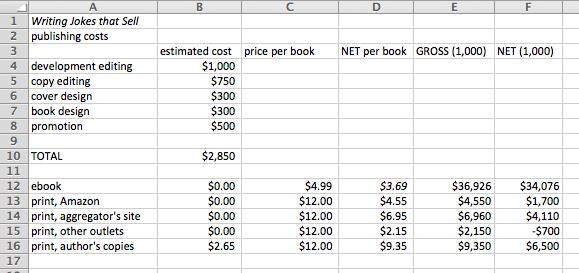
    When numbers matter, it’s always a good idea to check everything carefully. This might feel like a real drag, but this little habit can save you time, money and heartache in the long run. Take a look at the spreadsheet below. Can you spot the questionable values?

    Did you notice the numbers that are out of whack? They’re in E12 and F12: $36,926 and $34,076. It would be awesome to earn that much dough from the sale of 1,000 ebooks, but with a net of $3.69 per book, that doesn’t make any sense at all.

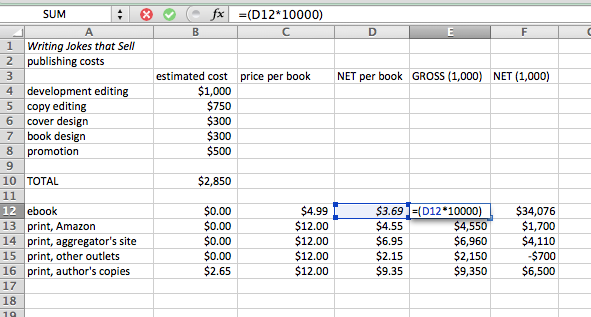
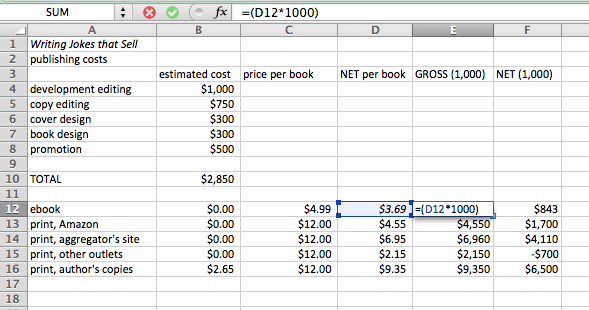
    There’s a problem with one of the formulas — probably in E12 or F12. So, let’s take a closer look. If this were your spreadsheet, you could double-click on E12, showing the formula.

    Now, this time, I’ve also included the tool bar over the table itself. Notice that the formula is listed to the right of fx. You can also see it in the cell itself. This formula says that you want to multiply the value in D12 by 10,000. (Count the zeros, if you can’t quite read it.) In other words, this is the net, if you were to sell 10,000 ebooks. But what you’re looking for is the net on 1,000 sales. Ta-da! That’s the problem.

    Next, you want to fix the error and see if that solves the problem in F12.

    Yep, it did. See what happens there? If you make a mistake in one cell, it can carry to other cells. It pays to be diligent.

    In this case, I had simply typed too many zeros. Another easy mistake is referencing the wrong cell (typing C12 instead of D12, which would be a tougher mistake to find). It’s also fairly common to accidentally add a cell name to a formula, by clicking the cell before closing up the formula.

    Finally, errors in using the order of operations are really easy to make. If you need to add before multiplying, be sure to put the addition step in parentheses. Otherwise, the computer will follow PEMDAS — multiplying before adding. Take a look:

    =((D12+E12)*5) means: Add the values in D12 and E12 and then multiply by 5
    =(D12+E12*5) means multiply the value in E12 by 5 and then add the value found in D12

    Big difference!

    The Formula You Typed Contains an Error

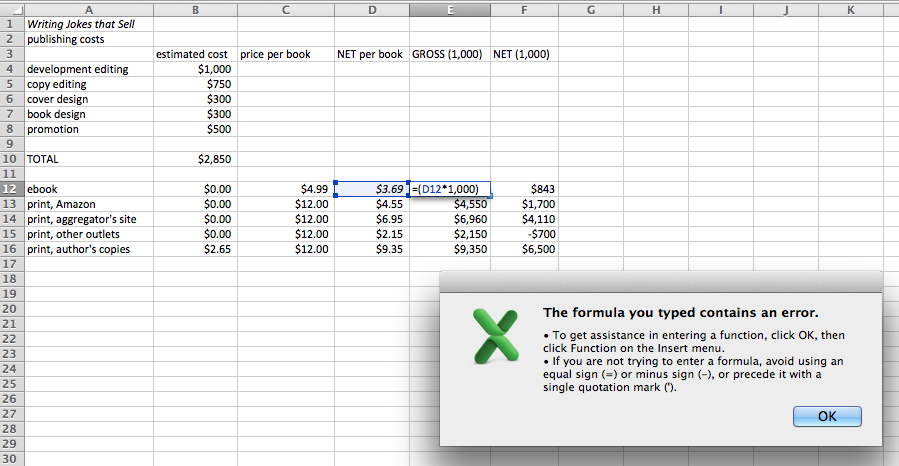
    Sometimes your spreadsheet program might give you an error message, like the one below.

    Of course the error message isn’t helpful at all. But look closely at the formula in the cell. Instead of typing “1000”, I’ve typed “1,000”. And that’s a big no-no. Take away that comma separating the 1 from the 0, and all will be right with the world. Other characters you want to avoid include dollar signs ($) and percentage signs (%). Stick to the symbols outlined in the previous post on building formulas.

    The key here is not to ever make mistakes but to identify them, if you do. Review all of your formulas before trusting their outcomes. Check that you’ve included the correct cell names, operations and used parentheses where necessary (so that your order of operations is correct. If you get an error message, look for symbols or letters that shouldn’t be in the formulas.

    With a little attention to detail, you can be sure that the data generated by formulas is good to go!

    What steps do you take to troubleshoot your spreadsheets? Do you have some advice to share or questions you need answers for? Talk to me in the comments section! There’s one more post coming up soon. Later this week, I’ll teach you how to make pretty graphs using spreadsheets. So easy, you won’t believe it!