Category: Math for Parents

  • Getting Aware of Common Core Standards

    Getting Aware of Common Core Standards

    Not all of us are parents or teachers, but I’ve long asserted that education is a “public good,” something that each and every one of us should be very, very concerned with. When kids don’t graduate or graduate with poor critical thinking skills, a lack of curiosity of the world around them or a dearth of basic math, reading and writing abilities, everyone suffers. And in a world where STEM-based employers are recruiting and paying more, we owe it to the next generation to do better.

    (This is not to say that our educational system doesn’t have some absolutely enormous issues in other areas. Perhaps the biggest problems our schools face are not academic at all. I believe that if our country took a good, hard look at poverty, violence and teacher care, we’d make huge strides in the right direction. But this post is about academics.)

    Enter the Common Core Standards. For decades, each state has developed and cultivated its own standards – or objectives required by each basic course, from history to language arts to biology. But over the last 20 years, a movement has grown to standardize these objectives across the country. With this umbrella of standards, what little Johnny is learning in Arkansas will be similar to what little Patrice is learning in Maine.

    Right now, the Common Core Standards only cover English (language arts) and math. They’ve been adopted by 45 states. (Alaska, Nebraska, Texas and Virginia haven’t adopted them at all, and Minnesota adopted only the English language arts standards.) Standards for other subjects are in the works, including science and social studies.

    For the last six months, I’ve been writing and editing curricula designed to meet the Common Core Standards for mathematics. I’ve gotten a pretty good feel for what they are, and I have to say that I like them for the most part. Here are some general thoughts I have:

    Students will learn certain concepts earlier. I haven’t spent much time with the elementary level standards, but at least in middle and high school, various mathematical topics will be introduced earlier in the standards. For example, exponential functions (an equation with x as an exponent, like with exponential decay or compound interest) is covered in Algebra I, rather than Algebra II. 

    The result is two-fold. As the standards are rolled out, some students will be left behind. In other words, kids who started school without Common Core may have a hard time catching up or bridging the gap. Second, students will have the opportunity to learn more mathematics throughout their high school career. The idea is to better prepare them for STEM in college and careers.

    The emphasis is on critical thinking. This part, I love, love, love. For example: geometry proofs are back! And rather than compartmentalizing the various branches of mathematics, students will make connections between them. I just wrote a lesson that looks at how the graphs, equations and tables for various functions – linear, quadratic and exponential – are alike and dissimilar. Previously, students may never have seen these functions together in the same unit, much less the same lesson.

    This means that assessments will change. Students will be asked to explain their answers or verbalize the concepts. Expect to see much more writing and discussion in math class.

    Applications, applications  applications. Math is no longer done for math’s sake. And this couldn’t be better news. As I’ve said here many times before, math is pointless until it’s applied. Students should get this first-hand with Common Core, which outlines very specific applications for various concepts.

    The idea here is to demonstrate that the math they’re learning is useful. The result? Hopefully more students will choose to enter STEM careers or major in these fields in college.

    Students learn in different ways. Modeling plays a big role in the new standards, which means that students can approach the math in a variety of ways – from visualizing the concepts to using manipulatives like algebra tiles to working out equations in more traditional ways to graphing. This way, students can enter the material from a variety of different doors. And that can translate to greater success.

    Sure, there is a lot to be concerned about (most especially the gap that we expect to see in student performance), but from my perspective the Common Core Math Standards are a step in the right direction. It’s important to know that these do not form a federal curriculum; the states are still responsible for choosing curricula that meet these standards, and education resource companies are scrambling to meet these meets. (That means I’m very, very busy these days!) It’s also important to know that chucking old ideas and implementing new ones puts a huge burden on already over-taxed schools and school systems. Finally, there is no doubt that this initiative was driven by the textbook companies, which means we’re still beholden to politics and capitalism.

    But in looking at the standards alone, I think Common Core is excellent. If we can implement the standards well and keep them in place for a while, I think our kids will benefit.

    What do you think of Common Core? Share your thoughts in the comment section.
  • Another Awareness: Organ donations

    Another Awareness: Organ donations

    Math shares its awareness month with another mission that is very near and dear to my heart: It is also Organ Donor Awareness Month. When I found that out earlier this week, I thought I’d indulge myself a bit and spend a post looking at the math of organ donation.

    When I was in middle school, my father learned that he had a very strange autoimmune disorder. His immune system was attacking his liver. In fact, his liver looked like that of a raging alcoholic, which he wasn’t. After months and months of testing and treatments (some pretty ugly), his doctors were finally able to get things under control. But they told us one thing that stuck with me forever: “This isn’t a terminal disease, but it is chronic. As a result, he won’t live as long as he would have if he was healthy.”

    To this day, we have absolutely no clue why my father’s immune system turned on him. When I was a toddler, he had surgery to remove part of his thyroid, because it was so overactive. As he aged, he developed other autoimmune disorders, including vitiligo, which caused his skin to lose pigment. But he kept on keeping on.

    About seven years ago, his doctors discovered liver cancer. This was a specific kind of cancer, related to his liver disease. They could remove it, but the writing was on the wall: his liver was on its last legs.

    So they put him on the liver transplant list. He stopped travelling more than a couple of hours from his hospital. He got poked and prodded. And he waited. And waited.

    I’m not sure how many people were on the list at the time. Today, there are nearly 17,000 people waiting for liver donations. Each of these individuals are scored, based on the severity of their liver damage. In 2006, when my father was on the list, the median national waiting time was 321 days. I wasn’t able to find out how many people die before receiving a liver transplant, but it’s estimated that 6,500 people die each year while waiting for a heart, kidney or liver.

    After eight months or so of waiting, my family and his doctors got worried. The tumors were coming back and multiplying. He needed a transplant soon. And so I made a decision that changed my life forever. I would donate my liver to him.

    The liver is the only organ (besides the skin) that grows back. And a live-donor liver was a great option for someone like my dad. I flew through the medical testing with flying colors.

    At about 5:00 a.m. on October 1, 2007, I was wheeled into an operating room at Virginia Commonwealth University Medical Center. They prepped me first, and then brought my father in for the transplant. The entire surgery took at least 8 hours, during which they took one full lobe of my liver and transplanted it into my father. Something like two hours of that time was devoted only to stitching up the large lambda-shaped incision that cut through my abdomen.

    After two days of recovery, my father was off the ventilator, and I was walking down the hospital corridors on my own to visit him. Within another two weeks, an MRI showed that my liver had already grown back to about 95% of its original size. (I’m not kidding!) In that time, I had lost around 20 pounds, from not being able to eat for about a week and from the energy my body spent regrowing an organ.

    I’m so sad to say that this story does not have a happy ending. I’m perfectly healthy. And my transplanted liver was doing great inside my dad. But no one knew that my father had pulmonary fibrosis. It must have been at the very, very early stages of his disease when he was tested and tested and tested prior to the transplant surgery. The doctors suspect that the progression of the disease was sped up considerably due to massive amounts of oxygen that were pumped into his lungs during surgery and while he was in intensive care.

    Had he not had this complication, I have no doubt that he would be living today. He died on November 6, 2007; his liver was still going strong.

    My point is not to share a very sad story. My point is to share with everyone some small mathematical facts about organ donation:

    1. Each day, about 18 people die, while waiting for a kidney, liver or heart. (That’s 6,500* people per year divided by 365 days.)

    2. Right now there are approximately 117,729 people waiting for a kidney, liver or heart. Each year, 4,000 more people join this list.

    3. Becoming an organ donor doesn’t have to be as dramatic as my experience was. Most donated organs are from a deceased donor. It takes a split second for you to indicate on your driver’s license that you want to be an organ donor. Or you can sign up at OrganDonor.gov.

    4. And happily, most people do not have my father’s experience. As of May 2009, 73.8% of those who had received a transplanted liver were still alive, five years after their surgery. Here are the percentages for others: 69.3% of kidney recipients, 74.9% of heart recipients and 54.4% of lung recipients.

    5. It’s not just the big organs that matter. Organs and tissues from a single deceased donor can help up to 50 people. (Yes, 50!) On average 79 people each day receive a donor organ or tissue.

    In fact, my father was so convinced of the value of organ donation that even after much of his body failed him, my father was able to donate his eyes, skin and tissue. It is an amazing thought that I and he were able to join together to do this.

    So if you haven’t taken the time to indicate that you’d like to donate your organs after death, please do so now. I don’t regret for a moment my gift to my father. At the same time, had there been more deceased donors, it wouldn’t have been necessary.

    Talk to your family about organ donation. Get some good information. And at the very least, make an intentional decision one way or the other.

    *Earlier, I had a typo here. This number has been corrected.

  • Daily Digits: My math day

    Daily Digits: My math day

    Most folks readily tell me that they don’t do any math in a day. Not a stitch. So maybe they don’t sit down and solve for x or graph a quadratic equation or use the Pythagorean Theorem. But we all do math every day. And I decided to prove it.

    It was last Tuesday — a pretty regular day.

    April 2, 2013

    6:00 a.m.: Review to-do list, estimating the time that each item would take. Count up the number of hours estimated to be sure not to exceed eight hours, while leaving time for lunch and exercise.

    7:00 a.m.: Track all Weight Watchers points that I expect to use for the day, by planning what I’ll have to eat for breakfast, lunch, dinner and snacks. Allow the online program to add everything up, but pay close attention that my breakfast and lunch are around 6 points each and that I’m using less than 8 points from my weekly extra points.

    10:00 a.m.: Review invoicing for first quarter. Within bookkeeping program, look at the data in a variety of ways: bar graphs, showing income for each month, and tables showing the income for each client. Compare income to goals and adjust expectations where necessary.

    11:00 a.m.: Set budget for new book postcard, using designer’s estimates. Compare costs of a fewer number of cards to the costs of a much larger run. Table the decision to think about things.

    12:00 a.m.: Attend weekly Weight Watchers meeting, and learn that I lost 0.4 pounds last week. Spend meeting mentally calculating how that could have happened, given the fact that I didn’t stay within my allotted daily points for a few days. Remember that balancing the equation of caloric intake and output, with variables like water retention, is way too complex for mental math. Decide to just feel fortunate and proud.

    1:00 – 3:30 p.m.: Outline online lesson about linear, quadratic and exponential functions. (Yes, this is where I and the rest of the world differs! But I wanted you to know that this curriculum doesn’t appear out of thin air.)

    4:00 p.m.: Meet with potential photographer for our wedding. Count backwards from the start of the wedding to estimate the time necessary and the cost of a second photographer. Mentally calculate how much over our budget we’d go if we hired this photographer. (Everything goes over budget, I’ve found.)

    6:30 p.m.: Meet a friend for drinks at a local restaurant. Scan menu for lowish-calorie drink, decide that since a cosmo is the same points as a glass of wine, why not have the pink drink in the fancy glass?

    7:30 p.m.: Get the check. Find the tip by taking 10% of the bill and doubling it. Then split the check evenly since we got the same drink and shared an appetizer.

    11:30 p.m.: Daughter can’t sleep. Mentally add up the number of hours of sleep we can each expect to get if she would just fall asleep right now. Finally she dozes off.

    And there you have it — my math day. As you can see, the math was tucked into various nooks and crannies. If I hadn’t been paying attention, I wouldn’t have even noticed it. And most of it had nothing to do with the way I learned to do math at school.

    So what about you? Here’s my challenge: Just for today, jot down when you’ve used math. Then share what you learned about yourself in the comments section. Did you find that you used math more than you thought? Did you discover that you’re using a kind of math that you never, ever expected? I want to know!
  • Sharing Awareness with Kids: Bedtime Math

    Sharing Awareness with Kids: Bedtime Math

    One of the questions I get most often from parents is this: How can I help my kids from being anxious about math like I am? And for a math nerd like me, the answer is pretty simple. I’m unnaturally aware of the math around me. Because of my background and experience — and maybe even the way my brain is wired to see patterns in damned near everything — I can weave math into just about any situation I come across.

    (Go ahead, try me. Post a situation in the comments section, and I’ll bring the math. It’s a game I used to play with my daughter, until she got really tired of losing.)

    But for most parents, this level of math awareness is just not as simple to access. This is where Laura Bilodeau Overdeck comes in. With degrees in astrophysics and public policy, Overdeck is probably a little like me — finding math in everything and pointing it out to her kids at every turn. But she didn’t just keep this to herself. Nope, she launched Bedtime Math, a really simple idea designed to help parents inject a little math in their kids’ everyday lives.

    Each day, she and her crackerjack team send out an email to subscribers (it’s free!) that offers three math questions — one for Wee Ones, one for Little Kids and one for Big Kids — that are centered on a little story or current event. Yesterday, the theme was tongue twisters. On Wednesday, it was hopping.

    During Math Awareness Month, Overdeck and her team have introduced a series of mini, math videos. And these things are funny. The first is about ninja training — what kid (or parent) wouldn’t want to find out what happens? Check it out below:

    I can’t tell you how much I love Bedtime Math. If you have little kids, give it a shot. You’ll probably learn something too — and you might even raise your awareness of the math around yourself.

    Are you a Bedtime Math subscriber already? How do you use it with your kids? What do your kids think about it? Share in the comments section.
  • Math Awareness Month: What’s Your Story?

    Math Awareness Month: What’s Your Story?

    Lots of people make one of two incorrect assumptions about me. I’m a writer, so they initially assume that I don’t have a good relationship with math. And when they find out that I have a degree in math, they assume that I love to sit down and solve trigonometry problems all day long.

    Sure, I like math. I’ve said it a hundred times – math is a useful tool. I feel comfortable using math to figure out problems that I have, like how much fabric I need to order to recover my couch or the number of calories in a 3/4 serving of granola. (Yes, I actually do that second thing on a regular basis.) But I’ve never been head-over-heels in love with math.

    What do I really love? A good story. And so for the third year, I’m inviting you to share your math story. Telling others how you came to love, like or hate math is an interesting process. I’ve learned that education – and particularly teachers – make a huge difference in how people feel about math. Get a great teacher, and you have a much better chance of at least coming out of the class appreciating math. But a burned out, cynical or, worse, mean teacher can destroy any positive feelings a student might be cultivating about math.

    Why share your story now? Well, April is Math Awareness Month, which is not about appreciating math. Nope. The goal of this month is to simply encourage people to notice the math around them. (Which is also my personal goal with this blog and my book.) The first step can be telling the story that helped form your impressions of math. Is there something blocking your understanding or appreciation? Could be.

    Before you share your story, you may want to read some others’. Start with mine, and then check out how math almost ruined Lisa Tabachnick Hotta‘s life and how Siobhan Green learned to use math, despite an early bad experience.

    Then tell your story in the comments section. Do you like math, hate it, don’t care one way or the other? Does math make your hands sweat? Why do you think you have these feelings about math? Do you have a sad story — giving up and giving in? Or did you triumph? Whatever your personal experience, I want to hear from you. And if you’d like more space, feel free to contact me about a special guest post.
    So what are you waiting for? Share your story today.

    P.S. The official theme for this year’s Mathematics Awareness Month is sustainability. That’s a wonderful topic, but I think for many of us, it’s a little esoteric. So I’m going to pull back and focus on some more mundane topics this month. However, math educators should check out the Math Awareness Month website for ideas on how to relate this theme to the classroom. There are some really cool resources there.

  • Finding the Funny in Algebra

    Finding the Funny in Algebra

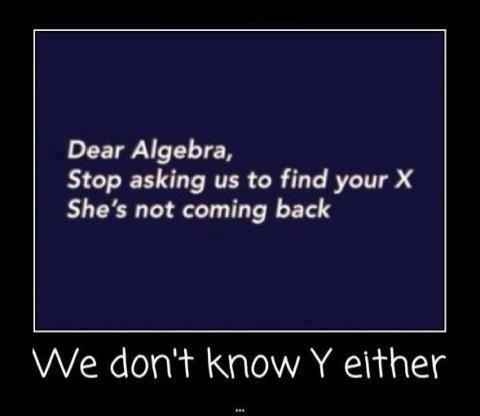
    So the person who inspired this series on Algebra is my dear friend Michele “Wojo” Wojciechowski – a very funny writer and stand-up comic. In her honor, I thought I’d wrap things up with a post looking at the humorous side of algebra.

    When something makes us uncomfortable, we make fun of it. I mean, why not, right? As a first-year teacher, I remember giving a geometry test, on which I asked students to define space. One student wrote: “The final frontier.” And I have to admit that I laughed.

    So, whether or not I’ve convinced you that algebra is a useful, everyday skill, at least join me in a little laughter today. And be sure to come back next week, when we start celebrating National Math Awareness Month. (The excitement never ends, does it?)

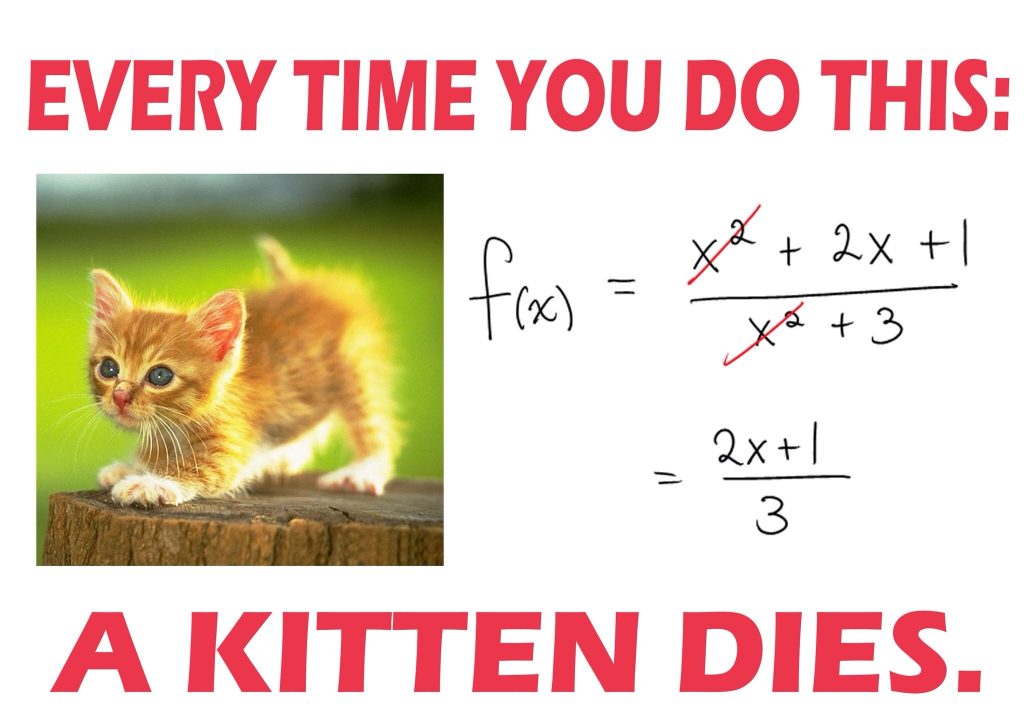
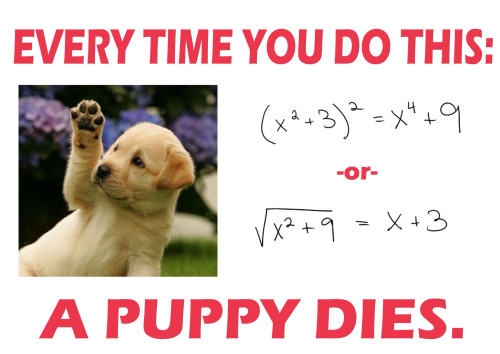
    These next two are great for math teachers, as they demonstrate very common errors that students make.

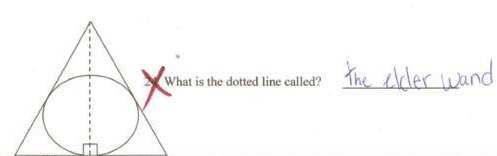
    You have to be a Harry Potter geek to get the next one:

    Happy weekend, everyone! Use some algebra and make the world a better place.

    Got any math jokes? Feel free to share them in the comments section.

  • Using Algebra – Literally

    Using Algebra – Literally

    Parks and Recreation, the Amy Poeler-driven mocumentary on NBC about a small-town parks department, features a tightly wound character, Chris Traeger, whose favorite word is literally – as in: “Biking for charity is literally one of my interests on Facebook.” It’s funny because it makes us grammar fanatics crazy. Literally is literally one of the most misused and/or overused words in the U.S.

    I had never seen the word applied to mathematics until recently. No kidding! That’s when I learned about literal equations. I mean, I already knew about them; I just didn’t know what they were called. And yes, you know about them too. They’re one of the ways that we use algebra in our everyday lives – without even knowing it.

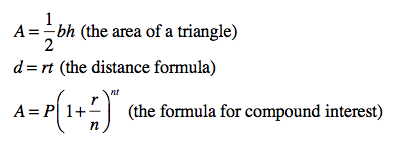
    Literal equations are equations with more than one variable. Ta-da! See, you knew about them, too. Here are some examples, in case you’re not convinced:

    Look at all of those variables. Each equation has more than one, which means that each of the above is a literal equation. That’s it. Easy.

    Now, the algebra of literal equations is much, much easier than most mathematics, especially if the equation is simple, like the distance formula. (Don’t panic. This is not one of those train-leaving-Pasadena questions.) The algebra is in identifying the variables, substituting into the equation and then solving.

    Let’s say that you’re an avid cyclist. In fact, you’ve got all the cool accouterments, like a gel-padded seat, clip-on pedals and a speedometer. You average about 16 miles per hour on flat roads, and you love trying out new routes, just riding where your bike takes you. But it’s critical that you know the half-way mark for most of your routes – otherwise, you won’t have enough steam to get back home.

    That’s where the distance formula can come in.  If you know your speed (or rate, r) and the time you’ve been out, you can find the distance. This way, you know when to turn around and head back to enjoy those endorphins.

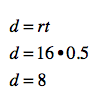
    One gorgeous Saturday morning in March, you head out on an unfamiliar route, cruising at about 16 miles per hour. Checking your watch, you find that you’ve been on your bike for half an hour. How far have you traveled? You can actually do this math in your head – just multiply 16 by 0.5. How do I know this? With the literal equation d = rt.

    See? You just used a literal equation. And you did it on your bike. As Chris Traeger would say, “You are literally the most impressive cyclist I know.”

    How have you used literal equations recently? Want to share in the comments section? Feel free. Also, feel free to challenge my thesis that algebra is an important part of a solid middle and high school education. I can take it. Really.

  • Coloring Inside the Lines: How algebra helps

    Coloring Inside the Lines: How algebra helps

    Math is black-and-white, with right-or-wrong answers. It’s hard to color outside the lines in math.

    While I often argue with this point, there is some truth to it. Just like grammar, chemistry and baking, math is a pretty precise subject matter. Sure, there are many different ways to add 24 and 37 in your head, but fact is, you can’t just decided that the answer is –19, right?

    Rules make math work. And algebra helps us write down these rules. Now, we don’t necessarily need to think of math rules in this way, but believe me, when teaching and writing about math, it sure does help. And there are some real-world situations when an equation can  really help make math easier.

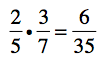
    Let’s consider the process for multiplying fractions. Do you remember what it is? Take a look at this problem, and see if you can figure it out:

    Of course there are several ways to describe what is happening above, right? You can do it in plain English:

    To multiply two fractions, multiply the numerators and multiply the denominators.

    Or, you can write this using algebra. This is not as hard as you might think! First, assign a variable to each of the unique numbers on the left side of the equation:

    a = first numerator

    b = first denominator

    c = second numerator

    d = second denominator

    Then substitute those variables for the numbers themselves:

    Now, perform the rule that was described in plain English above: multiply the numerators and multiply the denominators.

    How about that! Lickity split, we made like mathematicians and created a rule described algebraically. How hard was that really? 

    Now you can use this rule to multiply any fractions of any kind. I don’t care if they’re elementary fractions made up of just numbers or if they’re fancy-schmancy algebraic functions that have — gasp! — variables in them. You don’t even have to think of the abc or d. Instead, think of those variables as place holders. (Hint: this is where your mind can be really flexible, even though the rule is not.)

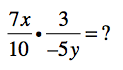
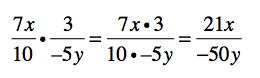
    Because you know this rule, you can solve this problem (even with the x and the y). Just multiply the numerators and then multiply the denominators.

    Because of the rule for multiplying fractions — which includes the variables aband — you can see how to multiply any fractions. That’s where the algebra comes in handy.

    Now, I know exactly what you’re thinking. When will I ever need to solve a problem like the one above. And here’s my honest answer: for most of you, never. Really and truly. I won’t lie.

    However, there are times when creating a rule for a specific real-word problem is very useful. That’s when we might create an equation. Stay tuned, when we’ll talk wedding receptions, guest lists, the price per person and rental fees.

    So what do you think of algebra and math rules? Did this example help you understand how algebra is important in developing and stating these rules? Do you disagree with me about why this is important? I can take it — so please do share your thoughts in the comments section.

  • Numbers and Letters Together: What is algebra?

    Numbers and Letters Together: What is algebra?

    A Math for Grownups follower asked me earlier this week to define algebra, and I thought that was an excellent place to start this month-long discussion. I think that most people might be surprised by what is generally found under the algebra tent. The basic definition is pretty broad:

    Algebra is a branch of mathematics that uses letters and other symbols to represent numbers and quantities in formulas and equations. This system is based on a given set of axioms.

    What does this mean? Well, it’s basically the step beyond arithmetic, where we only deal with numbers. Algebra allows us the flexibility of an unknown — the variable — so that we can make broader statements about situations.

    Look at it this way: 8 + 3 is always 11. Always. But 8 + x depends on the value of x. This means we can pretty much substitute whatever we want for x. See? Flexibility. (Of course 8 + x has no meaning without some kind of context. But we’ll get to that later in the month.)

    Algebra allows us to discover and create rules. These rules might be formulas or equations that describe a particular situation. Because of algebra, we know that the circumference of a circle is 2πr, where π is the number 3.14… and r is the radius of that circle.

    Now, let’s take this definition one step further. What is the circumference of a circle with radius 1?

    C = 2πr = 2π(1) = 2π

    But what about the circumference of a circle with radius 2?

    C = 2πr = 2π(2) = 4π

    If you look closely at this, you can draw a conclusion: The larger the radius of a circle, the larger its circumference. When the radius is 1, the circumference is 2π; when the radius is twice as long, the circumference is twice as big.

    This points to a critical aspect of algebra: relationships.

    Algebra is a branch of mathematics that deals with general statements about the relationships between values, using numbers and variables to describe them.

    The formula for the circumference of a circle is a description of the relationship between the circumference and the radius of any circle. When the radius changes, so does the circumference. When the circumference changes, so does the radius. (π is a constant, even though it is technically a Greek letter. Whenever you see π, you know you’re dealing with the number 3.14…)

    So that’s it. Algebra is nothing more than a way to describe the relationships between values (numbers, measurements, etc.). In the example of circumference, we’re dealing with two branches of math. The geometry describes why the circumference is twice π times the radius. The algebra is how we describe that relationship in the form of a formula.

    Without algebra, we really don’t have ways to describe many things about our lives — from geometry formulas to finding compound interest on a loan. We can fumble around and come to a conclusion, but in the end, algebra can make this process much simpler.

    What do you think about these definitions of algebra? Does thinking about algebra in these ways make it a little less threatening? If so, how? Share your ideas in the comments section!

  • Algebra: What good is it anyway?

    Algebra: What good is it anyway?

    Hating on algebra is all the rage these days. From New York Times editorials to cute little Facebook images, it seems that we’re settling into a big assumption: algebra is not useful to the average person. For the most part, this idea is pretty harmless. When I see those Facebook posts, I generally smile to myself and think, “Oh you’re using algebra. You just don’t know it!” (And yes, sometimes I say this out loud. I work alone, and my cats don’t care.)

    But of course when there are calls to remove algebra from high school math curriculum, things get pretty serious. If you had driven past me at lunch time one fall day last year, you might have seen me (literally) shaking my fist and shouting at my radio. My local public radio station was airing a talk show featuring some doofus (I think he was a philosophy professor?) who was advocating that we actually stop teaching algebra. Seems it upsets students too much and, heck, we don’t need it anyway.

    Want to make me mad? All you have to do is suggest this in a serious way.

    So, prompted by all of the online ribbing that I get from people, I’ve decided to take on a challenge. This month, I’ll be writing about exactly how algebra is useful. My goal is to convince anyone who thinks differently that they’re wrong. But I know this is a tough sell. So I’ll settle for a couple of small concessions.

    My thought is that I’ll focus on everyday uses for algebra (from spreadsheets to formulas), algebraic thinking (how we can think critically, thanks to algebra) and why I believe algebra is a cornerstone subject for middle and high school students.

    Want to challenge my thinking? Go right ahead! Want to offer your own experience? Please do! I’d love to promote a real conversation on this topic. I can always learn something new about how real, live people use the math devoted to finding x.

    In the meantime, share your algebra story in the comments section. I’d love to hear from everyone — whether algebra was the first time math clicked for you or you were one of those folks who said forget it, once letters were introduced to your math.

  • Math Summer Camps: Guest post by Lynn Salvo of MathTree

    Math Summer Camps: Guest post by Lynn Salvo of MathTree

    So last summer, I wrote about my disdain for math-geared summer camps. And I was summarily schooled by my friend Lynn Salvo, founder of MathTree, which offers summer camps in Virginia, Washington D.C., Maryland and Delaware. She was right, of course, and I invited her to share why a summer camp centered on math can be a rewarding experience for parents and students. Mind changed. (Thank you, Lynn.)

    While summer is a great time to kick back and recharge, the down side is that kids forget a lot of math over the summer.  Studies show that during the lazy months of summer, all kids suffer from “brain drain” or the loss of learning. In fact, students lose (on average) 2.6 months of mathematical competency in June, July and August.  Only the most math-minded and determined parents can find the math in everyday life to keep math going over the summer.  A couple of weeks of a math camp anywhere in the summer can bridge the long gap.

    I am president of  MathTree, which I founded in 1999 to address this very issue.  We have been providing math camps for children ages five to15 throughout the DC, Virginia, Maryland and Delaware area ever since, mostly in the summer but also during long school breaks.  Children love our camps and return summer after summer.  Some have even grown up to be instructors for us themselves.

    If you’re reading this blog, you probably know math is not the most popular subject.  MathTree would have gone out of business long ago if we had not found a formula that works to provide a great summer math experience for kids.  In a typical school setting, younger children are taught math by amazing elementary school teachers who are generalists, not specialists. And unfortunately, many of them don’t really like math all that well.  Summer is a great time to give your child an opportunity to work with folks who love math, love kids, and love teaching kids math!

    So what should you be looking for and how can you evaluate the math (summer) camp possibilities you are considering for your child?  Here are some questions:

    • Does the camp provide different ways of learning there is not time for in a packed school curriculum?
    • Does the camp promise an adventure?  Will the camp creatively lead my child on a mathematical exploration?  At MathTree we have our own mathical characters, including Princess KrisTen; Grouper, the Regrouper; and Numero, the Number Wizard, which we use to happily engage our campers in fun math exploration.
    • Is my child going to be set up to make mathematical discoveries?
    • Will my child play fun math-rich games?  For instance, we play games such as Ten Mingle to learn numbers that add up to 10 or Product Parfait to master multiplication facts.

    Other important questions should include:

    • Will my child actively engage with people who can sense subtlety and nuance in my child’s understanding or will s/he be babysat by an electronic device?
    • Does the camp provide a sustained and focused learning experience? Does it develop momentum and go deep into math?
    • Does the camp focus on why, not just how?  Will my child learn concepts, not just processes?  For example, will my child learn what division is, not just how to do it?
    • Does the camp provide an enriching head start on the big ideas coming in math in the next school year?
    • Will my child be placed with mathematical peers or lumped with others of the same age or grade regardless of where they are mathematically? It’s critical that your child is neither frustrated (too hard) nor bored (too easy).
    • How will my child be assessed?  Will my child’s understanding be monitored in multiple ways, even in simple conversations?
    • What is the staff to camper ratio?  Your child may have suffered already in a large class.

    I firmly believe that parents should always look for classes with less than 15 campers where there is a teacher and an assistant.  Here is what the teacher can do in that setting:

    • Actively engage your child in the learning
    • Tune in to your child — your child is not a number!
    • Embrace your child’s unique personality
    • Notice if your child looks confused
    • Jump in quickly and “unconfuse” your child.

    Here’s what the assistant can do in that setting:

    • Handle routine tasks so the teacher can be fresh and creative with the class
    • Check children’s work quickly
    • Prepare rich math materials for children to use and store them after use so there is more quality class time
    • Provide a challenge if your child gets ahead of the group.

    Whichever camp you choose, take the selection of your children’s summer math camp seriously.  You want your child to come away loving math (more) and you want to feel you got a high return on your investment.

    MathTree has been growing our children’s love of math since 1999. For more information about MathTree and registration, please go to www.MathTree.com.  MathTree provides summer camps for kids in 25 locations in DC, DE, MD, and VA.  Use our camp locator to find a MathTree camp near you.

  • Halving a Recipe: Dividing with fractions

    Halving a Recipe: Dividing with fractions

    New here? You’ve stumbled upon January’s Review of Math Basics here at Math for Grownups. This week, we’re doing a quick refresher of fractions.  Monday was multiplication, so if you missed that, you might want to take a quick look before reading further. Math concepts build, you know. 

    Psst! Wanna know a secret? Sure you do. So here you go: There’s a debate among math educators about whether dividing with fractions is useful at all. There. I said it. But don’t tell your kids or they might rebel.

    But yes, I’m being somewhat serious here. Among math teachers who really, really think about these things — perhaps too much and I’m often in that camp — dividing with fractions is pretty much unnecessary. Okay, so you might need to divide with fractions (like when you’re halving a recipe). But while the process is stupidly simple (trust me), there are other ways to think about it that may make more sense.

    [laurabooks]

    Let’s take a look at that rule:

    Dividing by a fraction is the same thing as multiplying by its reciprocal.

    If you know what all of those words mean, you can recognize that this is pretty darned easy. But if your days in elementary school are long past, you might have forgotten what the reciprocal is. Luckily, this is no big deal. The reciprocal of a fraction is formed when you switch the numerator and denominator. In layman’s terms, you turn the fraction upside down. Like this:

    It couldn’t be easier, right? So let’s put it all in context with an example.

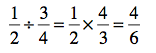
    See what we did there? We turned the second fraction over and multiplied instead of divided. This is called the “invert and multiply” process. Now, all we need to do is simplify the answer.

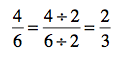
    Notice how the 4 and 6 are both divisible by 2? Well, that means the fraction can be simplified. On a 4th-grade math test, this means your teacher wants you to do more work. In the real world, it just means that the fraction will be easier to work with or even understand. (When you see the result, you’ll know what I mean.)

    Doesn’t 2/3 seem a lot easier to understand than 4/6? Think of recipes. Do you have a 1/6-cup measure in your cabinet? (I don’t.)

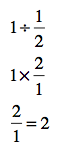
    So let’s consider how this works (or why, if you’d rather) by considering a really basic division problem: 1 ÷ 1/2.

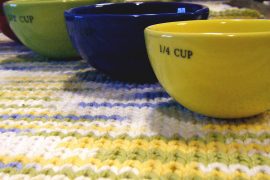
    How many ½s fit into 1? That’s the question that division asks, right? Think about those measuring cups. If you had two ½ cup measuring cups, you would have the equivalent of 1 cup. In other words:

    Make sense? Now here’s another way to look at it:

    Let me summarize: 2 ½s fits into 1. In other words, 1÷ ½ is 2. And that turns out to be the same thing as multiplying by the reciprocal of ½, which is 2.

    That’s a lot to take in, and you don’t have to know it by heart – or even fully understand. It just explains why this crazy rule works. And here’s another secret – there are lots of other ways to divide fractions. You can do it in your head. (It’s pretty easy to solve this problem without any arithmetic: ½ ÷ ¼. Right?) Or you could even find a common denominator (more on that Friday) and then just divide the numerators. (I’ll leave that process for you to figure out if you’re so inclined.)

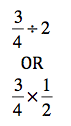
    The thing is, there aren’t many times in the real world that dividing by fractions is really necessary. Here’s an example to explain what I mean. Let’s say I’m cutting a recipe in half. The recipe calls for ¾ cup of sugar. How much will I actually need? Well, I can look at the question in a couple of different ways. (See which one jumps out at you.)

    I would bet – and I can’t prove it – that most of you thought about the second option. That’s because you’re cutting the recipe in half, not dividing the recipe by 2.

    In short, dividing by fractions is pretty darned simple, compared to other things you have been required to do in math. Too bad it doesn’t show up much in the real world, right?

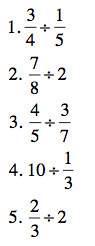
    Just for fun, try these problems on for size – using whatever method works for you. (No need to show your work!) Bonus points if you can simplify your answer, when necessary. (And no, there are no bonus points, because there are no points.)

    The answers to Monday’s problems: ⅓, 4/35, 15/8 or 1⅞, 5¼, 9⅔. How did you do? ETA: Me? Not so good. I made a careless error with the last problem. The correct answer is 3 ⅔, which is explained by the comments below.