Category: Math for Parents

  • How Far? Estimating metric distances

    How Far? Estimating metric distances

    Earlier this month, I showed you how to convert currencies, when given the exchange rate. When you’re not using an online calculator, that process involves proportions, which are pretty simple to use, but do require a little figuring on paper. This same process works for any conversions, including miles to kilometers, liters to ounces, etc.

    But while being exact with your money is pretty important, estimating how far you have to drive or walk is usually good enough. So instead of going into details about metric-to-traditional measurement conversions, let’s look at how you can find these distances with a little mental math. First, you’ll need to know a few facts:

    1. A mile is longer than a kilometer. So, when you convert miles to kilometers, the answer  will be larger than the original amount. (mi –> km = larger answer)

    2. A kilometer is shorter than a mile. So, when you convert kilometers to miles, the answer will be smaller than the original amount (km –> mi = smaller answer)

    2. In fact, 1 mile equals 1.61 kilometers. And 1 kilometer equals 0.625 mile.

    3. Those values are pretty darned close to 1.5 kilometers and 0.5 mile.

    Remember, we’re estimating here, so you’re not looking for an exact answer. Forget what your middle school math teacher said about the precision of math. You don’t always need to getan exact answer. But there’s another fact you’ll need to consider:

    4. The larger the value that you’re converting, the less precise your answer will be.

    If you depend on the estimate 1 mi = 1.5 km and you’re converting 15 mi to km, your answer will be pretty close. BUT if you’re converting 1,468 mi to km, your estimate will be a lot lower than the actual answer.

    Look, estimating is no big deal. In fact it’s a really, really powerful tool that can make your life much easier. You do need to know when estimation is in your best interests and when you should pull out the calculator. (See? Math really isn’t all that black and white!)

    Let’s look at an example. Zoe has finally made it to London! She’s spending the summer studying Shakespeare and working part-time as a docent at the Tate Modern. And she’ll have some time to roam around Europe a bit. She’s rented a car so that she can chart her own path, and next Friday afternoon, she’s going to cross the channel to France, where she hopes to spend four days winding her way down to Paris and back.

    But how long will it take her to get there? According to her map, the distance is 454 km. Since Zoe is used to miles, she’d like to convert the distance so that it makes more sense to her. She’s okay with a rough estimate, especially since she has no firm schedule. So she decides that knowing there are about 1.5 km in a mile is good enough.

    To make the math even easier, she decides to round the distance as well: 450 is pretty close to 454. Now she can easily do the math in her head, but we’ll get to that in a minute. Let’s write it out first.

    Because she’s converting kilometers (shorter) to miles (longer), her answer will be smaller than the original amount. That means she’ll need to divide.

    450 km ÷ 1.5 = 300 mi

    So she’ll travel about 300 miles to get from London to Paris — not a huge distance!

    But how could she do this in her head? For that, she’ll need to remember a few things about fractions.

    1.5 = 3/2

    450 ÷ 1.5 = 450 ÷ 3/2

    450 ÷ 3/2 = 450 • 2/3

    (That’s because when you divide by a fraction, it’s the same thing as multiplying by its reciprocal — or the same fraction upside down.)

    So in order to convert kilometers to miles in her head, she’ll need to multiply the value by 2 and then divide by 3 (which is the same as multiplying the value by 2/3. In other words:

    450 • 2/3 = (450 • 2) ÷ 3 = 900 ÷ 3 = 300

    Whew!

    But once Zoe remembers this little trick, she can estimate these conversions quickly and easily.

    30 km = ? mi

    30 km • 2 = 60

    60 ÷ 3 = 20

    30 km = 20 mi (approximately)

    Make sense? Try it for yourself: convert 75 km to mi and then use an online calculator to check your answer. Remember, if you’re using the process above, you’ll get an estimate, not an exact value!

    So take a guess: If you’re converting mi to km, what process would you use? See if you can figure it out and then offer your explanation in the comments section. Feel free to choose a value to convert, if it’s easier to explain that way.


  • Kids in the Car: Keep ’em busy with math

    Kids in the Car: Keep ’em busy with math

    Whether you’re flying across country or crammed in the mini-van for a trip to Grandma’s house, keeping a kid occupied on a long trip may mean you need a vacation at the end of it. And sure, we can plug them into movies or iPods or video games, but is that really what you want your children to remember about their trip to the Grand Canyon?

    Being trapped in a car or plane or train for hours at a time will either kill you or make you stronger, and I’m rooting for stronger. You can look at this as an opportunity to hang out with your kids — and even sneak in a little math.

    I know that sounds really, really geeky, but this was a real, live question that a parent asked me over at MSN.com’s Mom’s Homeroom where I’m the resident math expert. Since we’re talking travel this month, I thought I’d expand on the ideas here. The parent asked: “What are some fun math games that I can play with my 10 year old son and 7 year old daughter while on road trips?”

    First and Last

    This is a take on a game that I used to play with my daughter. She would say a letter, and I would say a word that began with that letter. Then she would identify the last letter of that word, and give me a word that began with that letter. For example: S prompted me to say spaghetti. She would say I and then igloo.

    This can easily be adapted to math, which helps kids (and adults) practice their mental computation skills. For example:

    First player: 16 + 3

    Second player: 19

    Second player: 19 – 10

    First player: 9

    First player: 9 • 3

    and so on…

    Set the rules of the game so that everyone can play. For example, no negative numbers, fractions or exponents, if your 13 year old is playing with his 8-year-old brother. Or tell them that they can only use even numbers or only addition and division. You might just find that your kids are getting really creative — and making some cool connections. (Did you know that when you add or subtract only even numbers, the answers will always be even?)

    Road Sign Math

    If you’re in the car, sometimes the only thing to read are road signs and license plates. But if you take a close look, you could find some math in there. In fact, someone has created a cool wiki devoted to this game. Take a look at the sign below.

    Photo courtesy of Road Sign Math wiki

    Do you see the math in there? It’s a very simple addition problem: 2 + 4 = 6.

    These can get downright complex! But you can keep it easy for your younger kids. Look out for route numbers, license plates and billboards for more ideas. If you’re used to traveling the same road over and over, this is a particularly good way to pass the time. What’s old becomes new again!

    I Spy

    This perennial favorite can be adapted to all sorts of situations. For example:

    “I spy with my little eye: a prime number!”

    “I spy with my little eye: 17!”

    I spy with my little eye: a fraction!”

    Try this with a boring magazine on the plane. Keep the questions on grade level and offer encouragement for good — or close or creative — answers. Need to remember what a prime number is? If you’re not driving, do a quick search on your smart phone.

    There are countless other ideas that can help you pass the time and inject a little math into the trip. Do you have suggestions? Offer them in the comments section!

  • Ah, Ohh! Math and fireworks

    Ah, Ohh! Math and fireworks

    Here in the states, today is Independence Day — the 236 anniversary of the signing of the Declaration of Independence. (Yes, I subtracted 1776 from 2012.)

    Most of us are taking the day off, but there is one industry that is working overtime: the guys and gals who choreograph and conduct fireworks displays. These gorgeous displays are patriotic, fantastical and downright dangerous.

    As you can imagine, there’s a ton of math that goes on to make sure that no one in the 500,000-person crowd at the National Mall in Washington, D.C. aren’t injured by the 66,000 pounds of explosives that go off in a 20-minute show. (Oh, and for any of you math teachers out there reading, this is how to get pyrotechnic teens interested in algebra. When they ask when they would ever use conic sections or quadratic equations, talk to them about fireworks and Punkin chunkin.)

    [laurabooks]

    So we’re not going to get into the nitty-gritty of the math here. Instead, let’s look at the concepts behind the math involved. First, you need to know how fireworks are set off.  The shell is set in a mortar tube, which rests on the ground. When the fuse is lit, a chemical reaction forces the shell into the air, following a predictable path.

    As long as everything is timed and spaced properly, the shell bursts and the debris begins to fall back to the ground. You can replicate this (safely) with a tennis ball. Throw it up in the air and watch what happens.

    You’ll notice that the ball rises and, once it hits a certain height, starts to fall again. If you throw it straight up, it will go higher. If you throw it at an angle, it goes farther out. (Parents: This is a really cool experiment for kids. Have them try throwing the ball at a number of different angles.

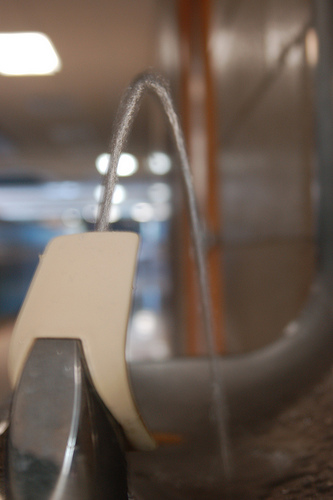
    What happens? Estimate the angle at which you’re throwing the ball. (Straight up and down is 90 degrees.) Then measure the distance from where you threw the ball and where it landed. What kinds of connections can you make between the two?) This is called a trajectory. Physics dictates that the path an object takes when launched into the air will be a curve. Specifically, this curve is a parabola.

    The water in this water fountain forms a parabola. (Photo courtesy of Paul Anderson)

    Here’s the math part: Every curve has an equation associated with it. That equation describes all sorts of things — like how tall and wide the curve is. But why do fireworks geeks care? Because the equation keeps everyone safe. The firework must be launched at the correct angle, or it could land in the middle of the watching crowd. This magic number depends on the firework in question. Heavier explosives must have greater force behind them. They need that velocity to get them to the right height. Second math part: These equations are always quadratic. In other words, their highest exponent is 2, like this:

    x2 + 3x – 9 = 0

    For most of the population, solving this equation isn’t important. But I do think it can be useful to know a few things:

    1.  Linear equations don’t have exponents,
    2.  Curves have exponents, and
    3.  Quadratic equations represent parabolas.

    Of course, anyone who is interested in getting into the fireworks biz is going to have to know more than that.

    So there you have it. A tiny fraction of the math behind fireworks. Now you have even more to ooh and ahh about.

    Questions about fireworks or quadratic equations? Ask them in the comments section! I’ll track down the answers for you if I can. (I’m no chemist or physicist, though!)

  • Feeling the Burn: The math of SPF

    Feeling the Burn: The math of SPF

    It’s the last post of June, but we have a lot more summer to go. That means a lot more opportunities to enjoy the outdoors — and expose ourselves to damaging UV rays. Not only is a burn uncomfortable (or downright painful), but it comes with a whole host of other problems, from wrinkles to cancer. Take a look at these facts from the Skin Cancer Foundation:

    • More than 3.5 million skin cancers in over two million people are diagnosed annually. That’s more than the combined incidence of cancers of the breast, prostate, lung and colon.
    • One in five Americans will develop skin cancer in the course of a lifetime.
    • Over the past 31 years, more people have had skin cancer than all other cancers combined.
    • Between 40 and 50 percent of Americans who live to age 65 will have skin cancer at least once.
    • One person dies of melanoma every 62 minutes.
    • One or more blistering sunburns in childhood or adolescence more than double a person’s chances of developing melanoma later in life.
    • A person’s risk for melanoma doubles if he or she has had more than five sunburns at any age.

    So that’s a lot of numbers and statistics. (Believe me, I only shared a fraction of what I found.) But there are other really important numbers to consider: SPF or sun protection factor.

    Basically, SPF is the estimate of time that you can be in the sun without burning. This is really easy math. Let’s assume that without sunscreen, you would burn after 15 minutes. If you used a sunscreen with SPF 15, you’d be able to stay in the sun 15 times as long without burning:

    15 minutes • 15 = 225 minutes

    225 minutes ÷ 60 = 3.75 hours

    If you used a sunscreen with SPF 30, you be able to stay out twice as long:

    15 minutes • 30 = 450 minutes

    450 minutes ÷ 60 = 7.5 hours

    But can you add SPF values? In other words, if you put on SPF 15 and then SPF 30, would you have SPF 45? Mathematically speaking, yes. But in actuality, nope. You’re only as good as the highest SPF you applied.

    It’s also important to note that SPF ratings are averages. So while these calculations can help protect you from a nasty burn, you can’t count on them for down-to-the-minute protection. (There’s that imprecision-of-math thing again.)

    There are also many, many other variables to consider — including time of day (sun exposure is harshest between 10:00 a.m. and 2:00 p.m.), location (water and sand reflect light, intensifying the rays) and activity levels (sweat and water can cause sunscreen to wear off).

    The bottom line? You can do all of the calculating you want, but the only sure-fire way to prevent a sunburn — and the health risks associated with it — is to avoid the sun. Protective clothing can help, along with staying out of the sun when it’s at its strongest. And look for new labeling on sunscreen products. Last summer, the Food and Drug Administration (FDA) introduced new rules for these products, which will start showing up next summer.

    This is perhaps the most basic math of all, so there’s no need to make it complicated. For once, you don’t need to multiply or do figures in your head. Just follow these simple rules:

    1. Wear the highest reasonable SPF levels. (The FDA says SPF 50 is the best you can do.)

    2. Everyone needs sunscreen. All skin types can burn or at least suffer from skin damage. So even if you have dark skin, apply sunscreen.

    3. Cover up as much as possible, with broad hats, swim shirts and umbrellas.

    4. Avoid the sun at peak times, especially if you plan to be on the water or beach.

    5. Reapply sunscreen at least every two hours, more often if you’re sweating or getting in and out of the water.

    Simple, eh?

    How do you manage the sun and outdoor activities in the summer? If you have cool tips to share, post them in the comments section!

    On Monday, we’ll take off on a month of travel math. Got questions? Let me know, and I’ll track down the answers.

  • Garden Geometry: A guest post from the Outlaw Garden

    Garden Geometry: A guest post from the Outlaw Garden

    My thumb isn’t even remotely green. The only plants I have any success with are those that can sustain a tremendous amount of neglect — like hydrangea, hostas and lariope. So I asked fellow write and founder of Outlaw GardenCristina Santiestevan to step in with some gardening math. She does not under-deliver! Check out the mad geometry skills she has. Then put her tips to work in your own garden. 

    In the garden, math is everywhere. There’s arithmetic and subtraction, which gardeners use to estimate how long it will take for a tomato to ripen or a seed to sprout. There’s multiplication, which helps gardeners calculate expected yields. And, there’s higher math too. Lots and lots of higher math.

    Yesterday, for example, I used a measuring tape and a bit of high school geometry to confirm that my tomato trellis would be a nice (right-angled) rectangle, rather than a slightly askew parallelogram. I also used an online calculator, because figuring out the square root of 10,116 isn’t especially easy to do by hand. I knew I’d get a number close to 100, but I wanted to be sure.

    Turns out that the square root of 10,116 is 100.57832768544127. I rounded to 100.5, because my measuring tape isn’t quite that fine-tuned.

    If you haven’t guessed yet, I was using the Pythagorean Theoremabc2. As an avid DIYer, I use this formula a lot. It’s a great way to be sure that your project will be square, with four right angles. That’s essential if you’re building any sort of box, especially if you’ll be adding a door later. A slight skew away from 90° can create all sorts of trouble.

    In this case, the motivation is all aesthetics. This trellis could work fine as a parallelogram. The tomatoes wouldn’t even notice. But, I would.

    So, here’s how I did it. The trellis is 96 inches tall and 30 inches wide. Those are our a and b sides. Putting them into the equation, we get 96+ 30c2. That works out to

    9216 + 900 = c2

    10,116 = c2

    This is when I googled “square root,” in hopes of finding an online square root calculator. I knew it would come in close to 100, because 100 • 100 = 10,000. But, I wanted to be as exact as possible. That’s where the online calculator came in handy. The answer — 100.57832768544127 — was more precise than I really needed. 100.5 inches is plenty good enough when building trellises in the garden.

    With that number in mind, I measured the diagonal from top to bottom on both sides of the trellis. One side measured about 100.25 inches and the other measured about 100.75 inches. A slight adjustment, and both sides measured 100.5 inches. The trellis was square. Success!

    Here’s the plan for the trellis. You can see where the right triangle would go:

    (Cristina has a great post detailing the step-by-step process for building her trellis, including a downloadable pdf of her plans. Check it out here.)

    Trellises aren’t the only place we use and see geometry in the garden. The Pythagorean Theorem is a great help to gardeners who want to ensure their garden beds and paths are perfect squares or rectangles, for example. And, equilateral triangles — three equal sides — provide guidance when planting the garden. While most books tell us to plant our vegetables in rows that are square to each other, that’s not the best way to maximize our garden space. No. Instead, plant your rows on a diagonal, using an equilateral triangle as your guide, and you will be able to fit more plants into the same amount of space. Like this:

    See how a series of six triangles creates a hexagon in the diagonal planting pattern? That’s where the extra space efficiency comes in; you’re basically planting on a hexagonal pattern. And, as bees already know, the hexagon is the most efficient shape.

    Even plants have geometry. All members of the mint family have perfectly square stems, like this bee balm:

    Sedges — a grass-like bog plant — have triangular stems. Some plants, like dogwood and maple trees, follow a perfect symmetry with their leaves. These are known as opposite plants, because their leaves form opposite one another on their branches. Alternate plants, on the other hand, form their leaves singularly or in groups, on alternate sides of the branch. Other plants grow their leaves and flowers in whorls or rosettes:

    The dogwood has opposite leaves.

    Virginia Sweetspire has alternate leaves.

    The leaves of the culversroot are in a rosette pattern.

    And, the Fibonacci Sequence is everywhere:

    The pattern of the yellow spirals in this chamomile are based on the Fibonacci sequence

    Thank you, Cristina! My advice to you, dear reader: do not miss her blog, Outlaw Garden; it’s funny, informative and really, really clever. Do you spend time in the garden? What kind of math do you use and see while tending your plants? If you have questions, don’t hesitate to ask in the comments section. Don’t worry, I’ll ask Cristina to come by to respond. (It’ll be better that way.)

  • How Hot Is It? Calculating the heat index

    How Hot Is It? Calculating the heat index

    Lordy, it’s hot. And the heat makes me cranky. When I saw that the temps were creeping up to the 90s and beyond this week, I vowed to stay in the airconditioning. Trust me; it’s best for everyone involved.

    So don’t even tell me what the heat index is. I really don’t want to know. But I have always been fascinated with how it is calculated. What are the variables that affect the heat index? Let’s take a look.

    The heat index is how it really feels when the humidity is figured in. (Those of you who live in a climate with dry heat have no clue about this. Count yourselves lucky.) When the humidity is high, the heat index goes up, producing a hot, sticky mess that makes my hair frizzy and sours my otherwise lovely temperament.

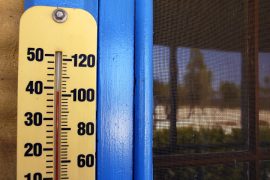
    The thermometer may say 95 degrees Fahrenheit, but if there’s significant humidity, it might feel like it’s 105. But of course meteorologists don’t guess at this number. There’s an actual formula that’s used to find the heat index.

    Before we get to that, let’s consider the variables involved. According to the National Oceanic and Atmospheric Administration (NOAA), there are 20 (yes, twenty) variables that are used to calculate the heat index. These range from vapor pressure to the dimensions of a human to ventilation rate to sweating rate (ew). Because most of these are very specific to each person, a mathematical model was used to determine an appropriate range for each. This allows meteorologists to use a (relatively) simple formula for finding the heat index:

    HI = -42.379 + 2.04901523T + 10.14333127R – 0.22475541TR – 6.83783(10-3T2) – 5.481717(10-2R2) + 1.22874(10-3T2R) + 8.5282(10-2TR2) – 1.99(10-6T2R2)

    Pretty, right? It’s actually not that hard to understand, if you break down the pieces. First, let’s define the variables.

    HI = heat index

    T = ambient dry bulb temperature (in Fahrenheit)

    R = relative humidity (integer percentage)

    So there are basically three variables, one being what we are looking for — the heat index. If you were to use this formula, you would need to know two things: the ambient dry bulb temperature (which is merely the ambient temperature as measured by a thermometer) and the relative humidity.

    If you put to work the logical part of your brain that notices connections and patterns (yes, you do have one), the math becomes clear. When the temperature and relative humidity go up, so does the heat index. How do you know that? Look at the equation. It’s full of addition and multiplication. In fact, aside from the negative exponents (which actually yield smaller numbers), the equation is based solely on increasing values.

    (That is, unless you have negative values for T and R. But in that case, you wouldn’t be figuring the heat index, right? A negative T means a negative air temperature, which is really cold in Fahrenheit. And I’m not sure that relative humidity can be negative at all.)

    Now, almost nothing is absolute in weather prediction and measurement, right? And this equation is no exception. As NOAA points out, this equation is created by multiple regression analysis, which means it is not exact. (Basically, in this process, the mathematicians are fitting points to the closest line. Think of a bunch of points on a graph and how you can draw a predictable line or curve that is closest to all of those points.) There is in fact an error of ±1.3 degrees Fahrenheit. But what’s 1.3 degrees when you’re looking at a heat index of 102? Either way, it’s still darned hot.

    How do you manage the heat? Do you head inside or hide in a cool, dark place? Share your ideas in the comments section.

  • Preserving the Harvest: Canning with Math

    Preserving the Harvest: Canning with Math

    As a child, the only time I ever heard my mother use the f-word was in reference to green beans. It was the summer that my father put in a huge garden at our house, and she was sick of it. When he came home from work one day, asking if she had picked the green beans, she threw down her dishtowel and responded with: “You go out there and pick the you-know-what green beans.”

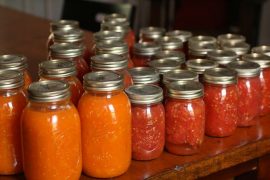
    That was the last time we ever had a garden, but it certainly wasn’t the last time my mother canned. As a little girl, I never had store-bought green beans, canned tomatoes or pickles. These were all preserved in Ball jars and stored in the basement for year-round eating. And while I’ve never canned myself, I am interested in at least pickling a few cukes this summer.

    So where’s the math? Well, it’s everywhere in canning. Just like with cooking, preserving foods requires recipes — and then there’s the part about taking a huge pile of fruits or veggies and divvying them up into a series of jars. Yep, math.

    See, canning is hot, hard work. In the middle of summer, you need to boil large pots of water, keep the jars warm in a hot dishwasher, the oven or a water bath. The last thing you want to do is run out of jars or lids in the middle of this entire ordeal. Doing the math upfront means you can get in and out of the kitchen without an added trip to the store (or your next door neighbor’s).

    Turns out there are easy-to-follow charts and tables for dealing with yield. But if your garden — or trip to the farmer’s market or pick-your-own farm — doesn’t yield the exact amount on the chart, you’ll need to do a little math.

    Drew’s humble green-bean patch is overflowing. After convincing the kid down the street to pick all of them (for a small fee, of course), he sits down in front of the television to snap them. (The Olympics and snapping green beans are a perfect combo.) At the end of a few hours, he estimates that he has about 16 pounds of green beans. Whoa.

    If he cans all of these beans, how many quart jars will he need? Turning to a trusted web source, he learns that a quart jar will hold about 2 pounds of green beans. Easy math: 16 ÷ 2 = 8. So he’ll need 8 quart jars.

    He’s got 15 quart jars in the basement, so the green beans are covered. But he also needs to put away his tomatoes. Will he need to buy more jars?

    After canning the green beans (and not using the f-word even one time — such restraint!), he considers those ruby red fruits. This time, he picks them himself, ending up with about 15 pounds. Consulting his yield chart again, he is faced with another decision: crushed or halved/whole? Canning tomatoes is a little more work, since he’ll need to skin them first. He decides to look at the yield for each option before making up a plan.

    Crushed tomatoes yield 2.75 pounds per quart, while halving them or leaving them whole yields 3 pounds per quart.

    Crushed: 15 pounds ÷ 2.75 pounds= 5.5 quarts (about)

    Halved/whole: 15 pounds ÷ 3 quarts = 5 quarts

    He’s already used 8 of his 15 quart jars, leaving him with 7. So he’ll have plenty of jars either way. If he crushes the tomatoes, he’ll need a couple of pint jars (because there are 2 pints in a quart). So, he decides to leave the tomatoes whole (or cut them in half, if necessary).

    And with two quart jars left over, he decides it’s time for pickles!

    Do you have plans to can anything this summer? Share your resources, tips, recipes and more in the comments section. I need inspiration!

    A programming note: I am changing my posting schedule a little — at least for the summer. Math at Work Monday interviews will now appear twice a month, rather than every Monday. If you have suggestions of folks I should interview, let me know!

  • Counting Pages: Make a memory book

    Counting Pages: Make a memory book

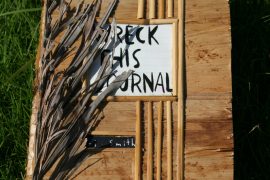
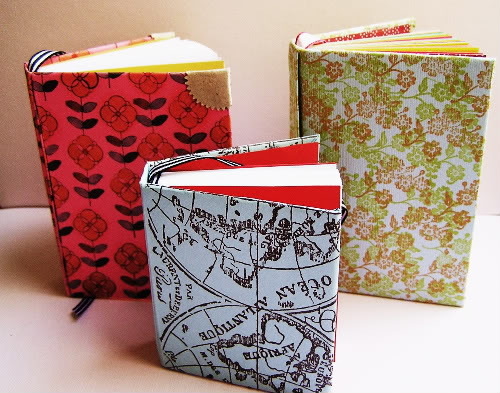
    Whether for graduation or summer camp or a great trip, a memory book or journal can be a nice way to remember a special time. And since I’m currently addicted to Pinterest, I’ve been browsing tutorials–from simple booklets to fancy, bound books. And then there are flower-pressing books and books constructed with homemade paper. The options are endless. (And they’re all so inspiring!)

    From my days as my high school yearbook editor, I know that there’s a little formula used to find the number of pages that a book can have. If you need to have a certain number of pages (at least), you’ll need to employ that tidbit of information. But first you must know how many pages you’d like to have in your book.

    Your teenager is headed off for a two-week long camp in the woods. She loves to write in a journal, and you’d like to make her a special book to take with her. If she uses three pages per entry, how many pages does her journal need to have?

    Let’s assume she’ll be journaling every day of her two-week stay. And let’s assume that she’s leaving on the last day. So that means she’ll journal for a total of 13 days (that’s two weeks, minus one day), and she’ll need a total of 3 • 13 or 39 pages.

    But here’s where you’ll need a little book-making insider information. Books are actually made up of signatures, which are sets of folded paper. You can put as many pieces of paper you want in a signature, and you can put as many signatures you want in a book — but the resulting page count will always be a multiple of 4.

    (Don’t panic if you don’t remember what a multiple is. Look carefully at the word. You’ll probably notice that multiply is a root, which may cause you to think of multiplication. You’re on the right track. A multiple is a product of two numbers. So the multiples of 4 are: 4, 8, 12, 16, 20, etc. That’s because 4 • 1 = 4, 4 • 2 = 8, 4 • 3 = 12… well, you get the picture.)

    In your book, the number of pages must be a multiple of 4, and you need at least 39 pages. Your first question: Can my book have exactly 39 pages? Nope. That’s because 39 is not a multiple of 4.

    You need to find a number close to 39 that is a multiple of 4, and you have two obvious choices: 36 (4 • 9) and 40 (4 • 10). Of course, you’re going to chose 40; otherwise, your daughter won’t have enough pages in her book. (Better to have too many than not enough.)

    Now you can decide how to create your signatures. I leave those details to the experts. Besides, you need to choose a book style first. Take a look at these great resources I found on Pinterest. Pick one, and have fun!

    The Pioneer Woman Makes a Book (from a granola bar box)

    Mini Jotter How-To from The Guilded Bee (by way of oh hello friend)

    Photo Courtesy of oh, hello friend and The Guilded Bee

    Flower Pressing Book from Family Fun

    Photo courtesy of Siona Karen

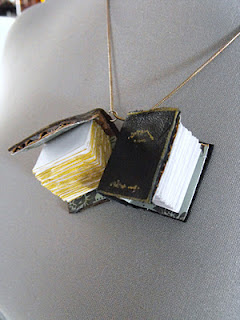
    Teeny-Tiny Leather Spell Book from Ruby Murray

    Photo courtesy of Ruby Murray

    Rainbow Art Book

    Have any tips for making memory books? Share them in the comments section!

  • Hittin’ the Trail: Taking the math in stride

    Hittin’ the Trail: Taking the math in stride

    I grew up a few miles from the Appalachian Trail in Southwest Virginia and my grandparents lived in the Shenandoah Valley, near Big Meadows a popular stop-off for trail hikers. While I’ve never had any inclination to take the entire trail from Georgia to Maine, I have done a few tiny sections — an hour or two hike each.

    It’s way too late in the year to start a thru-hike (doing the entire trail), but a section hike would be perfect for a lazy summer day. These are generally less than 5 miles, though you could string together two or more for a weekend adventure. And if you’re nowhere near the Appalachian Trail, just choose another trail to explore.

    But how much time should you allot for your hike? This is an important consideration, since it will determine the time you set out (there are no lights on the trail, so once the sun sets, it’s black as pitch) and what you’ll need to bring (food and water are essentials if you’re planning to be gone more than an hour or so).

    Experienced hikers can probably gauge how long it will take to hike a given number of miles. But if you’re like me, you don’t have a clue. That’s where pace counting comes in. The length of your stride will tell you how many steps it will take you to go a certain distance. From that, you can get a good estimate of how long it will take you to complete the hike.

    To measure the length of your stride, you’ll need two pens, a tape measure and a long hallway or sidewalk. Place one pen at the end of the hallway or sidewalk and stand with your feet together and hells against the pen. Now, walk 10 steps, taking normal strides. After the tenth step, bring your feet together again, and place the second pen behind your heels. Measure the distance between the pens, using the tape measure. Then divide by 10 to find your stride length. Ta-da!

    Another method is to estimate your stride based on your height. There’s a simple formula for this, but you’ll first need to have your height converted to centimeters. If you’re a man, multiply your height (in cm) by 0.415; women will multiply by 0.413.

    Once you have your stride length, you can use this to estimate the number of strides you’ll take when hiking a particular distance. Let’s say your stride is 28 inches long, and you’re hiking the Chestnut Knobsection in Virginia, which is 2.6 miles round trip. How many steps will you take in that hike?

    Ultimately, you’re going to divide the total hike by the length of each stride. But that means you need to have these measurements in the same unit. In other words, you need to convert 2.6 miles to inches. There are 63,360 inches in a mile, so the entire hike is 2.6 • 63,360 or 164,736 inches. Now divide, to find the total number of strides:

    164,736 ÷ 28 = 5,883

    So on this hike, you’ll be taking a total of 5,883 strides. Still, you don’t know how long the hike will take you, right?

    For that step, you need to know how long it takes you to walk a certain number of strides. Let’s go back to the where you found your stride length. If you timed how long it takes you to walk 10 paces, you can easily find the time, right? All you need to do then is use a stopwatch while you take 10 paces. Let’s say that value is 6 seconds. A little bit of math will get you closer to your answer.

    First, divide the total paces by 10. Why? Because your time is based on 10 paces, not one.

    5,883 ÷ 10 = 588.3

    Now multiply this answer by 6 or the number of seconds it takes to walk 10 strides.

    588.3 • 6 = 3,529.8

    So, it will take you 3,529.8 seconds to hike this section of the trail. It’s probably easier to understand, if you convert this to minutes or hours.

    3,529.8 ÷ 60 = 58.83 minutes or just under an hour

    Of course this estimate assumes a lot of things: that the terrain is easy to maneuver and that you’re not going to stop to look at the view of Burkes Garden. In other words, you can bet that you’ll be on the trail for longer than an hour, especially if you’re there to metaphorically or literally smell the flowers.

    Still, you can use these calculations to estimate the time it will take you to complete any number of hikes. Once you know your stride length and the time it takes for you to walk 10 paces, the math is pretty simple.

    What kind of hiking do you love to do? How have you used math to help you plan a hike or other outdoor activity? Share your stories in the comments section.

  • Getting an Education in Student Loans

    Getting an Education in Student Loans

    How about these scary statistics:

    1. In the U.S. student loan debt is huge. Last year alone, students took out $117 billion in federal student loans. The Consumer Financial Protection Bureau estimates that the total U.S. debt has now exceeded $1 trillion. And this debit is not simply because new students are going to school. Nope, it’s also because folks with college degrees are behind in their loan payments, which increases the total interest costs. (The New York Federal Reserve estimates that 1 in 4 people with student loan debt is behind in their payments.)

    2. The cost of a college education is rising fast. From the 1999 school year to the 2009 school year, tuition and room and board at public institutions rose 37% and at private insituations rose 25%(adjusting for inflation).

    All of these statistics — and more — have some economists worrying that student loans are the new economic bubble. Like the tech and real estate bubbles, if this one bursts, the country could be in for another deep recession, this time with the federal government holding the bag.

    So what the heck are colleges, parents and students doing to slow down this fast-moving train? Elgin Community College (ECC) in Elgin, IL is getting proactive, requiring financial aid counseling to students who are seeking federal student loans.

    “The feedback has been positive,” says Amy Perrin, ECC’s director of financial aid and scholarships. “Students have expressed appreciation for educating them on the loan basics, budgeting, percentage interest rates and expected monthly payments.”

    But student expectations are still a big issue. “We’ve had several students walk in with an inflated idea of what they ‘want’ to borrow — and walk out with a better understanding of what they ‘need’ to borrow,” Perrin says.

    Student loans aren’t free money. And unlike other debts, these loans can follow a person forever, since they cannot be discharged in bankruptcy. It’s not just the math that trips students up.

    “There seems to be a conflict between the Department of Education’s regulations and the student’s reality,” Perrin says. “The loan advising meeting covers many concepts, including creating a budget, interest rates, monthly payments, the student’s rights and responsibilities, and the consequences of default. After meeting with the staff, they should have a good understanding of the basic financial concepts of borrowing a student loan.”

    So how can math help? A solid understanding of interest payments is critical here, and although there are online calculators that can help students estimate the total cost of these loans, students must have some basic math skills in order to use them. Perrin also suggests that parents and schools work harder at developing financial literacy skills.

    “Parents can definitely play an important role in educating their children on basic financial concepts such as budgeting, how to open a checking account, why having a savings account is important and explaining ‘wants’ vs. ‘needs,’” she says. “Additionally, high schools should infuse financial literacy concepts into their classroom curriculum to further communicate the importance of wise financial decisions. High schools can partner with colleges to offer financial aid awareness events for parents and students.”

    This student loan debt isn’t going anywhere any time soon. Unless we turn on our math brains and really deal with the numbers behind these scary statistics, our country could end up in another ugly economic place. Here’s hoping that other colleges require students to attend these programs–so that college degrees can actually mean something more than a monthly debt that must be paid off.

    I’ll be the first to admit that my understanding of student loans is limited. So if you have questions, I completely understand! Post them here, and I’ll find the right expert to answer them. 

  • Ten Things Parents Wish Math Teachers Knew

    Ten Things Parents Wish Math Teachers Knew

    We’ve gotten advice from math teachers to parents and from students to math teachers. But parents can also play a big role in how their kids learn math and succeed in school. So, I’ve decided to given them a chance to share their feedback with math teachers. (Besides, when I went looking for students to give me advice, parents just couldn’t help themselves!)

    I’ve been on both sides of this equation, so I have lots of empathy for teachers and parents. Neither of you have easy jobs! In case it’s not clear, I wholeheartedly believe that most teachers are in the classroom because they love kids and want to make a positive difference in their lives. But we’re all human, and teachers can always strive to be better at their craft.

    Here goes:

    Help a parent out.

    The language of math is different than it was when most of us learned it the first time. (For example, in subtraction many of us “borrowed.” Our kids “regroup.”) A cheat sheet or a website with information would go a long way in helping parents help their kids with understanding the concepts.

    This goes double (or triple) for discovery-based math curriculum, like Investigations or Everyday Mathematics. These programs often don’t rely on the algorithms that many of us are used to using. To be fair, the curricula have parent components, but if the school or teacher doesn’t use them, parents are often left in the dark.

    Know the kids.

    Parents do understand that there are a lot of big stressors on teachers. Teachers are often told to do things that they wouldn’t choose to do (like teach to a test). They have large classes and short periods of time with the kids. But parents still expect teachers to know each child well. Teachers should know which kids have trouble with memorization and which ones struggle with understanding difficult concepts.

    Give parents a homework estimate.

    How long should students be working on an assignment? An hour? 15 minutes? Two hours? Kids work at different speeds, and parents need to know when we should be encourage our kids to pick up the pace or investigate whether our children are moving slowly because they don’t understand the concepts.  And while we’re on the topic of homework, parents told me that there was no point in sending home 50 of the exact same problems. One parent said: “Hours of pointless busywork make kids hate math.”

    Mean what you say and say what you mean.

    This doesn’t have anything to do with classroom management, though this is good advice here, too. Parents told me about very poorly worded questions that confused their kids. “My [child with Aspergers] is very literal,” said one mom. “This sometimes means he actually answers the question correctly but not the way the teacher intended. More than once I have had to ‘correct’ his homework and say, ‘Yeah, I know what you put is accurate, but that is not what the teacher meant by the question.’” One parent suggested having someone who is not an educator look at your materials to be sure that the questions are clear.

    Update your materials.

    Don’t pull old worksheets from old curricula that doesn’t apply to current pedagogy. And by all means, make sure that what you’re sending home with kids is what they’re learning about in class. It’s really frustrating for parents and kids to see homework that is not jibing with classwork.

    Review tests and graded assignments.

    Students need to understand where they made their mistakes and why. Parents need to know where students’ gaps in understanding are. Reviewing tests also reinforces the important idea that tests are a means for assessing understanding, not a big, red stop sign for learning. But don’t let students check each other’s work. “It’s demoralizing,” said one parent.

    Don’t confuse computational errors with conceptual misunderstanding.

    When a student makes a common addition error, that doesn’t mean she doesn’t understand the concepts behind the problems.

    Introduce relevant and meaningful application (word) problems.

    At the beginning of this school year, my sixth-grade daughter vented about a word problem she was given for homework: Carlos eats 25 carrots at dinner, and his brother eats 47 carrots. How many carrots did they eat in all? “Who eats 47 carrots?” she wanted to know!

    If you don’t know what’s relevant to your kids, ask them. Or watch a television program they may like or talk to parents or search the internet. Along with word problems, parents want financial literacy introduced early and often. These problems can be included in a variety of places within traditional curricula.

    When a child isn’t succeeding, ask why.

    Sometimes this is because of misbehavior, but sometimes misbehavior occurs when a child is bored or confused or just feels unconnected to the class. Some kids give up easily. And others have undiagnosed–or unaddressed–learning disabilities. Get the parents involved as quickly (and often) as possible.

    Don’t write our kids off.

    Some kids struggle and some kids understand the concepts right away. Parents want teachers to stick with their kid, no matter what. Parents can tell when teachers have decided that a kid isn’t worth their effort. That’s heartbreaking to parents–and students.

    Not all parents want or can be intimately involved in their kids’ math education, but I think it’s fair to give each parent a chance. Just as it’s fair for parents to give teachers the benefit of the doubt.

    Parents, do you have any additional advice for teachers? Teachers, do you want to respond to any of these ideas? Let’s get a good conversation going!

  • Math Tricks: Good or bad?

    Math Tricks: Good or bad?

    When I do interviews or speak to groups about math, one of the things I worry about is that people will expect me to do math tricks. And I worry about this for good reason. I can’t multiply two three-digit numbers in my head. I don’t know π to the 100th decimal place. Heck, I can’t always remember what 9 x 8 is!

    There are plenty of folks out there who have these abilities, and god bless ’em. It’s not my schtick. In fact, while I think these tricks are pretty nifty, I’m not so keen on people learning them, at the expense of gaining a deeper understanding of the math behind them. This goes for kids and adults.

    This is what I write about in one my first posts as the math expert for MSN.com’s site for parents, Mom’s Homeroom. Over the next several months, I’ll write articles and develop activities designed to give parents the tools they need to help their kids succeed in math. (Other experts address reading, social skills, homework and study habits and parental involvement.) One of my first posts, 5 Cool Math Tricks You Didn’t Know, looks at some neat shortcuts for basic math facts — like multiplying any number by 11 or finding out if a number is divisible by 3.

    The twist is that I show readers why these tricks work. But this is a step that most folks skip altogether. My friend, Felice Shore, who is an assistant professor and co-assistant chair of Towson University’s math department, explains why it’s critical to master the math behind the magic.

    “The important mathematics [in third and fourth grade] is still about building understanding of relationships between numbers — the very reasons behind math facts. Once you show them the trick, it’ll most likely just shut down their thinking.”

    That goes for grownups, too. If you’re brushing up on some basic math skills, don’t just memorize facts or use nifty tricks. When you take a little time to look beyond a quick answer, you will likely learn a great deal more. And as we all know, this can extend to other applications and concepts.

    Math is often described as a set of building blocks stacked on one another — the foundation must be there to move into more complex concepts and more difficult applications.

    But it’s also a web. What you learn about multiplication applies to division, which applies to factors and multiples, which applies to fractions. Sometimes, a concept that passes you by can be better understood later on when the idea shows up again. In other words, you might just learn your 12s times tables,when you’re applying measurement conversions (12″ = 1′). Tricks just might keep you from deeper understanding.

    So whether you’re trying to get good at math on the fly or helping your child remember that 9 x 8 = 72, be careful with the tricks. They just might keep you or your child from learning much bigger concepts.

    Do you depend on math tricks? If you’re a teacher, what do you think of students using math tricks?